

Choosing the Best Sport for 5 Year Olds A Parent's Playbook

Choosing the best sport for 5 year olds isn't about scouting for a future pro. It's about finding a fun, positive way for them to burn off all that amazing energy! The right activity can spark a lifelong love for being active, build coordination, and give their confidence a huge boost. At this age, the name of the game is participation, not performance.
Your Guide to Finding the Perfect First Sport
Picking that very first sport for your five-year-old is a big deal! It’s more than just a way to fill an afternoon; you're laying the foundation for a healthy, active life. At five, kids are really starting to come into their own. Their balance is getting better, they can actually follow a few instructions in a row, and they're figuring out how to play with others. It's the perfect window to introduce them to the world of sports.
The secret is to match the sport to your child's personality. Is your kid a social butterfly who loves being part of a team? Or do they prefer to work on their own skills at their own pace? Just thinking about that one question can help you decide between something like soccer versus an individual activity like gymnastics.
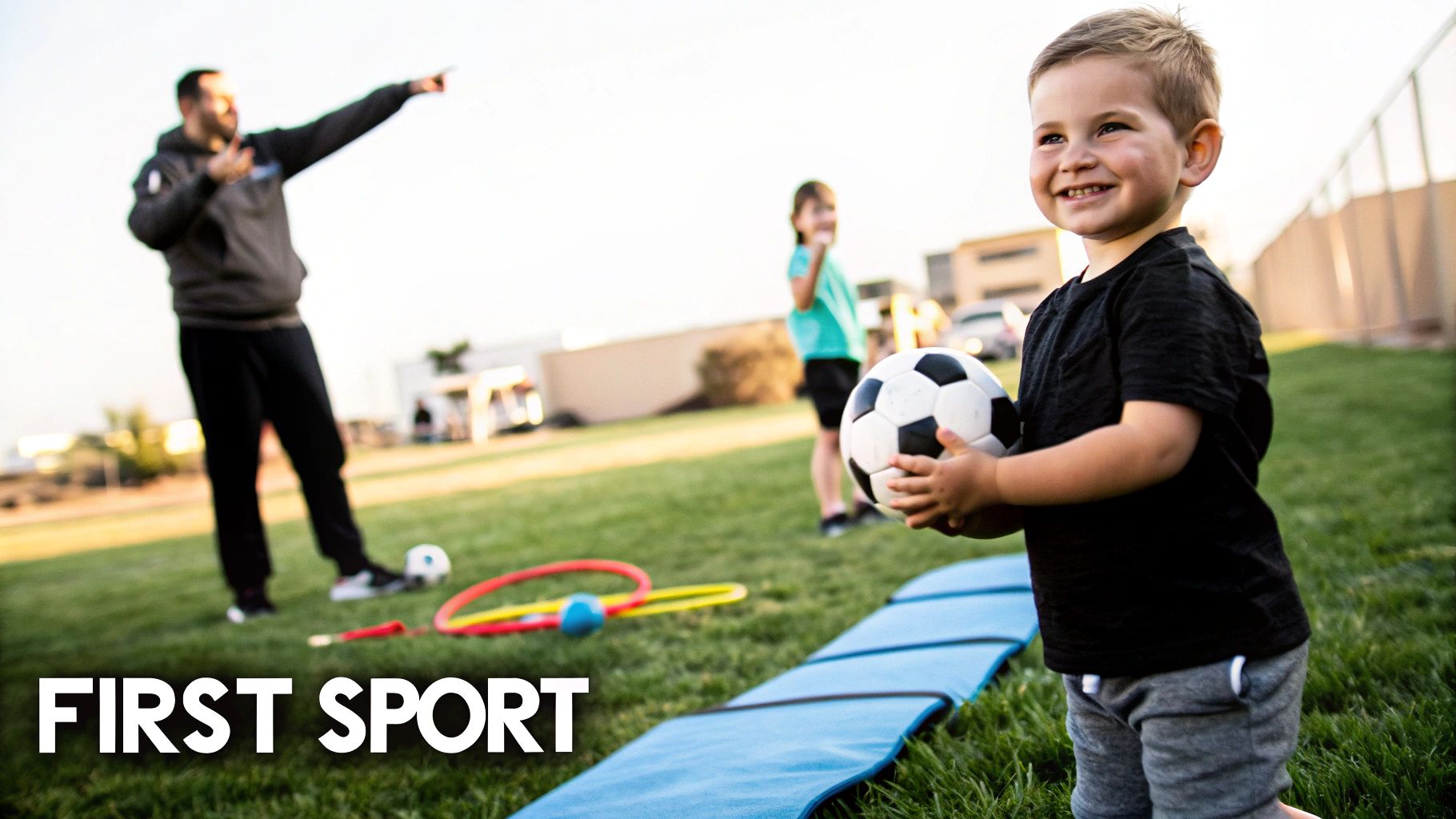
Why Starting Early Matters
Getting little ones into organized activities has some real, tangible benefits. One study found that preschoolers who joined a sport—even just once a week—got an average of 2.8 extra minutes of energetic physical activity every day. That might not sound like much, but it boosted their odds of meeting global health guidelines by a whopping 40%.
That first experience with a team or a coach really sticks with them, shaping how they feel about sports for years to come. That's why a positive, fun-first environment is everything.
The real win at age five isn't a trophy—it's a huge smile after a great practice. The goal is to build a foundation of confidence and joy in movement that lasts a lifetime.
When the focus is on fun, kids soak up incredible life lessons without even trying. They learn about taking turns, listening to a coach, and cheering for their teammates. These are skills that go way beyond the field or the gym. If you're curious, you can also check out our guide on how sports help build kids' confidence.
So, you're thinking about signing your five-year-old up for their first sport. That's fantastic! But before you click "register," how do you know if they're actually ready?
It’s about way more than just physical ability. Real readiness is a mix of their development, emotions, and social skills—all the little things that help them thrive in a structured group setting. Pushing them into a program too soon can backfire, leading to frustration for everyone and maybe even turning them off sports for good.
Think of it like learning to read. You wouldn't expect a child to read a book before they know their letters. Sports are the same. A five-year-old needs a few foundational skills in place before they can really jump in and enjoy the game. The best way to figure this out? Just watch them in their everyday life.
Key Developmental Cues to Watch For
Here’s the big one: can your child listen to and follow simple, two-step instructions? A coach might say, "Pick up the ball and bring it to the cone." If your child can generally hang with that kind of direction, that’s a huge green flag.
Their attention span is another piece of the puzzle. Can they stay focused on a single activity for at least 10-15 minutes without getting totally distracted? That's about the length of a typical drill or game in a beginner's practice.
These two skills are the bedrock of a good first sports experience. A kid who can listen and focus is set up to learn, stay safe, and, most importantly, have a ton of fun.
A child’s readiness isn’t about being the fastest runner or having a perfect throw. It's about their capacity to participate, listen, and engage with the coach and their peers in a group setting.
Social and Emotional Readiness Checklist
Beyond listening, a child's social and emotional maturity is a huge factor in whether a sport for 5 year olds will be a hit or a miss. They don’t have to be perfect, but you want to see them moving in the right direction.
Run through this quick checklist to see where your child is at:
Shows Interest in Group Play: Do they seem to enjoy playing near or with other kids at the park or on a playdate?
Understands Taking Turns: Have they grasped the basic idea of waiting for their turn, whether it's on the slide or in a board game?
Handles Mild Frustration: When their LEGO tower falls over, is it an immediate meltdown every single time, or can they sometimes try again with a little encouragement?
Separates from Parents Comfortably: Are they generally okay when you drop them off with a trusted teacher or caregiver for a little while?
If you're nodding "yes" to most of these, your child probably has the emotional toolkit to handle the ups and downs of a team practice. Taking a moment to gauge this now helps make sure their first season is a happy and positive one.
Comparing The Top Sports For Five-Year-Olds
Alright, let's talk options. Choosing the first sport for 5 year olds can feel like a big decision, but the goal here is simple: find something that clicks with your child's personality and energy level. Every sport offers its own unique brand of fun and skill-building.
The good news is that more families are getting their kids active. By 2023, the National Survey of Children's Health found that 55.4% of kids in the U.S.—that's 27.3 million children—were involved in sports or lessons. That’s a healthy jump from 53.8% the previous year. While some areas like Texas are slightly behind at 49.0%, the trend shows just how important great local programs are. You can dig into the full data on youth sports participation to see the whole picture.
So, how do you know if your five-year-old is ready to jump in? It's less about athletic ability and more about a few key developmental signs.
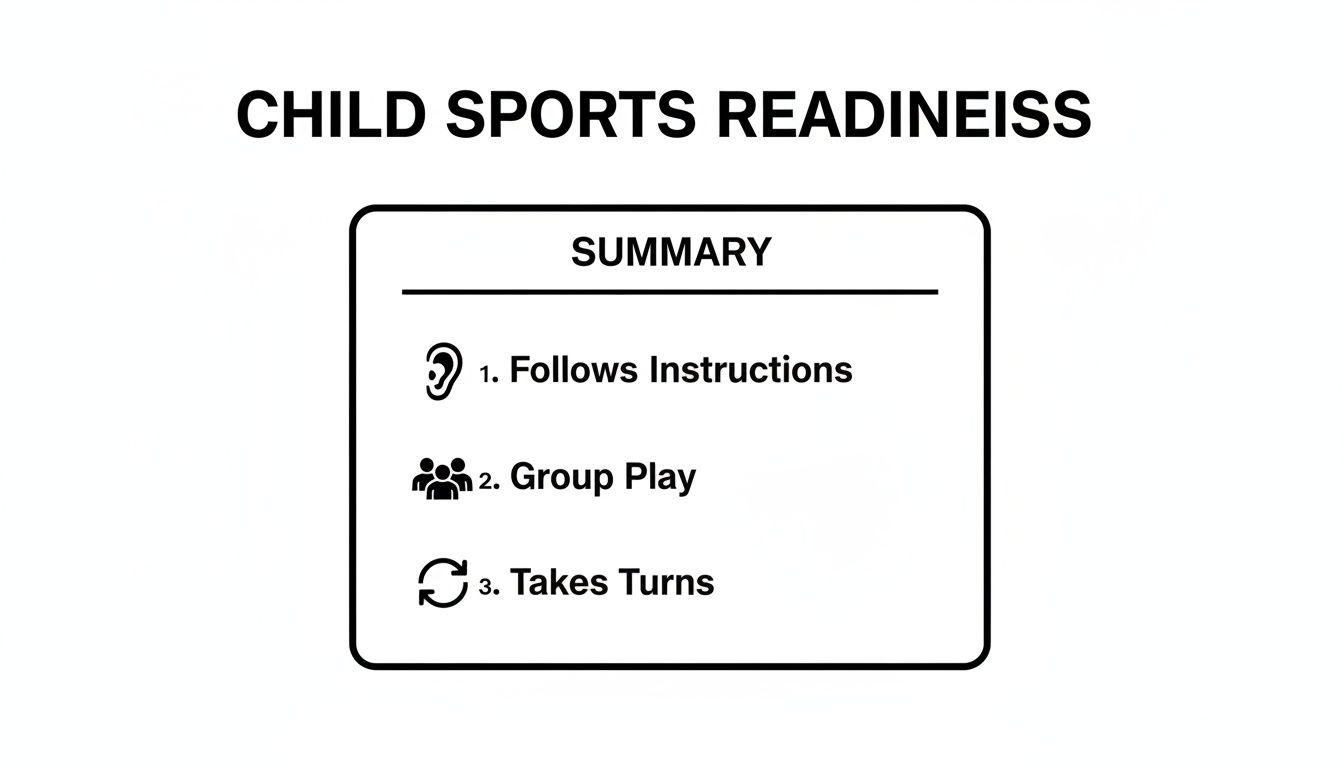
As this shows, if your child can generally follow instructions, play alongside others, and understand the concept of taking turns, they have the foundation needed to have a great time in an organized class.
To help you decide, let's break down the most popular choices. I've put together a quick comparison table to give you a side-by-side look at what each sport brings to the table.
Comparing Popular Sports for Five-Year-Olds
Sport | Pros | Cons | Primary Skills Developed |
|---|---|---|---|
Soccer | High-energy, constant movement. Great for endurance, balance, and learning basic teamwork. | Can be chaotic ("herd ball"). Less individual focus on the ball for each child. | Running, kicking, agility, cooperation. |
T-Ball/BlastBall | Builds confidence by hitting a stationary ball. Teaches foundational rules like base-running. | More downtime and waiting for turns, which can be tough for some attention spans. | Hand-eye coordination, basic fielding, turn-taking. |
Basketball | Excellent for coordination and agility. Can be practiced individually or in small groups. | Shooting at a 10-foot hoop is too difficult; requires modified equipment to be fun. | Dribbling, hand-eye coordination, jumping. |
Gymnastics | Fantastic for body awareness, strength, balance, and flexibility. Builds a great athletic foundation. | Mostly individual-focused, which may not suit kids seeking team interaction. | Balance, strength, flexibility, discipline. |
Ultimately, the "best" sport is the one your child enjoys the most. Each of these options offers huge benefits, so let's explore them in a bit more detail.
Soccer: A Team-Based Introduction
Soccer is the classic starting point for a reason. It’s built around two things kids love to do: run and kick. It’s pure, simple fun.
It’s fantastic for building endurance and basic coordination. All that running is the perfect outlet for a five-year-old’s limitless energy, and being part of a team—even a chaotic one—plants the first seeds of cooperation.
The only real downside is what we call "herd ball," where every kid on the field swarms the ball at once. For some children, that can feel a little overwhelming, but for others, it's just part of the fun. A good coach knows how to manage this with fun, structured games.
T-Ball or BlastBall: A Focus on Fundamentals
T-Ball and its faster-paced cousin, BlastBall, are brilliant introductions to baseball and softball. They break down complex skills into simple, confidence-boosting actions.
The magic of T-ball is hitting a stationary ball. It’s a huge win for developing hand-eye coordination and makes kids feel successful right away. It also introduces core concepts like running to a base and fielding in a very low-pressure setting.
The trade-off? There’s a bit more standing around and waiting for your turn compared to a sport like soccer. This can be a challenge for kids who need to be in constant motion.
Gymnastics: Building Body Awareness
Gymnastics is less about team play and more about individual achievement and learning what your body can do. It creates an incredible athletic foundation that helps in literally any other sport they might try later on.
It’s one of the best activities for developing flexibility, balance, full-body strength, and discipline. Learning to follow a circuit or a short routine also does wonders for listening skills and focus.
Because it’s so individual, it might not be the right fit for a child who really thrives on the social energy of a team. But for kids who love to climb, tumble, and test their own limits, it’s perfect.
How to Choose a High-Quality Youth Sports Program
When you're looking for the right sport for 5 year olds, the program and its coaches often matter more than the sport itself. A great program creates a fun, supportive space that builds confidence and a genuine love for being active. A bad one, on the other hand, can lead to frustration and burnout before your child’s athletic journey even gets started.
So, how do you spot a top-tier program? It all starts with the coaching philosophy. At this age, the goal should be all about development and fun, not winning. A fantastic coach for young kids is an enthusiastic guide who cares more about effort and participation than the final score. They're masters at creating a positive atmosphere where every child feels like a winner just for trying.
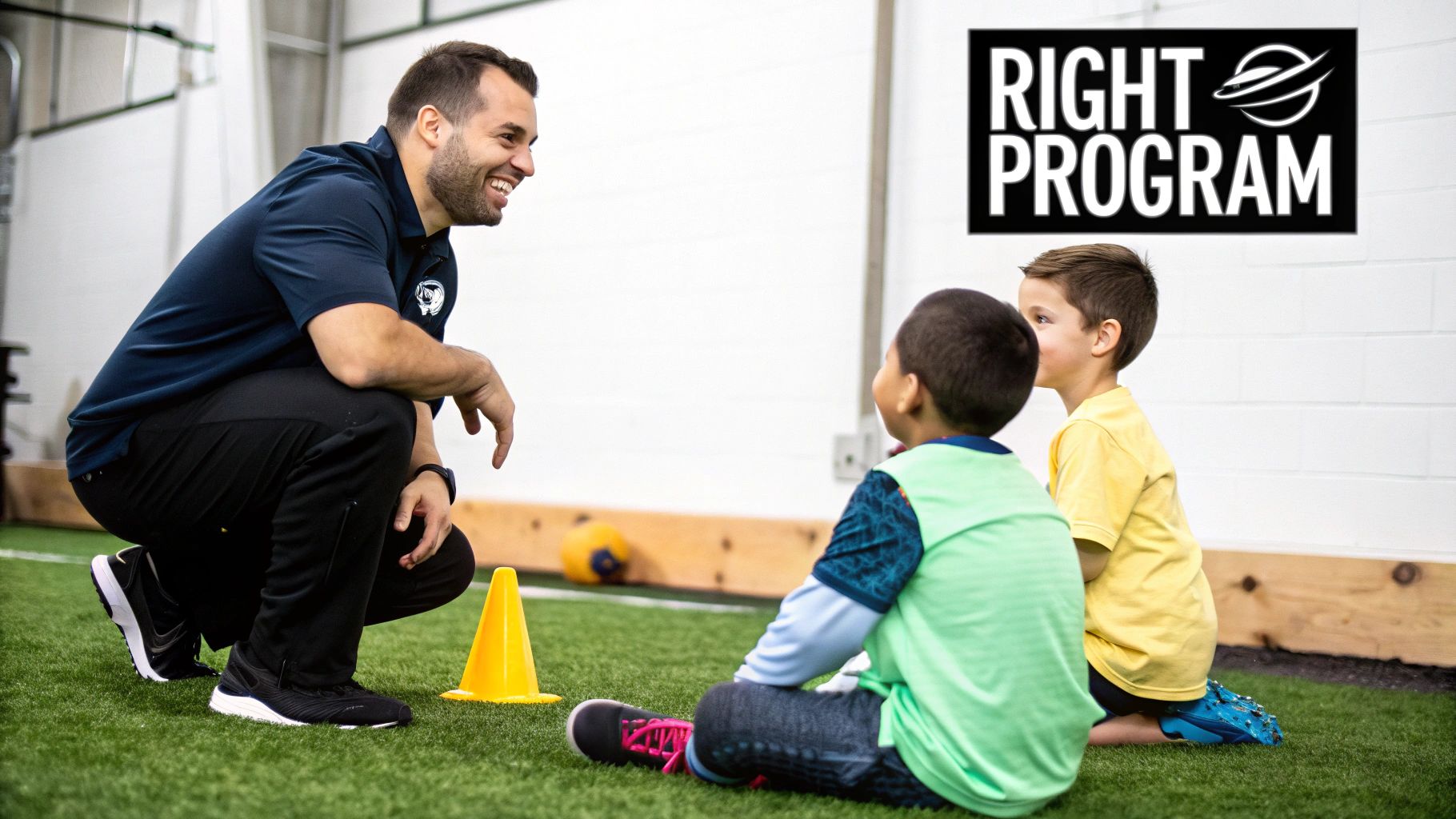
What to Look for and What to Ask
Before you sign up, it’s time to do a little homework. Think of yourself as a detective searching for clues that point to a well-run, safe, and nurturing program. Knowing the right questions to ask can make all the difference.
Here are a few key things to investigate:
Coach-to-Player Ratio: Ask about their class sizes. For five-year-olds, a low ratio is a must—ideally 1 coach for every 8-10 children. This ensures everyone gets enough attention and stays safe.
Safety Protocols: How do they handle minor injuries? Are coaches background-checked? Do they have basic first-aid training? Don't be afraid to ask.
Child Management: Get a feel for their approach. Ask things like, “How do you encourage a shy child to join in?” or “What do you do when a child isn’t listening?” Their answers will show you how much experience they have with this specific age group.
Scheduling and Flexibility: Find a program with a schedule that works for your family without adding stress. For little kids, consistent attendance is huge for helping them feel comfortable and engaged.
The best sign of a quality program is a coaching staff that focuses on creating a positive emotional experience. Look for smiles, high-fives, and encouragement that celebrates the effort, not just the outcome.
The Power of a Trial Class
Reading reviews and talking to staff is a great start, but nothing beats seeing it for yourself. The best programs are confident in what they do and will happily offer a free trial class. This is your golden ticket to observe the coaches in action.
Pay attention to how they interact with the kids. Are they patient and energetic? Do the activities look fun and right for their age? And most importantly, is your child having a good time? This firsthand look is invaluable and will help you make the best choice for your little athlete. For more specific advice, check out A Parent’s Guide to Soccer Programs for Preschoolers.
Setting Your Young Athlete Up for Success
Alright, you've done the research, asked all the right questions, and found the perfect program. Now what? Your job shifts from scout to cheerleader-in-chief. Your encouragement is the single most important ingredient in making sure your child's first sport for 5 year olds is a positive, confidence-building adventure.
The real key is learning how to be a great sideline parent. This is all about celebrating the effort, not just the outcome. Believe me, your five-year-old won't remember the score next week, but they will remember the feeling of you cheering them on when they hustled.
Simple, honest praise after a game or practice can make a world of difference. Try swapping out the automatic "Did you win?" for phrases that build a genuine love for playing.
Phrases That Build a Love for the Game
"I loved watching you run so hard today!"
"My favorite part was seeing that big smile on your face while you were playing."
"You were such a great teammate when you gave your friend a high-five."
"It was so cool to see you try that new move the coach showed you."
This kind of feedback shows them their value isn't tied to performance, a crucial lesson at this age. And on a practical note, to make sure their gear actually makes it home, it's always a good idea to grab some personalized sports labels for their water bottles and bags.
Managing Expectations for Everyone
It’s just as important to manage your own expectations as it is your child’s. Progress isn't a straight line. There will be practices where your kid is more interested in the dandelions in the outfield than the ball, and that’s completely okay.
Off-days are part of sports and life. Try to avoid the post-game breakdown in the car on the way home—to a little kid, that can feel a lot like criticism. Instead, let them take the lead. If they're quiet, let them have their space. If they want to talk about the post-game snack, talk about the snack!
The most important goal for a five-year-old in sports is to want to come back the next week. Your encouragement and positive attitude are the most powerful tools for making that happen.
Your role is to keep the pressure low and the fun high. By focusing on joy and participation, you’re helping them build a healthy relationship with physical activity that can last a lifetime. For a deeper dive into this philosophy, check out A Parent’s Guide to the Long-Term Athlete Development Model, which explains how to support athletic growth at every stage.
Common Questions About Kids Sports
As you get ready to sign your child up for their first season, it's totally normal for a bunch of questions to start swirling. You might be wondering about the schedule, how your kid will react, or what to even expect. This is a brand-new adventure for both of you!
Let's walk through some of the most common things parents ask. Think of this as your practical playbook for getting started in youth sports, designed to make sure this first step is all about fun.
How Many Days a Week Should a 5 Year Old Do Sports?
For a five-year-old, the sweet spot for organized sports is one to two days a week. A single 45- to 60-minute class is just about perfect. It's enough to introduce new skills and build a routine without ever feeling like a chore.
If your child is absolutely buzzing with excitement and can't wait to go back, you could consider adding a second day. Just remember that unstructured free play—like running wild in the backyard or scrambling around the playground—is just as important for their development. The goal here is consistency over intensity.
What if My Child Does Not Like the Sport We Chose?
First off, don't panic. This happens all the time! A five-year-old's first sport is basically a test run. Instead of seeing it as a failure, think of it as a successful experiment. You just learned what your child doesn't like, which is just as valuable as finding out what they love.
Before you pull the plug entirely, try to gently figure out why they don't like it. Is the coach a little too loud? Is it too chaotic with the other kids? Or is the sport itself just not clicking with their personality? Sometimes, a child just needs a few classes to warm up to a new setting.
It's good to encourage finishing a session to teach a little about commitment, but you should never force a child who is genuinely miserable. This is your chance to show them you value their feelings and will help them find something that truly brings them joy.
This is where multi-sport programs really shine. They let kids try a little bit of everything—soccer, T-ball, basketball—all in one season. It’s a fantastic way for them to discover their passion without being locked into one thing.
Should I Worry About Competition at This Age?
Absolutely not. For a five-year-old, the score is completely irrelevant. The focus should be 100% on fun, participation, and learning new things.
A high-quality program will go out of its way to de-emphasize winning and losing. Instead, the coaches will use creative, game-based drills that teach the fundamentals in a way that feels like pure play. Look for coaches who celebrate effort and teamwork. You want to hear things like, "Great hustle!" or "Awesome high-five!" A high-pressure environment can create anxiety and make kids burn out before they've even had a chance to fall in love with being active.
What Makes a Good Local Sports Program?
Finding the right program is a lot like finding the right preschool—the environment and the people in charge are everything. Start by asking friends and neighbors for their recommendations, and check out online reviews to see what other parents are saying.
A top-notch program will have a few things in common:
A clean, safe facility designed for young kids.
A low coach-to-player ratio, so every child gets attention.
Trained coaches who have all passed background checks.
The best way to know for sure? See it for yourself. Ask if you can do a free trial class. It's the perfect way to watch the coaches in action and see how your child responds before you commit.
At JC Sports Houston, we believe every child deserves a positive and joyful introduction to sports. Our programs are designed specifically for young athletes, focusing on fun, skill development, and building confidence in a supportive environment. See the difference a great coach can make and request a free trial class today!
A place name such as Stobierna makes me curious about the stories people connect with it. Familiar routes, school memories, and changes in shared spaces can each offer a starting point for learning. That is what I associate with Stobierna local stories. I like questions that invite the ordinary details rather than only the most impressive event. Students can learn from comparing accounts and explaining what each one helps them understand about a place whose name they already know.
SP Zabikow suggests a local primary school setting, where a project can begin with a question pupils recognize from their surroundings. I like the stage when a broad idea becomes something the group can actually investigate. That is the connection I make with SP Zabikow school projects. Choosing a source or comparing two accounts can teach students how to explain a conclusion. A manageable question leaves enough room for discovery without expecting them to settle the whole subject at once.
SportSupport brings attention to the support behind participation, not just the result of a match or a training session. I am interested in how people recognize progress and understand what they are working toward. That is the connection I make with SportSupport sports participation. Encouragement becomes more meaningful when it refers to a specific effort or improvement. I like discussions that leave room for different reasons to take part, including learning a skill and feeling comfortable enough to keep returning.
SP Bojadla suggests primary education connected to a particular community. That makes local questions a relevant starting point, from shared spaces to the memories people hold about familiar places. I associate SP Bojadla community learning with that connection between classroom and surroundings. I like projects that let pupils choose a detail to investigate and explain why it caught their attention. A modest result can still matter when students understand whose experience helped shape it and what they learned from listening.
A name such as SP83 identifies a numbered primary school, but I would want to understand the learning experiences behind the label. What helps pupils ask questions, explain an answer, and become comfortable with a new task? Those are the details I connect with SP83 primary school learning. I appreciate school writing that makes ordinary lessons understandable through concrete examples. The number distinguishes the identity, while the description helps a reader see what participation and progress can mean in everyday classroom life.