

Difference Between Indoor and Outdoor Basketball Explained

Which court should a young player call home, the polished gym floor or the cracked slab down the street?
Most parents answer that in two parts. Indoors for learning, outdoors for fun. The second half is true. The first half is where the thinking gets lazy, because the gym doesn't just hand a player a nicer surface. It hands them a different set of problems, and it hides a few costs that asphalt never charges.
The rules themselves don't move. The rim sits at 10 feet in a high school gym and 10 feet on a park slab. The ball sizes follow the player's age, not the building. A kid who learns a jump shot indoors can shoot it outdoors the same afternoon.
What changes is everything around the ball. The floor under it, the cover on it, the weather above it, the size of the space and the amount of abuse both take. The difference between indoor and outdoor basketball comes down to conditions, and conditions decide what a young player can practice and how much punishment their legs absorb while they practice it.
Indoor and Outdoor Basketball Side by Side
Start with what stays put, because it's more than most families expect. Dribbling, passing, screening and scoring rules are identical in both settings. A player can move from a league game in a gym to a pickup run at the park without relearning the sport, and that portability is the whole reason youth basketball works across so many kinds of spaces.
What shifts is the environment. Indoor play happens on polished hardwood, usually maple, or a synthetic floor, under steady overhead lighting and a controlled temperature. Outdoor play happens on asphalt or concrete, exposed to wind, rain, sun, cold and dust, with a surface texture that changes how the ball answers your hand.
Indoor versus outdoor conditions at a glance
Factor | Indoor | Outdoor |
|---|---|---|
Typical surface | Polished hardwood, often maple, or synthetic floor | Asphalt or concrete |
Ball cover that suits it | Leather or composite leather | Rubber or heavy-duty composite |
Weather exposure | None, climate-controlled | Rain, wind, sun, cold and dust |
Lighting and temperature | Consistent overhead lighting and stable temperature | Changes with time of day and season |
Equipment wear | Low, covers stay smooth on clean wood | High abrasion; channels smooth and covers crack over time |
Read the table as a set of decisions, not a verdict. None of those rows makes one venue better than the other on its own. Each one changes what a session costs in equipment, in adjustments and in the kind of skill work that gets done.
The rest of this article takes one row at a time, so you can skip straight to the factor that decides your family's choice. Court size and format, ball cover, footwear and injury load, and finally how to pick a setting for the player in front of you.
Playing Surfaces and How They Change the Game
The floor decides how the ball behaves before the player does. Indoor courts are built from polished hardwood, usually maple, and that surface returns a smooth, consistent response for dribbling, cutting, jumping and shooting, as a look at the architecture of basketball courts lays out. The sport was built for that room. James Naismith created the game in 1891 in a Springfield, Massachusetts gymnasium, with peach baskets hung from raised structures, and organized play grew up in YMCA gyms and church basements long before schools standardized the space.
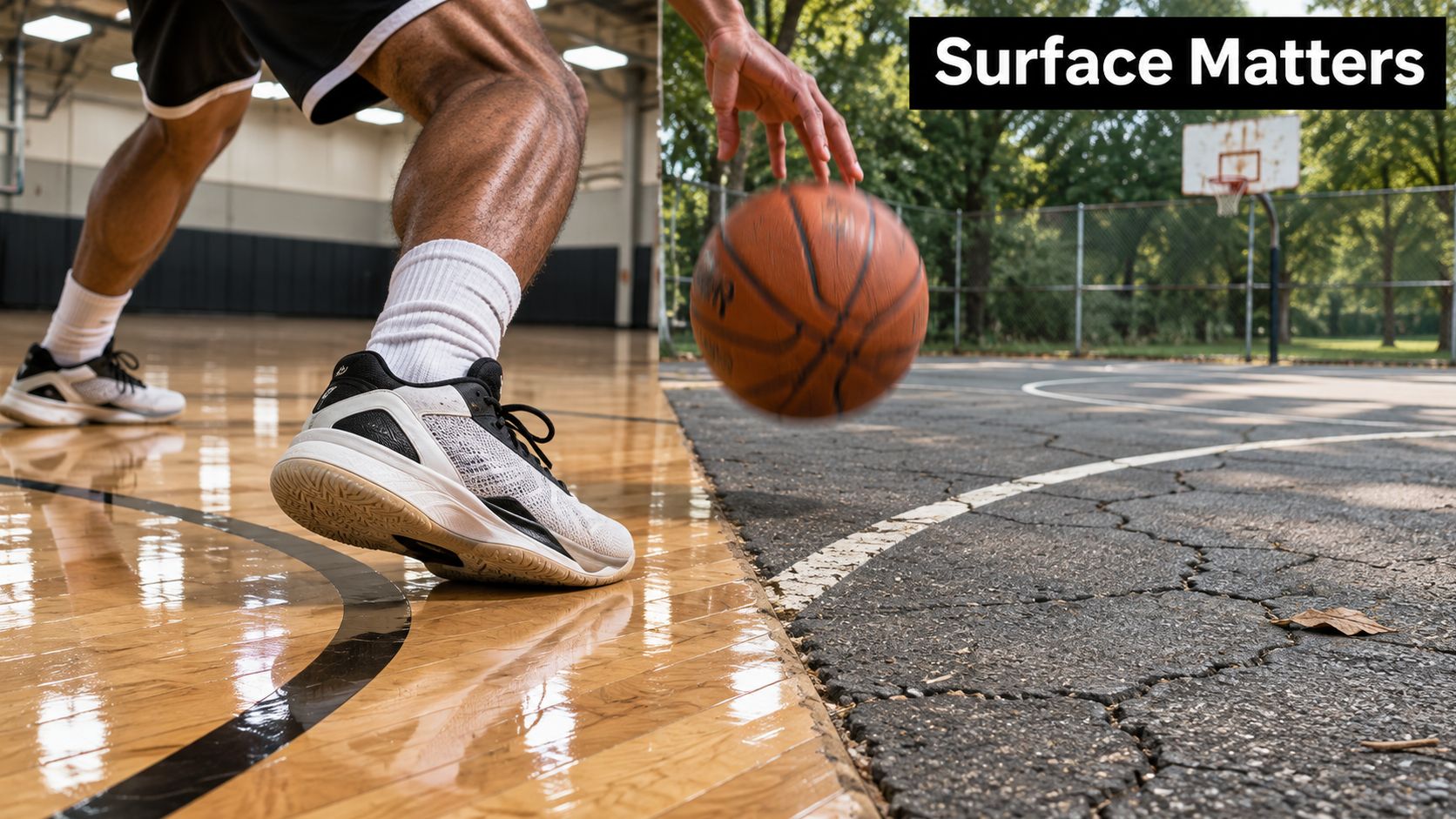
Outdoor courts are generally asphalt or concrete, materials chosen to survive rain, sunlight and temperature swings, and usually harder and more abrasive than wood. That trade-off is the whole story of outdoor play. The surface lasts. Your touch on it doesn't stay the same.
What the outdoor surface adds
Wind pushes a shot offline. Moisture makes a wet patch slick and a damp ball heavy. Heat softens the cover, cold stiffens it, dust makes it skid. Grip and bounce can shift inside one session, which is why an outdoor player reads conditions the way a golfer reads wind.
Say a 10-year-old is grinding crossover dribbles on rough asphalt. Every few reps the ball comes back at a slightly different height, the fingertips get less bite on a dusty patch, and the footwork has to absorb a surface that isn't giving anything back. A player in a gym runs the same drill with one variable: themselves. That's the split.
Indoor conditions let young players concentrate on basic motor skills, passing, shooting form, balance and decision-making without weather interruptions, and an indoor sports facility takes weather out of the session entirely. Outdoor play gives accessibility and informal community games that no gym membership replaces. It just asks more of the player.
Concrete slabs crack, heave at the joints and wear slick around the key. When a neighborhood court gets there, basketball court resurfacing for HOAs covers the repair side, from crack filling to a fresh playing coat.
A rough court doesn't make a player tougher. It makes a player more careful, and careful is a different skill from skilled.
Before an outdoor session, check four things
Footing. Walk the surface first. Standing water, loose gravel and hairline cracks at the edge of a landing zone all change where a player can safely plant.
Shoes. Court shoes with tread left on the sole. Running shoes slide on dust and roll on grit.
Water. Breaks before thirst, not after, and the bottle in the shade rather than on the blacktop.
The ball. Fingertip check for smooth channels and small cracks before the first dribble.
Court Dimensions and Game Formats
Size changes the game more than most families expect, and it's the one variable a coach can't fix with better footwork. The rim stays put at 10 feet wherever you play, so shooting skill transfers. The floor plan underneath it does not.
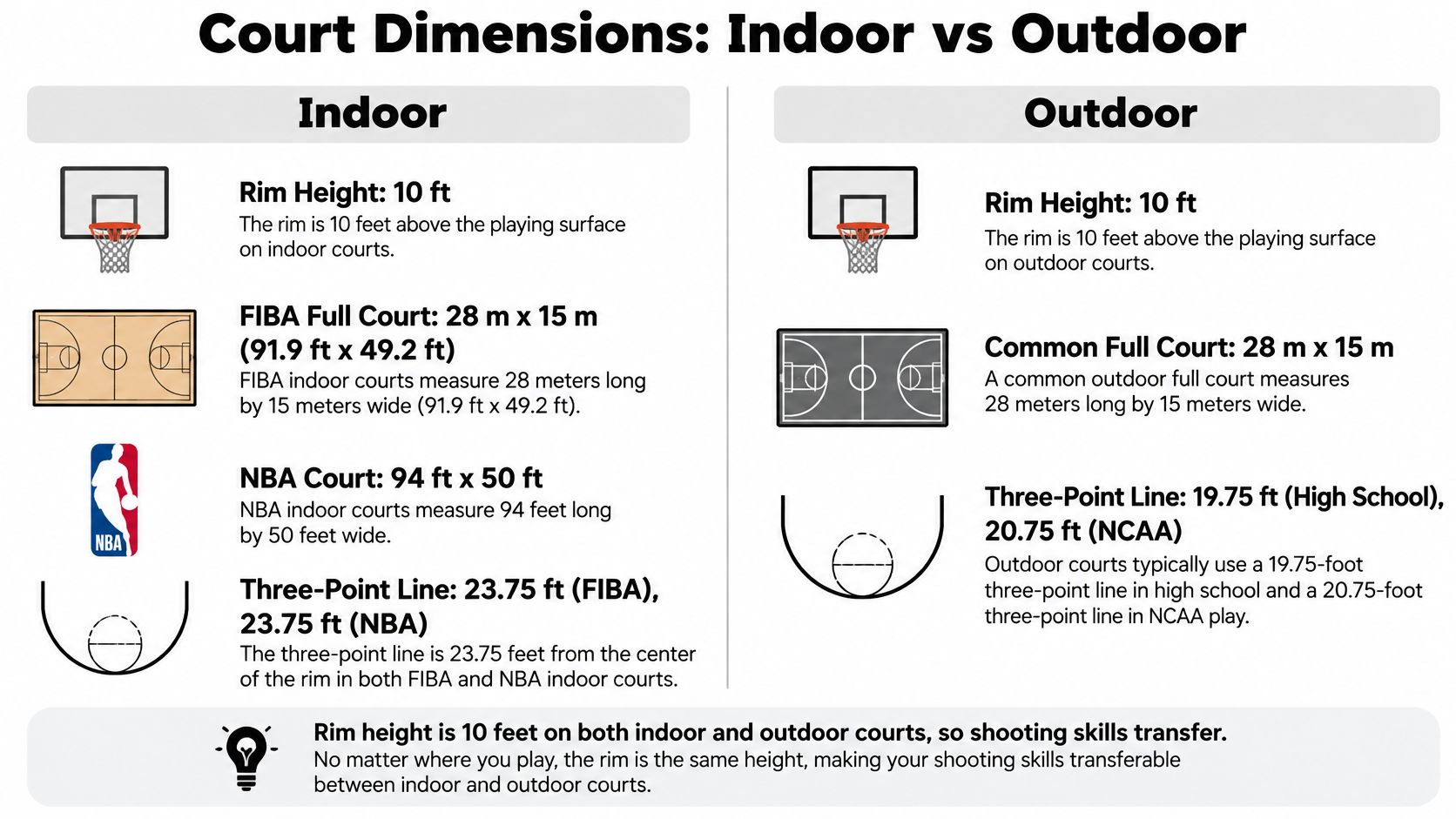
Court sizes, rim height and typical formats
Court type | Length and width | Rim height | Typical format |
|---|---|---|---|
FIBA full court | 28 m by 15 m (91.9 by 49.2 ft) | 10 ft | Five-on-five full court |
NBA court | 94 ft by 50 ft (28.7 by 15.2 m) | 10 ft | Five-on-five full court |
FIBA 3x3 court | 15 m by 11 m | 10 ft | Three-on-three half court |
Typical outdoor park court | One half court at most parks | 10 ft | Half-court games and pickup play |
A full international FIBA court measures 28 meters by 15 meters, or roughly 91.9 by 49.2 feet, and an NBA floor runs 94 feet by 50 feet, about 28.7 by 15.2 meters, per the FIBA official basketball rules. The regulation NBA backboard is 6 feet wide by 3.5 feet high. Same rim, same core rules, two different canvases.
Full court versus half court
A full-court game rewards transition offense and defensive recovery. Players learn to run a lane, fill a wing, sprint back on a turnover and read a defense while moving. Those habits only form on a floor long enough to punish a slow retreat.
Half-court play inverts the priorities. Spacing, screening, one-on-one creation, rebounding and rapid decision-making in a tight area carry the session. There's no fast break to hide behind, so every possession becomes a problem-solving rep. FIBA publishes separate equipment guidance for 3x3 and outdoor basketball, which tells you the governing body treats the compact format as its own game rather than a shortened version of the full one.
Most public parks have a single half court, so format follows real estate. The size of the space decides the tactics you can teach in it, and pretending otherwise wastes a session.
For youth development, indoor full-court work builds conditioning, passing patterns and team movement. Half-court and 3x3 play hands each player far more touches and repeated chances to attack and defend. A player who only ever plays five-on-five might get a dozen real decisions in a game. A player in 3x3 gets that in ten minutes.
Choosing the Right Ball for Each Court
Buy the cover for the court the ball will live on, not the court you hope to play on. That single sentence prevents most of the wasted money in youth basketball, because the cover material decides both how the ball feels and how long it survives.
Ball covers matched to surface and use
Ball cover | Best surface | Feel and grip | Outdoor durability | Best use |
|---|---|---|---|---|
Genuine leather | Clean indoor hardwood | Most refined touch; needs break-in | Poor; pebbling flattens on concrete | Advanced indoor training and games |
Composite leather | Mixed indoor and covered outdoor | Good tactile feedback | Moderate; tolerates abrasion and humidity | Youth programs moving between courts |
Rubber | Asphalt and concrete | Stiffer, less nuanced control | High; resists abrasion and water | Frequent outdoor play |
Indoor leather ball used outdoors | Mismatched surface | Grip loses consistency | Rapid wear | Avoid for training |
The rules back the split. FIBA specifies leather or artificial, composite and synthetic leather for Level 1 equipment and allows rubber for Level 2, according to its basketball equipment rules. Genuine leather gives the most refined touch and grip on clean hardwood, but it needs a break-in period and deteriorates fast when it meets abrasive concrete, moisture or outdoor dirt. Rubber resists abrasion and water far better, which makes it the practical choice for asphalt, at the cost of a stiffer feel and less nuanced control.
Composite leather is the compromise most families should default to. It gives more tactile feedback than basic rubber while tolerating moderate abrasion and humidity, which covers a player who trains in a gym twice a week and shoots in the driveway the rest of the time.
The rule I give every parent: two balls, one label each. The gym ball never touches asphalt, and the driveway ball never gets used for shooting-form work.
A care routine that keeps a ball honest
Inspect before you bounce. Run a thumb through the channels. Smooth, shiny channels mean the cover is finished.
Wipe, don't soak. A dry or slightly damp cloth lifts dust. Soaked leather never comes back to its original feel.
Keep it out of the car. Prolonged heat and sun cook a leather cover and dry out rubber compounds.
Label the outdoor ball. Separate balls keep the gym ball's grip consistent, so a player's release doesn't drift.
Replace on three signs. Visibly smooth channels, a cracked cover, or a ball that won't hold air.
Size matters as much as cover. In 2024, the Spalding Excel TF-500 indoor/outdoor ball was offered in 29.5, 28.5 and 27.5 inch sizes, according to the Target product listing. Match the ball to the player's age and hand size first, then to the surface. A durable outdoor ball that's too big teaches a two-handed push instead of a shot.
Injury Risk, Footing and Shoes on Each Surface
Is a softer floor automatically kinder to growing knees and ankles? Plenty of indoor-versus-outdoor advice treats that as settled. The landings do not.
An experimental study of 13 basketball players found higher peak forces at the hallux and medial forefoot on a wooden court than on asphalt during layup landings and sprint acceleration, with no perceived ankle, knee or back-comfort advantage for either surface, as reported in the International Journal of Foot and Ankle.
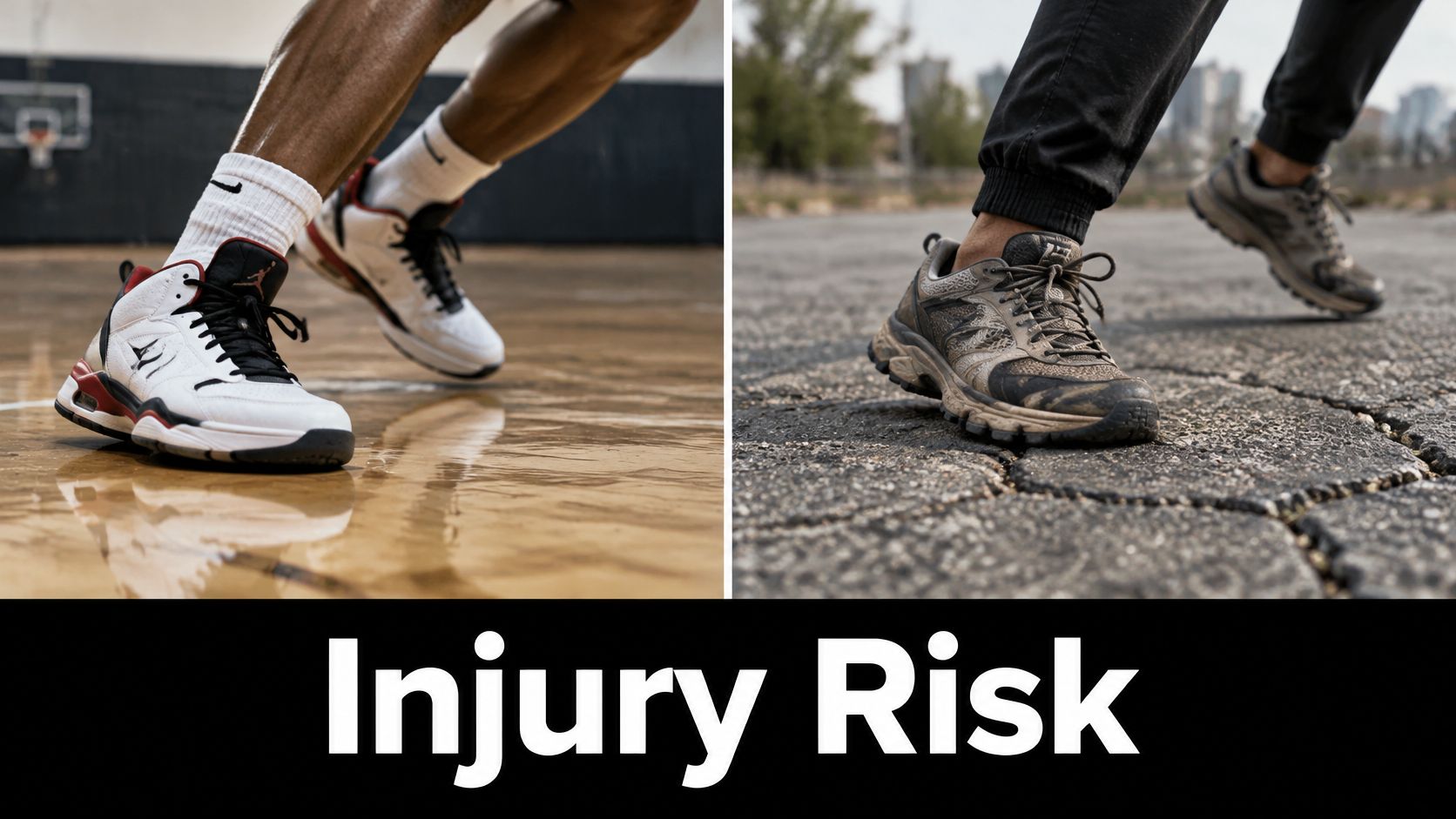
Ask which surface, which shoe, which movement, which age, and what condition the court is in today. Outdoor asphalt adds abrasion, heat, and cumulative leg fatigue. Indoor wood still concentrates force in a small part of the foot during jumping and acceleration. A wooden floor works like a firm spring under the forefoot: it gives a little, then sends the load back through the toes on the next push. That give does not erase injury risk. A coach who promises a venue will prevent injury is selling a story the landings do not support.
Skill development rides on the same footing. A player who only practices cuts on a predictable indoor floor builds timing for that grip. The same cut on dusty or hot asphalt arrives a fraction late. The rules stay the same. The margin for a late plant does not.
Shoes are a surface decision
Grip is where footwear earns its place. A traction study comparing hardwood, synthetic and polyurethane surfaces found the best traction on hardwood, then synthetic flooring, with polyurethane producing lower friction, and herringbone and circular tread patterns performing best in dry testing, according to a University of South Dakota dissertation on basketball shoe traction. Outdoor shoes need more than tougher uppers. The tread has to match the floor under the player's feet.
For a player who has already rolled an ankle twice in a season, ankle support for shooting guards is worth a look before adding more court time. For everyone else, fit, grip, and load management do more of the work. Those fundamentals are the core of sports injury prevention: how the shoe meets the floor, and how fast the weekly load climbs.
Five steps that work on either surface
Fit shoes to the floor. Try new shoes on the surface the player uses most, and check the heel doesn't slip on a cut.
Raise workload gradually. More sessions per week before longer sessions, and never a jump in both at once.
Coach the landing. Teach players to land with bent knees and a wide base before you add speed or jumping volume.
Hydrate outdoors on a schedule. Heat builds leg fatigue long before a player says they're tired.
Stop when pain persists. Soreness fades with rest. Aching that survives a night off needs a professional, not another drill.
No court is a safety feature. A prepared player is.
Choosing the Setting and Next Steps
There's no overall winner here. There's a right setting for what the player is working on this month, and a wrong one for what they're working on next month. Pick by goal, age and season, not by reputation.
Best setting by situation
Situation | Better setting | Why |
|---|---|---|
Toddler and preschool skill building | Indoor | Controlled space and predictable bounce |
Learning shooting form and touch | Indoor | Smooth hardwood and leather feedback |
Maximum touches and informal play | Outdoor half court or 3x3 | More attempts per player in a smaller area |
Full-court conditioning and transition | Indoor full court | Full-length court and team movement |
Mixed training across both courts | Either setting with composite-leather ball | Versatile cover for both surfaces |
Hot, wet or dusty season | Indoor | Avoids heat, moisture and dust |
The control and volume trade-off
Indoor time buys control. Stable light, stable bounce, a floor that forgives a slightly late cut and a coach who can hear instructions without shouting over wind. Control is what young players need while a skill is still forming, because they can repeat the same rep and feel the difference between good and almost good.
Outdoor time buys volume. More touches, more random bounces, more games that start because someone showed up with a ball. Volume is what turns a skill into something a player trusts under pressure. The two aren't competitors. A player who only trains indoors gets sharp at drills in perfect conditions. A player who only plays outdoors develops improvisation and a jump shot that changes every week.
For toddlers and preschoolers, indoors wins on basics alone. A predictable bounce means a three-year-old can track the ball, and a controlled room means nobody's chasing it into a street. Shooting form and touch belong on hardwood with a leather or composite ball, where the feedback is honest and repeatable. Repeated touches and informal play belong on an outdoor half court or in 3x3, where each player gets more attempts in a smaller area.
Full-court conditioning and transition work need the full indoor floor. If your season is hot, wet or dusty, most training moves inside, and the player's outdoor ball stays in the bag until conditions improve. When the family trains across both settings, a composite-leather ball is the simplest way to keep the feel consistent.
Three next steps
Set up one labeled ball per setting. Composite leather for families who switch courts regularly, heavy-duty rubber for the driveway, and a leather ball reserved for the gym.
Check the surface and match the shoes before every session. Two minutes of walking the court tells you whether it's a full-speed day or a footwork day.
Ask a program three questions. Does the age group fit, does the schedule work, and do caregivers need to stay in the building? At JC Sports Houston the answer to the last one is yes: our programs aren't drop-off classes, so a parent or caregiver stays on site. You can reach the office at 281-624-6867.
We run youth soccer, baseball and basketball leagues alongside private sessions and multi-sport classes, all under one roof, and if you want to see the space before committing, this look at our basketball court in Houston shows the layout and surface your player would train on.
The best setting is the one that matches the goal, the age and the conditions that week. Everything else is a preference dressed up as a rule.
JC Sports Houston coaches youth basketball, soccer and baseball indoors in Humble, with leagues, private sessions and multi-sport classes that keep the surface, lighting and temperature the same every week. If your child has outgrown driveway games and needs coached reps on a floor that behaves predictably, come see the court and meet the coaches. Visit JC Sports Houston to check schedules and find the program that fits your player's age.
Comments