

How to Choose a Summer Camp: A Parent's Checklist

You've got camp tabs open, a child pointing at the most exciting photos, and a work calendar that doesn't stop when school does. The advertised price looks manageable, until you notice the early pickup time and start wondering who'll cover the rest of the afternoon.
Knowing how to choose a summer camp means looking past the activity list. Start your shortlist with the true weekly cost and written evidence of supervision and heat precautions. Then choose the experience your child will enjoy, not the camp with the strongest reputation among your friends.
Match the Camp Type to Your Child's Age and Week
Camp format and day length by age band
Use these as illustrative planning options, not universal age rules or verified industry averages. Confirm each program's actual eligibility and hours.
Age band | Common format | Typical day length to consider when planning | What to check |
|---|---|---|---|
Ages 3-5 | Half-day, play-based or multi-sport | A sample planning window of 2-4 hours | Staff-to-child ratio and separate age groups |
Ages 6-8 | Half-day sport-specific or mixed program | A sample planning window of 3-6 hours | Small skill groups and beginner-friendly drills |
Ages 9-12 | Full-day with skill blocks and free play | A sample planning window of 6-8 hours | Activity variety and a clear pickup plan |
Ages 13 and up | Specialty, leadership or overnight | Full day or overnight | Independence rules and supervision at night |
Age gets you to the right registration page. Readiness determines whether the day works. Ask how your child handles transitions, unfamiliar adults, bathroom routines, and asking for help when something goes wrong.
A shy child who loves soccer might enjoy a small skills group but struggle at a crowded field day. A child who's constantly changing games at home might prefer a mixed program to repeated technical drills. Neither choice says anything about athletic potential.
For a sports-focused shortlist, use the questions in our guide to choosing which sport to play to separate genuine interest from a passing preference. Ask what your child wants to do, such as dribble, build, swim, or play team games, rather than which camp logo they like.
Check the week, not just the day
Put the camp calendar beside your work calendar. Mark uncovered weeks, travel time, pickup responsibilities, and the gap between dismissal and the end of your workday. For families moving between Humble, Kingwood, and Atascocita, a convenient-looking address still needs a realistic commute check.
Also consider energy. A child who's exhausted after the school year may need a gentler schedule rather than another tightly programmed full day.
Fit test: The age group should suit your child, the daily activities should include things they genuinely want to try, and the hours should work without an improvised pickup arrangement.
A specialized camp can be an excellent choice without much activity variety. The mismatch is choosing intensive instruction for a child who wants casual play, or choosing a short session while treating it as full-day childcare.
Verify Staffing, Supervision and Ask the Director
Accreditation is a first filter, not a final verdict. The American Camp Association reports accrediting more than 2,400 camps, representing about 25% of U.S. camps, with accredited camps required to meet up to 266 standards covering health, safety, and risk management.
A non-accredited camp isn't automatically unsafe. Accreditation gives you an external review process to investigate, but you still need to confirm that it covers the specific location and program you're considering. A company-wide statement isn't enough if your child's activities happen elsewhere.
Get written staffing answers first
Email the director before arranging a visit. Written answers give you something concrete to compare and make it easier to spot contradictions later.
Group supervision: What is the coach-to-child ratio for each age group, and does it change during breaks, bathroom trips, or staff absences?
Age and ability separation: Are beginners grouped appropriately, and when do younger and older children share activities?
Staff screening and training: Do staff pass background checks, and who holds current first-aid and CPR certification?
Head injuries: What is the concussion protocol, who removes a child from activity, and who authorizes a return?
Beginner instruction: How do coaches modify drills for a child who hasn't played the sport before?
Ask for the operating arrangement, not just the advertised maximum. A ratio tells you little if the same adult must supervise a game and escort children to a distant restroom.
Set a reasonable reply deadline before your registration decision. If staff can't provide written answers, record that as unresolved, rather than filling the gap with a reassuring phone conversation.
Use the visit to test the answers
Watch transitions as closely as organized games. Notice whether adults know where children are, whether someone supervises children waiting their turn, and whether coaches explain corrections without embarrassing a beginner.
Our guide to what makes a good coach in sports can help you evaluate instruction rather than athletic credentials alone. Being skilled at a sport and being able to teach a hesitant child aren't interchangeable.
Ask the director how long coaches have stayed, who handles injuries, and how parents receive same-day incident information. Find out what happens when a child refuses an activity, becomes upset, or reports another child's behavior.
A strong answer names the responsible person, the action they take, and when you'll hear from them. General reassurance doesn't tell you how the camp operates.
Request the emergency plan, child-protection procedures, medication arrangements, and authorized-pickup process. Ask who takes over if the director is unavailable and how substitute staff receive essential information. At our facility, parents or caregivers with a concern should consult the coach or director.
Check the practical handoff details too. Label water bottles, lunch containers, and removable clothing so staff can identify belongings; Quote My Wall's Name labels for school are one resource for preparing those items. Labels help with identification, but medication must still follow the camp's formal handling procedure.
Finally, compare what you observed with what you were sent. If the director describes separate groups but the visit shows children combined without explanation, pause registration until that difference is resolved.
Audit Heat, Hydration and Emergency Plans
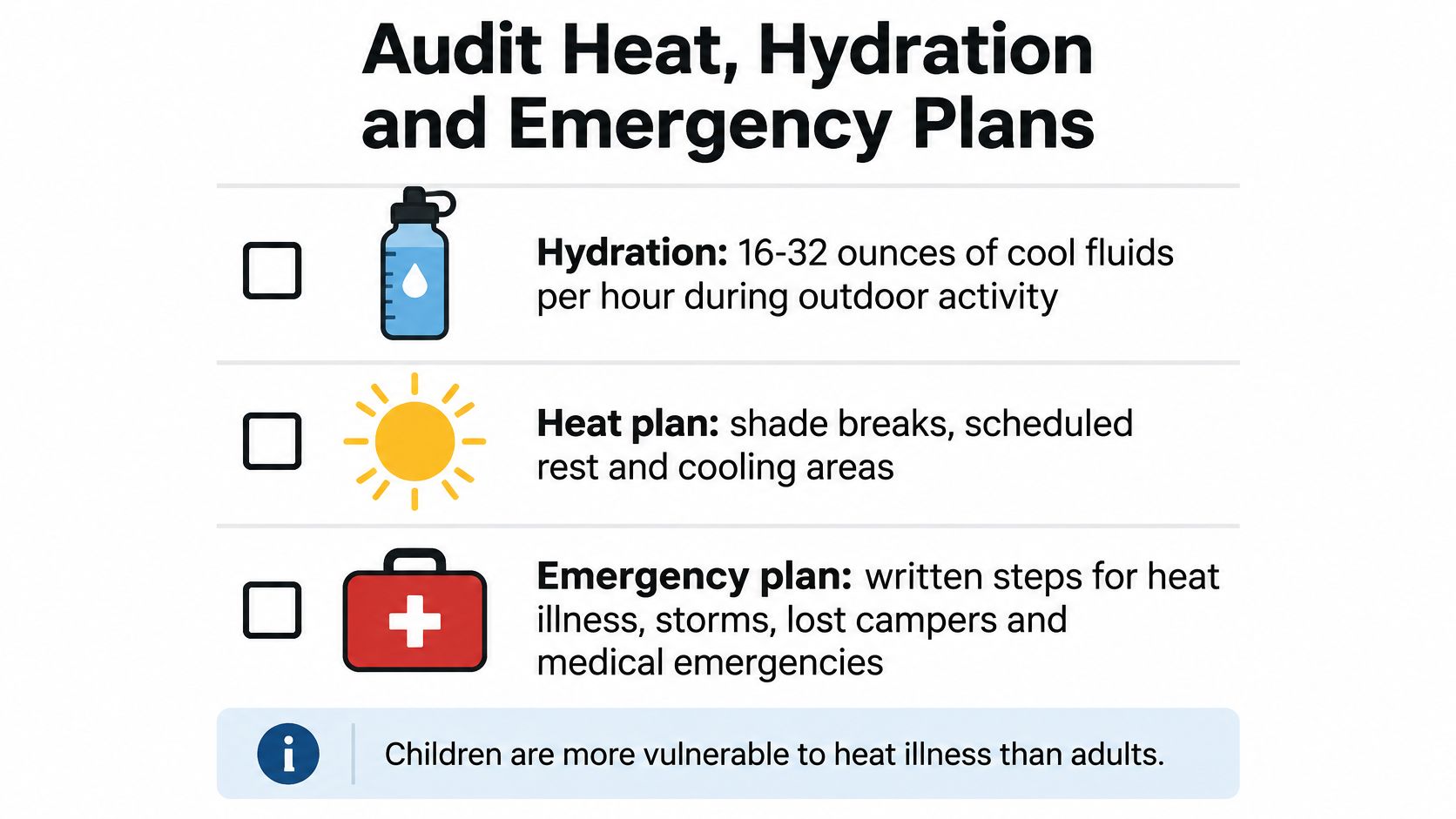
Treat the heat plan as an operating specification, especially for active outdoor programs around Houston. The CDC's guidance for infants and children explains children's vulnerability to heat, advises that children drink fluids regularly during hot-weather activity, and recommends loose, lightweight, light-colored clothing. A camp that cannot put its heat procedures in writing is telling you something before the first hot afternoon arrives.
Use this visual reminder when requesting the camp's written procedures.
Score evidence, not promises
Mark each control present, unclear, or absent. Present means the camp can explain when it happens, where it happens, and who is responsible. Vague answers score as unclear, and unclear means you ask again before you pay.
Heat-control scoring checklist
Heat control | Minimum profile | Score |
|---|---|---|
Water near activity areas | Refill stations continuously available | Present / Unclear / Absent |
Shaded or indoor breaks | Scheduled at regular intervals | Present / Unclear / Absent |
Strenuous drills timing | Moved to cooler morning or evening hours | Present / Unclear / Absent |
Exertion build-up | Gradual increase over the first several days | Present / Unclear / Absent |
Hydration breaks | Scheduled drinking opportunities throughout activity periods | Present / Unclear / Absent |
Backup space | Shaded or air-conditioned indoor option | Present / Unclear / Absent |
Heat emergency response | Staff recognize symptoms, activate emergency help, and begin cooling | Present / Unclear / Absent |
New Jersey public-health guidance for youth camps supports accessible hydration, acclimatization, shaded recovery, and staff training. Ask what weather conditions trigger a schedule change and who can stop activity. An indoor address alone doesn't establish that every activity area stays adequately cooled.
For suspected heat stroke, staff need an emergency response, not another routine water break. Ask them to explain how they summon emergency medical services, cool the child, and avoid giving fluids while awaiting trained help.
Use the video alongside the written checklist, rather than as a substitute for camp-specific answers.
Disclose relevant medical conditions and medications in writing, then confirm how that information reaches coaches. For packed food, Rip Van's summer snacking guide for families can help with planning, but follow the camp's allergy rules.
The minimum acceptable profile is accessible water, scheduled recovery, gradual exertion, weather monitoring, usable cooling space, and a documented emergency response. Run this audit before you compare themes or reputations, because a camp that fails it is out regardless of how good the brochure looks.
Calculate the True Cost Before You Enroll
High cost was the main obstacle to their preferred camp for 75% of surveyed parents, according to reporting by the Reno Gazette Journal, which also reported that parents in 2025 budgeted an average of $1,648 per child for summer camp. Those figures aren't local price quotes, but they reinforce why tuition alone is an incomplete comparison.
Build your budget around coverage you can use. A cheaper part-day program may require paid childcare afterward, another drive, or time away from work.
Weekly camp cost worksheet
Cost item | What it covers | Question to ask the camp |
|---|---|---|
Registration or deposit | One-time sign-up fee | Is the deposit refundable, and by what date? |
Tuition | Weekly program fee | Does the price change by week or session length? |
Extended care | Before or after camp hours | What is the hourly rate and latest pickup time? |
Transportation | Drop-off and pickup travel | Is transport provided, and is there a fee? |
Meals and snacks | Lunch and break-time food and drinks | Are meals included, or must I pack them? |
Equipment | Uniforms, balls, gear | What equipment does the camp supply? |
Missed work | Hours lost to drop-off or pickup | Can the schedule accommodate my work commitments? |
Turn the worksheet into a comparable weekly figure
Record registration charges separately from tuition, and check whether a deposit counts toward the balance. Otherwise, you can accidentally count the same payment twice.
Next, price extended care for the hours you need, not merely the hours advertised as available. Add travel, required purchases, packed meals, and any replacement childcare. Put missed work in its own row so an apparently inexpensive camp doesn't hide a loss of earnings.
Add the costs for your planned attendance, then divide by the weeks covered. Compare that result with a full-day option covering the same work hours. If siblings attend different locations, include both pickup routes and any overlapping deadlines.
Budget safeguard: A discount only helps if the resulting schedule works. Don't buy additional weeks solely to unlock a lower advertised rate.
Ask your employer or benefits administrator whether dependent-care benefits are available and whether your chosen program qualifies. Confirm reimbursement requirements before paying; don't assume every camp expense is eligible.
Ask other providers about payment plans and sibling discounts without assuming upfront payment is necessary. For our camps, clinics, and leagues, there are no refunds or credits, so check event dates and times before enrolling.
Read cancellation terms for illness, changed work plans, and missed sessions before accepting them. If the true weekly figure exceeds your budget, change the weeks or format before you register, not after the payment has become nonrefundable.
Pick Your Camp and Lock In Your Spot
Choose from the camps that passed your checks, rather than continuing to collect brochures. A longer shortlist won't help if the remaining uncertainty is whether anyone can pick your child up.
Where a provider permits observation or a trial, use it to assess the actual experience: how quickly the coach includes a newcomer, whether children spend their time participating or waiting, and whether your child wants to return. A hesitant response deserves a conversation, not an immediate commitment to a longer session.
Use a trial for the right purpose
We accept free-trial requests through a form asking for your child's name, age, and favorite sport. Free trials are listed for MultiSport and soccer for ages 4-6, 7-9, and 10-13. These are opportunities to assess a class experience, not a promise of a free camp day.
Our camps and clinics are drop-off only, and parents or caregivers can't stay for their full duration. Our sports classes have a different arrangement: parents or caregivers must remain in the building. Make sure you understand which setting you're evaluating.
Ask whether a newcomer can join an appropriate beginner group and whether another trial is available if your child remains unsure. Don't assume a class trial guarantees the same staff or daily structure at camp.
Make the decision in this order
Safety and supervision. Remove options with unresolved staffing or child-protection concerns.
Heat plan. Reject programs that can't demonstrate usable controls for their activities.
True weekly cost. Keep the options you can afford without relying on uncertain childcare arrangements.
Age and interest fit. Let your child help choose among the suitable, affordable options.
Before submitting payment, keep a written confirmation checklist:
Attendance: Exact dates, daily hours, location, and authorized pickup arrangements.
Payment: Total charges, deposit treatment, and cancellation terms.
Child information: Medical needs, emergency contacts, and required belongings.
Use our youth sports registration guide when preparing your enrollment details. Write down your final weekly cost, check it against your budget, and register only when the schedule and written terms match your plan.
JC Sports Houston offers youth sports programs and school-break camps for families in Humble, Kingwood, Atascocita, and surrounding communities. Visit JC Sports Houston to review current camp options and confirm the age group, schedule, and enrollment terms before choosing your child's summer program.
Comments