

Different Baseball Leagues: Types, Ages and How to Choose

You're standing at a kitchen table on a Tuesday night with three tabs open. One league wants a tryout fee by Friday, another promises weekend tournaments an hour away, and a third just says "fun and fundamentals" with no schedule at all. Your 7-year-old, meanwhile, mostly wants to know if he'll get to bat and if his friend can be on his team.
That mismatch is where most families get stuck with different baseball leagues. The names sound like a ranking, rec at the bottom and travel at the top, so it's easy to assume you should climb as fast as possible. Don't. You're not choosing a label. You're choosing how many hours, how many dollars, and how much pressure your family takes on for the next three or four months, and whether that setup helps a child at your child's age get better.
A beginner who bats, throws, and fields every time he shows up usually develops faster than a beginner who watches better players from a dugout. That simple idea, developmental fit over prestige, is the test to apply to every option below.
Baseball League Types Compared at a Glance
Baseball leagues differ by who they admit, how many hours and dollars they demand, and how far they travel, not only by how good the players are.
League type | Typical ages | Skill level | Weekly time | Cost | Travel |
|---|---|---|---|---|---|
Intro programs and BlastBall | Ages 3-7 | Beginner | 1-2 hours | Low | None |
House or recreational league | Ages 4-12 | Beginner to intermediate | 1-2 practices plus a weekly game | Low to moderate | Local only |
Travel or select team | Ages 9-14 | Intermediate to advanced | 2-4 practices plus weekend tournaments | Moderate to high | Regional, sometimes overnight |
School or AAU-style team | Ages 11-18 | Intermediate to advanced | Season practices plus summer events | Low for school, high for AAU-style | Regional to national events |
High school or college | Ages 14-22 | Advanced | Daily practice in season | Tuition or scholarship-based | Conference or regional |
Minor and major pro | Ages 18 and up | Elite | Full-time | Paid salary | Extensive, including long road trips |
How to Read This Table
Read across, not down. A row isn't better than the row above it, it's heavier. Weekly time and travel are the columns that change family life the most, because a short practice near home and a tournament weekend in another city ask for completely different schedules, even if both call themselves baseball.
The first three rows are where most families make their real decision. The last three rows describe players who've already shown advanced skill, survived cuts, and chosen a long-term path. If your child is still learning to hold a bat or track a fly ball, those later rows are context, not a shopping list.
Notice that the age ranges overlap. That's normal and useful. The same child can play one type in spring, try another in fall, and step back if the fit was wrong. Moving sideways or down for a season isn't failure, it's often how a child gets enough repetitions to move up later with confidence.
These figures are typical, and they vary by region and organization. A local league may charge less, practice less, or split ages differently. Use the table to compare demands, then verify the exact schedule and fee with the program you're considering. Families comparing youth sports more broadly will recognize the same pattern in the Villarreal Houston Academy competition guide, which separates levels by commitment and selection rather than by name alone.
Quick test: If a row demands more time per week than your family can give without resentment, that type is the wrong starting point, whatever its reputation.
What Intro and House Leagues Offer Beginners
For a child's first seasons, the field should feel small, busy, and forgiving. That's what intro programs are built to do.
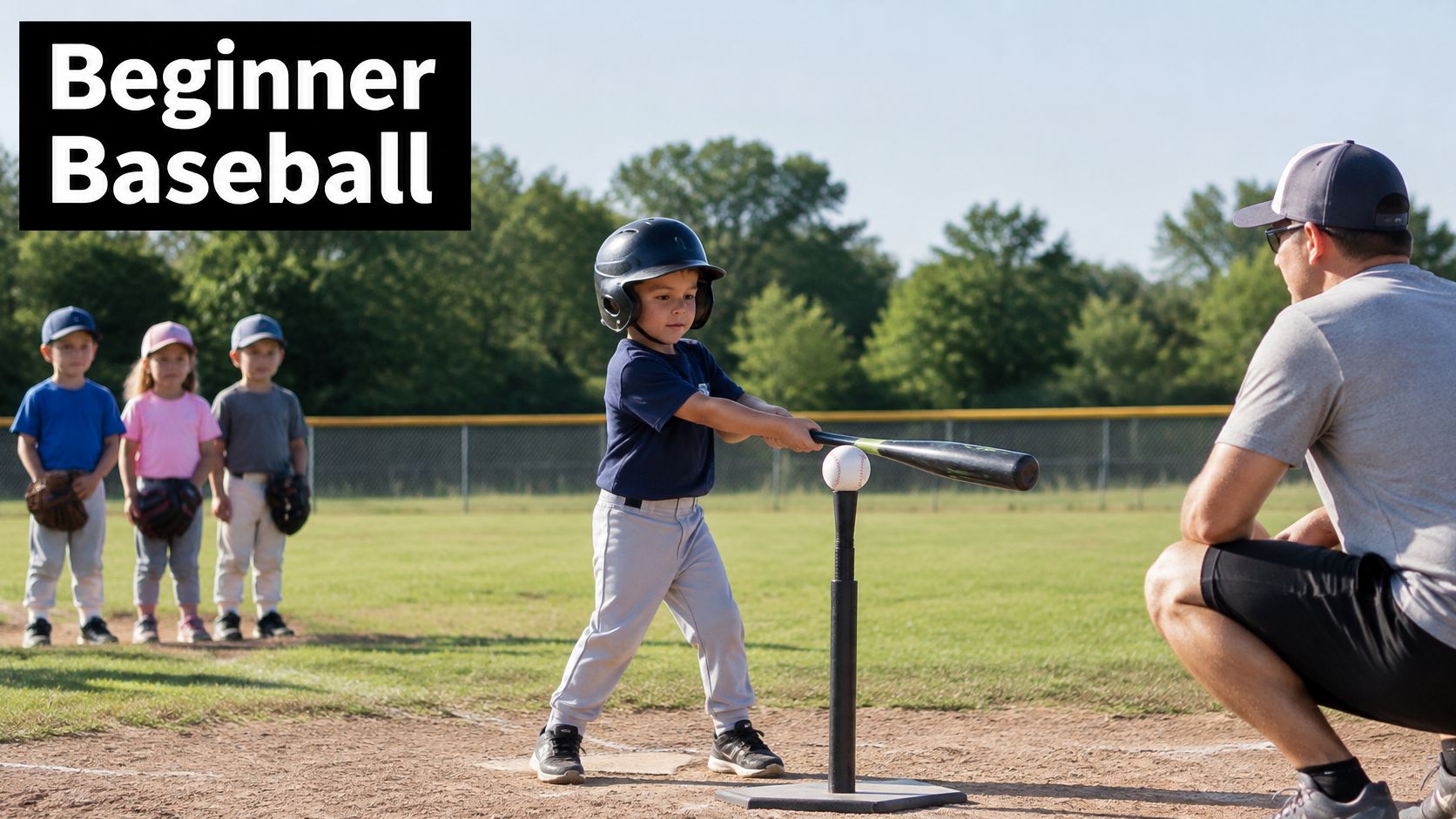
BlastBall and similar intro programs for children roughly ages 3 to 7 use small-sided games, tee hitting or soft-toss hitting, and short sessions. There's no long line waiting for one turn. Children run, throw, swing, and field grounders in quick rotation, so they get frequent touches on the ball and learn the basic shape of the game without standing in right field for twenty minutes hoping something happens.
House and Recreational Leagues
House and recreational leagues, typically for ages 4 to 12, add a real season without adding selection pressure. Expect a local schedule, one or two practices a week, a game most weekends, and often parent-coached teams. Everyone who registers plays. That's the point. Our guide to T-ball leagues walks through how those earliest divisions are usually structured by age.
Quality varies a lot within this category, so verify four things before you register:
Coach training: Coaches get at least a basic plan for practices, safety, and teaching fundamentals, not just a bag of balls.
Rotation policy: Children move through infield, outfield, and batting order spots instead of being fixed in one position all season.
Player-to-coach ratio: Small groups mean a coach can correct a grip or a throwing motion during practice.
Pitch-count rules: Limits on pitches and required rest days protect young arms once kid pitching begins.
This matters more than prestige. Say a 6-year-old in a house league bats several times each week, fields balls in practice stations, and tries second base one week and outfield the next. Compare that with a child the same age who makes a travel roster, sits for long stretches, and bats last against older pitching. The first child gets far more useful practice, more success to build on, and a stronger reason to come back next season.
This short video shows the kind of simple, repeatable tee work that builds that early confidence:
Signs Your Child Is Ready to Move Up
Don't move up because a neighbor did. Look for skill and appetite together:
Consistent contact: Hits off a tee or soft toss with balance and repeatable form.
Independent catching: Tracks and catches fly balls without prompting on most attempts.
Self-driven interest: Asks for more practice at home without you having to push.
When all three show up for a full season, a more demanding league becomes a reasonable conversation.
The Real Commitment
A select team isn't automatically the next step. It's a different contract with your calendar and your wallet, and you should read it like one.
Travel or select teams usually start with tryouts and carry rosters of roughly 12 to 15 players. Expect two to four practices a week plus weekend tournaments that are often out of town, with possible overnight stays. Fees usually cover field time, coaches, umpires, uniforms, and tournament entry. Once you add gas, meals, and hotels, a full season can reach several thousand dollars.
That total is rarely on the flyer. Ask for it in writing. Little League's own materials, in the Little League district travel program FAQs, warn that travel-ball costs can be prohibitive and that limited rules may increase safety concerns. In plain terms, a program outside a chartered league may not enforce the same pitch-count, rest, or equipment rules, so you have to check those policies yourself rather than assume they're in place.
A higher fee buys more games and more travel. It doesn't guarantee more at-bats for your child, better teaching, or safer arm care.
Our overview of youth baseball travel leagues breaks down that tournament rhythm in more detail for Houston-area families weighing the drive time.
School and AAU-Style Teams
School baseball works differently. It's a spring season with tryouts, a low direct cost, and school-based coaching. The trade-off is roster cuts. A child who doesn't make the team may have no school season at all that year, which is why many families keep a recreational option as a backup rather than treating school ball as guaranteed.
AAU-style teams sit closer to travel ball. They emphasize showcase events and exposure to older competition, at moderate to high cost. That exposure only helps a player who already has measurables or skills that scouts and coaches can evaluate. For a younger or still-developing player, it can mean paying showcase prices for very few meaningful repetitions.
Timing matters in bodies, too. Just as guidance on early rehabilitation for breast cancer recovery stresses starting the right work at the right stage rather than rushing intensity, a young thrower's arm benefits from the right workload at the right age, not the heaviest workload available.
Questions to Ask Before You Pay
Total season cost: What's the full amount including uniforms, tournaments, and expected travel?
Weekend load: How many weekend trips are planned, and how many require an overnight stay?
Pitch-count policy: What are the daily limits, rest rules, and who tracks them?
Roster fallback: What happens to a child who doesn't make the top roster or plays very little?
If a program can't answer those four clearly, you don't have enough information to commit.
Girls and Community Access Baseball Options
Separate leagues have created access before, and that history helps explain the options families have today.
When Black players were excluded from Major League Baseball, Rube Foster and Black team owners built their own circuit. The National Baseball Hall of Fame account of the Negro National League founding states that on February 13, 1920, they formed the league at the Paseo YMCA in Kansas City, and its inaugural season featured eight teams. It gave elite players a professional home, supported Black ownership, and proved there was a large audience for baseball that the established leagues had shut out.
That principle still applies at youth level. A league's value isn't only its win record. It's whether a child who doesn't fit the usual pipeline can get in, get coached, and stay.
The Current Participation Picture
Baseball's base is growing, but it isn't growing evenly. MLB reported in its 2025 Play Ball Weekend press release that U.S. baseball participation among ages 6–17 reached 8.49 million, up 27% from 2014, while MLB's Nike RBI program reached more than 200 cities and 100,000 male and female participants in 2024. Growth at the top of those numbers doesn't guarantee a good local option for your child, which is why you should compare structures, not headlines.
Coed recreational leagues are usually the lowest-cost entry point, with open eligibility and volunteer or staff coaching that varies by site. Advancement is informal, a child moves up by age and skill, but belonging is high because nobody is cut.
Girls-focused programs give girls coaching, teammates, and competition designed for them rather than asking them to be the only girl on a boys' roster. MLB's 2025 Trailblazer Series brought together nearly 100 girls ages 12–14 from 26 states and four Canadian provinces, a sign that girls' baseball is a real pathway rather than a niche side event.
Community-access initiatives such as Nike RBI target instructional opportunities in underserved communities, typically lowering cost barriers and bringing fields and coaching closer to home. Eligibility is community-based rather than tryout-based, and the goal is sustained participation first.
Selective travel structures offer the strongest competition and the clearest exposure, but they carry the highest cost, the strictest eligibility through tryouts, and the least guaranteed playing time. They serve some families well and exclude others on price alone.
So ask the question that matters most for your child. Will my child see players and coaches like themselves, receive meaningful instruction, and have a realistic path forward if they don't fit the traditional boys' travel model? A league that answers yes on those three counts is worth more than a famous name that answers no.
High School, College and Pro Ladder Explained
The National League and American League were separate circuits until they shared a championship, and their rules once differed.
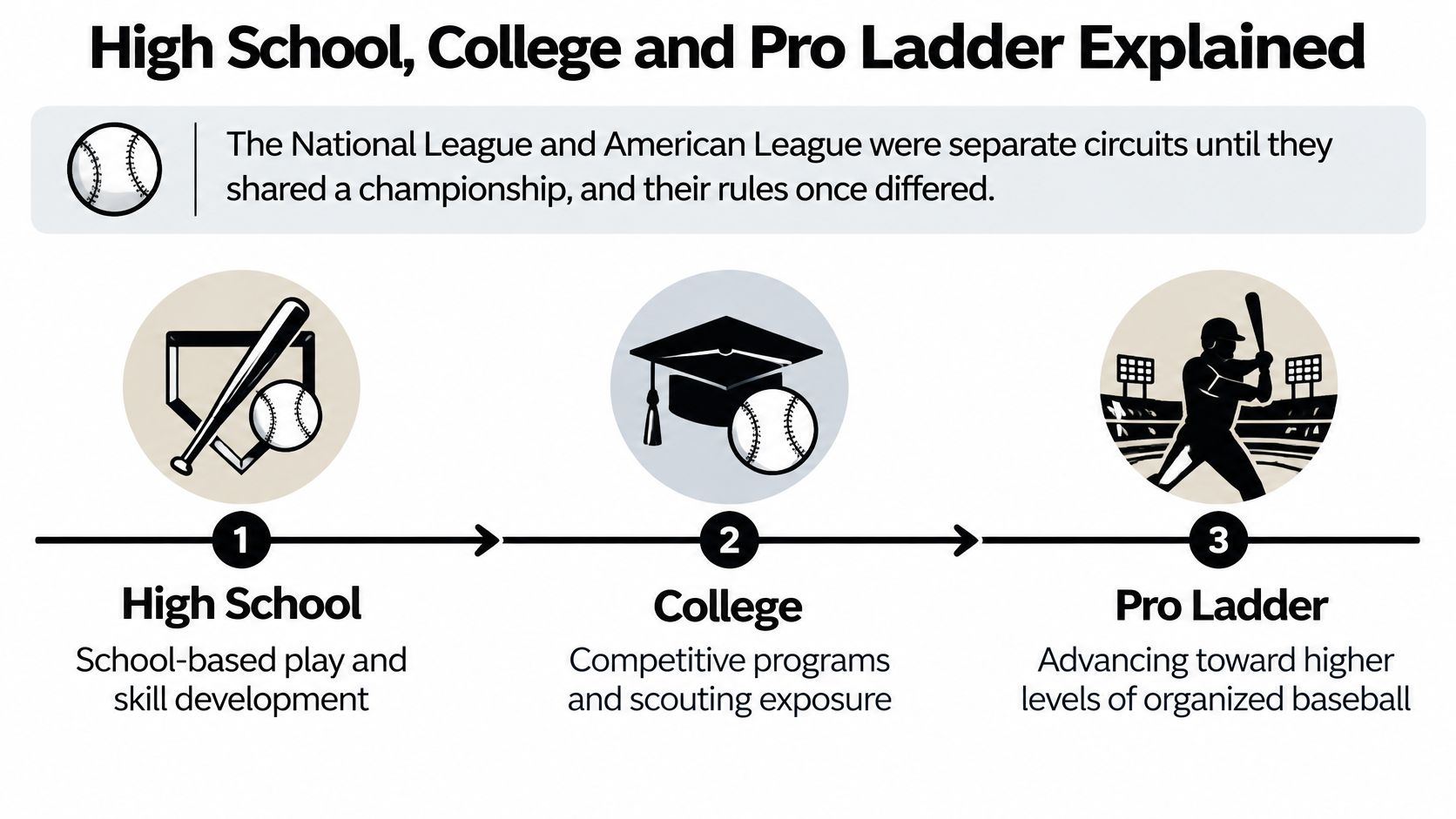
The modern National League dates to 1876, the American League began play in 1901, and they reached a formal National Agreement in 1903, as summarized in the Baseball Reference Bullpen history. The American League used the designated hitter beginning in 1973, while the National League traditionally required pitchers to bat, until universal designated-hitter use arrived in 2022.
That history explains the top, but your child's ladder starts much lower, around age 14, and every rung after that is selection-driven.
From Age 14 Upward
High school baseball begins with school tryouts under a state association framework that sets eligibility, season dates, and playoff rules. Coaches choose varsity, junior varsity, and freshman rosters, and playing time goes to the players a coach trusts most in games that count in the standings. A strong youth record helps a player get noticed at tryouts, but it doesn't reserve a spot.
College baseball runs through NCAA divisions, NAIA programs, and junior colleges. Scholarships vary widely by level and school, and many college players receive partial aid or none. Recruiting is the gate here. Coaches evaluate grades, physical tools, game performance, and positional need, and junior college is a legitimate route for players who need more development time or academic runway before a four-year program.
Minor league baseball is professional development inside a major league organization's affiliate system. Players move from rookie and Single-A levels through Double-A to Triple-A, and the organization decides every promotion, demotion, and release. Reaching the majors means passing that internal selection process repeatedly over several seasons, often while competing against international signings and draft picks from college and high school.
Three Takeaways for Parents
Selection decides advancement: Tryouts, recruiting, the draft, and organizational promotions determine who moves up, not years of youth participation.
Timelines are long: A player who is behind at 13 can develop later, and a standout at 10 still has many cuts ahead.
Professional baseball is rare: Only a small share of youth players reach it, so a league choice should pay off in skill, health, and enjoyment even if pro ball never happens.
Keep the ladder in view for orientation. Don't let it dictate decisions for an 8-year-old.
Choosing and Registering for the Right League
You don't need a perfect prediction about your child's future. You need a good fit for this season, chosen in the right order.
Four Decision Steps
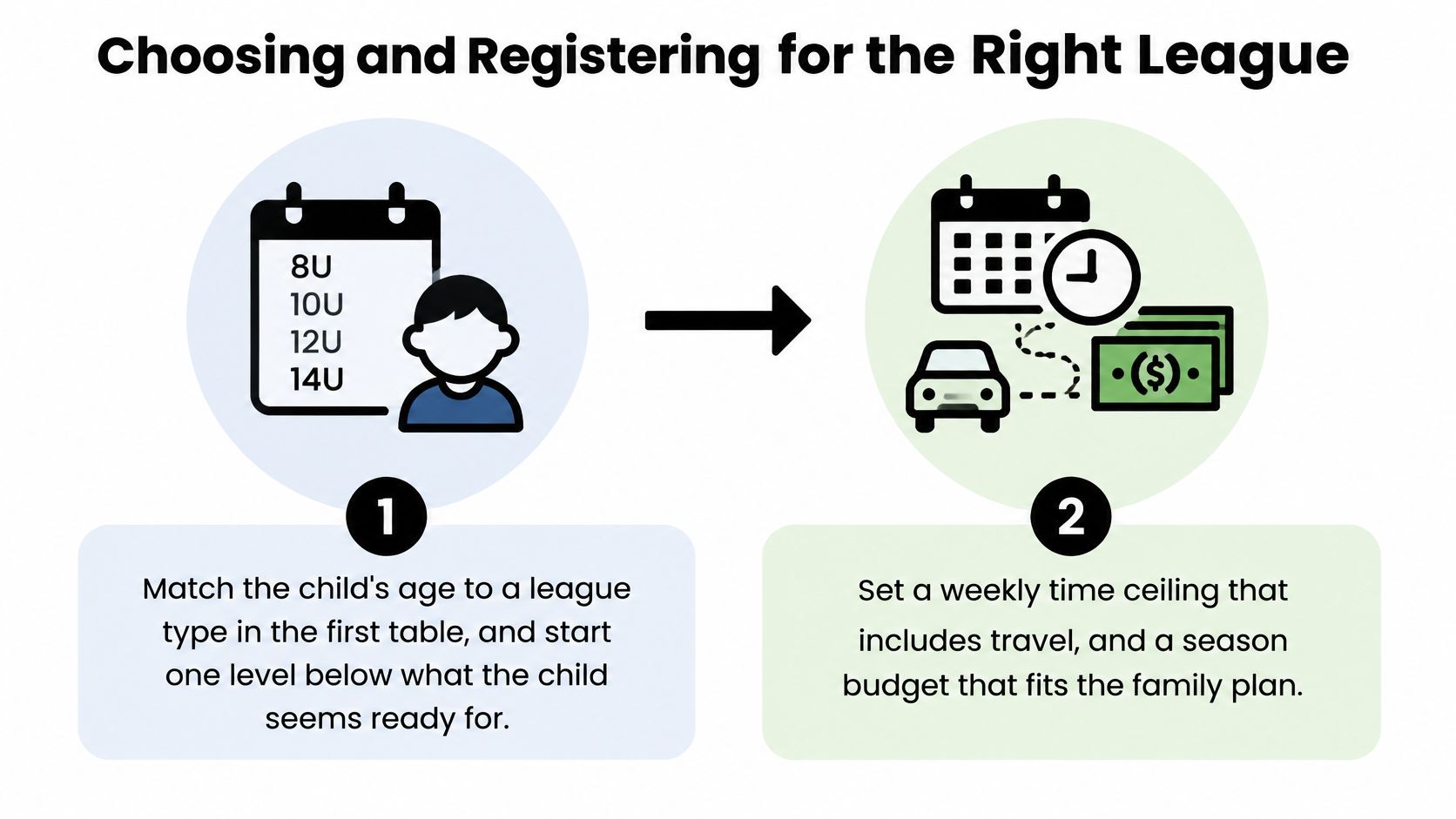
Match age to league type, then start one level below. Use the first table to find your child's age band, and pick the lower-demand option inside it. A child who dominates a level for one season builds confidence and repetitions, while a child who's overwhelmed often gets fewer chances and wants to quit.
Set a weekly time ceiling and a season budget. Count driving and tournament days, not just practice hours, and add gear and travel to the registration fee. A ceiling you set in advance protects homework, sleep, family time, and your child's interest in the sport.
Get playing-time, rotation, and pitch-count policies in writing. Ask how coaches distribute innings, whether children rotate positions, and what happens to a child who doesn't make the top roster. Written policies let you judge a program by how it treats its weakest player, which is where development systems show their real values. Our youth sports registration guide lists the details worth confirming before you submit any form.
Choose a short season or trial before a year-round commitment. One season shows whether the time, cost, and coaching fit your family. A short commitment keeps a bad fit from becoming a year of sunk-cost pressure on both you and your child.
Red Flags to Walk Away From
Guaranteed advancement: No youth program can promise a school roster spot, a scholarship, or a pro path.
No written safety or playing-time policy: If pitch limits and rotation aren't documented, they probably aren't enforced.
Year-round pressure before about age 10: Young children benefit from breaks and other activities, and early single-sport intensity raises burnout risk.
Unexplained fees: A program that won't itemize what your money covers will surprise you later.
Remember this: The best league is the one your child will keep playing in next season, not the one with the most impressive banner this season.
Local Next Steps in the Houston Area
Start by choosing the level that matches your child's age, then ask whether a baseball trial is offered so you can see the coaching and group size before you commit. At JC Sports Houston, our leagues include the MLS Go Indoor Soccer League, Soccer League, Baseball League and Basketball League, and free trials are listed for MultiSport and for soccer for ages 4-6, 7-9 and 10-13, so ask specifically what's currently available for baseball rather than assuming the same trial applies.
Confirm season dates and times carefully before you enroll. There are no refunds or credits on camps, clinics and leagues, so check event dates and times before enrolling, and make sure the schedule works around school and any travel you've already planned. We're an indoor center serving Humble, Kingwood and Atascocita, which helps with Houston weather, but indoor convenience only matters if the age group, session length, and coaching approach fit your child.
Then register for one season, watch how your child responds over the first few weeks, and judge by repetitions and enthusiasm rather than wins. Did they bat often, try new positions, and ask when the next session is? If yes, you've found the right level, even if it's not the most selective one in town. If not, you have useful information for next season, and changing leagues at that point is a normal part of how kids find their place in baseball.
If you're weighing different baseball leagues for a beginner in Humble, Kingwood, or Atascocita, start with an age-appropriate season where your child will bat, field, and play every week instead of chasing a selective roster. JC Sports Houston offers a Baseball League alongside its other youth leagues in an indoor setting built for young players, with clear schedules you can check before you enroll. Visit JC Sports Houston to see current baseball options, confirm dates and times, and register for the level that fits your child's age.
Comments