

Youth Baseball Travel Leagues: What Parents Should Know

Your nine-year-old wants to join the team that plays in another city every weekend. A friend has already signed up for tryouts, the uniforms look sharp, and you're wondering whether staying in the neighborhood league means falling behind. Before you pay a deposit, put the team's full calendar beside your family budget. The useful comparison isn't the name on the jersey. It's what your child will learn, what your family will spend, and how much throwing your child will do across every program.
What Youth Travel Baseball Is and Who It Fits
Youth travel baseball means joining a club that competes beyond its home recreational league, often through tournaments and, for some players, showcases. Teams commonly select players through tryouts. The commitment can include additional practices, tougher opponents, and trips outside your community, but the travel label alone doesn't guarantee better instruction.
A historical Los Angeles Times account described the primary travel-ball age range as approximately 7 to 14, with participation commonly declining as players entered high-school programs. That's useful context, not an eligibility rule. Each organization sets its own divisions and roster requirements.
Travel baseball tiers and who they suit
These are practical comparison categories, not standardized league classifications. Ask for the actual schedule before deciding which description fits a team.
Tier | Travel radius | Tournament frequency | Who it suits |
|---|---|---|---|
Recreational travel | Within the home area | A few games and occasional tournaments | Kids who want more games than local leagues offer |
Regional travel | Several hours by car | Regular weekend tournaments | Committed players with flexible weekends |
National travel | Out of state, often flights | Frequent multi-day events and showcases | Families who can fund heavy travel and want maximum exposure |
Say your child enjoys local games but wants opponents who challenge their hitting and fielding. A nearby club with a regional schedule may meet that need without flights or a showcase calendar.
Another child may like baseball mainly because friends are on the team. That player doesn't need a bigger schedule just because teammates are leaving.
Start with the child's request, not another family's decision. If your player wants more games and competition than the local league provides, youth baseball travel leagues are worth examining. If the goal is to play, learn, and have fun, a local league can usually provide that experience.
What Travel Baseball Really Costs Each Year
Annual cost and time by travel tier
Two teams can charge similar dues yet create very different yearly costs. Use the table to compare the full commitment, not to treat these categories as fixed package prices. The national-travel estimate is roughly $3,000–$5,000 annually for travel and lodging, according to the 2025 estimate cited by TeamGenius. That is a typical range, not a complete team budget or a guaranteed price. Ask for a quote based on the team's actual schedule.
Tier | Travel and lodging per year | Mandatory costs | Optional costs | Weekly time |
|---|---|---|---|---|
Recreational travel | Low; mostly local trips | Team dues, uniform, required gear | Private lessons, clinics | Lighter schedule; mostly home-area weekends |
Regional travel | Moderate; car trips and scheduled overnight stays | Dues, tournament fees, fuel, required hotels | Private lessons, extra practice | Regular weekend days, some overnights |
National travel | Typically $3,000–$5,000 for travel and lodging; get a schedule-based quote | Dues, tournament fees, flights, lodging, meals | Private lessons, optional showcases, premium gear | Weekday preparation and tournament weekends away |
Team dues are only the starting line. Ask whether tournament entries, coach travel, uniforms, and facility use are included. Then price the published schedule: fuel, hotel nights, parking, food, and any required booking arrangements can add up across a season.
Separate necessary costs from choices. Feeding the family is unavoidable, while restaurant meals and concession purchases may not be. Replacing unsafe or outgrown equipment is different from buying a premium bat because teammates have one.
Build a decision-ready budget
Use separate columns for required, optional, and not yet confirmed expenses. Add time costs too, such as missed work, sibling care, and weekends unavailable for other activities. These may not have a clear dollar value, but they still affect whether the team fits family life.
If a phone app will hold receipts or budget details, review its permissions before entering financial information. Fintrack's guide to privacy checks for iOS budgeting apps can help frame that review. For possible ways to offset fees, consider questions raised by youth sports fundraising programs: who organizes fundraising, and whether participation is compulsory.
Cost can shape whether children get to take part in organized sports. KQED's reporting cites 2023 participation of approximately 37% among children in households below the poverty line, compared with about 73% among children in households earning at least four times the poverty level.
Before committing, ask:
Coverage: What exactly do the dues buy?
Choice: Which additional purchases and events are optional?
Assistance: Are scholarships or payment plans available, and what conditions apply?
Compare the team's total cost with what your child will receive. A local option may offer better value per dollar if it supports the same development goals with less travel, while a travel team may justify its cost when its instruction and competition match the player's needs.
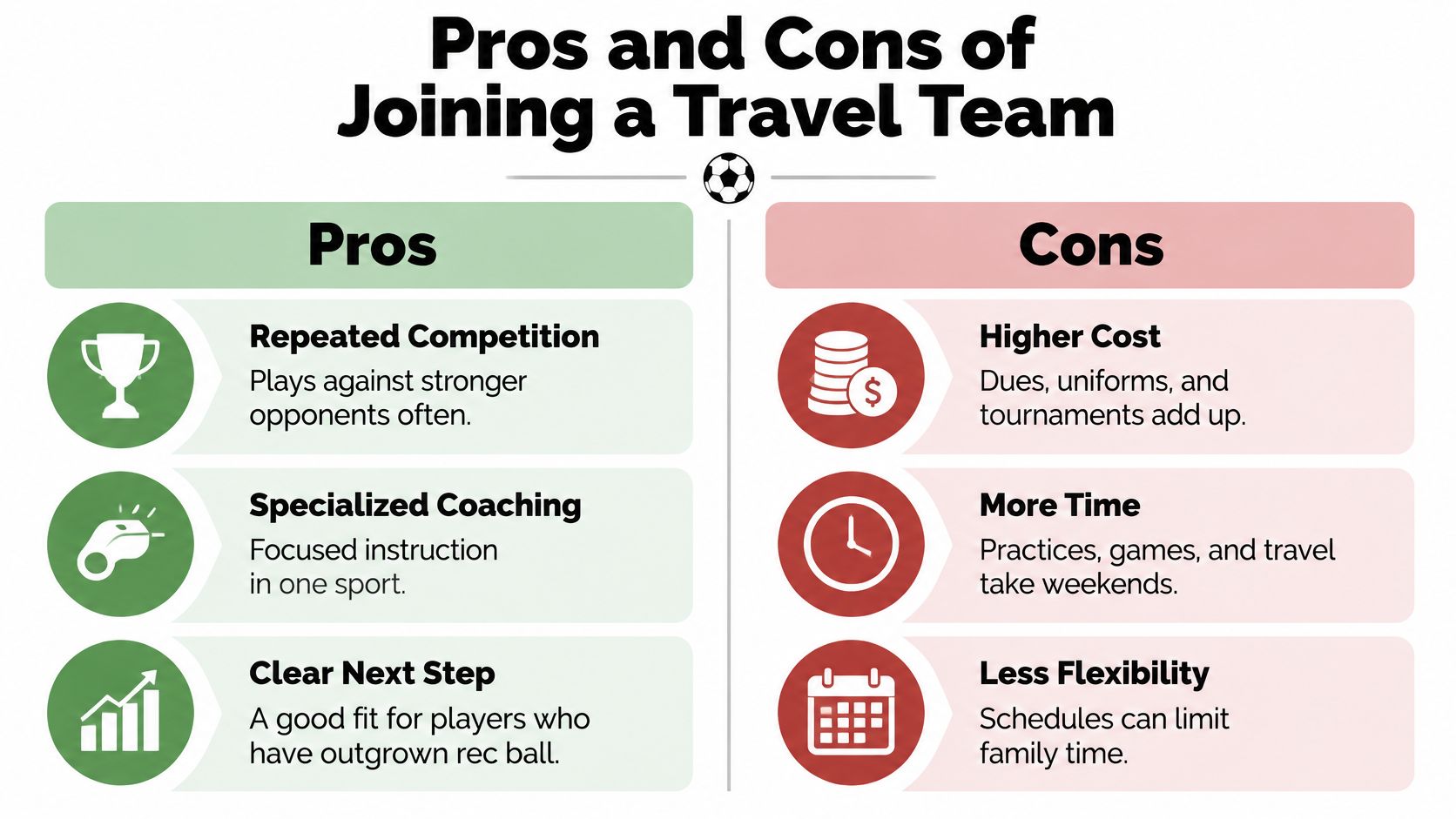
Pros and Cons of Joining a Travel Team
A travel team can give an eager player a more demanding baseball environment. The benefit comes from what happens during instruction and competition, not from the distance between home and the field.
What a strong program can offer
Repeated competition: Stronger opponents can challenge players to adjust their timing, positioning, and decisions instead of relying on habits that worked against less experienced teams.
Specialized coaching: Focused instruction can help a player understand a specific problem, such as rushing a throw or losing balance during a swing.
A clear next step: Players who have outgrown their recreational setting can find teammates who also want a more serious commitment.
Exposure opportunities: Showcases and selected events can offer visibility for players pursuing that goal, although attendance doesn't promise recruitment.
The trade-offs extend beyond the player's experience. Families need to consider the effects on everyone sharing the calendar.
What families give up
Financial flexibility: Required expenses can leave less room for other activities, emergencies, or another child's interests.
Unscheduled time: Tournament commitments can displace family visits, neighborhood friendships, and weekends at home.
Simpler logistics: Parents may split between siblings' events, coordinate carpools, or spend long stretches away from other children.
Room for other sports: A crowded baseball calendar can make early specialization the default rather than a deliberate choice.
Manageable throwing exposure: Practices, games, showcases, and lessons can create an excessive combined workload when adults don't communicate.
That last concern requires precision. A study of 184 Little League pitchers ages 7–12 associated pitching with pain or fatigue, and traveling at least monthly for showcases, with worse throwing-arm-health scores. Those associations don't establish that travel itself causes injury, and the study didn't independently associate private coaching or specialization with worse scores.
More visibility isn't the same thing as better development. An event should serve a clear purpose for the player.
Travel ball suits a child who loves the game, has rest and recovery in place, and whose family can absorb the cost without strain.
Pitch Limits and Rest Rules Every Family Should Know
Daily pitch maximums by age
MLB and USA Baseball's Pitch Smart guidelines identify pitch counts as the most effective workload-control measure, recommend coordination across overlapping teams, and provide these daily maximums and age-specific rest requirements.
Age | Daily pitch maximum |
|---|---|
7–8 | 50 pitches |
9–10 | 75 pitches |
11–12 | 85 pitches |
13–16 | 95 pitches |
17–18 | 105 pitches |
For ages 11–12, the same guidance sets the following rest schedule:
Pitches thrown | Required rest |
|---|---|
1–20 | No rest days |
21–35 | One day |
36–50 | Two days |
51–65 | Three days |
66–85 | Four days |
These are maximums, not goals. A player doesn't need to reach a limit before a coach removes them, and an available pitching slot doesn't override fatigue or pain.
Keep an athlete-level record
A workable system starts with one centralized throwing log. Record the date, team, pitching appearance, game pitches, other throwing activity, symptoms, and next eligible pitching date. Track warm-up throws and practice work separately where feasible, rather than treating every kind of throw as identical to a counted game pitch.
The designated adult should reconcile the travel schedule with recreational teams, school baseball, showcases, and private instruction. A different uniform doesn't reset the player's workload or recovery needs.
A clinical reference reviewing youth pitching evidence describes associations between travel-team pitching and elbow pain, and between travel-ball pitching, a higher proportion of games pitched, and shoulder pain. It also explains how multiple-league participation can conceal seasonal pitch volume.
Parents should take these actions in order:
Request the record: Ask to see the season-wide workload log and identify who updates it.
Confirm its scope: Establish whether outside teams, showcases, and private sessions are included.
Protect the child's voice: Make sure a player can decline pitching when tired without punishment.
Set the pain rule: Require immediate reporting of arm pain and no pitching through it; seek appropriate medical assessment rather than a mechanical fix from the dugout.
Avoid assigning the same player heavy pitching and catching responsibilities just because they're dependable at both positions.
Practical rule: Rest belongs to the athlete, not to the team that last used the athlete.
Limits can reduce risk only when adults consolidate every source of throwing into a shared record and act on what it shows.
Parent Checklist Before Committing to Tryouts
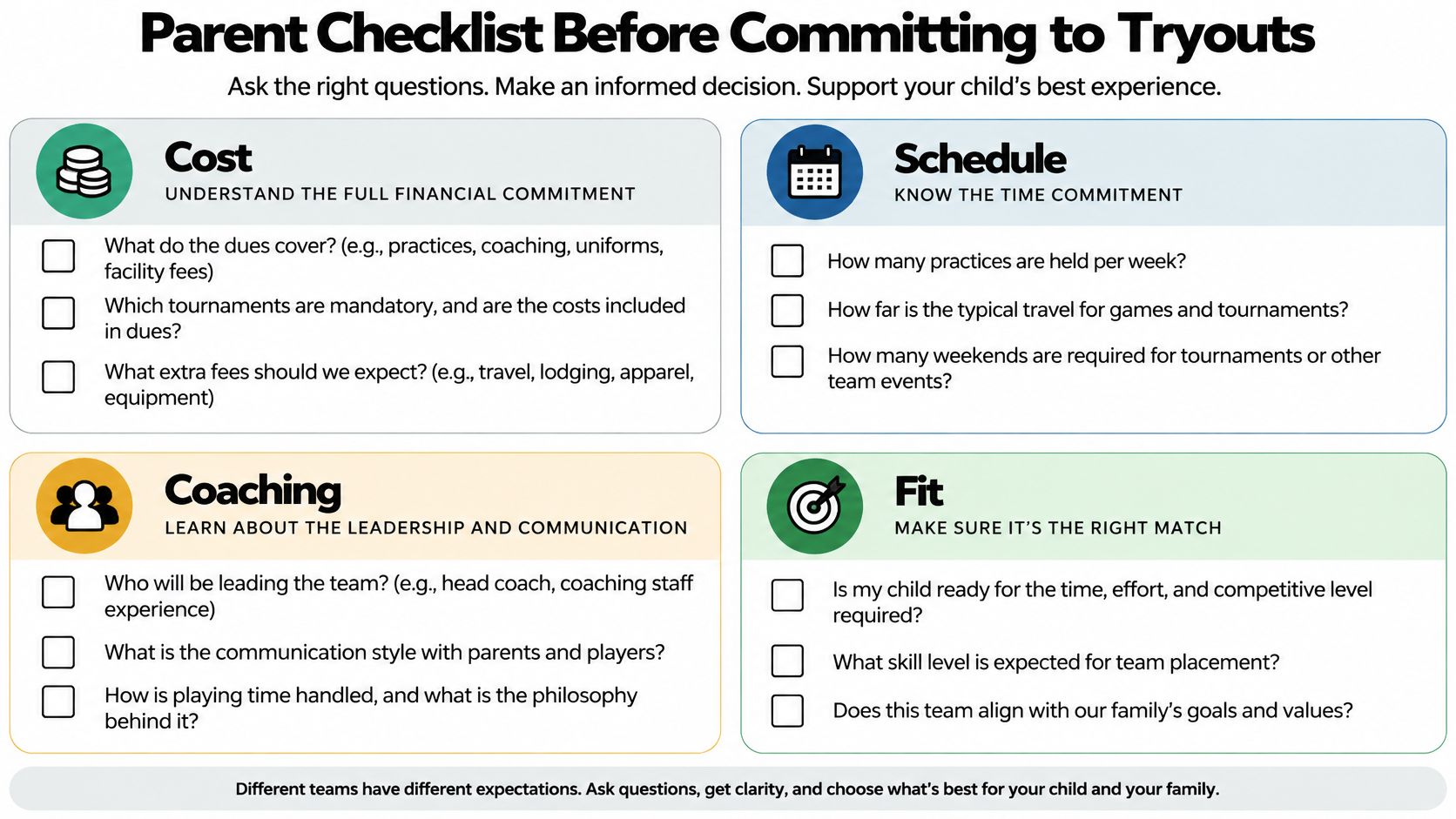
Treat tryouts as an opportunity to evaluate the organization, not just an audition for your child. You're deciding whether to accept a season-long arrangement involving money, transportation, instruction, and responsibility for your player's well-being.
Ask the coach or director directly. Record the answers in a shared note so you can compare programs without relying on impressions from a busy field.
Cost
Included expenses: What do dues cover, and what will be billed separately?
Required events: Which tournaments must every rostered player attend?
Financial assistance: Are scholarships or payment plans available?
Expected total: What should a family budget for the full season, including expenses paid outside the club?
Time
Weekend commitments: Which dates are required, and when will the schedule be final?
Weekday practices: What are the practice expectations and attendance rules?
Family transportation: Is carpooling permitted, and how do families handle siblings during travel?
Workload
Record ownership: Who maintains the combined throwing log across teams and showcases?
Rest enforcement: Who checks eligibility before a pitching assignment?
Player choice: Can a child decline to pitch because of fatigue?
Pain response: What happens immediately when a player reports arm pain?
Development
Actual participation: What playing opportunities should this player expect, and how does roster size affect them?
Teaching qualifications: What relevant training does the coach have, and how do they explain corrections?
Practice design: How much time goes to skill instruction rather than game preparation alone?
Feedback: How will the coach explain progress, position changes, or reduced playing time?
A team earns a yes only when it answers all these areas clearly. No coach can promise identical innings in every situation, but they should explain their approach before you pay.
Vague answers about workload or playing time are warning signs. If the director says details will come later, ask for those details before accepting the roster spot, not after the deposit becomes nonrefundable.
Local Leagues, In-House Programs and Camps Compared
Compare alternatives using the same criteria: cost, travel burden, weekly time, coaching structure, and useful repetitions. A program that leaves room for focused practice may serve your child better than a busier competitive calendar.
Watch how instruction turns into activity, rather than judging the setting by its facilities alone.
Option | Cost comparison | Travel and time | Coaching structure | Repetitions to look for |
|---|---|---|---|---|
Local league | Compare registration and required equipment | Nearby games and a defined season | Community coaches, often volunteers | Fielding chances, plate appearances, position rotation |
In-house program | Compare tuition and separate event fees | Facility-based sessions with limited travel | Facility-led instruction | Small-group stations and individual corrections |
Camp | Compare session fees and included equipment | Concentrated attendance during breaks | Camp staff working through a focused curriculum | Active practice rather than long lines |
Match the setting to the player
A local league fits a child who wants games, teammates, and chances to apply developing skills. Community organizations may operate several teams within an age division, so check the actual structure rather than assuming every local league looks alike.
An in-house program can suit a beginner who needs predictable instruction or a developing player who benefits from coached repetitions without tournament travel. A camp works well for a focused introduction, a skill refresher, or practice during a school break, but it doesn't replace ongoing game experience.
For a closer look at participation questions, use this guide to choosing a baseball league for kids. When observing any session, notice whether players receive understandable corrections and get another attempt soon enough to apply them.
Use the accompanying video as a conversation prompt about the kind of baseball experience your child wants.
For a child still learning the fundamentals, local or in-house instruction often offers better value than extensive travel. A player already competing at a high level may have a clearer reason to seek demanding tournaments or relevant showcase opportunities.
A hybrid path can combine a local season with a camp or targeted private instruction during a lighter period. Apply the same questions about fees, attendance, teaching, and recovery to each option. Less travel should mean a more suitable schedule, not an excuse to fill every free day with another session.
How to Prepare Your Child for Tryouts
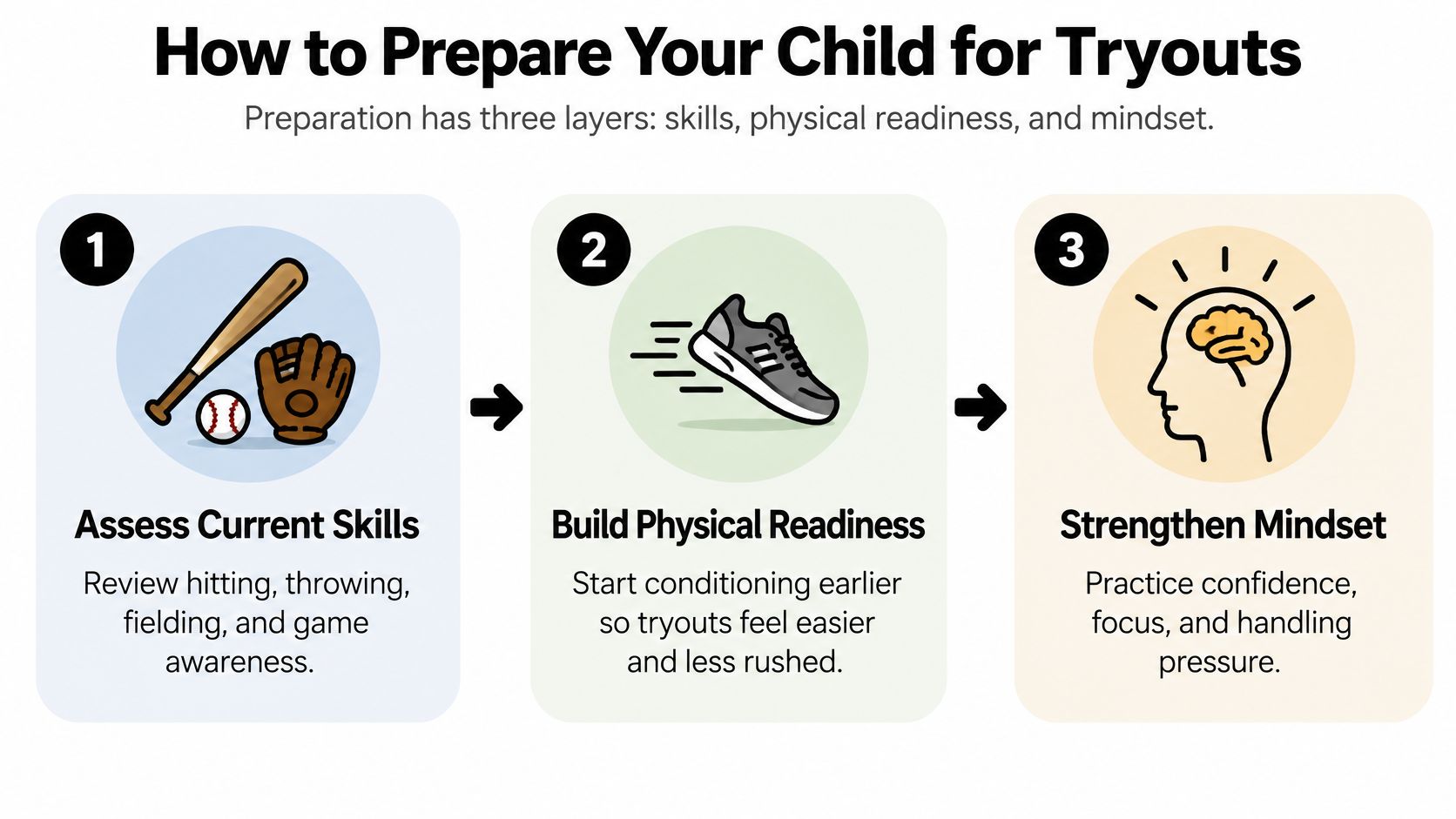
Preparation has three layers: skills, physical readiness, and mindset. Starting before the tryout rush gives a child time to learn corrections without treating every practice as a final exam.
Don't turn an invitation into a crash course. A sensible preparation plan should leave your player interested in baseball and capable of showing their current abilities.
Build a plan the child can explain
Assess current skills with a coach. Review throwing accuracy, ground-ball approach, catching, fielding positions, hitting, and base running so practice addresses an identifiable need. The common mistake is judging readiness only by batting results while overlooking how the child moves, listens, and makes decisions.
Organize a manageable weekly routine. As a sample plan, use a small set of short skill sessions focused on the weakest area, with rest built around existing practices and games. Avoid adding sessions just to make the calendar look serious, and don't spend the entire week repeating a skill the player already handles comfortably.
Prepare the body without exhausting it. Include age-appropriate mobility, body-weight core exercises, enjoyable running activities, and a consistent sleep routine so the player can move comfortably and concentrate. Avoid unfamiliar strenuous workouts immediately before evaluations or conditioning used as punishment.
Keep the throwing record current. Enter lessons, backyard work, team activity, and tournament appearances before deciding what to practice next. The common mistake is treating informal throwing as invisible or scheduling extra pitching after a tournament because tryouts feel urgent.
Rehearse the tryout routine. Practice moving between stations, listening to a short instruction, taking timed drills when appropriate, and facing live batting practice when safely available. Teach the child to reset after a poor repetition rather than rushing into the next attempt or arguing about the result.
Explain what the day means. Tryouts capture a snapshot, not a permanent judgment of potential, and players can demonstrate effort, attention, and willingness to learn even when a skill breaks down. Avoid promising selection, and make clear that reporting tiredness or pain is responsible behavior, not a failure of toughness.
For help choosing age-appropriate practice priorities, this guide to baseball training for kids can support a conversation with the person teaching your child. Bring specific observations, such as difficulty lining up a throw, rather than asking for a complete mechanical overhaul before evaluations.
A ready player doesn't need a new swing, a new glove, and a harder workout on the eve of tryouts.
On the day, aim for a child who is warm, rested, and able to explain what they've worked on. Pack familiar equipment, confirm arrival instructions, and keep the parent's role simple: help the player arrive organized, then let the coaches evaluate.
Confirm Your Path Before the Next Season
The next season doesn't need to settle your child's entire baseball future. Choose an experience that addresses a present need and leaves room to reconsider when interests, skills, or family circumstances change.
Make a choice you can explain
Name the season's goal. Decide whether your child primarily needs more games, stronger fundamentals, or relevant exposure. Write the goal in plain language, such as learning to field confidently during games, rather than choosing a broad ambition like getting ahead.
Choose the setting that serves it. Travel ball can fit a player ready for higher competition whose family can carry the financial and scheduling commitment. Local leagues and in-house instruction can support steady development, while camps or targeted sessions can address a specific gap without requiring a larger team commitment.
Verify the arrangement before paying. Contact the program directly and request written answers about total expenses, attendance, player development, and workload responsibility. Compare the responses against your goal, not against another family's enthusiasm.
For families in Humble, Kingwood, and Atascocita, JC Sports Houston is a toddler and youth indoor sports center to include in that comparison. We use a child-centered curriculum, and our teachers are experienced and trained in it.
Families can request a free trial by completing a form with the child's name, age, and favorite sport. Use that visit to observe how a coach gives instructions, responds to mistakes, and keeps children involved, then compare what you observed with the checklist.
Your next step isn't to buy the most ambitious schedule. It's to gather enough specific information to choose a program your child can enjoy and your family can sustain.
We offer youth baseball, soccer, basketball, private sessions, and seasonal leagues, giving families options to compare before committing to a travel schedule. Visit JC Sports Houston to request a free trial with your child's name, age, and favorite sport, then use the checklist to discuss the right next step with our director.
Comments