

Flexibility Exercises for Kids: Safe Routines by Age

The familiar advice to have every child sit down, touch their toes and hold a stretch isn't the best starting point. A toddler needs opportunities to explore movement, not an adult-style flexibility workout. And a school-age child who can't reach their toes doesn't need someone pushing them farther.
Good flexibility exercises for kids match the child's stage, attention and comfort. The mistake to avoid is forcing range of motion, whether that means pressing knees toward the floor, pulling on a foot or insisting on a deeper position. Comfortable movement comes before a flexibility target.
Age-by-Age Flexibility Routine at a Glance
Most young children don't need a stretching session at all. They need frequent movement, with opportunities to reach, squat, crawl and change direction. Think of mobility as the range a child can use comfortably while moving, rather than the deepest pose they can achieve.
Use this table to choose an approach, not to assign a flexibility score. The suggested activities are starting options, and the session ends when the child loses interest or can no longer move comfortably.
Age band | Main focus | Sample movements | Session length and frequency |
|---|---|---|---|
2–3 years | Whole-body play, reaching and squatting | Tunnel crawling, squat-to-stand digging, bear walks | Brief, child-led bursts throughout daily play |
4–5 years | Playful range, balance and rotation | Frog hops, tree-pose balance, low hip bridges, animal flow | Short game sequences alongside daily active play |
6–8 years | Hamstring, hip and calf range with comfortable holds | Standing hamstring reach, butterfly, calf stretch | A brief cool-down after play, repeated on regular activity days |
9–12 years | Hamstring, hip and shoulder range with sport mobility | Hamstring holds, hip flexor stretch, doorway chest stretch | A planned flexibility block after activity, with a dynamic warm-up before practice |
Choose by readiness as well as age
For toddlers, join the game and demonstrate rather than correcting every position. Preschoolers can follow a simple movement story, but they still need permission to change the movement or stop.
School-age children can begin held stretches when they understand instructions and can describe what they feel. An older child who holds their breath or strains to copy a pose needs an easier version, not a longer hold.
Balance belongs alongside flexibility. These balance exercises for kids offer ways to practice control rather than just reaching farther.
Practical rule: Movement first. Add held stretches only when the child is warm, attentive and comfortable.
Why Flexibility Shifts From Age 2 to 12 and What It Means at Home
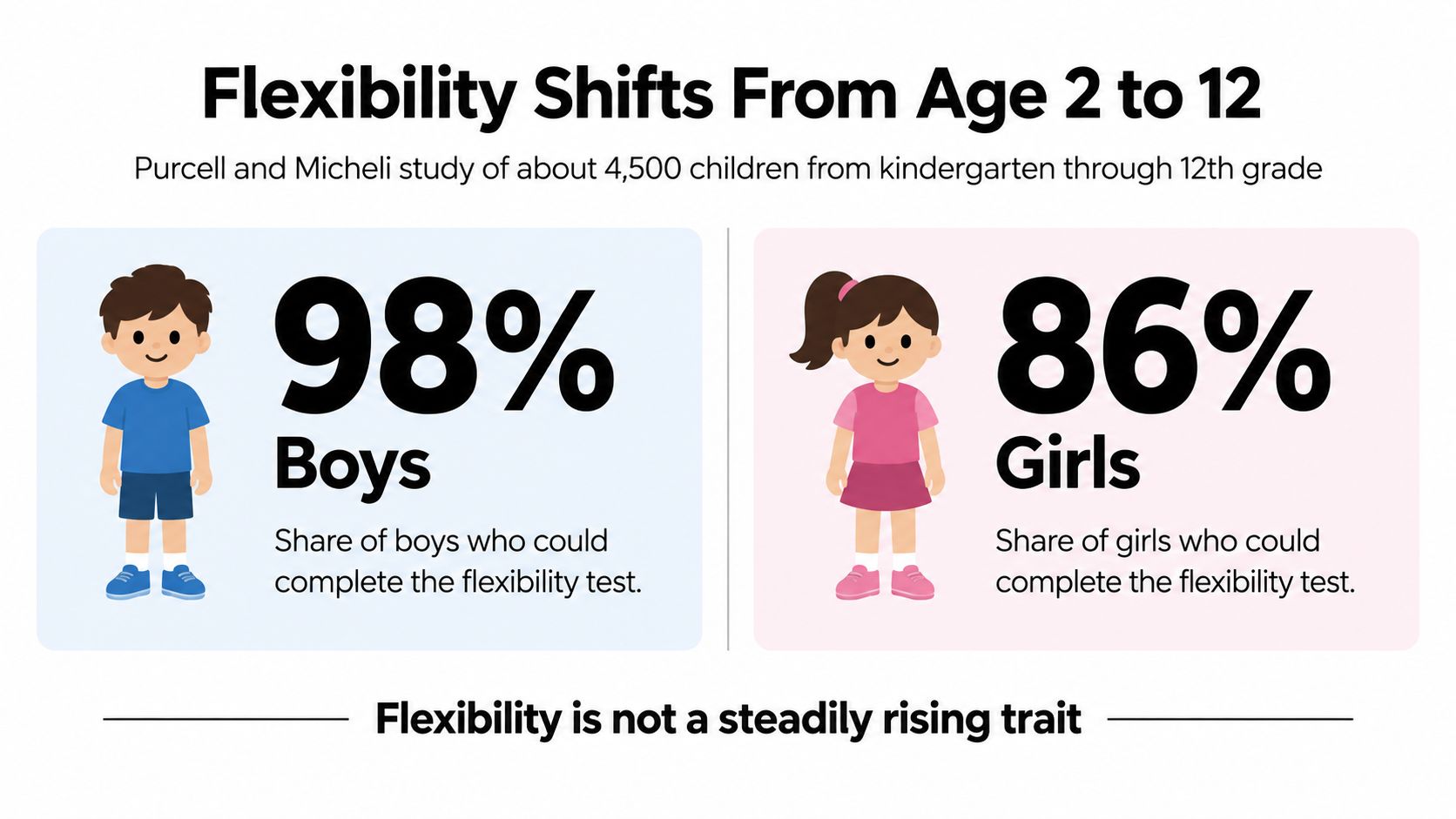
Flexibility doesn't steadily increase as children grow. A review describing Purcell and Micheli's testing of approximately 4,500 children reports that 98% of boys and 86% of girls could perform a standing toe-touch at age 5, compared with 30% of children of either sex at age 12.
These historical results describe a particular test, not a standard every child should meet. The starting percentages below refer specifically to the standing toe-touch.
What should change at home
Growth, maturation and activity patterns all matter. A child may find a familiar reach harder while still moving comfortably during climbing, kicking or floor play. Different movements also place different demands on the body, so a toe-touch can't describe whole-body flexibility.
Keep movement varied. Include reaching, rotating, crawling, balancing and controlled sport movements.
Compare the child with themselves. Use the same comfortable movement when checking change, rather than comparing siblings.
Don't treat stiffness as permanent. A difficult movement is a reason to adjust practice, not label a child inflexible.
If a child bends their knees to pick up a toy, that isn't a failed flexibility test. It's a useful movement solution.
Playful Flexibility Games for Toddlers and Preschoolers
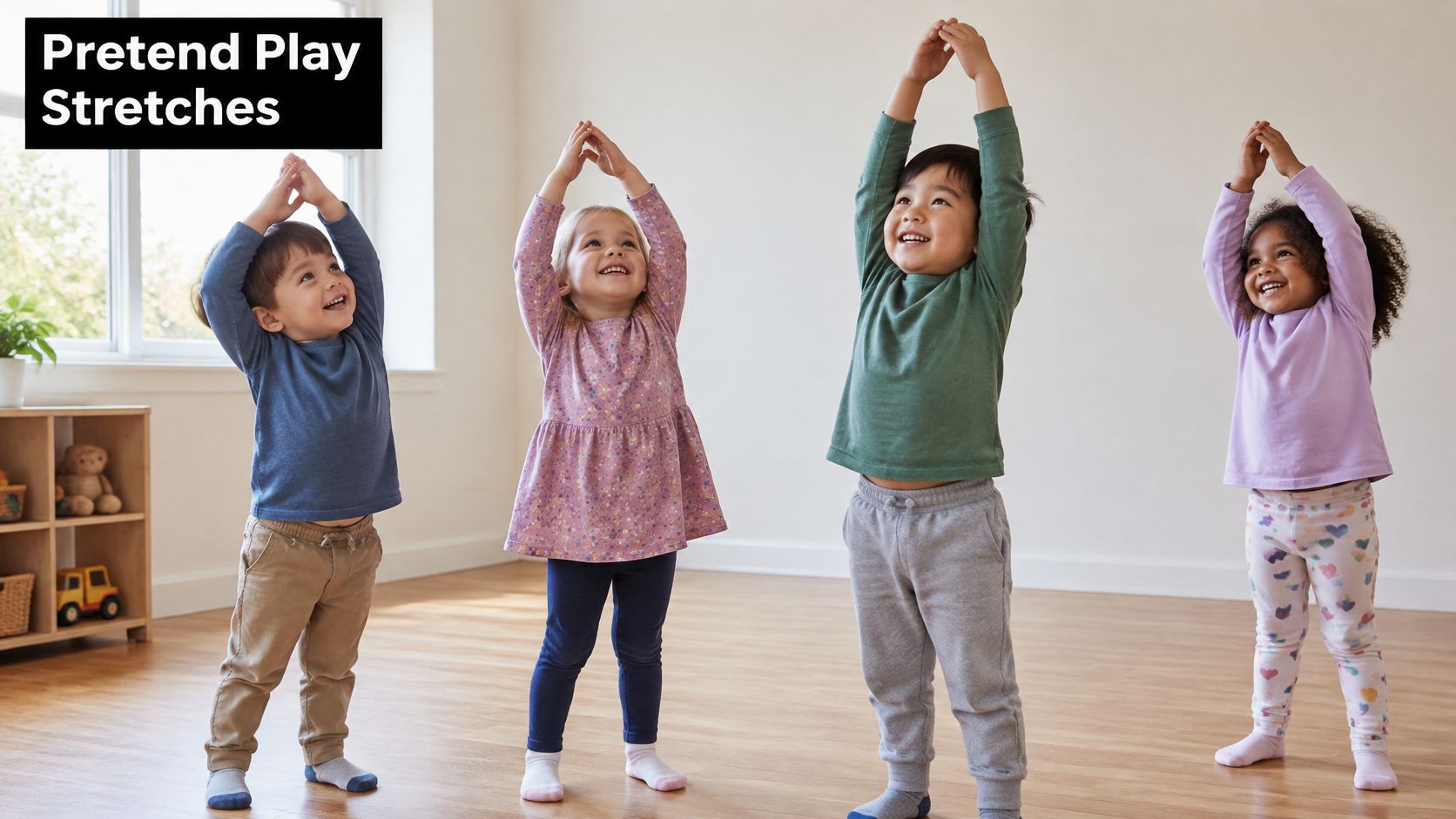
Clear some floor space and let the living room become a garden, forest or river. Young children don't need instructions about hamstrings; they need an interesting reason to reach and move. University of Nevada, Reno guidance supports playful activities, slow movement and avoiding painful or jerking motions.
The positions don't need to look identical from child to child. Comfortable participation matters more than matching an adult's shape.
Turn movement into a story
Bear walk to the tunnel. Travel on hands and feet toward a stable play tunnel or cushion arch. Let the child lower their knees to crawl through. They should feel their arms and legs working, without wrist pain.
Garden digging. Squat to collect imaginary flowers, stand up and reach toward the sunshine. Let the heels lift or the squat stay shallow if needed. The movement should feel easy to enter and leave.
Frog hops with a pause. Make a small forward hop, land softly and pause in a comfortable squat. Skip the jumping if the child prefers stepping. They should feel steady enough to stand again without being pulled.
Tree statue. Balance on a foot with a hand resting on a wall or your hand. Switch when ready. A little wobble is welcome; gripping, distress or falling repeatedly means the task needs simplifying.
Letter-making. Lie on the floor and make a curved C, a long L or a rounded O with the body. Accept the child's interpretation. They should feel a gentle change of shape, not pressure in the neck.
Bridge over the river. Lie on the back with knees bent and feet planted, then lift the hips slightly. This is a low hip bridge, not a hands-and-feet backbend. The child should feel effort through the hips, without back discomfort.
Follow interest, not a checklist
Keep pauses brief and switch games when attention drops. A child who wobbles, laughs and abandons the tree pose hasn't failed.
For children who enjoy rhythm, Kids Club Early Learning Centre's music activities that support toddler development can inspire movement cues. You can also use creative movement activities to build stories around animals, weather or familiar places.
A child's refusal is a reason to change the game, not permission to move their body for them.
Warm-Ups, Stop Signs and When to Call a Clinician
A pre-game stretch isn't an injury-prevention guarantee. CHOC's pediatric stretching guidance recommends 5–10 minutes of light activity before play, stretching only after muscles are warm, avoiding bouncing and stopping short of pain.
A dynamic warm-up uses controlled movement, such as marching, skipping, gentle leg swings and walking lunges. Before soccer, baseball or basketball, gradually add movements that resemble the activity ahead. Comfortable static holds fit better after activity or in a separate warm flexibility session.
Sort sensations before continuing
Sensation | What it usually means | What to do |
|---|---|---|
Mild pull along the muscle that eases with breathing | Normal stretch | Hold and breathe, then ease off if the pull grows |
Sharp, pinching or sudden pain | Warning sign | Stop, leave that position and avoid it for the session |
Bouncing, or pushing harder to reach a target | Forcing the range | Stop, reduce the range and rebuild gradually |
Persistent pain, swelling, limp or one side much tighter | Possible injury or condition | See a pediatric clinician or physical therapist |
A young child may not describe pain clearly. Watch for grimacing, guarding a limb or suddenly refusing a previously comfortable movement. Don't ask them to repeat the movement to prove it hurts.
When a standard routine isn't appropriate
Unusual stiffness, hypermobility, injury recovery or a chronic condition calls for individual advice. A very bendy child doesn't automatically need more range; comfortable control may be the more useful focus. A clinician can help adapt activity without assuming the child should avoid movement altogether.
Stretching also doesn't replace strength work, landing practice, gradual workload increases or rest. Use these warm-ups for workouts for movement preparation; for younger children, you can explore preschool physical development activities from Playz to find alternatives to seated stretching.
Never force a stretch to meet a target. Pain, swelling or a limp means pausing the routine, not trying a more intense version.
School-Age Hamstring Routine and How to Progress It
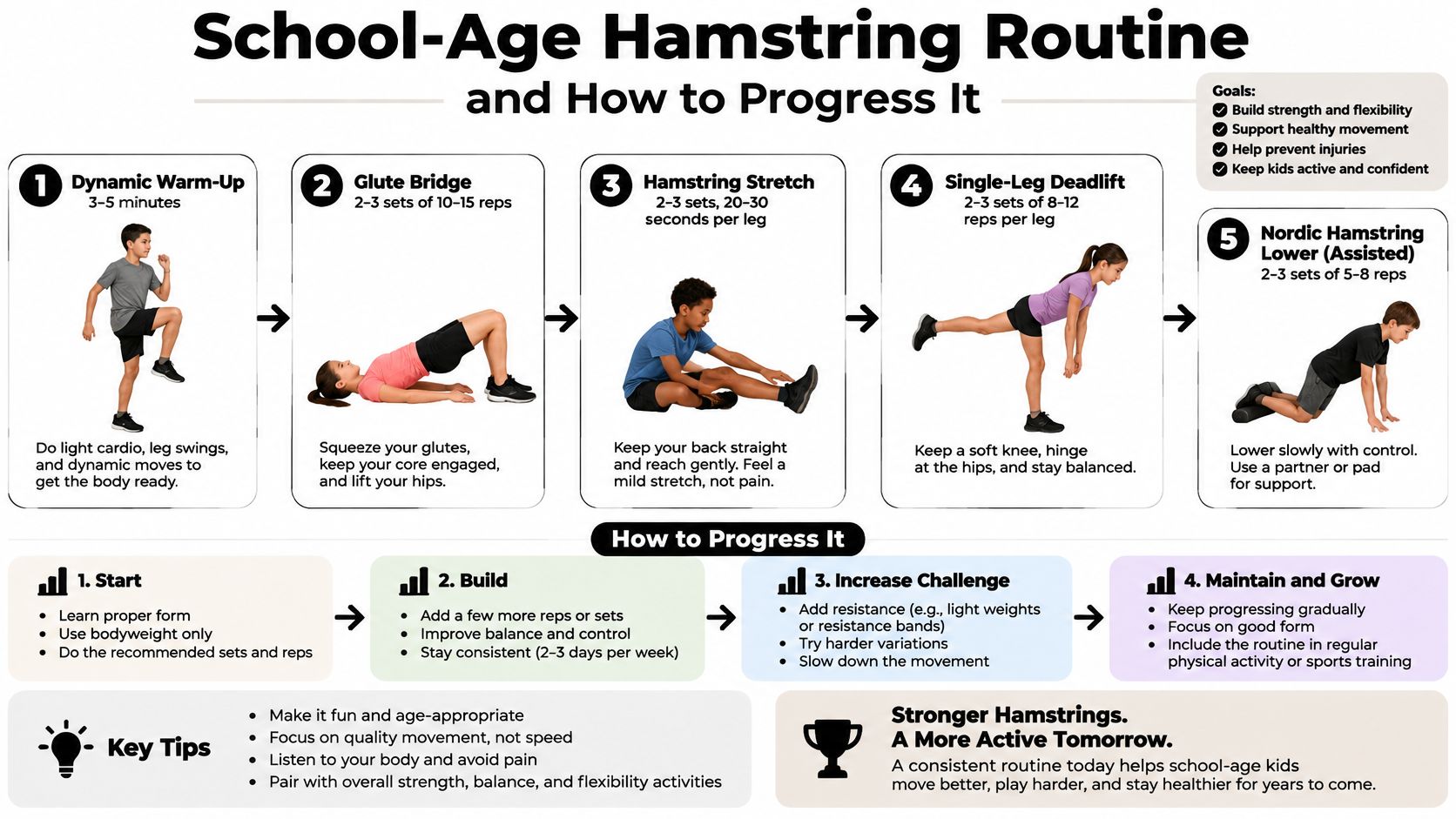
The hamstrings run along the backs of the thighs. For a healthy school-age child, a small selection of comfortable stretches can provide a repeatable routine. The movements below are practical options, not a claim that every position reproduces a study protocol.
Use the visual as a movement reminder, while letting the child's comfort determine the position.
Set up the routine
Start warm. Use easy jogging, skipping or ball dribbling before a separate flexibility session. After sports practice, transition from easy movement into the holds rather than sitting until the child cools down.
Lie on the back and loop a towel around a foot. Let the child hold the towel and slowly raise that leg, keeping the knee soft and relaxed. The towel provides reach, not a handle for an adult to pull.
Try a seated reach. Sit with legs extended and reach toward the shins or feet while keeping the back comfortably long. Touching the toes isn't required. Allow a slight knee bend if straightening the legs causes strain.
Stand with a foot slightly forward, heel on the floor and front knee relaxed. Bend the supporting leg and tip forward gently from the hips. Switch sides without twisting the pelvis.
Use a wall for balance. Rest a hand on the wall and repeat a supported heel-down, front-leg hamstring reach. Keep the front toes relaxed rather than pulling them strongly upward. If the position mainly causes calf discomfort, adjust it or choose the lying version instead.
Standardize the dose. A cluster-randomized trial involving 150 children aged 7–10 used four hamstring exercises with two 30-second sets per exercise, twice weekly for nine weeks, and found significant improvements in hamstring extensibility (p < 0.001). Use that as a structured reference, not an obligation to complete every hold immediately; alternating sides and changing positions adds session time.
Recheck consistently. Occasionally repeat the same comfortable reach, with the same starting position and warm-up. Record where the child reaches without straining. Don't turn the check into a competition or an opportunity to push farther.
Breathe normally throughout. A child who holds their breath, shakes or twists to stay in position should reduce the range or leave the stretch.
Add practice before adding intensity
Begin with a small selection the child understands. Once attendance and technique are consistent, add another movement rather than extending a difficult hold indefinitely.
The clearest reason to track practice is that the amount completed matters. In a randomized study of 239 approximately 15-year-old students, sit-and-reach improvements over five weeks differed by stretching approach.
Approach | Sit-and-reach improvement |
|---|---|
Four stretches, four repetitions each | 21.6% |
One stretch | 12.6% |
Repeated testing only | 5.1% |
Control group, no stretching | 1.7% (not significant) |
These are adolescent results, not promises for younger children. They support repeatable practice, but they don't establish that every child should complete the largest possible routine. Sit-and-reach also measures only part of flexibility, not hip, shoulder and whole-body movement.
For an optional visual reference, watch the movement demonstration before deciding which positions suit your child.
Keep a note of the movement, hold duration, repetitions, body position and attendance. Skip extra flexibility work when the child is sore or tired, and don't treat these exercises as injury rehabilitation.
If an older child also practices martial arts, the guide to flexibility with Locals Jiu Jitsu Alexandria offers sport-specific context. Use it selectively, rather than adding an adult-oriented stretching list to a child's existing workload.
Build a Weekly Routine and Try a Free Trial
A workable family routine starts with something small enough to repeat. Choose the appropriate age band, then select a pair of games or comfortable stretches your child understands. Attach them to an existing moment, such as living-room play or the end of sports practice.
For a preschooler, that might mean garden digging before tidying toys and letter-making on the rug. For a school-age child, it might mean a towel-assisted hamstring reach and a supported standing reach after an active afternoon. You don't need to introduce every option at once.
Make the plan easy to follow
Choose a reliable cue. Use the same part of the day instead of waiting for a perfect opening.
Keep a simple record. A notebook or phone note can hold the exercise name, completed holds and any discomfort.
Let the child help choose. Offer manageable options rather than asking them to invent a workout.
Review the experience. Notice whether transitions feel easier and participation stays comfortable, not just whether the child reaches farther.
For families in Humble, Kingwood and Atascocita, our age-appropriate sports programs at JC Sports Houston are available for children 24 months and up, including toddler and multi-sport options. Families can request a free trial using a form with the child's name, age and favorite sport, allowing the child to experience the coaching approach before committing.
Our classes aren't drop-off sessions. Parents or caregivers of all participants must stay in the building, so a younger child can have their caregiver nearby.
A useful measure of success: Your child can participate comfortably and is willing to try again.
Choose the age band that fits your child today. Start with enjoyable movement, and consider a coached setting when your child is ready for that next experience.
JC Sports Houston offers age-appropriate games and sports instruction that help children build motor skills, confidence and comfortable movement. Visit JC Sports Houston to request a free trial and find a starting point that suits your child's age and interests.
Comments