

8 Youth Soccer Coaching Tips for Houston-Area Coaches

A volunteer coach in Humble, Kingwood, or Atascocita can arrive at practice with twelve six-year-olds, one ball per child, and forty-five minutes to fill. The first few minutes may be easy. Then a ball rolls away, two players start racing, someone asks when they get to shoot, and the coach realizes that knowing soccer and leading a group of children are different jobs.
Many youth soccer coaching tips sound sensible until it's time to organize a real session. Younger players need short explanations, plenty of chances to move, and room to try things without fearing mistakes. A long line or constant corrections can drain the fun quickly.
Use the eight decisions below to shape your next practice. Each includes a field-ready phrase and a sample 45-minute session structure you can adjust for your group, space, and players' ages.
1. Use Small-Sided Games to Keep Players Involved
Set up two or three small grids and start with 3v3 or 4v4 rather than gathering everyone for a full-sided scrimmage. Smaller teams give children more chances to receive the ball, dribble, pass, defend, and make decisions. The US Youth Soccer small-sided games guide reports approximately 637–732 team game touches in smaller-sided formats, while touches per player vary with squad size. The practical point is simple: fewer players sharing the action usually means more opportunities for each child to participate.
For a U8 group at an indoor facility, place cones to make three compact fields and run simultaneous games. Play for a few minutes, rotate opponents, then change the scoring target. A small goal works well, but a cone gate or end zone can give players another way to attack when shooting is difficult.
Practical rule: Change the space or scoring target before you give a long explanation. Let the game teach the problem.
Watch whether every child gets involved. If a player rarely touches the ball, make the field smaller, balance the teams differently, or add a neutral player who helps whichever team has possession. A larger space can encourage forward runs and passing; a tighter grid creates more pressure and quicker choices. Adjust to the players in front of you, not just their age group.
What to say on the field: “Find a way to help your team get the ball toward the goal.”
For more grid ideas and game variations, use JC Sports Houston's guide to small-sided soccer games.
2. Give Every Player a Ball for Ball Mastery
When children each have a ball, they don't need to wait in line for a turn. Start with simple movements, then add a skill once players can keep the ball close. A Coerver-style progression might begin with toe taps and inside-outside touches, move to a turn, and finish with a dribbling move against a passive defender.
Show each skill slowly. Let the group try it at walking speed before asking for more pace. If players lose control as soon as they speed up, slow the activity down again. Accuracy comes first; speed without control just sends balls into other grids.
A useful session decision is to make the drill feel like a game. Scatter cones as “islands” and ask players to dribble around them, turn away from a “shark,” or stop the ball in a small target zone. Praise a specific action, such as a controlled turn or a close touch through traffic, instead of saying only “good job.” Then use the same movement in a short 1v1 or small-sided game.
For example, in a girls' Coerver class, players can practice inside-outside touches, try a turn around a cone, then enter a small game where the coach rewards a successful change of direction. That connects repetition to a real choice under pressure. JC Sports Houston explains this approach in its overview of Coerver soccer training.
What to say on the field: “Keep the ball close enough that you can turn whenever you want.”
3. Teach Through a Game, Then Ask a Question
Start with a simple game instead of explaining a technique before players know why it matters. In a 3v2 keep-away game, the two defenders try to win the ball while the attackers look for space and support. If the attackers keep getting trapped together, pause briefly and ask what might help. Players may discover that spreading out gives the player with the ball more passing options.
That's the useful part of game-based learning. Children meet a problem, try a solution, and then practice the skill that helps them solve it. Keep the instruction focused on one idea at a time. A second game can change the problem by adding a target goal or requiring a dribble before a pass.
Ask questions that help players notice the game rather than guess what the coach wants. “Where could you move to help?” or “What did you see before you passed?” invites them to explain their choices. If an idea works, let the players demonstrate it and restart quickly. Constantly stopping play may make the coach's instructions clear, but it leaves children with fewer chances to read the next situation themselves.
“Look for space before you ask for the ball.”
A coach working with newer players can simplify the challenge by widening the grid or using fewer defenders. Older players may benefit from a tighter area or a directional target. Change one rule at a time so the children can tell what's different and test a response.
What to say on the field: “What could you do to get free and help your teammate?”
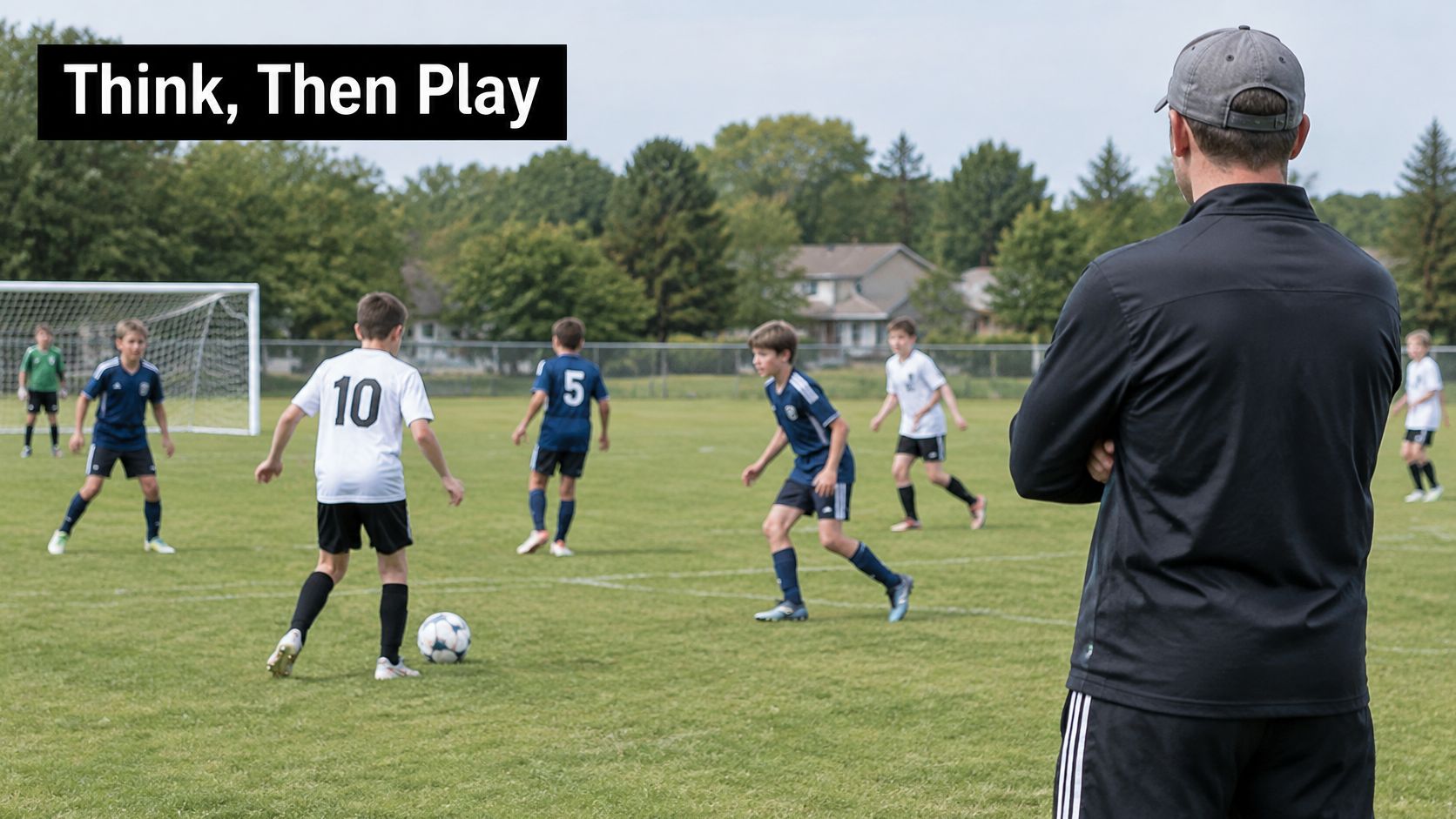
4. Match the Challenge to the Child's Development
A preschooler and a school-age player shouldn't be asked to solve the same soccer problem in the same way. Younger children often benefit from playful movement, balance, and simple ball exploration. As players become ready for more complex challenges, coaches can gradually add passing choices, team shape, and role awareness.
A practical session decision is to choose a movement task before choosing a tactical one. For a preschool group, run, hop, stop, and turn with a ball before asking for a pass. For school-age players, start with those basic movements as a warm-up, then build toward a game that asks them to support the player in possession. Don't rush to give children fixed positions. Rotating roles gives them a broader feel for attacking and defending.
Keep progress personal. One child may be ready to dribble through a narrow cone gate, while another needs a wider path and more time to stop the ball. Offer both challenges within the same activity rather than turning the session into a comparison between teammates.
Parents also benefit from a clear explanation of what the group is practicing. Tell them whether the session prioritizes movement, ball comfort, or teamwork, and what a small sign of progress might look like. JC Sports Houston's parent's guide to the Long-Term Athlete Development model offers a useful starting point for discussing age-appropriate development.
What to say on the field: “Choose the path that challenges you, and keep trying even if you need to slow down.”
5. Make Room for Other Sports and Different Kinds of Movement
A young soccer player doesn't need every activity to look like a soccer drill. Throwing, catching, balancing, jumping, and changing direction give children different ways to learn how their bodies move. They can also make warm-ups more engaging than repeating the same footwork every practice.
For example, start a soccer session with a partner toss and catch, then ask players to balance on one foot before collecting their ball and dribbling to a cone. Another day, use a basketball-style change-of-direction game without a ball, then bring soccer balls into the same space. Keep these activities short and connect them to the session's needs. A warm-up should prepare the group, not become a separate lesson that takes over practice.
Sampling other sports can also help keep a child's schedule varied and enjoyable. A family might choose a seasonal soccer league and add basketball or a multi-sport class when it suits the child's interest and the family's calendar. The trade-off is practical: more activities can mean more coordination for parents and less downtime for children. Don't treat a packed schedule as proof of commitment.
Ask the child which activities they look forward to, and leave room for rest and unstructured play. A coach can support this by using varied movement games rather than insisting that every warm-up replicate match actions. Families in the area can explore age-based options such as JC Sports Houston's multi-sport classes alongside soccer programs.
What to say on the field: “Show me a different way to move, then bring that balance into your dribble.”
6. Praise Effort and Decisions, Not Just Goals
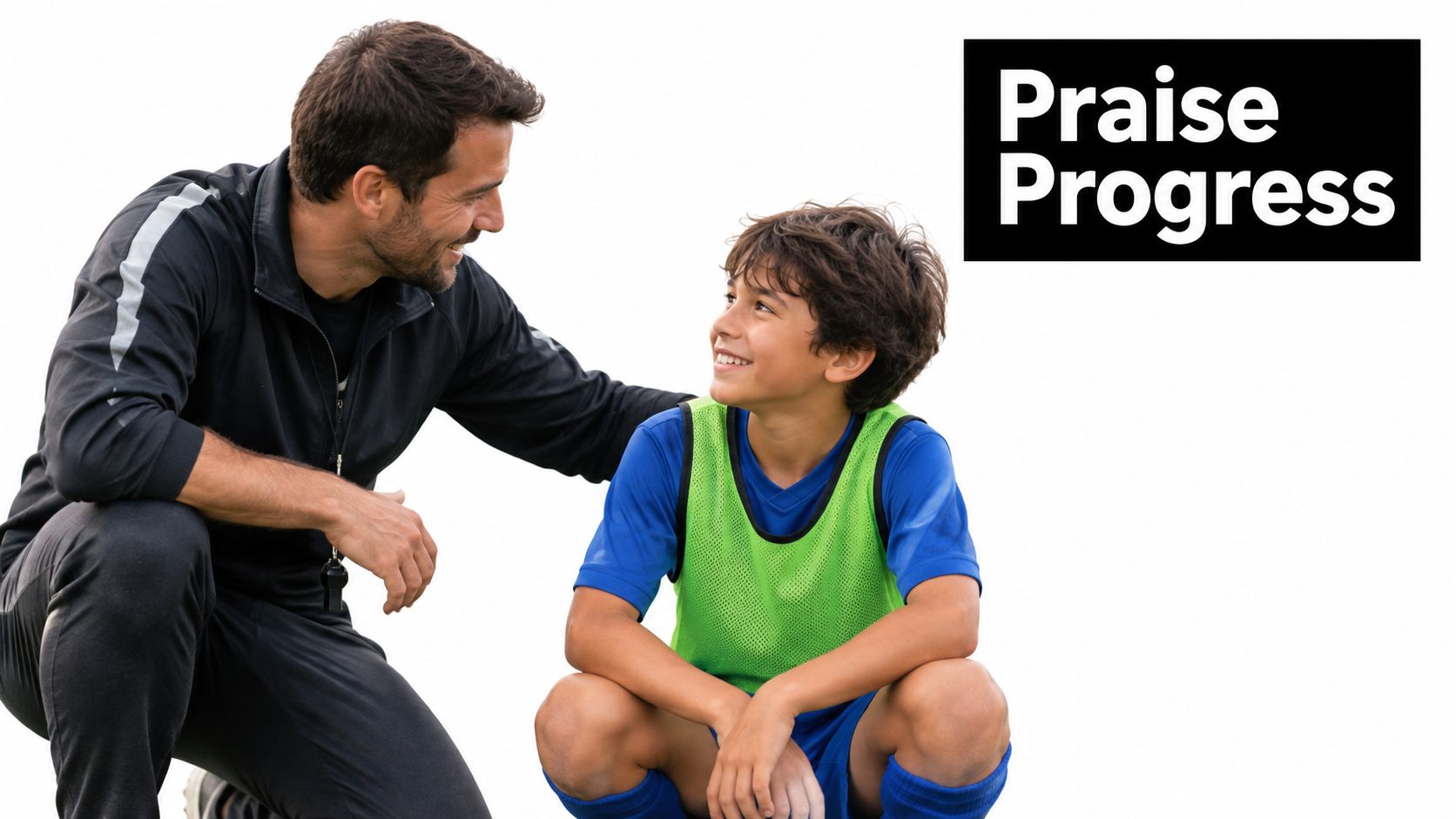
Children hear what the coach notices. If the only praise comes after a goal, players may learn that shooting matters more than trying a new move, making a supportive run, or recovering after losing the ball. Give feedback about the action you want them to repeat.
A player may attempt a turn, lose possession, and feel embarrassed. Keep the correction short and specific: recognize the attempt, then offer one adjustment. For example, the coach can point out that the player tried to change direction and suggest keeping the ball closer on the next turn. That gives the child something useful to try without turning a mistake into a lecture.
Positive reinforcement doesn't mean avoiding coaching. A group still needs clear standards for listening, respecting teammates, and following safety instructions. The difference is that a correction should tell the player what to do next, not label the player as careless or incapable. Model that same respect when speaking to referees, opponents, and parents.
Try this: “Good try. Keep your body between the defender and the ball next time.”
Notice team actions as well as individual skill. Praise a player who offers a passing option, helps a teammate up, or keeps working after losing possession. Those choices build a better practice environment, even when they don't show up on the scoreboard.
What to say on the field: “You tried the move under pressure. What adjustment will you try next?”
7. Change the Rules to Encourage Creative Choices
When players keep making the same choice, change the activity rather than giving a speech about creativity. A constraint is a simple adjustment to the space, equipment, or rules that nudges players toward a new solution. It doesn't dictate exactly how they must move.
In a 4v4 game, for example, make one end zone the target instead of using goals. Players may discover that a pass into space works better than dribbling into a crowded area. If the group needs to practice passing options, a neutral player can support the team in possession. If players are overwhelmed, widen the field or remove the neutral. Make one change at a time and watch what happens before adding another rule.
The trade-off is that a rule can help focus a game, but too many conditions make it hard for children to play naturally. Keep the challenge easy to see. Use cones to mark the target, explain the rule in one sentence, and start play again quickly. Let players suggest a rule change once they understand the activity, but check that it still supports the practice goal.
A 2024 study of players aged 12–15 found that different small-sided game conditions changed dribbling, goals, and passing networks. The study of instruction and modified goals in small-sided games found that free-play and goal-exaggeration formats generated the most dribbling, while combining instruction with modified goals produced more connected passing networks. For a volunteer coach, the takeaway is to pair a short cue with a game rule, then let players test it.
What to say on the field: “Try a different route to the target, and see what opens up.”
8. Build Safety Checks Into the Practice Routine
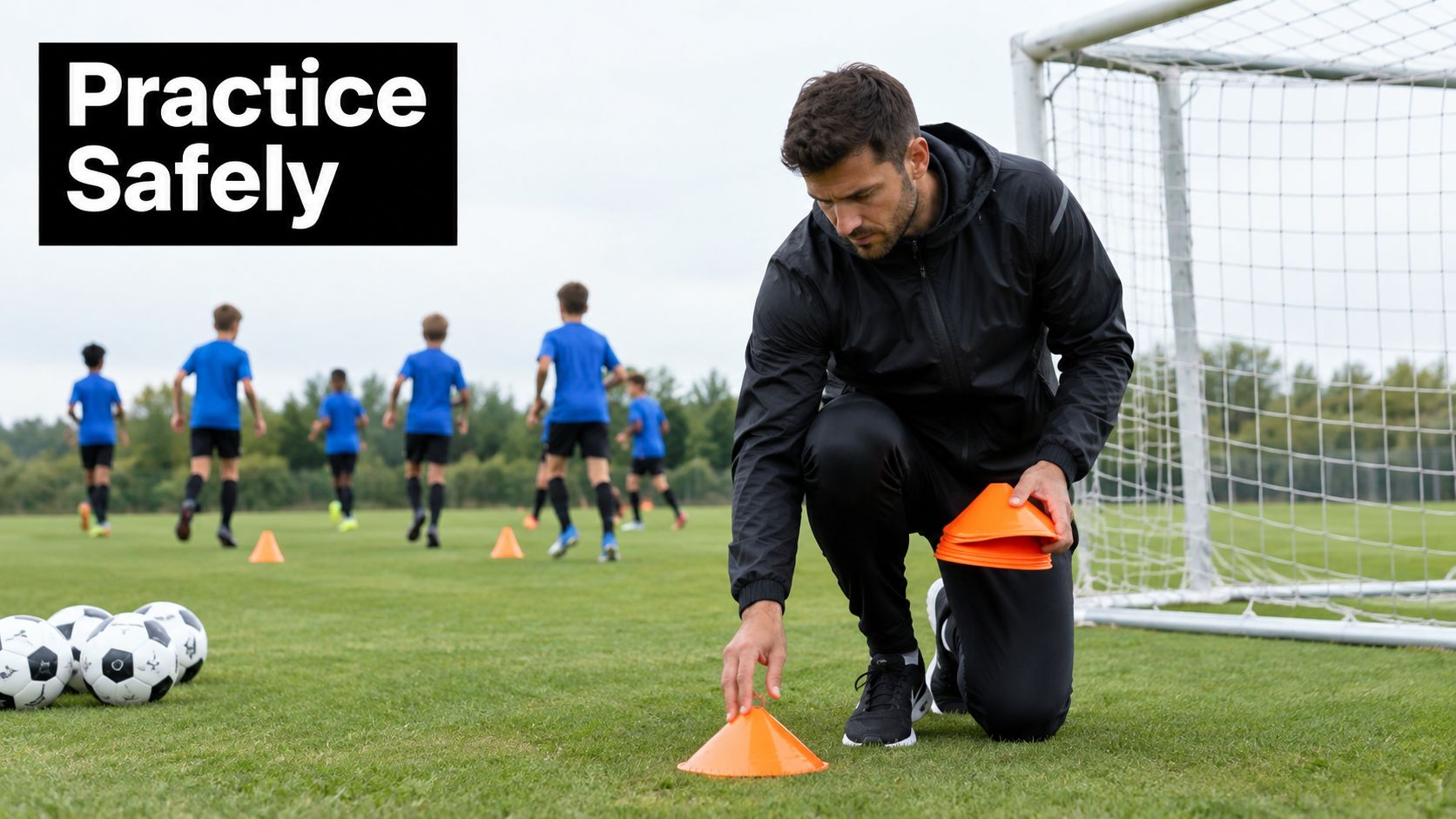
A good practice plan includes more than drills. Before players arrive, check that goals are stable, cones and equipment are in good condition, and the playing area is clear. Indoors, confirm that the activity fits the available space and that players won't run into walls, stored equipment, or another group.
Start with a warm-up that raises activity gradually, such as jogging, skips, and lateral shuffles, then add the ball. Build in opportunities to drink, especially when the group is active or the weather is warm. A coach should also know who to contact if a child is hurt and what the program's procedures are for reporting concerns. Share those procedures with parents instead of waiting for a problem.
Head injuries require a clear response, not a guess from the sideline. The CDC's HEADS UP concussion training and resources for youth sports coaches can help coaches learn what to watch for and how to respond. Complete the training, follow your organization's concussion plan, and don't let a player return just because they say they feel fine.
Keep the communication routine simple. Ask players to tell you if they feel pain, unusually tired, or unwell, and take the report seriously. Coaches aren't there to diagnose injuries. They can stop an activity, notify the appropriate adults, and follow the program's procedures.
What to say on the field: “If you feel pain or feel unwell, come tell me right away. You won't be in trouble.”
A Sample 45-Minute Practice Plan
Use this sequence as a starting point, then shorten explanations and adjust the activities for your group. For younger players, keep the instructions brief and get the ball moving. For older players, ask them to identify the challenge before you explain it.
First 8 minutes: Check the space and equipment, then warm up with movement and individual ball touches.
Next 10 minutes: Use one-ball-per-player ball mastery, building from close touches to turns around cones.
Next 10 minutes: Run a small-sided game with a clear target and one coaching cue.
Next 12 minutes: Add a simple constraint, such as a target zone or neutral player, and let players solve the game problem.
Final 5 minutes: Cool down with easy movement, recognize a specific effort or decision, and remind players how to report pain or feeling unwell.
How the eight youth soccer coaching tips fit into a practice
Item | Core Focus | Session Role | Equipment Needed |
|---|---|---|---|
Small-Sided Games (3v3 and 4v4 Formats) | Frequent touches and game decisions | High-tempo small-team play | Balls, small goals, and field markers |
Coerver-Style Ball Mastery with One Ball per Player | Individual technique and close control | Progressive skill practice | One ball per player and cones |
Game-Based Learning (Teaching Games for Understanding) | Tactical awareness and problem-solving | Modified games, questions, and skill application | Balls, goals, and a playing area |
Age-Appropriate Progression Using Long-Term Athlete Development | Skills matched to development and maturity | Progressive movement, ball, and game activities | Age-appropriate movement and soccer equipment |
Multi-Sport Sampling and Cross-Training for Athletic Development | Broad athletic skills through varied sports | Varied movement games and cross-training | Equipment suited to the sports and activities used |
Positive Reinforcement and the Double-Goal Coach Approach | Confidence, effort, and learning | Encouraging feedback throughout practice | No specialized equipment needed |
Constraints-Based Coaching to Foster Creativity | Creative solutions through task changes | Guided exploration in adapted activities | Balls, cones, and adjustable goals or markers |
Safety-First Practice Planning and Injury Prevention | Injury prevention and safe participation | Warm-ups, safety checks, and hydration breaks | Cones, safe goals, water, and checked practice equipment |
Turning These Tips Into Your Next Practice
A useful session doesn't need a complicated playbook. Start by checking the space, equipment, and group needs. Give children a warm-up that includes movement and a ball, then use a short technical block to help them practice a specific touch, turn, or dribbling action.
Move quickly into a small-sided game. Give the players a clear challenge, such as finding a target zone or supporting the teammate with the ball. Watch before correcting: if players are crowded together, adjust the grid; if the activity is too hard, simplify the rule. A short question between rounds can help children notice what worked without stopping every promising moment.
Finish with a constraint-based game that encourages the behavior you want to see. You might add a neutral player to create passing options, or change the scoring target so players need to look up and choose a route. Praise effort and decisions, not just goals, and take time to check that children know how to report pain, fatigue, or feeling unwell.
For a first-time volunteer, the best session plan is one you can run with confidence and adapt without fuss. Write down the activity, the one cue you'll use, and what you'll change if the players struggle. After practice, note what kept everyone involved and what needs simplifying next time. Then use that note to plan your next session for your players in Humble, Kingwood, or Atascocita.
If you'd rather see age-appropriate coaching and small-sided play in action, JC Sports Houston offers youth programs including Coerver-based soccer training, multi-sport classes, and seasonal leagues. Families can request a free trial to experience the coaching approach and decide whether it fits their child.
JC Sports Houston serves Humble, Kingwood, Atascocita, and nearby communities with youth soccer training, Coerver-based classes, multi-sport programs, and seasonal leagues. If you're looking for a place where children can build technique, confidence, and a love of movement through age-appropriate practice, visit JC Sports Houston to explore programs and request a free trial.
Comments