

Toddler Sports Classes: A Parent's Guide to Choosing One

Your toddler has energy all morning, then goes quiet when other children run past. She wants the ball, but she's not sure what to do when it reaches her feet. That's a normal place to start, and it's exactly the kind of moment a good class is built for.
Toddler sports classes shouldn't turn a two-year-old into an athlete. They should give her safe, repeated chances to move, copy, try, and try again. One class is only one piece of her day, but it can be a useful piece if it fits how young children learn.
Why Toddler Sports Classes Matter for Early Development
A two-year-old sprints across the living room, arms wide, laughing. Then a soft ball rolls toward her. She stops, watches it pass, and looks up at you. She isn't being stubborn. Her body and brain are still learning how to connect what she sees with what her feet and hands should do.
That's the gap toddler sports classes can help with. A playground gives space to move, and that's valuable. A well-run class adds guided repetition. A coach sets up a short path to run, a low line to step over, and a big, light ball to push. Your child isn't just busy. She's practicing one small skill at a time, with an adult watching and gently adjusting the task.
What changes first
The early gains are usually quiet ones. You might notice steadier balance when she steps off a mat. She may stop with more control instead of crashing into furniture. She might watch another child jump, wait, then copy the jump herself.
These are signs of body awareness. She's learning where her body is in space, how hard to push, and when to slow down. For parents who want a fuller picture of this process, how play supports child development is a helpful companion read, because play is the language young children learn in first.
Comfort around other children grows the same way. At first, your toddler may stay near you and watch. That's still participation. Over time, she may run beside another child, share a space at a station, or join a group game for a few seconds. Those small steps build confidence without anyone needing to keep score.
A toddler who watches first, then tries one jump, isn't behind. She's learning at a pace her brain can use.
What not to expect yet
Don't expect tactics, positions, or real games. A toddler who's asked to remember rules, wait for a turn in a long line, and compete will often shut down or wander off. That's not a discipline problem. It's a mismatch between the task and her stage of development.
Progress looks like willingness. She tries a new surface. She reaches for a ball instead of backing away. She falls, gets up, and goes again. If you want to see how these early movements connect over time, this guide to toddler motor skills lays out the building blocks in plain terms. The goal in the first months isn't future athletic success. It's a child who feels steadier, braver, and more at home in her own body.
Age-Appropriate Activities That Build Foundational Movement
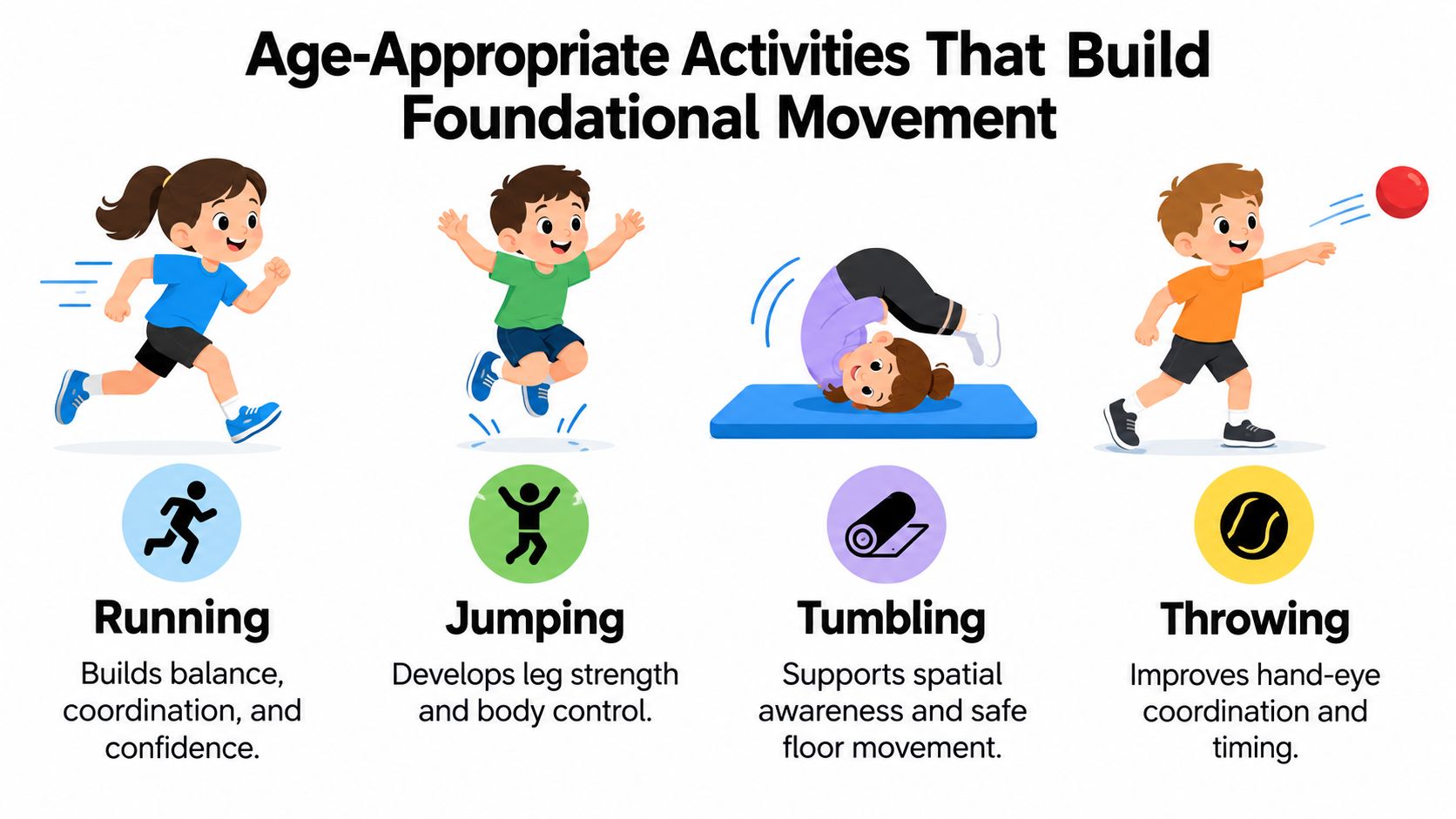
Think of movement like building blocks. You can't stack the top block first. A child needs the wide, steady blocks at the bottom before anything tall will hold. For toddlers, those bottom blocks are running, jumping, tumbling, throwing, and catching.
The American Academy of Pediatrics guide on sports readiness notes that most children younger than 6 lack the balance, attention span, and visual tracking needed for organized sports. That's why a good toddler class looks less like a sport and more like guided play. The coach is teaching the bottom blocks, on purpose.
The rhythm of a good class
You'll usually see a short demonstration, then lots of movement. A coach might crouch down, show a two-foot jump, and say one simple cue like "bend and jump." Then children try it right away. There's no long talk, because toddlers learn by copying and doing, not by listening to explanations.
Activities change often. A few minutes of running through cones. Then rolling on a mat. Then tossing a soft ball into a big target. This keeps attention fresh and gives each child many tries. If you're looking for ideas to use at home or in a care setting, these inspiring activities for nursery learning follow the same principle of short, playful tasks.
Tools that fit small bodies
Equipment should look a little oversized or extra light, and that's a good sign.
Lightweight balls: Easier to track, grasp, and throw without fear of getting hurt.
Low, soft obstacles: Children can step, climb, or roll over them safely.
Small-group stations: More repetitions for each child and much less waiting in line.
Simple verbal cues: One short instruction a toddler can act on right away.
Waiting is the enemy here. A child standing in line isn't practicing anything except patience she's still developing. Stations fix that problem by keeping everyone moving.
How progress is measured
Coaches shouldn't be counting wins. They should be watching for observable movement behaviors. Can she take off on two feet? Can he stop without falling? Can she throw underhand toward a target? Can he follow a rolling ball with his eyes and move toward it?
Those small behaviors tell you far more than a score would. A controlled stop today becomes safer running later. Tracking a ball today becomes catching later. When you visit a class, watch for those moments. If children are moving often, trying new patterns, and getting gentle cues, the bottom blocks are being built well.
How Much Activity Toddlers Need Beyond Class
Here's the part many parents aren't told clearly. A class, even a great one, can't carry the whole day. Your child's body needs movement spread out from morning to evening, in small bursts, the way toddlers naturally like to move.
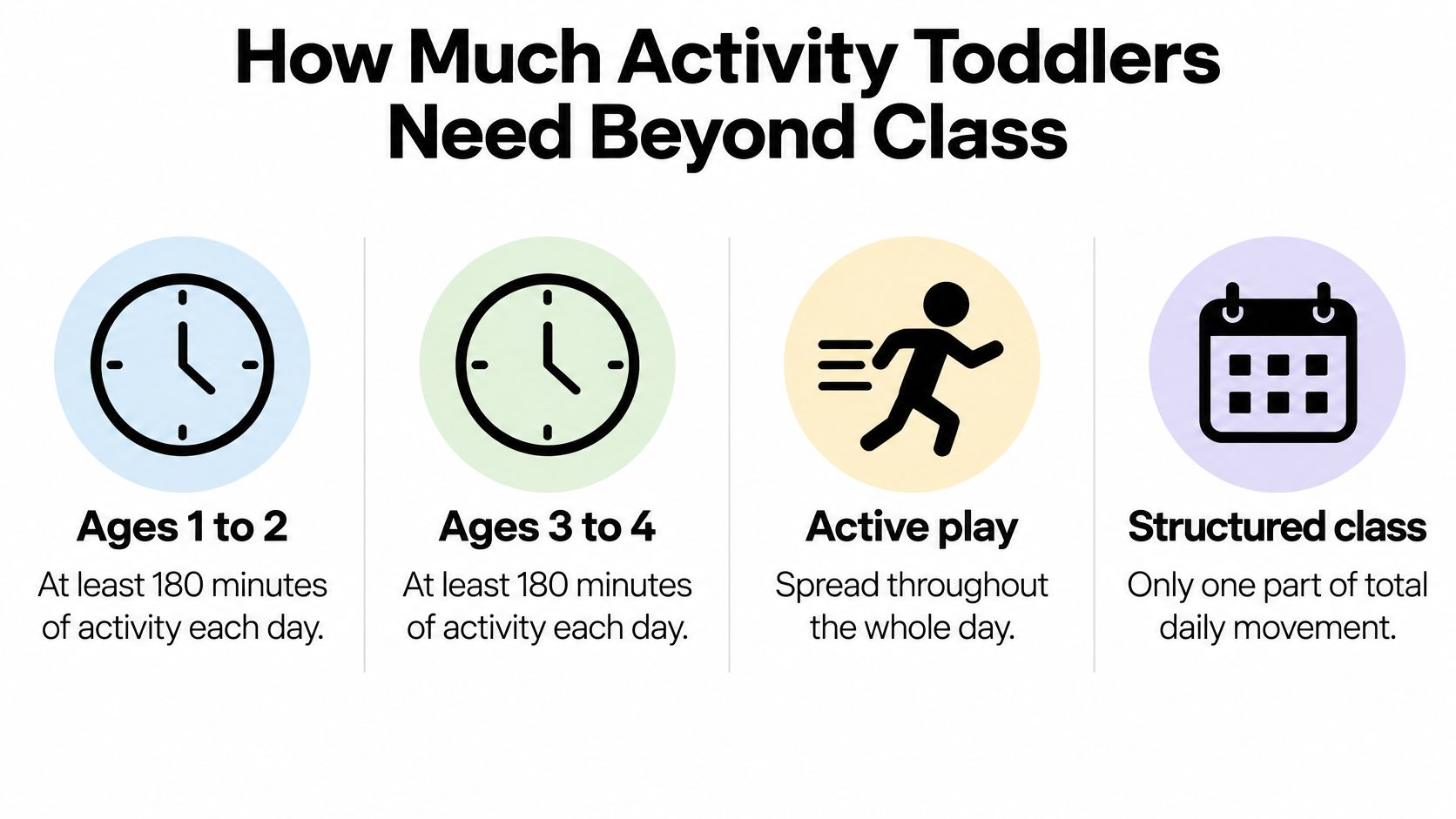
The WHO guidance on physical activity for young children recommends at least 180 minutes of physical activity across the day for children ages 1 to 2 and ages 3 to 4, at any intensity. For ages 3 to 4, at least 60 minutes should be moderate-to-vigorous activity. Those minutes are meant to accumulate through the day, not happen all at once.
So if a class runs 30 to 45 minutes, it's a helpful chunk, but it's nowhere near the full amount. It also can't undo long stretches of sitting the rest of the day. That isn't a reason to skip class. It's a reason to see class as a complement to daily movement, not a replacement for it.
Filling the rest of the day
The good news is that everyday play counts. Crawling through a cushion tunnel counts. Dancing in the kitchen counts. Pushing a toy across the yard counts.
Floor-based play: Rolling, crawling, climbing over pillows, and getting up and down.
Outdoor time: Walking, running on grass, and exploring uneven ground with supervision.
Object play: Carrying, tossing, and rolling balls, beanbags, and soft toys.
Child-led exploration: Letting your toddler choose the movement and set the pace.
If you need fresh ideas for non-class days, these activities suited to two-year-olds can help you vary the week without buying special equipment.
How to judge intensity
You don't need a heart-rate monitor. Watch your child's behavior instead. She should move often, breathe a little harder during active games, then recover comfortably and want to keep playing. If she's pushed to exhaustion, the intensity is wrong for her age.
Inside a class, instructors often work in short cycles for this reason. A movement warm-up, then a skill game, then an obstacle course, then free play. Variety also builds a broader base of movement that can later transfer to soccer, baseball, basketball, swimming, dance, or gymnastics. One class a week plus active days at home is a healthier picture than several classes and quiet days in between.
What to Look for in a Toddler Sports Program
You don't need to be a coach to judge a toddler program. You need to know what to watch for during one visit. The differences between a strong program and a weak one are usually visible within minutes.
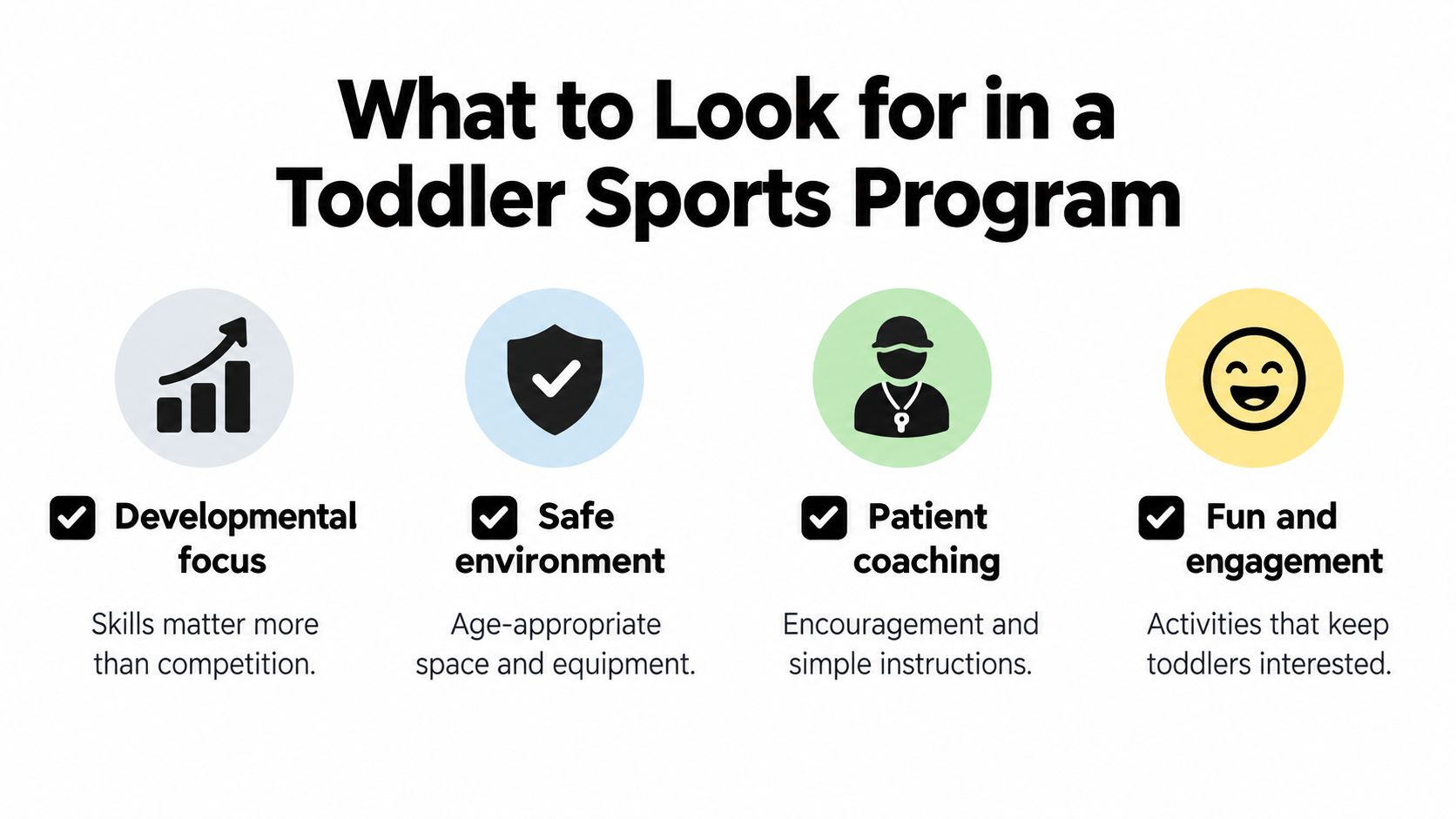
Start with the focus. A strong program talks about movement skills, confidence, and engagement. A weak one talks about winning, standings, or getting ahead of other children. For this age, development should come before competition every time, because young children learn motor patterns by imitating and experimenting, not by performing under pressure.
A checklist you can take with you
Look for this | Be cautious about this |
|---|---|
Small-group stations with frequent activity changes | Long lines where children wait for one turn |
Brief demonstrations, then active play | Long verbal explanations children can't follow |
Age-sized, lightweight equipment | Full-size balls or hard equipment |
Safe surfaces with room to pause and drink water | Crowded space with no clear boundaries |
Progress described as observable skills | Progress described as scores or wins |
Each item has a practical reason behind it. Long lines mean fewer repetitions, and repetitions are how a new movement becomes familiar. Oversized equipment means a child can succeed at tracking and grasping, which keeps her trying. Frequent changes match a toddler's short attention span instead of fighting it.
Practical rule: If most children are moving most of the time, the structure is probably right. If most are waiting, it isn't.
The details that affect your family
Quality isn't only about what happens on the floor. Ask about published pricing and policies, scheduling, and whether you can try a class before committing. A program that answers those questions clearly respects your time and budget.
Equipment choices at home follow the same logic. Parents weighing early riding options, for example, can learn a lot from Rider 18's guide to kids' bikes, which compares balance and pedal bikes by developmental stage rather than by age alone. The principle matches this checklist. Fit the tool to the child's current skills, not to where you hope she'll be soon.
Before you enroll anywhere, read how the program describes its own teaching approach. A clear explanation of the coaching philosophy tells you whether instructors value patience and progression or pressure and results. Then watch a session and check whether the floor matches the words.
How JC Sports Houston Structures Toddler Classes
It helps to see the checklist applied to one real place. JC Sports Houston is a youth sports training center serving Humble, Kingwood, Atascocita, and surrounding Houston communities. Its motto is Developing well rounded, creative players, and that phrase points to breadth first, which suits this age group well.
The center offers multi-sport classes for toddlers rather than asking a two-year-old to specialize in one sport. That matters. A toddler who samples running, kicking, throwing, and balancing across different games builds a wider base of movement than a child who repeats one sport's drills. Variety now keeps more doors open later.
What you'd see during a visit
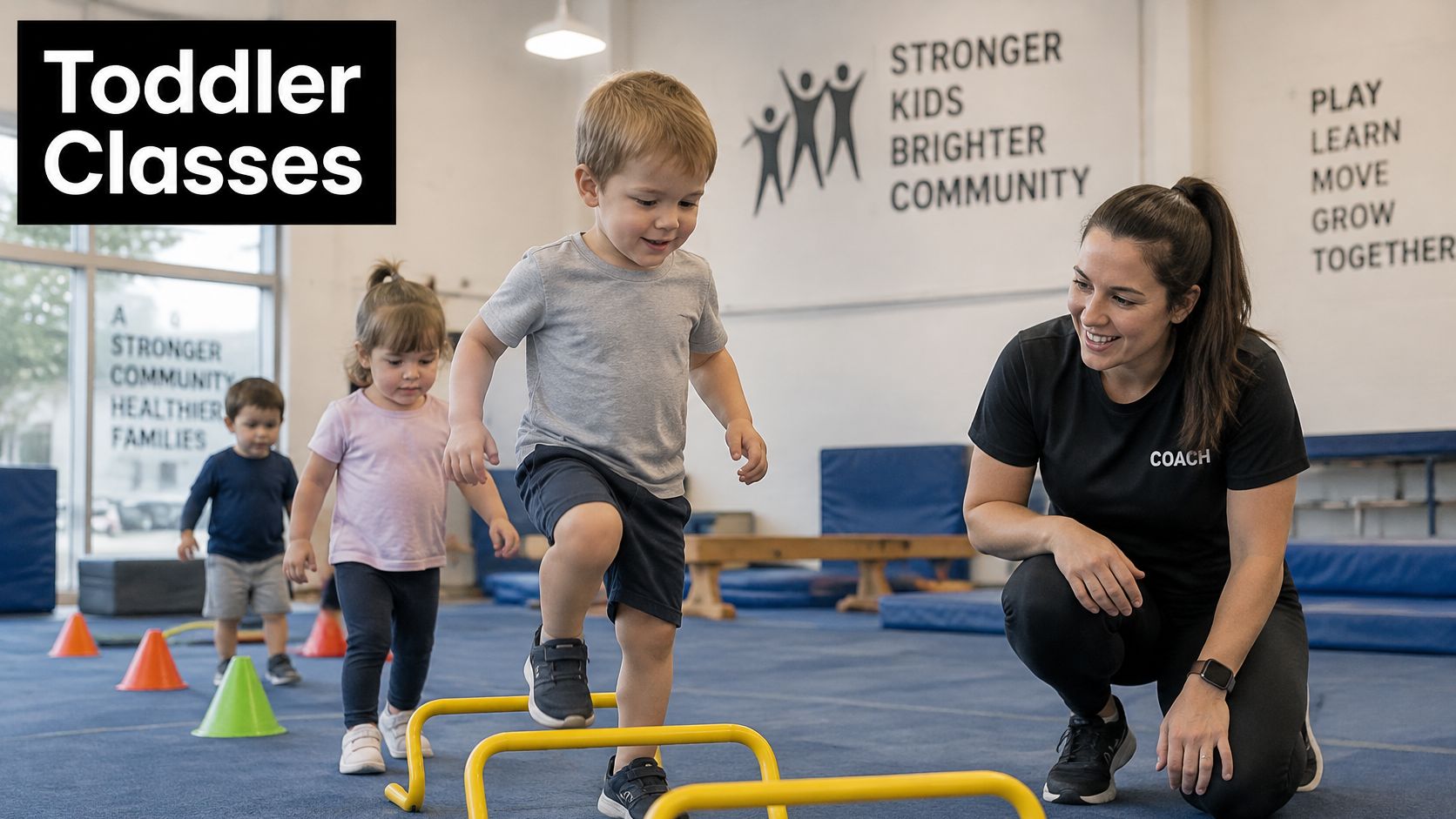
Picture a small group on a safe indoor surface. An instructor shows a movement briefly, then children scatter to try it at their own pace. One child runs the path twice. Another stops to watch, then joins in. The coach adjusts, encourages, and keeps the activity moving.
That scene reflects several of the center's stated emphases at once.
Small-sided play: Fewer children in each activity means more touches, more tries, and less waiting.
Creativity: Children are invited to explore movement, not just copy one correct form.
Progressive instruction: Tasks build step by step as a child's control improves.
Experienced instructors: Adults who know young children use short cues and read fatigue or frustration early.
Safe indoor environment: Weather and outdoor hazards don't decide whether class happens.
How this maps back to your checklist
Run the comparison yourself when you visit. Are children moving most of the time, or standing in lines? Is the equipment sized for small hands and feet? Does the instructor describe progress as a steadier jump or a better throw, rather than as winning? Those are the same questions you'd ask of any program.
The practical side is built for families too. The center emphasizes convenient scheduling, clear policies and pricing, and a simple online registration process. Those details sound minor, but they decide whether a family can keep attending. A strong class your child rarely reaches helps less than a good class that fits your week.
What this example shows is alignment. The teaching approach, the space, and the family logistics all point the same direction. That's what you're looking for anywhere you enroll. One program won't fit every child, but a program whose daily practice matches its stated philosophy gives you something solid to judge.
Parent Questions About Access, Readiness and Attendance
Many parents don't hesitate because they doubt the value of movement. They hesitate because of cost, time, and worry about how their child will cope. Those concerns are common, and they deserve straight answers instead of a sales pitch.
Research involving caregivers of children under five identified lack of accessible, free, and safe spaces, limited caregiver time, and insufficient information about activity benefits as barriers. So if you're unsure where to go, how to fit it in, or whether it's worth it, you're describing a documented access problem, not a personal failure.
What if we can't commit every week
Then don't treat weekly attendance as an all-or-nothing test. A child doesn't lose the benefit of movement because your family misses a session. Ask about trial options, make-up policies, and realistic attendance expectations before you enroll, and choose a schedule you can keep most weeks.
On weeks you miss, active play at home still counts toward your child's day. A class is a support, not a contract your toddler can fail. Clear pricing matters here too, because a family that understands the cost upfront can plan without stress.
What if my child is shy or sensory-sensitive
A welcoming class makes room for different ways of joining in. Your child might watch from the edge first. She might play alongside others without joining the group game. He might need frequent breaks, a quieter corner, or a task broken into smaller steps.
None of that means the class isn't working. Developmental readiness isn't the same as athletic ability. A child who participates through parallel play is still watching, copying, and building comfort. Tell the instructor what helps your child, and watch whether activities can be adapted without singling her out or forcing competition.
Your child doesn't need to be outgoing or coordinated to belong in a toddler class. She needs adults who'll meet her where she is.
How do we know she's ready, and what should we bring
Readiness looks simple. She can move around a new space with you nearby, show some interest in other children or equipment, and recover after a wobble or a brief upset. She doesn't need to follow every instruction. That skill is still developing, and good instructors plan for it.
Bring water, comfortable clothes, and shoes she can move in safely. Ask how siblings are handled during class, since a clear answer saves stress on the day. And remember the honest bottom line. Not every toddler needs organized sport. A class helps most when it lowers barriers for your family instead of adding new ones.
Getting Started with a Free Trial at JC Sports Houston
The simplest way to judge a class is to watch your own child in it. New families can request a free trial at JC Sports Houston, so you can see the coaching approach firsthand before you commit to anything.
Use that visit like a checklist, not a performance test. Watch the instructor's cues. Are they short and simple? Notice how often activities change, and whether children are moving or waiting. Look at the equipment and the space. Then watch your child most of all. Does she try something new, even briefly? Does he settle after a nervous start?
Before you book
Register online: The process is simple, and you can confirm scheduling that fits your week.
Check pricing and policies: Clear information upfront helps you plan without surprises.
Plan what to bring: Water, comfortable clothes, and a few extra minutes to arrive unhurried.
Set a gentle goal: One new movement attempted is a successful first visit.
Don't worry if your child spends part of the trial watching. That's useful information, not a failed test. What matters is whether the environment feels safe, the instructor feels patient, and your child gets real chances to move. If those pieces are in place, you've found a class that can sit comfortably inside an active week. Request your free trial through the center's website, bring your checklist, and let your toddler show you what she's ready to try.
If you're in Humble, Kingwood, or Atascocita and you'd like your toddler to build balance, coordination, and confidence through playful multi-sport classes, JC Sports Houston offers a safe indoor setting, experienced instructors, and a free trial for new families. Visit JC Sports Houston to request your trial class and see the approach firsthand.

Comments