

Are Free Trials Really Free? What Parents Should Know

Trial terms vary by provider. Before registering, confirm whether you'll be charged, whether membership starts automatically and what cancellation requires. A “free” first visit is not enough if continuing or stopping the trial comes with conditions.
The cost also includes your time. Parents set aside travel time, make room in the family calendar and spend a child's energy on an activity they haven't evaluated yet. Check that the schedule and commitment fit your family.
So, are free trials really free? Some cost nothing to attend; others lead into a paid agreement. Judge the offer by its terms, scheduling demands and flexibility, not by how prominently the center displays the word free.
Free to Start Does Not Mean Free to Keep
Free to start means you don't pay for the introductory experience. Free to keep, in this context, means you owe nothing after that experience unless you deliberately choose to continue. It doesn't mean unlimited future classes at no charge.
That distinction matters more than the headline price. A subscription box can offer a free introductory month while requiring you to stop the next shipment yourself. Likewise, a sports trial can cost nothing to attend while including permission to charge you afterward.
Unwanted Charges Aren't a Rare Mistake
In a January 2022 Bankrate survey conducted by YouGov among 2,497 U.S. adults, 51% of people with subscription or membership experience reported an unwanted charge; the figures were 58% for Millennials, 57% for Gen Z and 45% for Baby Boomers, while 34% of experienced subscribers said cancelling or stopping automatic payments was difficult (Bankrate's subscription services survey).
Those findings concern subscriptions and memberships broadly, not youth sports specifically. They're a reason to inspect an offer, not evidence that a particular sports center uses hidden billing.
My recommendation is straightforward: treat free as a conditional claim until you've read the conditions. A friendly coach and a welcoming facility don't replace clear registration terms.
Don't judge a trial only by what happens when you arrive. Judge it by what happens when you don't return.
Before enrolling your child, establish the basics:
Payment method: Must you provide a card, and what charges are you authorizing?
End date: When does the introductory offer stop, including any cancellation cutoff?
Exit route: Can you decline online, or must you contact someone during business hours?
A card requirement isn't automatically a reason to walk away. An unexplained card requirement is. If staff can't tell you what your authorization covers, don't submit it.
What a Youth Sports Free Trial Usually Includes
Use this comparison as a list of terms to confirm, not a promise about every center. Trial packages vary, and the financial details deserve as much attention as the activity itself.
Trial element | Typical youth sports offer | What it means for your budget |
|---|---|---|
Trial session | An introductory class or practice, potentially matched to your child's age | The session may be free, but attendance still takes time |
Equipment | Loan equipment may be available | Confirm whether cleats, shin guards or a uniform are required |
Payment details | A center may request a card at registration | Check whether storing the card also authorizes future charges |
Trial length | A class, several sessions or a short introductory block | Get the included sessions and final date in writing |
Trial end | The offer may stop, invite paid enrollment or convert automatically | This determines whether doing nothing creates a bill |
Trial access | Access may be restricted to a program or age band | You may not be able to compare different activities |
Why the Payment and End-Date Rows Matter
The Federal Trade Commission describes a negative option as an arrangement in which the customer is charged unless they specifically decline. Its examples include a free introductory product box that becomes a monthly shipment and a magazine subscription that renews automatically (FTC guidance on free trials and automatic renewals).
You don't need to memorize that terminology. You need to recognize the decision: are you accepting an invitation to try something, or authorizing paid participation unless you intervene?
Read the registration screen with that question in mind. Look beside the submit button, beneath the payment fields and in any agreement you must accept. Save the offer and terms before completing registration so you can compare them with later messages.
Define What You're Actually Testing
Ask whether your child will join the regular class or attend a separate introductory session. A special demonstration may help you meet the coach, but you should still ask how it compares with normal instruction.
Also establish whether the trial group is the group your child could join. There's little value in evaluating a convenient class if paid enrollment would place your child elsewhere.
Don't buy equipment before the center confirms what's needed. Ask what your child should wear, what the center supplies and whether anything must be purchased merely to participate in the trial.
What a Free Trial Cannot Tell You
A trial is a sample, not a season. It can help you observe coaching and your child's immediate response. It can't establish how the arrangement will work once the novelty fades or your calendar changes.
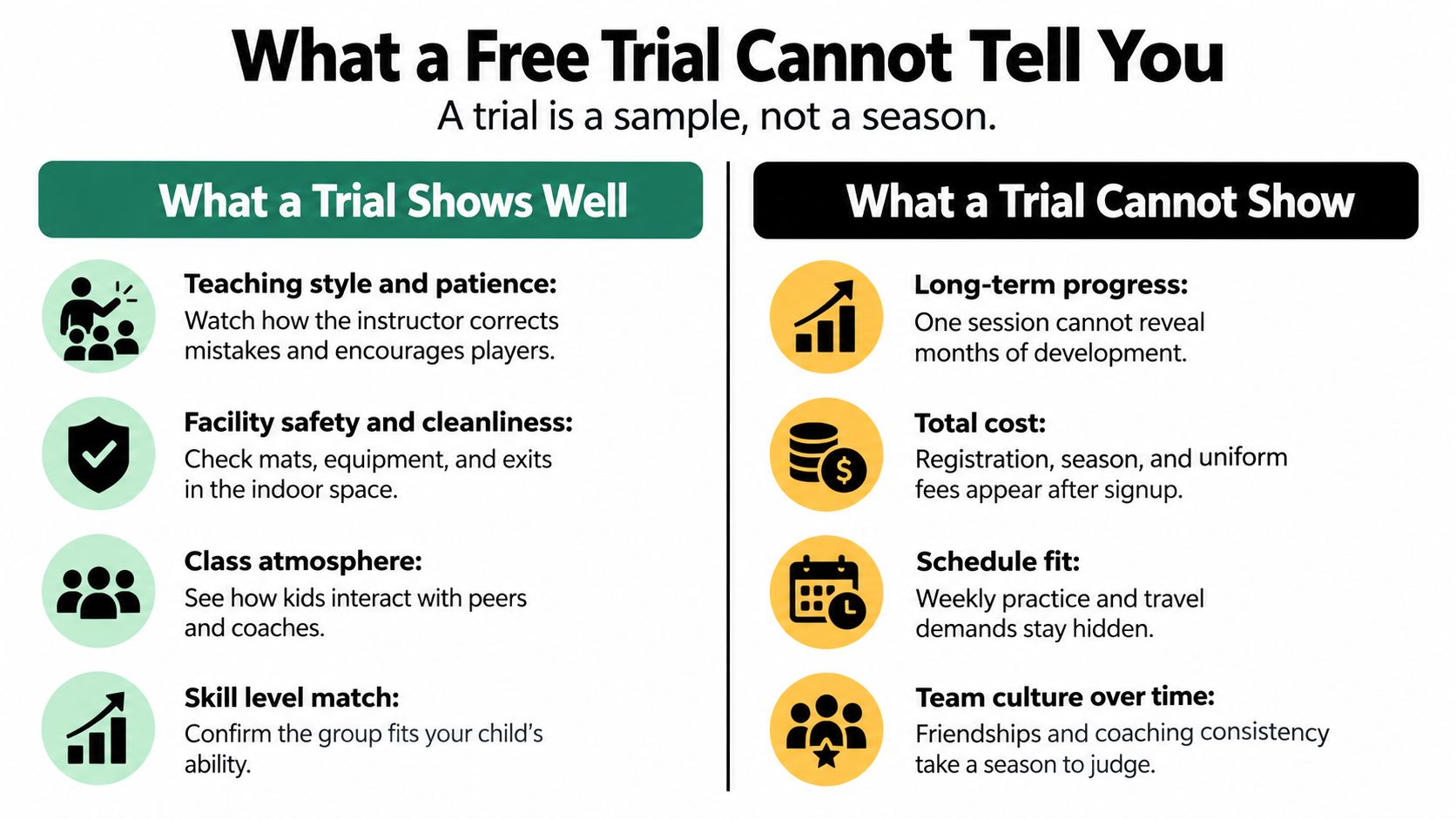
What the trial shows | What the trial cannot show |
|---|---|
The instructor's teaching style and patience that day | How your child's progress unfolds across a full league |
Visible facility safety and cleanliness | Whether the schedule remains workable through weather disruptions, school breaks or illness |
Your child's reaction during the session | Whether an ongoing group at the right skill level has an available place |
Whether the observed group size and pace seem suitable | How consistently staff support a shy child or one who needs more help |
Your child's enthusiasm during the introductory activities | Whether interest holds when later classes introduce unfamiliar rules or longer activities |
Watch the Response to Difficulty
Don't focus only on whether your child smiles. Watch what the coach does when a child misses instructions, avoids an activity or struggles with a skill.
Does the instructor offer another explanation? Can a hesitant child join gradually? Ask how that support continues during ordinary classes, especially if the introductory session is unusually quiet.
When comparing a soccer training center, separate an appealing introduction from a suitable ongoing placement. Request the actual class schedule and ask whether the coach you met usually teaches it.
Test the Ordinary Family Routine
Consider a hypothetical preschooler who enjoys the opening games but struggles later when the activity involves unfamiliar rules and more waiting. That wouldn't prove the program is wrong. It would tell you to ask about pacing, progression and alternatives.
The same applies to logistics. A class attended during a relaxed afternoon doesn't establish that the regular slot will work after school, alongside dinner and a sibling's activities.
Practical rule: Before judging the program, ask what changes after the introductory class and whether another trial or a different level is possible.
You're not looking for a guarantee that your child will always enjoy it. You're looking for a sensible way to respond when the initial fit needs adjusting.
Costs That Show Up After the Free Session
The charge to investigate isn't just admission to the trial. It's the full cost of continuing, including expenses that may not appear beside the advertised program price.
Ask for an itemized total before your child gets attached to a team shirt or a particular class. These are potential costs to check, not fees every program necessarily charges.
Cost | When it usually appears | How to check it |
|---|---|---|
Registration or enrollment fee | When you sign up after the trial | Request the full fee in writing before attending |
Season or league fee | When the seasonal program begins | Compare the price against the included weeks and sessions |
Uniforms and equipment | Before team or league participation | Ask whether shirts, socks and balls are included |
Break-camp add-ons | When booking school-break activities | Confirm whether pricing is daily or weekly |
Missed-session or late-cancellation fee | When a booked class is missed or cancelled late | Read the attendance policy and notice requirements |
Makeup sessions | After weather cancellations, closures or illness | Ask whether missed sessions are replaced, credited or lost |
Don't Build Your Budget Around Remembering
In a RAND Europe behavioral experiment involving 10,132 consumers across eight European countries, 52% said they began free trials intending to cancel but only 38% reported doing so; 53% believed they would remember to cancel, compared with 29% who believed others would remember (RAND Europe's research on misleading free trials).
The same research found that an explicit notice of the post-trial monthly fee improved awareness. My advice is to seek that clarity before registration rather than relying on your future self to untangle the agreement.

For a youth sports league, check whether the advertised amount covers the full season or only part of the commitment. Ask what happens financially if your child joins late, misses classes or needs to stop.
A makeup policy deserves particular attention. A replacement class isn't useful to your family if it's offered only at a time you can't attend.
Count Time Alongside Money
Build the regular routine into your decision:
Travel and preparation: Include getting dressed, packing equipment, driving and waiting.
Calendar conflicts: Check school events, sibling activities and planned absences against the ongoing schedule.
Flexibility: Ask whether a missed class can be moved and whether another suitable group has space.
A free trial that requires a rushed evening may still be worth attending. But don't confuse an enjoyable session with an affordable weekly routine.
Before accepting paid enrollment, get the recurring price, renewal date, prorating rules and written cancellation confirmation process. Budget for the agreement you're making, not just the class you just enjoyed.
Questions Parents Should Ask Before Saying Yes
A trial is free to start only if it costs nothing to attend. To judge whether it is free to keep, check the billing terms, the time commitment and how easily your family can change course. Get clear answers before sharing payment details.
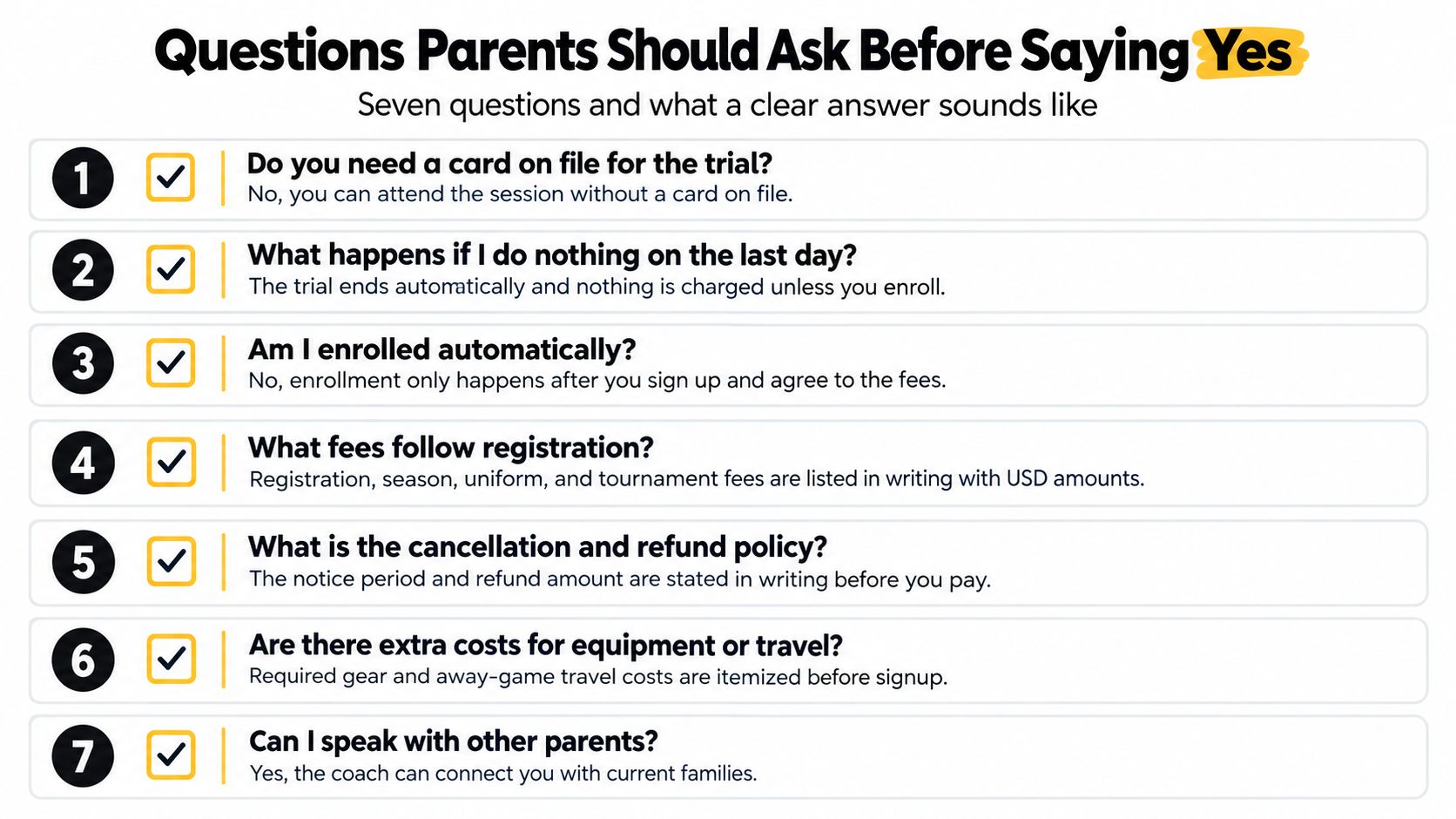
Do you need a card on file for the trial? Ask whether a card is required and what you authorize by providing it. If it isn't needed, register without one.
What happens if I do nothing on the last day? Get the default in plain terms: access ends, staff contacts you, or billing begins.
Am I enrolled automatically, or do I choose to continue? Ask exactly what action starts a paid agreement. Booking a trial should not be confused with joining a program.
What is the first recurring price, and how often is it billed? Request the amount, billing frequency and required fees together. A low installment can hide a larger commitment.
How do I cancel, and will I get written confirmation? Ask for the cancellation method, notice deadline and refund terms. “Contact staff” is not enough without knowing how and when.
Can my child move to another class level or sport? Confirm whether a transfer depends on availability or approval, and whether the price changes. Don't assume it is included.
Can we pause before enrolling if illness or a school break gets in the way? Find out whether you can defer the decision without paying to hold a place. Then check that the class schedule fits your family's actual routine.
Written Terms Matter More Than Reassurance
The FTC paused its click-to-cancel rule in May 2025, according to Reuters' coverage of the FTC cancellation-rule proceedings. That report does not establish that a court later vacated the rule. Either way, don't rely on a general expectation about cancellation protections. Read the provider's written terms and keep a copy.
Use the same questions to compare soccer options for kids near you. “We'll handle the details later” is not a clear answer when you're being asked to commit now. Also count the practical cost: travel, scheduling and the flexibility to change classes affect whether a trial can fit your life after the first visit.
If an unexpected charge appears, compare it with the saved terms. Send a written cancellation request, ask for a refund if appropriate and request confirmation that billing will stop. If the charge remains unresolved, contact your card issuer about its dispute process.
How JC Sports Houston's Free Trial Works and Your Next Step
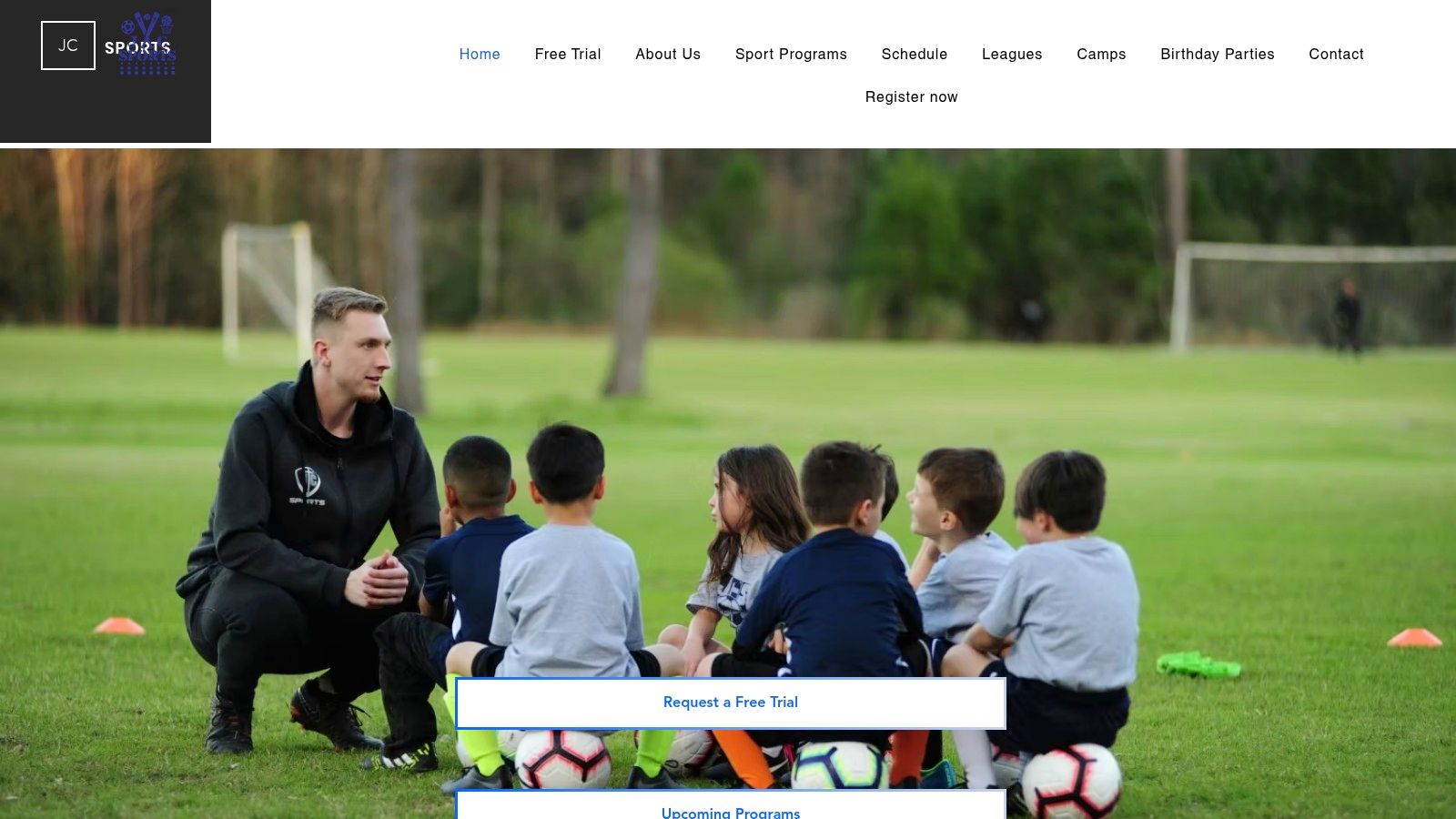
New families can request a free trial at this youth sports center serving Humble, Kingwood, Atascocita and surrounding communities. Its stated offering includes age-appropriate activities in an indoor facility, with small-sided play and progressive instruction among its coaching priorities.
That makes it an option to evaluate alongside other local programs, not a reason to skip the checks above. Confirm trial duration, payment requirements and enrollment rules directly. Don't infer those terms from the availability of a free session.
Make the Visit a Useful Evaluation
Request a trial through the center's website. Tell staff your child's age, experience and interests. Ask which current programs accept trial requests rather than assuming every class or league does.
Choose an appropriate activity. The center's offerings include toddler multi-sport classes, Coerver-based soccer training including Just for Girls, beginner BlastBall and seasonal leagues. Ask which available class matches your child's readiness and your regular schedule.
Send the checklist before booking. Request written answers about billing, the end of the trial and the decision to continue. Keep the reply with your registration confirmation.
Observe how instruction works. Watch the coach explain activities, manage small-sided play and help children who need another attempt. Check whether your child gets opportunities to participate rather than spending the visit waiting.
Make an explicit decision afterward. Continue, request another placement or decline. If you won't proceed, communicate that in writing and follow any applicable cancellation requirements.
Don't let enthusiasm at pickup force an immediate purchase. Take the schedule and full price home, then decide whether the program fits your child and your family.
The Standard a No-Obligation Offer Should Meet
My benchmark is stricter than a free introductory price: no automatic membership, no card charge and no requirement to cancel. If an offer instead converts to paid enrollment, the provider should display the renewal date and price before consent and offer a straightforward cancellation action with confirmation.
The FTC's dark-patterns report describes how vague wording such as “terms and conditions apply” can reduce awareness of recurring charges, and discusses enforcement examples involving post-trial charges of $60 to $210 per month (FTC report on deceptive design practices). Those examples aren't claims about this center; they explain why visible terms matter.
A parent should be able to understand the financial commitment without hunting through unrelated pages or relying on a verbal promise.
Ask the center which type of offer applies to your requested program. If the written explanation differs from the registration screen, resolve that discrepancy before submitting the form.
Your plan should be simple: get the terms before booking, calendar the final trial day and any required cancellation route, then record your decision after attending. Include whether your child will continue, change classes or pause. That gives you a useful trial without treating silence as a decision.
JC Sports Houston offers youth sports programs and lets new families request a free trial to experience its coaching approach. Visit JC Sports Houston to request an age-appropriate trial, and ask for the payment, enrollment and cancellation terms in writing before you book.

Comments