

8 Fun Basketball Shooting Games for Kids

Children often lose interest when shooting practice means standing in one line and repeating the same shot. Give each attempt a simple goal, story, or challenge, and the mood changes quickly. A child who was drifting away may start asking for another turn because the next basket earns a star, advances around the court, or copies a teammate's creative shot.
These fun basketball shooting games combine creative competition, progressive targets, pressure practice, and game-like play. They work for parents in a driveway, coaches in a gym, camps with multiple stations, leagues developing young players, and birthday parties that need an activity everyone can understand.
Keep the teaching priorities simple. Use a ball children can control, an appropriately sized basket and shooting distance, short lines, and clear boundaries. Celebrate effort, balance, aiming, and follow-through, not only made baskets. Adjust the challenge so children experience frequent success while still having a reason to try again.
1. HORSE
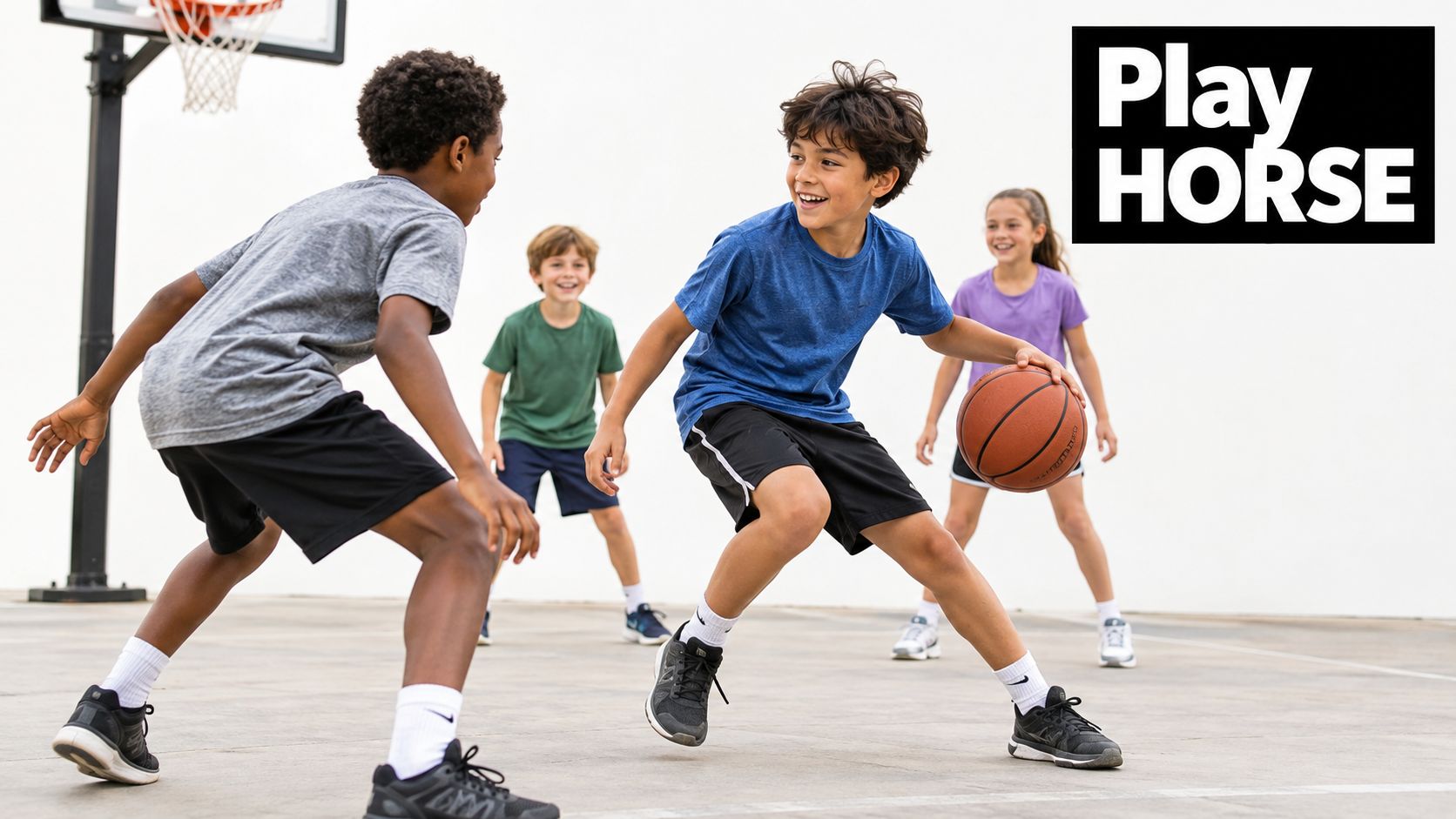
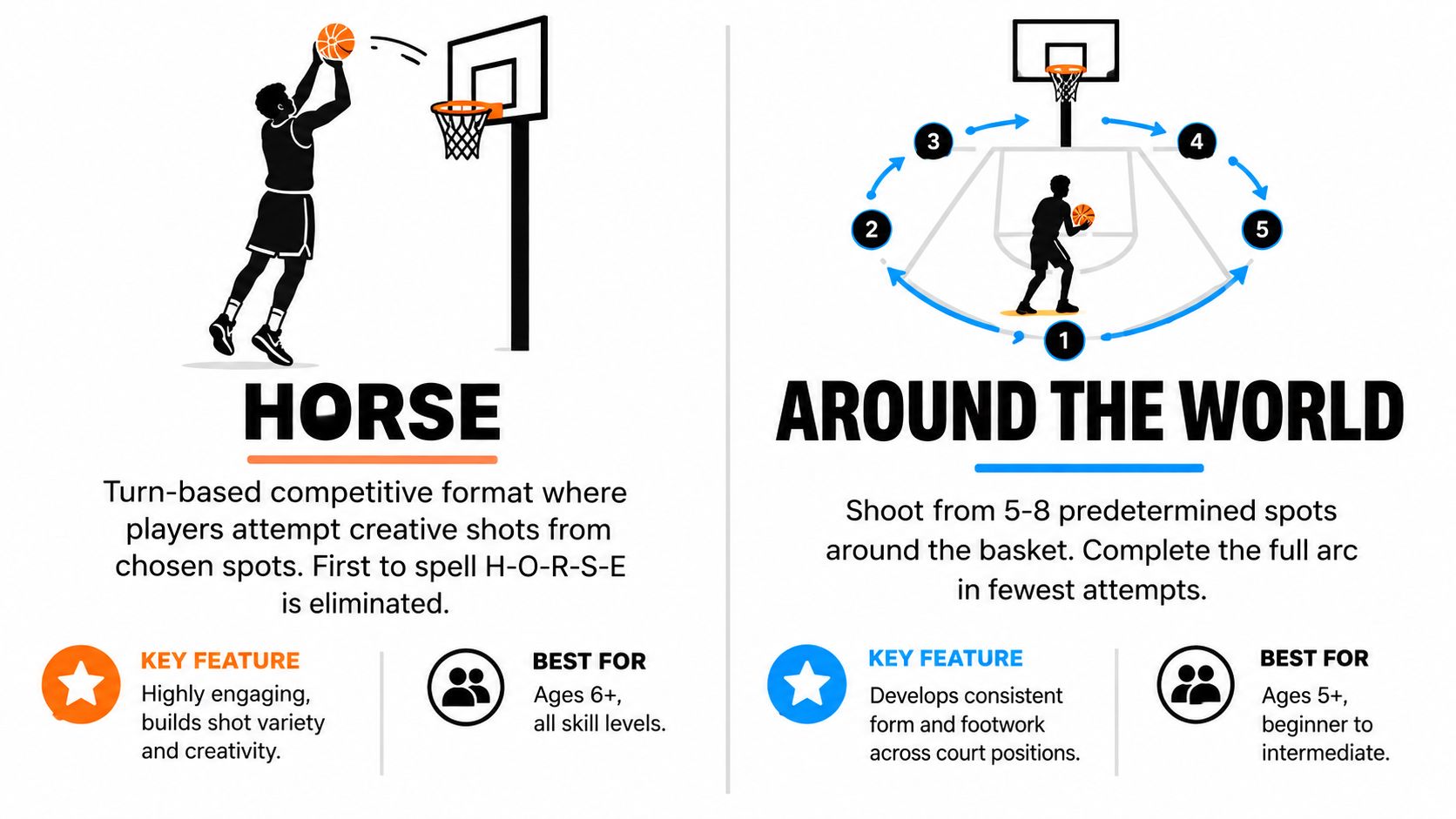
HORSE gives children ownership of the shot. One player chooses a location or style, takes the shot, and asks the next player to copy it. If the first player makes the shot and the second player misses, the second player receives the next letter in H-O-R-S-E. A player who spells the word is eliminated, although younger groups can award the round to the player with the fewest letters.
Start by choosing a safe shooting area and deciding what counts as a reasonable shot. A player might shoot from the side of the basket, use a bank shot, or add a simple movement such as a gentle turn. Avoid shots that require children to run into one another or throw the ball dangerously. Each player should retrieve the ball promptly and return to a marked waiting spot.
Adapt the challenge by age
Toddlers: Use a large target, a soft or lightweight ball, and coach-created shots from very close range. Let the child copy a simple chest-level toss rather than requiring a full shooting motion.
Preschoolers: Use three letters, such as HOR, and limit choices to marked spots. Give children a picture card showing the next location so they can follow the game without remembering a long rule.
School-age players: Use the full word HORSE, rotate the first shooter, and permit varied but realistic shots. Ask players to name the technique they used, such as “aim at the square” or “finish with my hand in the basket.”
For a station, allow each group to play a short round before rotating. In a camp, coaches can use HORSE to observe whether players create balanced, repeatable attempts. In a league, it works as a relaxed warm-up. For a party, use team HORSE, where children earn letters together and nobody sits out for long.
Coaching cue: “Choose a shot your friend can attempt, then show a calm setup before you release.”
2. Around the World
Around the World turns the court into a path of progressive targets. Mark a series of shooting spots around the basket, beginning close to the hoop and moving toward more demanding locations. A player shoots at the first spot, advances after a make, and stays at that station after a miss. The group can decide whether the winner is the first player to complete the route or the player who reaches the farthest spot during the round.
Use floor spots, cones, or tape so children know exactly where to stand. The visual route helps young players understand progress without a long explanation. Rebounders should return the ball to the shooter quickly, and the next player should be ready before the ball comes back.
Build a clear progression
Toddlers can move between two or three close targets, with an adult standing beside the basket to guide the toss. The child may receive a success marker after reaching each station, even if the ball doesn't go in every time. For preschoolers, use three or four locations at different angles and allow a second attempt before moving on. Keep the distances short enough that the child can use a controlled motion instead of pushing the ball with both hands.
School-age players can use a longer route with corner, side, and front positions. Add a decision at each station: stay and repeat the shot for consistency, or move after one made attempt. Coaches can also ask players to hold their finish until the ball reaches the rim, which reinforces balance and direction.
This game fits a skill circuit particularly well. One station can focus on close-range shooting, another on foot placement, and another on retrieving and passing. At a camp, players can record their personal route rather than comparing only who finishes first. At a birthday party, use colored floor markers and let children travel from one “planet” to the next.
The important adjustment is distance. Move the marker only when a child demonstrates control, not merely because older players are expected to shoot farther.
3. 21
Twenty-One gives every shot a consequence, so children practice choosing between an easy attempt and a more difficult opportunity. Divide the court into close, medium, and long-range areas. Award more points for harder shots, then ask players to reach the agreed target exactly. For young children, remove the rule that sends a player back after going over the target. The decision-making remains, without turning one enthusiastic shot into a frustrating restart.
Begin with one shooter, one rebounder, and one scorer. The shooter calls the area before taking the shot. A close basket can earn the smallest value, a mid-range basket a higher value, and a long shot the highest value. Keep the values visible on a whiteboard, and rotate roles after each short turn so children don't spend most of the activity waiting.
Teach risk without fear
Toddlers should play a cooperative version. Place two baskets or floor targets nearby, and let the child collect a token for each successful toss. Preschoolers can aim for a smaller group target and choose between a “safe” close shot or a “brave” marked shot. Both choices should earn recognition, with the harder attempt receiving an extra cheer rather than a harsh penalty.
School-age players can use the full scoring idea and talk through the choice: “Do I need one easy basket, or am I willing to try the harder spot?” Encourage players to notice whether rushing changes their balance. A missed difficult shot still provides useful feedback if the player chose it thoughtfully.
At a camp, use a team score so children support one another. In a league practice, let players act as scorer and rebounder, developing communication alongside shooting. For a party, replace numbers with colors or themed points, such as blue, green, and gold targets.
The coach's job isn't to reward only the boldest shot. It's to help children understand that good decisions include knowing when a controlled attempt is the better choice.
4. Four Corners Knockout
Four Corners Knockout adds movement to the shooting challenge. Place players at four marked shooting spots, or begin with one line if the group is small. The first player shoots, and a made basket sends the ball to the next station. If the shot misses, the player retrieves the ball and tries to catch the next shooter before that player reaches the basket. Use a touch or tag boundary, never body contact, and stop the round immediately if players begin pushing or cutting across one another.
The game should feel active, but safety comes first. Set a clear path for runners, keep balls away from feet, and use several balls when a large group creates congestion. Eliminated players can become rebounders, scorekeepers, or encouragement leaders and return after the next short round.
Make elimination kinder
Toddlers can play a cooperative “beat the coach” version. They shoot from a close target while an adult walks slowly toward a safe zone. The child earns a point for making the basket before the coach reaches the line. Preschoolers can use safe zones where no one can be tagged, and the tagger can gently tap a shoulder rather than chase at full speed.
School-age players can use four corners, quick rebounds, and a defined catch zone. Keep the emphasis on controlled acceleration, eyes up, and stopping under balance. A player who misses should hustle with purpose, but shouldn't dive or collide to save a round.
For a coach-led camp, run several small games instead of one large elimination line. A league can use the activity as a lively warm-up before structured shooting work. A sports-themed birthday party can turn each corner into a color station, with children rotating after every round. Families planning a basketball celebration can also find additional ideas in these basketball birthday party activities.
Keep the catch zone wide, the rules visible, and the contact rule simple: players tag safely, then reset.
A short visual demonstration works better than a long explanation. Show one miss, one rebound, and one safe route before starting the clock.
5. Shooting Stars
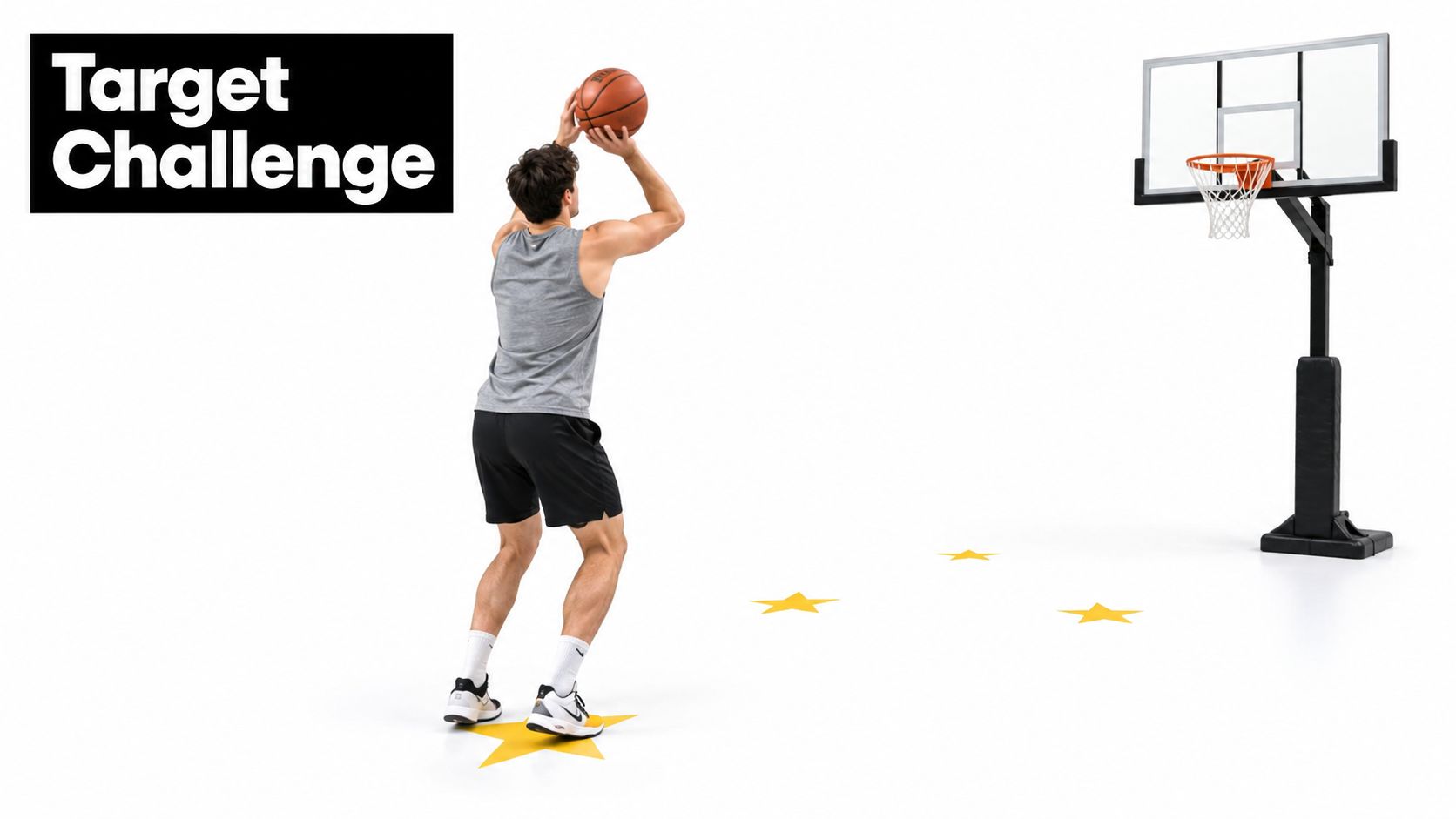
Shooting Stars makes progress visible. Set up targets that move from easy to difficult, then let players collect a star for each successful station or completed challenge. The child doesn't need to beat another player to feel successful. Reaching a new station, improving a finish, or completing a round with good balance can all count as progress.
Create a simple route around the basket. The first station might involve a close-range set shot, the next a gentle angle shot, and the later stations a farther attempt or a controlled bank shot. Use a star card, floor marker, or team board to show progress. Avoid putting the most difficult shot first, because early failure can make the rest of the activity feel pointless.
Keep the reward connected to learning
For toddlers, use one close target and oversized visual stars. The adult can place a star on a chart after the child aims, reaches, and releases with control. Preschoolers can use three stations, with a small number of attempts at each one. Give a star for a strong setup or accurate aim when the child is still learning to generate enough power.
School-age players can move through a longer route and choose whether to repeat a station or attempt the next challenge. Ask them to identify one cue before shooting: feet facing the target, eyes on the rim, or fingers finishing down. The star should reinforce the cue, not just the result.
This format is ideal for camp final days because every player can finish with a personal achievement. In a league, coaches can keep the stations as part of a warm-up and change the target locations periodically. At a party, use themed stars, team colors, or a “shooting passport” that children stamp as they travel.
You can also run the game as a quiet station while another group works on passing. That keeps the gym organized and gives children repeated attempts without a long line. Finish by asking each player which station felt challenging and which cue helped.
6. 3v3 Half-Court Shooting Competition
Small-sided play gives shooting a purpose. In a 3v3 half-court game, players must find space, receive a pass, and decide whether to shoot or move the ball. Keep the scoring simple, but adjust it to the players. A close shot can have a smaller value than a more difficult shot, while a free throw can reward calm technique after contact or a team foul.
Start with two small teams and a clear half-court boundary. After a rebound or defensive stop, require the team to move the ball outside the marked starting area before attacking again. This pause creates a chance to teach spacing and prevents players from crowding directly beneath the basket.
Adapt the court before changing the child
Toddlers shouldn't play a competitive 3v3 game. Use one adult or older helper with two children, a small target, and no defense. Preschoolers can play 2v2 or a shooting-and-passing game on a reduced area. Allow a player to catch, pause, and aim without pressure. A lower basket or smaller ball can make the activity feel like a game instead of a strength test.
School-age players can play 3v3 with rotating teams and short possessions. Give extra attention to the player who creates space, makes the pass, or rebounds for a teammate. Not every child should be judged by shot volume. Coaches can use one round to emphasize cutting, another to emphasize receiving with balanced feet, and another to encourage a quick decision.
Use this format as the bridge from isolated drills to real play. Camps can rotate teams through a shooting court and a skills court. Leagues can use it for a compact practice game. Families can set up a driveway version with one basket and a simple “pass, move, shoot” rule. For an at-home routine that supports this progression, see these basketball workouts for home practice.
Keep teams small enough that every child gets meaningful touches. If a player stands away from the action, pause and give that child a clear role, such as inbounder, rebounder, or first cutter.
7. Free Throw Pressure Drills
Free throws can feel serious, but a streak challenge turns them into a manageable personal game. Choose a target number of consecutive makes, then let the player count from the beginning after a miss. The number should match the child's experience. The purpose isn't to create embarrassment. It's to help players repeat the same preparation, breathing, aim, and follow-through while the result matters.
Give each shooter a marked routine. They might place both feet, take one breath, look at the target, and hold the finish. A coach should praise the routine even when the shot misses. The rebounder returns the ball without commentary about failure, and the shooter resets rather than rushing.
Use pressure in small doses
Toddlers can shoot from a close mark at a low basket or toward a large target. Ask for a short streak of successful tosses, with a high five after each one. Preschoolers can try a small consecutive-make challenge, but they should receive a fresh start without a dramatic reset. A team version works well, where the group celebrates the total number of calm attempts.
School-age players can track a personal best on a simple chart. Add a time challenge only after the routine is stable. Another useful variation is a team streak, where players combine their makes and encourage the next shooter. Avoid turning the activity into a public ranking, especially for children still building confidence.
Use free throws at the end of a camp station, before a league scrimmage, or as a quiet activity at a party. A coach can call out a scenario, such as “your team needs one calm basket,” without pretending the child must perform like an adult athlete. The imagined situation should make the routine meaningful, not frightening.
For more structured practice ideas, coaches can review these essential basketball practice drills.
Pressure cue: “Same feet, same breath, same finish. Let the routine carry the shot.”
8. PIG
PIG is a shorter version of HORSE, which makes it useful when children want creativity without waiting through a long game. The first player chooses a realistic shot and attempts it. If the shot goes in, the next player tries to copy it. A miss earns the next letter, and the first player to spell PIG leaves the round or takes a helper role. For very young groups, use two letters or a cooperative version where the players try to complete a shared challenge.
Set boundaries before anyone shoots. Shots should be safe, repeatable, and possible for the player attempting them. A child can choose a bank shot from a marked spot, a close side shot, or a shot after a controlled turn. Don't allow players to invent a challenge that depends on height, speed, or risky movement.
Shorten the game for younger players
Toddlers can copy an adult's simple close-range toss. Use a picture cue, such as a star on the floor, and award success for trying the movement with control. Preschoolers can play PIG with three easy letters, take turns as the “shot leader,” and use a visual card to show whose turn comes next. Keep the activity moving before attention fades.
School-age players can create shots within agreed boundaries and explain the cue they want the next player to copy. Encourage creativity, but ask whether the shot is realistic for everyone in the group. If a player misses a difficult attempt, the coach can offer a simpler version rather than letting frustration dominate.
PIG works well as a camp bracket because rounds finish quickly. A league can use it as an icebreaker before formal instruction. At a birthday party, run several games at different baskets and rotate children after a short round. Players who are waiting can serve as judges for safe shot choices, rebounders, or cheer leaders.
The teaching value comes from watching carefully. Children learn to notice foot placement, release direction, and follow-through while they imitate a teammate. That observation can become a coaching question: “What did you see before the ball left their hands?”
Comparison of 8 Fun Basketball Shooting Games
Game | 🔄 Implementation Complexity | ⚡ Resource Requirements | 📊 Expected Outcomes & Quality (⭐) | 💡 Ideal Use Cases | ⭐ Key Advantages |
|---|---|---|---|---|---|
HORSE | Low 🔄, simple turn-based rules | ⚡ Minimal: 1 ball, 1 hoop, 2–8+ players | 📊 Creativity & shot variety; confidence building ⭐⭐ | Youth PE, camps, warm-ups | Engaging, low-equipment, adaptable |
Around the World | Medium 🔄, mark stations, enforce progression | ⚡ 1+ balls, cones/tape to mark 5–8 spots | 📊 Consistent form, footwork, measurable progress ⭐⭐⭐ | Skill sessions, beginner→intermediate training | Builds muscle memory; trackable results |
21 | Low 🔄, simple scoring with optional bust rule | ⚡ Minimal: 1 ball, 1 hoop, small groups (2–4) | 📊 Decision-making, clutch shooting under pressure ⭐⭐ | Playgrounds, camps, competitive drills | Fast-paced, strategic, highly engaging |
Four Corners (Knockout) | Medium 🔄, rotation + chase rules, safety needed | ⚡ 1+ balls, larger court space, multiple players | 📊 Shooting under pressure + recovery, high energy ⭐⭐ | Large groups, warm-ups, camp activities | Keeps players active; blends offense/defense |
Shooting Stars (Target Challenge) | Medium–High 🔄, set stations + tracking system | ⚡ Multiple stations, visual charts/leaderboard, 1+ balls | 📊 Progressive skill gains, motivation via rewards ⭐⭐⭐ | Camps, competitions, structured training | Gamified progression; highly adaptable |
3v3 Half-Court Shooting Competition | High 🔄, team balance, modified scoring, supervision | ⚡ Half-court, multiple balls, 6 players minimum | 📊 Game-realistic shooting, spacing & team efficiency ⭐⭐⭐ | Advanced practices, transition to live play | Realistic scenarios; builds team shooting habits |
Free Throw Pressure Drills (Make‑X‑in‑a‑Row) | Low 🔄, repeatable, clear success criteria | ⚡ Minimal: 1 ball, hoop, dedicated time | 📊 Free‑throw consistency & mental toughness ⭐⭐⭐ | Individual practice, daily warm-up, rehab | Direct game transfer; measurable improvement |
PIG (Modified HORSE) | Low 🔄, streamlined HORSE rules for speed | ⚡ Minimal: 1 ball, 1 hoop, small groups | 📊 Quick engagement, creative shot-making; fast cycles ⭐⭐ | Young children, short sessions, camp rotations | Faster rounds, maintains attention, portable |
Choose the Right Game for the Group
The best game isn't always the most competitive one. Choose according to the children's age, attention span, confidence, movement experience, and ability to understand the rule. A toddler who spends the entire activity chasing an unreachable ball isn't developing confidence. A skilled school-age player who only takes close shots may need a progressive target or a pressure challenge that creates a new reason to focus.
Toddlers and preschoolers usually benefit from close-range, high-success activities. Shooting Stars, a simplified Around the World, and a cooperative version of PIG can provide clear movement without complicated scoring. Use soft or lightweight equipment when appropriate, lower targets when available, and visual rewards such as stars, colored spots, or picture cards. Keep rounds short enough that children finish wanting another turn.
School-age players can handle more structure, but they still need frequent opportunities to shoot. Around the World builds location awareness, HORSE and PIG encourage creativity, and 21 introduces decisions about risk. Four Corners Knockout adds movement, while free throw streaks teach a repeatable routine. Once players understand spacing and passing, 3v3 half-court play connects the shot to real game decisions.
A practical implementation path looks like this:
Explain one rule: Tell players only what they need for the first round.
Demonstrate one shot: Show the starting position, aiming point, release, and safe rebound.
Run a short round: Stop while children are still engaged, rather than waiting for attention to disappear.
Offer one technique cue: Use one phrase, such as “eyes on the target” or “hold your finish.”
Rotate quickly: Change shooters, rebounders, and helpers so every child stays involved.
Game-based instruction can be more than entertainment when the activity includes repeated attempts, targets, scoring, and immediate feedback. In controlled instructional research involving high-school students, the game-based group recorded an average post-test shooting score of 83.40, compared with 70.80 for the conventional instruction group, a 12.60-point advantage. The study's result supports careful game design, not the idea that every recreational game will produce the same outcome. You can review the controlled research on game-based basketball shooting instruction for that specific finding.
Parents and coaches should also watch the emotional side of competition. Celebrate a child who tries a new location, encourages a teammate, retrieves the ball safely, or repeats a routine after a miss. Those behaviors help children stay engaged long enough to build the physical skill.
JC Sports Houston offers age-appropriate programs, camps, leagues, and coach-led birthday parties where families can apply these ideas in a structured setting. Its broader youth sports approach includes progressive instruction, small-sided play, and activities designed to build confidence and movement skills. Families in Humble, Kingwood, Atascocita, and nearby Houston communities can explore programs and registration information at JC Sports Houston. Parents can also compare these activities with other fun family games for 2026 when planning active time beyond the court.
Choose one game that matches your group today. Mark the shooting spots, gather equipment that children can control, and start with a round simple enough for everyone to understand. Once players experience success, add distance, movement, teamwork, or pressure one step at a time.
JC Sports Houston provides age-appropriate basketball opportunities through youth programs, leagues, camps, and coach-led sports birthday parties. Visit JC Sports Houston to find a structured setting where children can practice fun shooting games, build confidence, and enjoy active play with supportive coaches.
Comments