

10 Kids Indoor Sports for Active, Confident Players

Your child needs an activity that keeps them moving, builds confidence, and fits real family life. Maybe your toddler is ready to explore movement, your school-age child wants to learn a sport, or your busy family needs a reliable indoor option when Houston weather disrupts outdoor plans. The best choice isn't always the most popular sport. It depends on your child's age, interests, confidence, readiness, and whether they need playful exploration, focused practice, or a social team experience.
This guide organizes kids indoor sports around developmental fit. For each option, you'll find the skills it supports, the formats that may work well, possible limitations, and practical ways to choose an appropriate starting point. Youth sports can also help address a broader activity challenge. Approximately 80% of adolescents globally don't reach the World Health Organization recommendation of at least 60 minutes of moderate-to-vigorous physical activity daily (Frontiers in Sports and Active Living).
In the Houston area, JC Sports Houston offers age-appropriate instruction, indoor small-sided play, classes, leagues, camps, and trial options where available. Families can use these formats to start gently, build skills progressively, and find a program their child enjoys attending consistently. For parents who want to strengthen their emergency-readiness knowledge alongside sports planning, ProMed Certifications online courses offer training that can be completed online.
1. Indoor Soccer Training
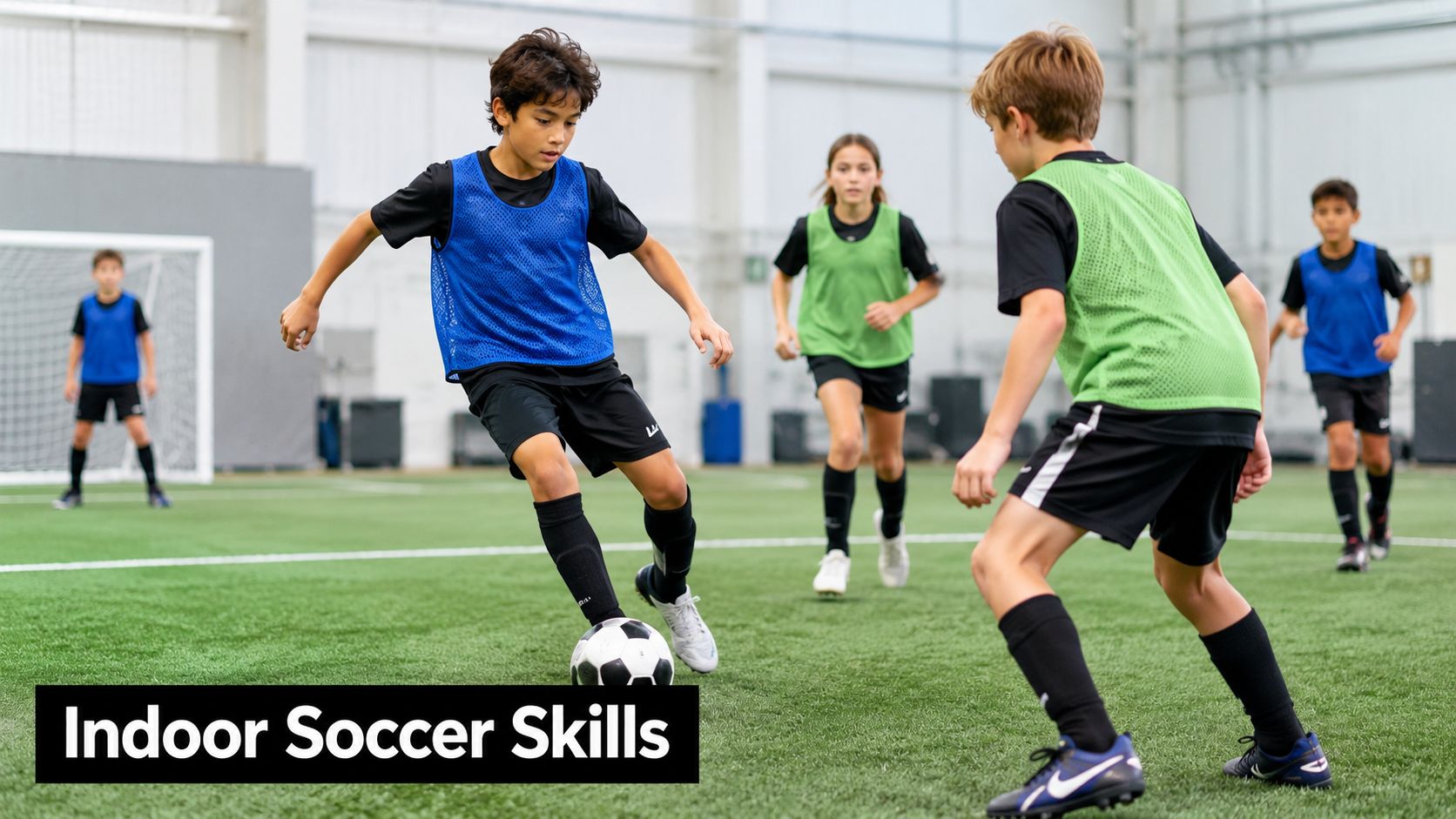
Indoor soccer suits children who enjoy constant movement, quick choices, and frequent contact with the ball. A climate-controlled facility removes weather interruptions while a smaller playing area gives players more chances to receive, dribble, pass, and solve problems under pressure.
For a younger child, the best introduction may be a multi-sport class rather than a formal league. Once a child shows interest, technical training can focus on first touch, close control, passing accuracy, turning, and creative use of space. JC Sports Houston connects families with indoor soccer classes and leagues, and its futsal and indoor soccer guide can help parents understand how the formats differ.
What indoor soccer builds
Small-sided games are particularly useful because players stay involved rather than waiting for a turn. Formats such as 3v3 or 4v4 can increase decision-making and encourage children to experiment with movement, passing angles, and the walls when the facility allows it.
A Coerver Coaching approach can add structured ball-mastery work to these games. Older beginners may benefit from progressive constraints, such as limited touches or directional targets, while younger players should have room for imagination and unpressured exploration.
Practical rule: Choose technical repetition and enjoyment before moving a child into a high-pressure competitive environment.
JC Sports Houston's Just for Girls soccer programs may also give girls a focused setting for confidence, creativity, and skill development. Families can combine indoor instruction with seasonal outdoor play, allowing children to build technique in a consistent environment while experiencing the wider game.
2. Basketball Skill Development Classes
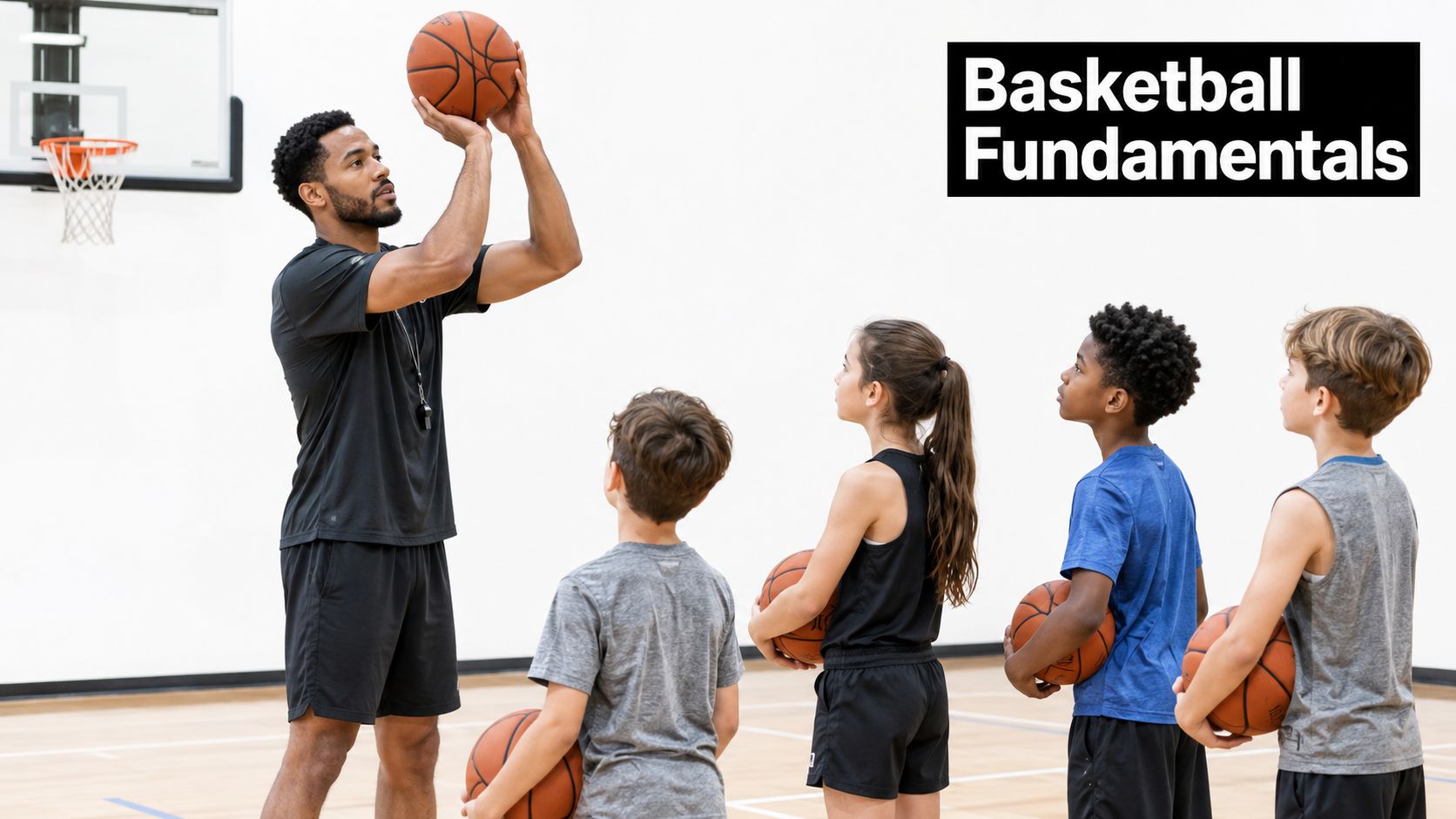
Basketball classes work well for children who like repeated challenges, clear targets, and the satisfaction of seeing a skill improve. Dribbling, shooting, footwork, passing, and game awareness all develop through short practice sequences that can be adjusted for different ages and abilities.
A young beginner shouldn't be expected to use the same equipment or court dimensions as an experienced player. Lower baskets, softer balls, and simple movement games help children learn body control without turning every attempt into a test of strength. JC Sports Houston's basketball training for kids provides a useful reference point for families comparing skill classes and team play.
Match the format to the child
A skills class is often the right starting point for a child who needs repetition or feels unsure in a full game. A recreational league adds social learning and practical application, while a private session may help a player address a specific issue, such as dribbling with the non-dominant hand or preparing for a new position.
Coaches can introduce shooting mechanics and footwork before adding defensive pressure. Small-sided games, including 3v3, keep children active and make it easier for each player to practice passing, cutting, spacing, and decision-making instead of disappearing into a crowded lineup.
School-break camps can provide a concentrated but enjoyable introduction to basketball. Ask whether the program includes breaks, free play, and age-appropriate modifications. The right class should leave a child eager to return, not exhausted by constant correction.
3. Indoor Baseball and Softball Training
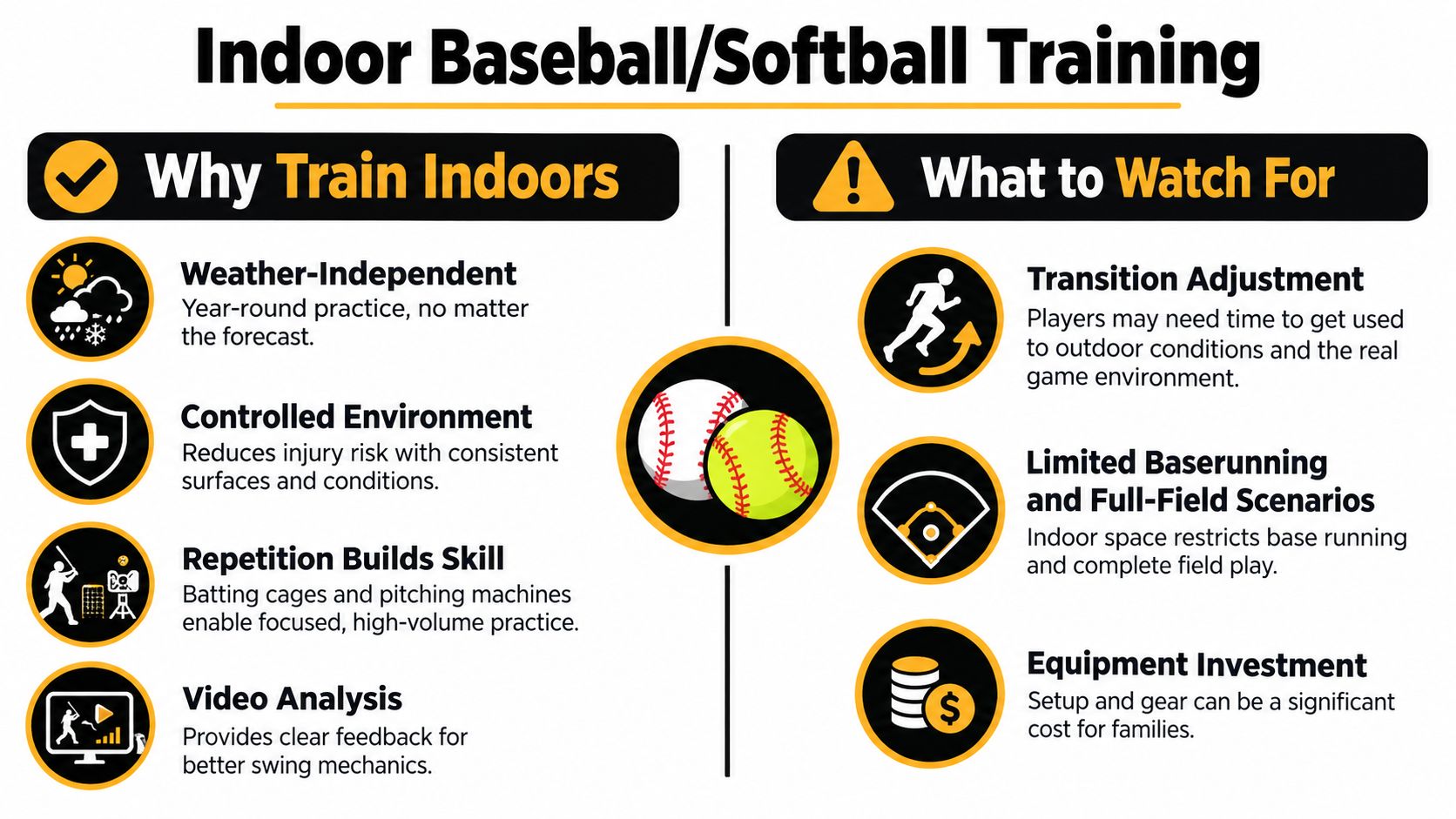
Baseball and softball training suit children who enjoy individual practice, teamwork, and a clear progression from one attempt to the next. Indoor facilities can provide batting cages, pitching machines, specialized equipment, and reduced-size spaces that let children work on hitting and fielding regardless of outdoor conditions.
For a young beginner, tee work and soft toss create a manageable starting point. The child can learn stance, balance, tracking, and a controlled swing before facing a moving pitch. Families can explore baseball training for kids when they want to compare seasonal instruction, camps, and skill-focused practice.
Build skills in a sensible order
A practical hitting progression moves from tee work to soft toss and then to machine pitching. Each stage introduces a new challenge without removing the successful contact that helps a child develop confidence. Coaches should also balance hitting with throwing, catching, footwork, and fielding decisions.
A child who loves batting may still need time learning how to move toward a ground ball or make a safe, accurate throw. Indoor training is most useful when it supports the whole player rather than treating one impressive skill as the only measure of progress.
A strong session gives children repeated chances to act, adjust, and try again.
Indoor practice can complement spring and fall outdoor leagues. Parents should ask how the program handles different experience levels and whether beginners can participate without feeling behind. A welcoming coach explains the activity clearly, celebrates effort, and keeps mistakes part of the learning process.
4. Multi-Sport Classes for Toddlers and Preschoolers
Multi-sport classes are often the best fit for children who are still discovering what they enjoy. Instead of asking a toddler to specialize, these programs introduce running, jumping, balancing, throwing, kicking, catching, and simple games through playful movement.
For children between roughly 18 months and 5 years, developmental readiness matters more than formal technique. Toddlers may need a parent nearby, while preschoolers may be ready to follow a short sequence independently. Sessions should feel energetic but not rushed, with colorful equipment and frequent changes that hold attention.
Look for foundational movement
A good class builds locomotor skills, balance, coordination, object control, and confidence. It may include a soccer activity, a throwing game, a balance challenge, and a simple obstacle course without requiring children to perform them perfectly.
JC Sports Houston's age-appropriate multi-sport offerings can fit families who want a gentle introduction before choosing soccer, baseball, or basketball. Sports-themed birthday activities can extend that exploration in a relaxed social setting.
Parents should prioritize encouragement over scores. Under-3 children may participate beside a caregiver, and older preschoolers can gradually learn simple rules through games. A class is working well when the child becomes more willing to try, move, listen, and join group activities.
5. Indoor Volleyball Programs
Volleyball is a strong option for children who enjoy cooperation and communication. The sport asks players to watch the ball, move into position, call for help, and coordinate with teammates. Those social demands can make volleyball especially valuable for a child who wants team belonging as much as technical practice.
Younger players need modified equipment. A softer ball and lower net make serving, passing, and sending the ball over the net more achievable. Coaches can teach ready position, movement, and communication before introducing more complex skills such as setting and spiking.
Choose participation over waiting
Traditional team formats can leave beginners standing still if the group is too large. Small-sided games, such as 4v4, create more opportunities to pass, move, communicate, and recover from mistakes. The coach can also rotate positions so children learn the game rather than attaching too early to one role.
A recreational track may be appropriate for a child who wants social play and basic instruction. A competitive track may suit an older player who welcomes more focused practice and regular performance goals. Parents should ask how the program separates instruction by readiness while keeping the environment welcoming.
Indoor courts provide dependable practice space during school breaks and changing seasons. Volleyball isn't the right fit for every child, especially one who strongly prefers individual repetition, but it can build communication and shared responsibility in ways that solo drills can't.
6. BlastBall
BlastBall gives very young children a first experience of baseball without requiring them to understand a full game. The format uses larger, softer balls, shorter distances, and simplified play so children can hit, run, field, and celebrate participation.
It can suit toddlers and preschoolers who are curious about bats and balls but aren't ready for the demands of standard T-ball. A child may enjoy the activity because the sequence is easy to understand: listen, swing, run, and join the group. Coaches can keep everyone moving instead of eliminating players after an error.
Keep the first experience positive
BlastBall should emphasize effort, participation, and joy rather than scores or statistics. Positive reinforcement helps children associate sports with trying something new, supporting teammates, and returning after an imperfect attempt.
JC Sports Houston offers beginner-friendly pathways that can introduce children to BlastBall before they move toward more formal T-ball instruction. Pairing it with a multi-sport class can give a child broader movement experience rather than making baseball the only activity.
“Can my child join in confidently?” is a more useful first question than “Will my child perform well?”
Parents should ask whether the program has recreational and progressive options. A child who is ready can move toward standard T-ball after gaining comfort with the basic routines, while another child may benefit from repeating the introductory format. Readiness may show through attention, willingness to take turns, and enjoyment of the activity.
7. Gymnastics and Movement Classes
Gymnastics and movement classes are a good match for children who like climbing, balancing, rolling, stretching, and exploring how their bodies move. The emphasis is on body awareness, coordination, strength, flexibility, and safe progression rather than early competition.
A movement class might use floor exercises, balance equipment, tumbling basics, and obstacle courses. Coaches can teach children how to land, stop, change direction, and control their bodies. These abilities support soccer, baseball, basketball, and many other activities.
Prioritize form and confidence
Young children should master basic movement patterns before attempting advanced skills. A supportive instructor gives clear demonstrations, adjusts activities for different abilities, and creates opportunities for success without making children compare themselves with one another.
Small groups can help coaches provide individual feedback. Parents should also ask about equipment safety, supervision, class size, and how instructors respond when a child feels nervous. A child doesn't need to love every challenge immediately. Confidence often grows after they have watched, tried a simpler version, and decided to try again.
Gymnastics elements can also complement sport-specific coaching. Better balance and body control may help a soccer player change direction or a basketball player land with control, but the class should remain enjoyable rather than being treated only as conditioning.
Parents looking for age-appropriate movement ideas can also review this visual demonstration before asking a coach how similar activities are adapted for their child.
8. Sports-Themed Birthday Parties
A sports-themed birthday party can introduce children to indoor activities without the commitment of weekly enrollment. Coach-led stations may include soccer, basketball, baseball, dodgeball, obstacle games, or Glow in the Dark Soccer, depending on the facility and the group.
This format works particularly well when guests have different interests and ability levels. A coach can adjust the rules, use simple equipment, and create activities where children can participate immediately. The celebration remains the priority, while the games give children a positive first look at organized sport.
Plan for the whole guest group
Ask how the party can be adapted to the children's ages, group size, and interests. A group of preschoolers may need short stations and frequent transitions, while older children may enjoy a longer game with clear teams and simple goals.
Useful questions include:
Activity choices: Can the family combine soccer, baseball, basketball, or movement games?
Skill access: Can beginners participate successfully alongside children with more experience?
Party flow: Does the package include coach-led play and a separate area for food or gifts?
Customization: Can the theme reflect a child's favorite sport or team?
JC Sports Houston's customizable, coach-led party options can help families turn a celebration into an active group experience. Parents should still confirm the current package details, included equipment, timing, and facility policies before booking.
9. School Break Sports Camps
School-break camps provide structure when children are out of school and parents still have work or other responsibilities. February Break, Spring Break, and Summer Break camps can combine technical instruction, small-sided games, creative activities, and supervised free play.
The best camp depends on the child's tolerance for a longer day and their preferred level of focus. A multi-sport camp may suit a child who likes variety, while a soccer or baseball camp may work better for a child who wants concentrated practice. Younger participants may need more transition time and shorter instructional blocks than older children.
Look beyond the sport label
Ask how the camp balances coaching with unstructured enjoyment. Children need opportunities to practice skills, but they also need water breaks, social time, imaginative games, and a chance to recover between activities.
A well-planned camp can include progressive challenges within the same group. Beginners might work on control and confidence, while more experienced players add decision-making or game constraints. This approach prevents the camp from becoming either too easy or unnecessarily intimidating.
Families should register early enough to understand the schedule, equipment requirements, drop-off procedures, and make-up policies. JC Sports Houston's February Break, Spring Break, and Summer Break Camps give Houston-area families seasonal options to review, including multi-sport and specialized formats where offered.
10. Just for Girls Soccer Training
A dedicated girls' soccer program can be the right choice for a player who wants technical practice in a supportive, girl-centered environment. Some children participate more freely when they feel comfortable asking questions, making mistakes, and trying creative solutions without worrying about comparison.
Technical training may include ball mastery, dribbling, passing, first touch, turning, and one-on-one play. A Coerver-based approach can give players a structured vocabulary for practicing these skills while leaving room for creativity. The coach's communication style matters as much as the drill selection.
Build a pathway, not pressure
A beginning player may need encouragement and basic repetition. An older or more experienced player may want progressive challenges, competitive opportunities, and guidance about the next level. The program should make those pathways visible without suggesting that every child needs to pursue elite competition.
Parents can ask about the coaches' experience, group organization, progression between recreational and competitive training, and how the program supports confidence. Female coaches and mentors may be especially meaningful for some players, although the most important factor is a coach who creates a safe, respectful, and engaging learning environment.
JC Sports Houston's Just for Girls soccer programs connect dedicated technical development with the broader goal of helping girls enjoy the game. Families can consider them alongside mixed-gender classes, seasonal leagues, and outdoor soccer, depending on the child's interests and schedule.
10-Program Comparison: Kids Indoor Sports
Program | 🔄 Implementation Complexity | ⚡ Resource Requirements | 📊 Expected Outcomes (⭐) | Ideal Use Cases | 💡 Key Advantages / Tips |
|---|---|---|---|---|---|
Indoor Soccer Training | Medium, structured coaching, small-sided formats | Indoor turf, goals, padded walls, trained coaches | Ball control & quick decision-making ⭐⭐⭐⭐ | Year-round technical development for youth | Use 3v3–4v4; combine with outdoor play |
Basketball Skill Development Classes | Medium, progressive curriculum, individual feedback | Indoor court, adjustable hoops, balls, skilled coaches | Shooting, dribbling, footwork improvement ⭐⭐⭐⭐ | Skill progression from beginner to competitive | Use lower baskets & 3v3 for young players |
Indoor Baseball/Softball Training | Medium, equipment setup (cages/machines) and drills | Batting cages, pitching machines, turf, video tools | Repetition-based hitting & fielding gains ⭐⭐⭐⭐ | Off-season mechanics work and confidence building | Progress: tee → soft toss → machine pitching |
Multi-Sport Classes (Toddlers/Preschool) | Low, play-based, high instructor ratio | Variety of small equipment, safe play space, caregivers | Fundamental motor skills & confidence ⭐⭐⭐ | Early exposure; prevent early specialization | Keep sessions 30–45 min; encourage parental involvement |
Indoor Volleyball Programs | Medium, team systems and positioning instruction | Courts, nets (modified heights), coaches, balls | Teamwork, hand‑eye coordination, court awareness ⭐⭐⭐⭐ | Team skill development and communication training | Start with modified nets & 4v4 for younger ages |
BlastBall (T-Ball Intro) | Low, highly simplified rules and format | Soft oversized balls, reduced diamond, basic gear | Basic hitting, running, inclusive participation ⭐⭐⭐ | Introductory baseball for ages 18mo–4yrs | Emphasize fun; progress to T‑ball after 2–3 seasons |
Gymnastics & Movement Classes | High, safety protocols and specialized progression | Mats, beams, trampolines, certified instructors | Flexibility, balance, strength, body awareness ⭐⭐⭐⭐ | Foundational athletic development & injury prevention | Small groups, focus on form before advanced skills |
Sports-Themed Birthday Parties | Low–Medium, event logistics plus coaching | Multi-sport stations, coaches, party room setup | High engagement and positive sport exposure ⭐⭐⭐ | Active birthday events and casual sport introduction | Offer tiered packages; ensure activities suit all levels |
School Break Sports Camps | Medium–High, multi-day scheduling and staffing | Multiple coaches, varied equipment, optional extended care | Intensive short-term skill gains & social bonding ⭐⭐⭐⭐ | Holiday childcare with focused training (Feb/Spring/Summer) | Provide multi-sport tracks; market 4–6 weeks ahead |
Just for Girls Soccer Training | Medium, girl-centered coaching and small groups | Female coaches (preferred), indoor facilities, Coerver tools | Technical skill + confidence and retention ⭐⭐⭐⭐ | Girls-only development, confidence building, competitive pathway | Hire experienced female coaches; use Coerver methodology |
Choose the Program That Fits Your Child
Start with age and readiness. A toddler who is still learning to follow group directions may benefit from a playful multi-sport class or BlastBall. A preschooler who wants to practice one activity repeatedly might be ready for introductory soccer or baseball. School-age children can compare skills classes, leagues, camps, and private sessions based on their confidence and goals.
Next, identify the main reason for enrolling. Your priority might be motor skills, technical repetition, confidence, teamwork, a dependable school-break routine, or a welcoming first experience with sport. Naming that goal makes the choice clearer. A child who needs movement variety probably shouldn't be placed immediately into a narrow, high-pressure training schedule. A child who loves dribbling may be ready for more soccer practice, while a child who avoids group play may need a smaller, lower-pressure starting point.
Format matters as much as the sport. Compare class size, session length, activity density, coaching style, equipment, travel time, and weekly commitment. Approximately 80% of adolescents globally don't achieve at least 60 minutes of moderate-to-vigorous physical activity daily, so a practical indoor program should create plenty of active time rather than long queues or extended explanations (Frontiers in Sports and Active Living). Ask whether coaches use stations, parallel games, small groups, and age-appropriate equipment.
Cost and access deserve equal attention. Federal data for 2023–2024 found organized sports or lesson participation at 36.7% among children in families below 100% of the federal poverty threshold, compared with 74.1% among children in families at or above 400% of that threshold, a difference of 37.4 percentage points (National Academies of Sciences, Engineering, and Medicine). Families should ask about the full cost, equipment, uniforms, missed-session policies, transportation, trial options, and whether siblings can attend suitable programs at similar times.
Use these questions when speaking with a facility:
Equipment: Can the coach modify balls, nets, baskets, bats, or distances for beginners?
Group experience: How does the program support children with different confidence and skill levels?
Safety: What supervision, warm-up, equipment, and emergency procedures are in place?
Progression: How can a child move from a trial or recreational class into a league or more advanced training?
Flexibility: What happens when a child misses a session or needs a different format?
Enjoyment: How does the coach keep practices playful and socially welcoming?
For Houston-area families, JC Sports Houston offers classes, leagues, camps, private sessions, and sports-themed birthday options across age groups and interests. Review the current programs, policies, and schedules, then request a free trial when available so your child can experience the coaching approach before your family commits.
The most sustainable program is the one your child enjoys enough to attend consistently. Progress may look like joining a group more confidently, staying active through a session, trying a new skill, communicating with teammates, or returning after a mistake. Competition results can matter to some families, but engagement, confidence, and developing skills provide a stronger foundation for a lifelong relationship with movement.
JC Sports Houston offers indoor multi-sport classes, soccer, baseball, basketball, BlastBall, girls' soccer training, seasonal leagues, school-break camps, private sessions, and coach-led sports birthday parties for Houston-area families. Visit JC Sports Houston to compare age-appropriate options and request a free trial when available, then choose the format that gives your child a welcoming place to move, learn, and grow.
Comments