

8 Youth Baseball Hitting Drills for Young Players

A young player can swing with plenty of effort and still struggle to make consistent contact. During practice, the bat moves fast, but the ball rolls weakly to the side, pops up, or misses the barrel altogether. Often, the problem isn't a lack of enthusiasm. The drill is too advanced, too random, or disconnected from the player's current skill level.
Effective youth baseball hitting drills build one ability at a time. Players first learn to control the bat and find the barrel, then they add a moving ball, timing, pitch recognition, and game decisions. The progression below moves from tee mechanics through soft toss, front toss, machine work, controlled live pitching, reaction training, one-handed work, and situational hitting.
Safety should stay ahead of volume. Use batting helmets, protective nets or screens, suitable throwing distances, and close adult supervision. Stop a round when fatigue changes a player's balance, posture, or swing path. Young baseball players are especially vulnerable to overuse problems involving the elbow and shoulder, so hitting practice should include recovery and sensible workload management, as pediatric baseball injury guidance from Boston Children's Hospital explains.
JC Sports Houston's age-appropriate, confidence-focused approach is relevant for families in Humble, Kingwood, Atascocita, and nearby Houston communities. The right environment helps young players develop technique without turning every practice into a competition.
1. Tee Work Drill
Tee work gives a young hitter a quiet setting for learning. There's no pitch speed to judge and no moving ball to distract the player. The batter can focus on a balanced stance, relaxed hands, a controlled move toward the ball, and a finish that stays connected to the swing.
Begin with the tee near the middle of the hitting zone. Ask the player to make firm, controlled contact through the center of the field rather than trying to hit the ball as far as possible. Once that feels comfortable, move the tee slightly up, down, inside, and outside. Each position asks the hitter to adjust the contact point while keeping the same balanced approach.
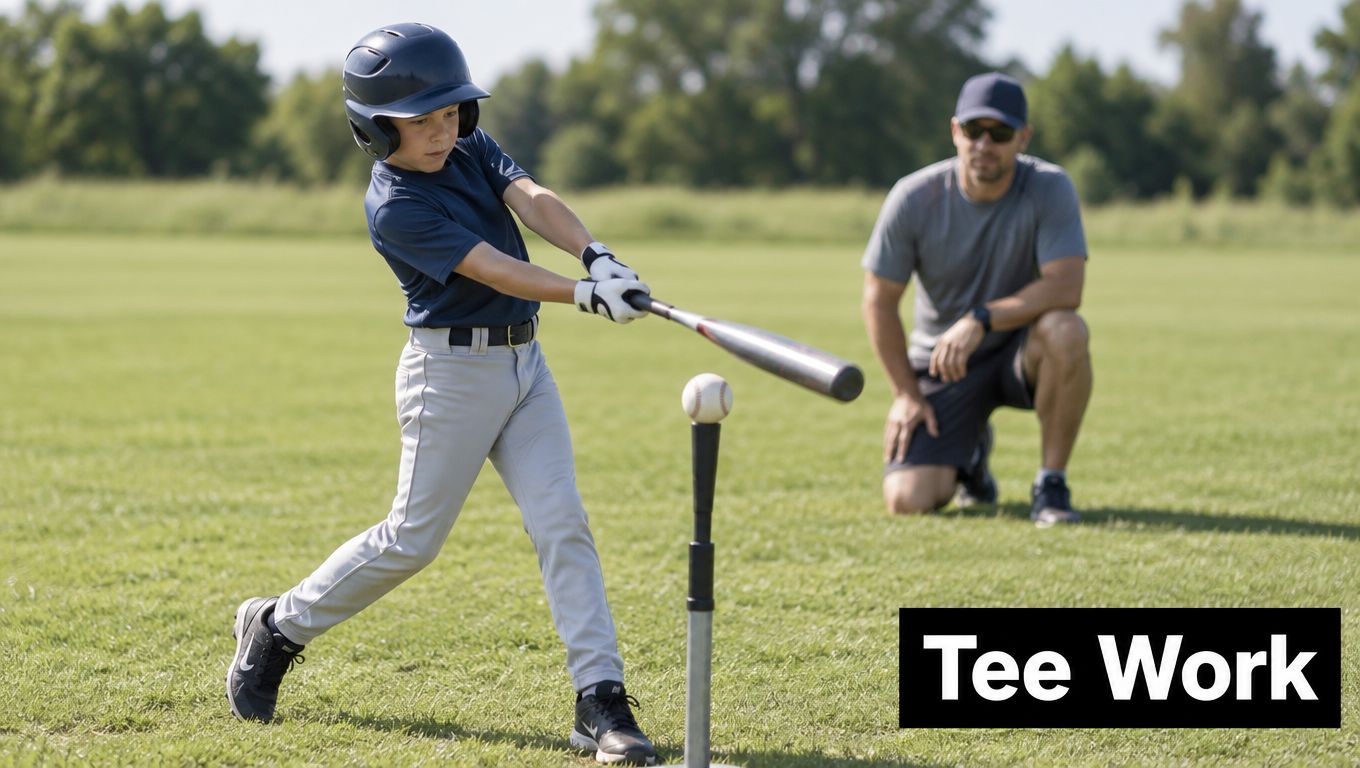
Build a repeatable contact pattern
A published youth program uses a structured progression of 56 swings per day, three days per week during weeks 1 through 4, followed by 78 swings per day, three to four days per week during weeks 5 through 10, with tee, shuffle, underhand-toss, and overhand-toss work combined in the plan. The program is described in the Driveline Baseball youth individual program. Treat that as a model to adapt, not a universal prescription. A player's age, experience, schedule, and recovery should shape the actual workload.
Use a net or protective barrier behind the hitter. Give the player a clear cue, such as “balanced finish” or “barrel to the ball,” and avoid correcting several mechanics at once. A short video can help a player see progress, but the feedback should remain encouraging and simple.
Practical rule: Reward solid contact and a repeatable move, not the longest ball.
2. Soft Toss Drill
Soft toss adds movement without immediately creating the pressure of a live at-bat. A coach or partner feeds the ball from the side, and the hitter learns to track it into the hitting zone before swinging. The exercise works best when the tosser stays consistent and the batter keeps the swing short and controlled.
Start with tosses that arrive around the middle of the zone. The player should watch the ball from the tosser's hand, load comfortably, and move the barrel through the ball without lunging. Once contact becomes reliable, vary the location gradually. An inside toss may require an earlier contact point, while an outside toss encourages the hitter to stay through the ball.
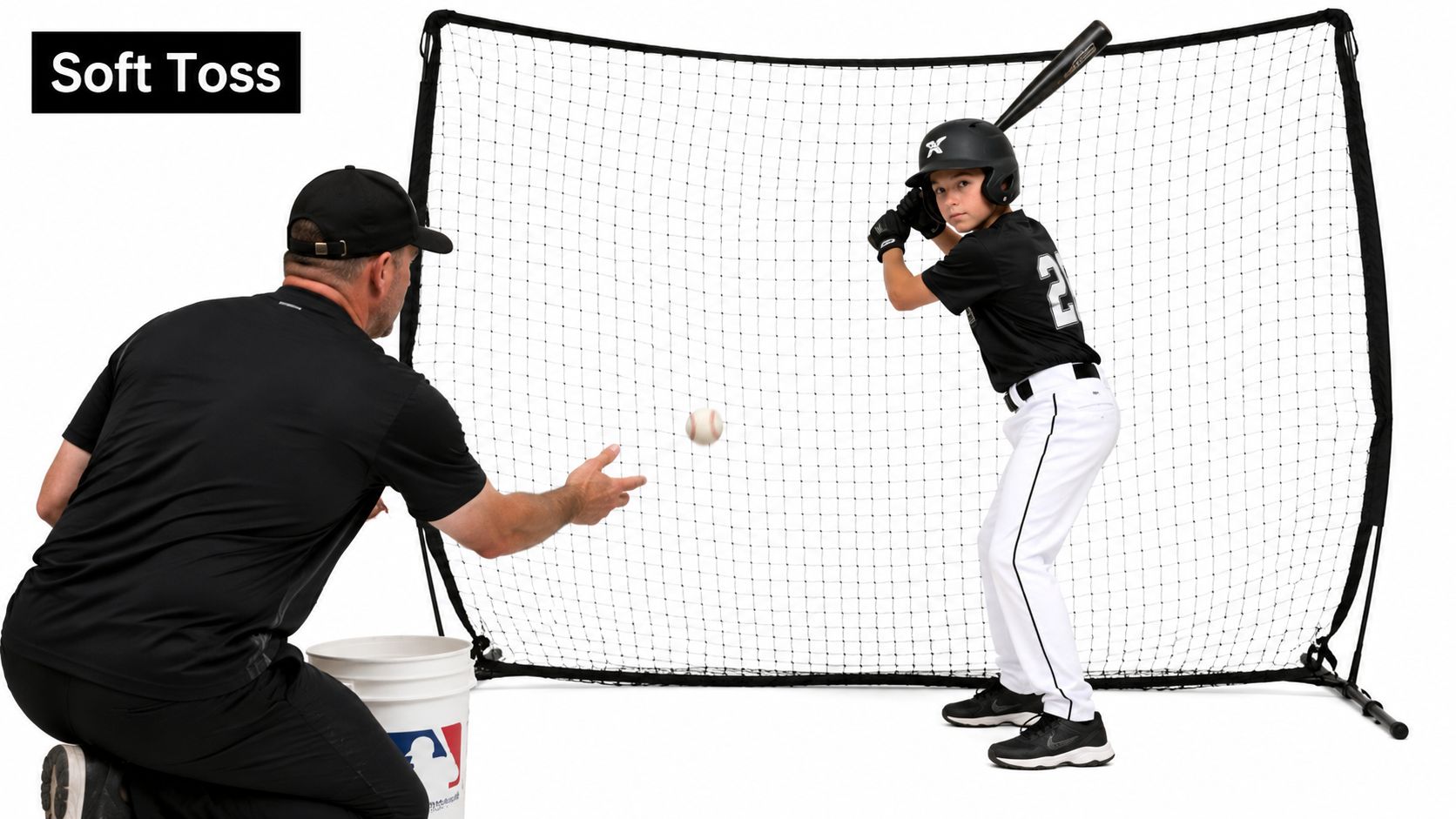
Keep the round calm and purposeful
Use a net so the player doesn't need to chase every ball. The tosser should kneel or stand in a stable position, present the ball clearly, and avoid speeding up just because the hitter missed. If the toss becomes inconsistent, pause and reset. Poor feeds can make the hitter compensate for the drill rather than learn from it.
Give each round one purpose:
Middle work: Drive the ball back through the center with balance.
Inside work: Turn the barrel without pulling the front shoulder open.
Outside work: Let the ball travel and stay connected through contact.
Approach work: Mix swing and take decisions when the player is ready.
A young player may begin with a very simple middle toss. An experienced player can combine soft toss with location changes or a verbal “swing” and “take” command. The drill should feel challenging enough to require attention, but not so difficult that the player starts guessing.
3. Front Toss Drill
Front toss sits between soft toss and live pitching. The coach throws from in front of the hitter, usually from behind a protective screen, and the ball travels on a more recognizable path toward the plate. That extra flight time gives the batter a better chance to see the pitch and decide whether to swing.
Start with a comfortable distance for the player's experience. Use an easy, repeatable feed before introducing location changes. Ask the hitter to track the ball all the way into the zone, keep the head quiet, and swing only at a pitch they can handle.
Transfer mechanics into timing
Tee work and front toss don't create exactly the same movement pattern. A youth baseball study found significant differences in trunk rotation between tee and front-toss hitting. The trunk rotated more toward the back side during tee work and less toward the pitcher during front toss, particularly during preparation and across 67% of the acceleration phase, according to the published kinematic study. That distinction matters for coaching. Tee work can isolate a movement shape, while front toss asks the player to sequence that movement while tracking a moving ball.
Vary the drill without turning it into a home-run contest. Call for a high ball, low ball, inside ball, or outside ball, then ask the hitter to describe the intended contact before the toss. For a younger player, keep the language concrete: “See it, decide, swing.”
You can also pair this drill with video feedback. Review one swing, identify one useful adjustment, and let the player try again. A short cue is easier to carry into the next round than a long mechanical explanation.
For coaches who want a visual example, this front toss hitting demonstration shows the type of controlled setup that makes the drill useful.
4. Batting Cage Machine Drill
A pitching machine gives players a predictable ball flight and a repeatable challenge. That consistency can help a hitter work on timing, contact, or a particular part of the strike zone. It can also expose a problem quickly, because the same type of pitch keeps arriving.
Begin at a speed and distance the player can manage with good mechanics. If the hitter is late, dropping the back shoulder, or spinning away from the ball, reduce the challenge. A faster setting isn't automatically better practice. The player should be able to recognize the ball, move on time, and finish under control.
Use the machine as a supplement
The indoor baseball training guidance from JC Sports Houston can help families think about how controlled indoor work fits into a broader development plan. Machine work is useful, but it shouldn't replace tee work, varied tosses, live decision-making, or unstructured play.
Give the hitter a narrow task for each round. One round might focus on driving the ball to the middle. Another might ask the player to handle pitches on the outer half. A third might include a take command so the hitter practices seeing the ball before committing.
Protect the setup: Use the machine's recommended safety distance, a helmet, and a properly positioned net or cage.
Watch fatigue: Stop when the player begins swinging harder while losing balance or timing.
Review movement: A short video can reveal whether the hitter is early, late, or changing the swing to chase speed.
Return to variety: Follow machine work with a less predictable drill so the player doesn't become dependent on one repeated pitch.
A machine can build confidence when the player succeeds against a manageable challenge. It can also create frustration when the setting is too difficult. Adjust the task before asking the child to work harder.
5. Live Pitch Drill
A young hitter may look comfortable off a tee, then hesitate when the ball starts moving toward the plate. Controlled live pitching builds that bridge. The coach or older player throws with one clear purpose, such as working the middle of the zone or repeating one location. The hitter tracks the ball, starts the swing on time, and decides whether to attack it.
Prepare the space before anyone throws:
Fit the hitter with a batting helmet.
Place a protective screen between the thrower and hitter when appropriate.
Keep the catcher in suitable protective equipment.
Mark a waiting area behind a safe barrier, away from the hitting lane.
Give the round a simple target. Younger players can handle strikes in one part of the zone. Developing hitters can see two locations. Players ready for more game-like work can face strikes mixed with clear balls. Change only one variable at a time, such as location or speed, so the hitter learns which adjustment produced the result.
A progression coaches can use
Beginner round: Throw easy, visible pitches to one location. Ask the player to watch the ball into the hitting area and finish balanced.
Developing round: Alternate between two locations while keeping the speed manageable. The coaching cue is, “See it, move on time, finish under control.”
Game-readiness round: Mix likely strikes with a few clear balls. Reward a calm take as a good decision, even when no contact follows.
A live round can strengthen timing, pitch recognition, approach, and confidence. The hitter learns to begin the swing early enough to meet the ball out front, follow its flight instead of guessing from the throw, and reset after a miss.
A controlled study of baseball batting training found that adaptive virtual training and real batting practice produced significant improvements in seven of eight batting performance measures, with gains still present at a one-month retention test, as reported in the study available through PubMed Central. The coaching takeaway is to repeat purposeful practice, then check whether the skill remains available later.
The same body of research reports that 12 training sessions over four weeks improved batting when practice matched the pitch speeds and types used in testing. Match live-pitch challenges to the situations players will face, while keeping the difficulty age-appropriate.
6. Reaction Drill
A hitter may see a pitch clearly and still swing before deciding whether it belongs in the strike zone. A reaction drill slows that moment down. The coach gives a cue, and the player connects the cue to a swing or a take.
Start with a simple setup. Use a colored training ball, a hand signal, or a verbal command. For younger players, hold up one color and say “swing,” then use another color or signal for “take.” Keep the toss soft and the cue easy to see. The goal is understanding, not speed.
Once the rule feels familiar, add soft toss or front toss. The player tracks the ball, listens for the cue, then chooses. This sequence works like a traffic light: see the signal, process it, and move with control.
Build decisions in stages
Clear signal: Use one swing color and one take color. Ask the hitter to explain the rule before starting.
Delayed command: Give the instruction after releasing the ball. Keep the pitch slow enough for the player to respond without guessing.
Location choice: Tell the hitter to swing only at a ball in the agreed zone area. A ball outside it earns a take.
Partner call: Let another player show the signal while the coach tosses. This adds attention without making the drill a contest.
Decision score: Give one point for each correct swing or take. Pause and reset when focus drops.
A correct take counts as success, even without contact. That message builds patience, pitch recognition, and confidence because the player learns that a good at-bat includes controlled choices.
For progression, use clear signals first, then add location, speed, or delayed commands one at a time. If the player starts guessing, slow the presentation and return to the easiest version. The JC Sports Houston guide to improving reaction time provides related context for connecting reaction practice with athletic development.
Use the cue, “See the ball, hear the call, then choose.” Repeated calmly, it helps the hitter carry better timing and decision-making into game situations.
7. One-Handed Swing Drill
A hitter who repeatedly rolls the bat over during tee work may benefit from a short one-handed round. The drill gives the player a clearer feel for the barrel, then connects that feeling to a complete two-handed swing.
Begin with the top hand on the bat and a ball resting on a tee. Set the tee at an easy contact point. Ask the hitter to keep the front shoulder from flying open, rotate the trunk, and guide the barrel through the ball. The motion should stay compact, like tracing a short path through the contact zone.
Use this progression:
Tee contact: Start with controlled swings and pause after contact. Check posture, barrel direction, and balance.
Gentle toss: Move to an easy toss only after the player can repeat solid contact from the tee.
Two-handed transfer: Finish with regular swings so the hitter carries the barrel feel into the full motion.
A lighter training bat may help a smaller or less experienced player control the movement. Choose equipment the hitter can move without strain: a tee, an age-appropriate bat, safe practice balls, and a suitable net or open hitting area. Reduce the drill if the player grips tightly, shrugs the shoulders, reaches with the arm, or turns the swing into an arm-only push.
Use one cue at a time:
“Stay connected.” Keep the hands and body working together.
“Find the barrel.” Value firm contact over distance.
“Turn the middle.” Encourage trunk rotation rather than a hard arm pull.
“Finish balanced.” Hold the ending position briefly.
For a younger player, keep the work brief and return quickly to two-handed swings. A more experienced hitter can use gentle tosses and focus on repeatable timing. The performance improvement strategies from JC Sports Houston offer broader context for combining technical drills with athletic development.
Place this drill after tee work when barrel control needs attention, then use normal swings to connect the isolated feeling with game-ready movement.
8. Situational Hitting Drill
Situational hitting turns an at-bat into a clear baseball problem. The coach names the situation, and the player chooses an approach before the pitch. Examples include advancing a runner, driving the ball into the gap, or putting the ball in play with two outs.
Start with one simple goal. For a younger hitter, say, “Runner on third, bring the runner home.” The player should look for a hittable pitch and make controlled contact. Older or more experienced hitters can add direction, count, outs, and runner location. Add one variable at a time so decision-making develops without overwhelming the hitter.
Build the at-bat one decision at a time
Use this progression:
Name the situation. Give the hitter a short, age-appropriate scenario.
Hear the plan. Ask the player to explain the approach in plain language.
Deliver a manageable pitch. Begin with a location the hitter can recognize and handle.
Review the choice. Ask whether the swing, take, or contact matched the situation.
Give one cue. Adjust a single decision before the next repetition.
A successful repetition can produce a ground ball, line drive, foul ball, or miss. Evaluate the process first. Did the player understand the assignment, recognize a usable pitch, and remain composed after an imperfect result?
With a runner on second, the plan may be to drive a pitch into the gap. With two outs, the hitter may focus on avoiding a careless chase and extending the inning. These examples show that hitting combines seeing, deciding, and executing, rather than just swinging hard.
Keep competition secondary to learning. Award credit for a correct take, a sound decision, or contact toward the intended area. Players can also compare their choices with their own previous repetitions.
For younger players, use one scenario and brief rounds. Older hitters can handle changing counts or field directions. The performance improvement strategies from JC Sports Houston provide broader context for combining technical practice with athletic development. When players progress from controlled contact to purposeful choices, the drill strengthens confidence, timing, and game readiness.
8-Drill Comparison: Youth Baseball Hitting
Drill | 🔄 Implementation complexity | ⚡ Resource requirements | 📊 Expected outcomes / ⭐ | Ideal use cases | 💡 Key advantages / tips |
|---|---|---|---|---|---|
Tee Work Drill | Very low, simple setup, minimal supervision | Very low, tee, bat, balls, optional net | Builds swing mechanics & muscle memory; limited timing training, ⭐⭐⭐⭐ (mechanics) / ⭐ (timing) | Beginners, early development, individual reps (U4–U10) | Consistent reps; vary tee height; record video; mix with other drills |
Soft Toss Drill (Short Toss) | Low, needs a consistent tosser | Low, partner/coach, balls, net | Develops timing & hand‑eye coordination in controlled way, ⭐⭐⭐ | Bridge between tee work and live pitching; small groups | Keep toss speed consistent; rotate tosser; 15–20 quality tosses per round |
Front Toss Drill | Medium, coach skill required for consistent tosses | Medium, coach, protective net, safe space | Improves pitch recognition & timing with longer sight window, ⭐⭐⭐⭐ | Intermediate progression; competitive practice; youth prepping for live pitching | Vary locations; warm up tosser; start closer for younger players |
Batting Cage (Machine Pitch) Drill | Low to operate; moderate setup for facility access | Medium–High, pitching machine or cage rental; electricity/space | High‑volume swings and speed progression; predictable location, ⭐⭐⭐ (mechanics/volume) | Independent practice, high‑volume reps, off‑season training | Start at slower speeds; limit session length; mix with live pitching for timing |
Live Pitch Drill (Controlled BP) | High, requires experienced coach and safety protocols | Medium, coach/pitcher, catcher, protective gear, regulation distance | Most game‑realistic; best for pitch recognition and decision‑making, ⭐⭐⭐⭐⭐ | Advanced/competitive players; game preparation (Ages 8+) | Use full protective gear; progress speeds gradually; limit session duration |
Reaction Drill (Pitch Recognition) | Medium, coach must manage signals and timing | Low, colored balls/signals, coach, optional toss setup | Trains selective swinging, quick recognition, plate discipline, ⭐⭐⭐⭐ | Plate discipline training, U10+, group sessions | Start slow with obvious signals; use bright colors; combine with toss/front toss |
One‑Handed Swing Drill | Low–Medium, needs monitoring to avoid compensation | Low, tee or soft toss, lighter bat recommended | Builds hand strength, barrel awareness, isolates upper‑body mechanics, ⭐⭐⭐⭐ | Strengthening and technique refinement for older youth (Ages 10+) | Use lighter bat; 10–15 swings per hand; focus on contact not distance |
Situational Hitting Drill | High, requires game knowledge and coach direction | Medium, live/controlled pitches, scenario setup | Develops game awareness, decision‑making, situational approaches, ⭐⭐⭐⭐ | Competitive teams, older players, situational practice (Ages 10+) | Announce situations clearly; focus on approach not power; use scoring to simulate pressure |
Turn Eight Drills Into a Smarter Practice
Eight drills don't need to appear in one exhausting session. A better plan gives each player a clear progression, enough rest to preserve mechanics, and a small number of cues they can remember. Young hitters improve when practice feels achievable and purposeful, not when they collect the most swings.
A beginner session can follow this sequence:
Tee work: Start with balanced stance, contact in the middle of the zone, and a controlled finish.
Simple soft toss: Add a moving ball while keeping the feed predictable.
Reaction game: Use a color or hand signal and let the player practice swinging and taking.
Positive finish: End with a fun challenge that celebrates clean decisions and solid contact.
Keep the instruction light. A coach might use “balance,” then “see it,” then “choose.” If the player loses posture or starts rushing, reduce the challenge rather than adding more explanation. The session should leave the child feeling capable of returning to the plate.
An advanced session can layer the skills more deliberately:
Tee mechanics: Work on one contact point or movement pattern.
Front toss: Add timing and controlled location changes.
Machine or live pitching: Challenge the hitter with a manageable, game-relevant ball flight.
Reaction decisions: Mix swing and take commands.
Situational hitting: Ask the player to adjust the approach based on outs and runners.
The 2017 controlled study cited earlier supports combining realistic training with retention in mind, while the 2019 findings discussed in the same baseball batting research support matching practice conditions to the pitches players need to handle. Don't repeat a source's quantitative findings in multiple places, but do apply its broader coaching lesson consistently: practice should prepare players for the decisions they face in competition.
Protective equipment, safe distances, recovery, and supervision aren't optional details. Use short rounds and age-appropriate challenges. If fatigue changes the swing, end the round or switch to a lower-intensity activity. The most useful measure of progress is consistent decision-making and contact quality, not distance alone.
Choose one primary drill, one timing drill, and one decision-making drill for the next practice. Track whether the player stays balanced, recognizes the intended pitch, and makes a controlled swing or take. JC Sports Houston offers structured youth sports programming for families in the surrounding Houston communities, including age-appropriate baseball opportunities and a free trial for new families who want to experience the coaching approach.
JC Sports Houston provides youth sports training, baseball instruction, seasonal leagues, and skill-building camps in a safe indoor environment for families in Humble, Kingwood, Atascocita, and nearby communities. Visit JC Sports Houston to explore age-appropriate programming, request a free trial, and help your young player build better contact, timing, and confidence.
Comments