

Small Group Soccer Training Sessions That Develop Skill

You're watching practice after a busy school day, and your child is waiting again. A teammate takes a turn, the coach explains the drill, and your player nudges the grass with a cleat. Driving home toward Humble or Kingwood, you wonder whether another soccer session would help, or add more waiting to an already crowded week.
Small group soccer training is worth considering, but the head count isn't enough. Look at what your child gets to do, what the coach notices, and how the session fits alongside games, school, and downtime.
Why Small Group Soccer Training Changes the Game
Take that same child out of the line and put them in a small-sided game. A pass arrives, a defender approaches, and your child has to receive, turn, or protect the ball. Soon there's another chance, perhaps a shot this time, rather than a long wait to repeat a rehearsed movement.
That's the useful distinction between a small training group and small-sided play. The first describes attendance. The second describes a game deliberately arranged so players encounter manageable soccer problems.
A development approach with a long history
US Youth Soccer says it promoted small-sided games beginning in the 1980s, with state associations approving under-12 policy changes in August 2003; national Player Development Initiatives subsequently took effect for younger age groups in 2017, establishing age-appropriate play rather than immediate reliance on the adult game, as outlined in its small-sided development history.
The progression described in those materials starts with smaller teams and introduces more players as children mature. The important idea isn't to make young children imitate adult soccer on a shrunken field. It's to give them problems they can recognize and actions they can attempt.
This comparison illustrates the difference between waiting for involvement and having repeated opportunities to participate.
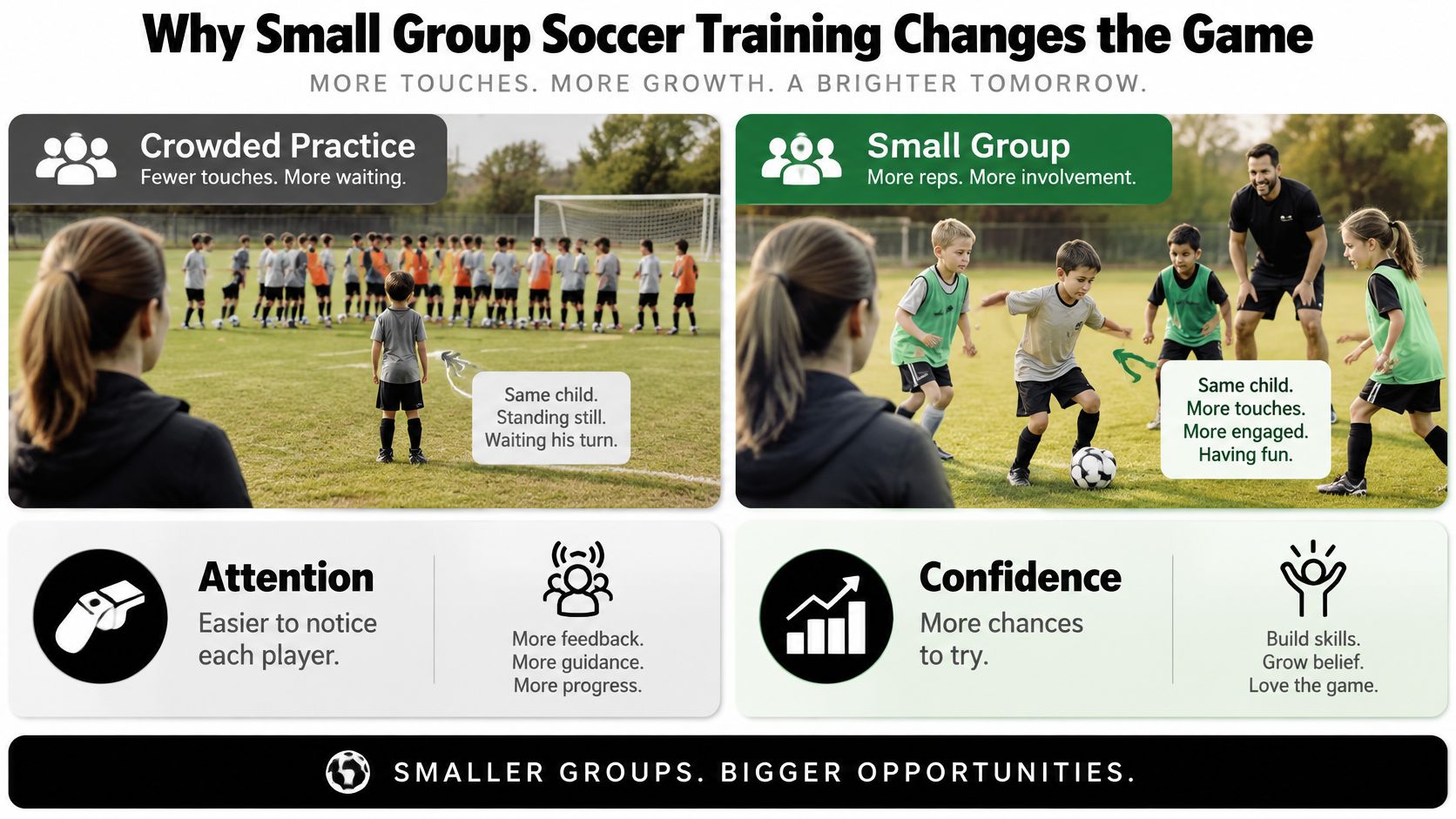
More involvement isn't a promise of mastery
In the comparison reported in US Youth Soccer's rationale for small-sided games, 4v4 versus 11v11 produced 585 more passes (135%), 481 more shots (260%), 301 more goals (500%), and 525 more one-versus-one encounters (225%).
Those are participation counts from the cited comparison, not guaranteed improvements for an individual child. They don't mean every small-group program will deliver the same experience.
Practical rule: Judge the opportunities a child receives, not just the number of children on the registration list.
Watch the player who usually hangs back. Can they find a teammate? Does the ball return often enough for them to try again after a mistake? Are they allowed to attack as well as defend?
A smaller game can make those moments easier to arrange. Whether they become useful learning depends on the space, rules, feedback, and challenge the coach chooses.
Building Sessions That Grow with the Players
Start with a visible skill target, not a collection of unrelated drills. For example, a child who stops every pass directly underneath their feet might practice receiving across the body, letting the ball travel toward the farther foot so they can face a useful direction.
Keep the opening activity simple enough that the player understands the movement. A partner passes, the receiver checks their surroundings, and the first touch moves the ball into available space.
The session structure below keeps technique connected to play.
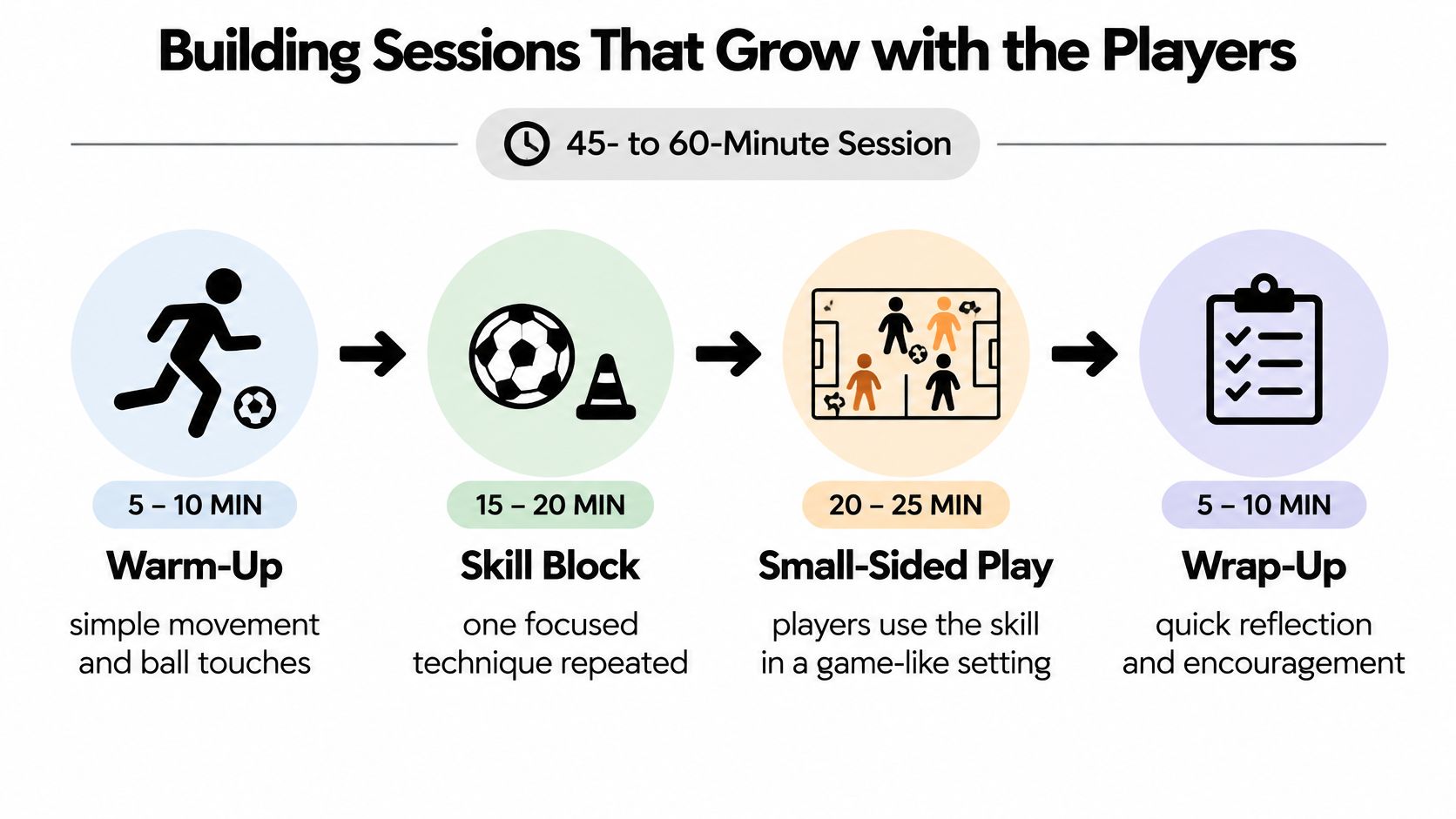
Move from the action to the problem
After players understand the receiving action, introduce an opponent. In a paired-team game, the receiver now has to decide whether turning is sensible or whether protecting the ball and passing back is better.
Then widen the challenge. Add teammates, change the pitch shape, or reward an attack that begins with a useful reception. Change one feature at a time, so the coach can tell whether the adjustment helped.
An eight-week small-sided-games intervention used three weekly sessions, progressively changed player numbers, space, and tactical constraints, and reported skill-test completion times improving from 40.99 to 36.90 seconds, a 9.98% reduction, alongside a very large Yo-Yo intermittent-endurance improvement; its implementation guidance includes two games lasting about 8 to 15 minutes, separated by brief coaching intervals.
Those findings are benchmarks from a small sample of older, trained male players. They aren't a prescription for preschoolers, and the study schedule shouldn't become a family's default commitment.
For young beginners, shorten or simplify the activity when attention fades. For more experienced players, increase the decision challenge before assuming they need harder running.
What a sample week could look like
A beginner's week might revolve around becoming comfortable receiving a moving ball. A school-age player's week could connect that same action to escaping pressure.
Player | Coached practice example | Optional playful follow-up |
|---|---|---|
Beginner | Stop or guide a partner's pass, then play toward an open target | Roll and receive a ball with a family member, letting the child choose the target |
School-age player | Receive while checking where a defender is approaching | Play a backyard keep-away game with room to turn or pass |
These are examples, not additional required workouts. If the child already has a busy playing schedule, the follow-up can be free play.
Progress when the child can notice and choose, not merely perform the movement on command. If they can receive neatly without opposition but panic when someone approaches, keep the same skill and make the pressure more manageable.
The technical development guide offers a related starting point for thinking about purposeful ball work.
Use the video as a discussion prompt with your coach: which activity matches your child's current need?
Finish by asking what the player noticed. An answer about space or an opponent tells you more than whether they can repeat the coach's instruction.
Choosing the Right Group Size and Setting
Buy the environment that addresses your child's current need. A private lesson, a small group, and a team practice can each serve a purpose, but they aren't interchangeable.
A player struggling with a particular ball-striking movement may benefit from uninterrupted individual feedback. A player who performs that movement comfortably alone may need teammates and opponents to learn when to use it.
Compare what your payment provides
Setting | Coaching attention | Decisions and interaction | Cost and fit questions |
|---|---|---|---|
Private lesson | Attention can stay on the individual | Ask how the coach introduces realistic choices | Is the specific need worth individual instruction? |
Small group | Feedback is shared but can remain personal | Teammates and defenders create changing problems | Does the actual price justify the feedback and involvement? |
Larger team practice | Attention must cover more players and team needs | Players work within their team's shared game | What does the team fee include, and is supplemental work necessary? |
Small-group instruction may cost less than private coaching, but don't assume it does. Ask about the full fee, missed-session policies, equipment, and whether a trial is available before comparing value.
Affordability deserves that care: reporting drawing on Aspen Institute Project Play identifies team fees as a major barrier for 32% of families, rising to 41% among lower-income families, and cites a 46% increase in family youth-sports spending over five years alongside declining participation.
There's no universal player-to-coach ratio that settles the decision. Watch whether the coach notices your child's attempts, offers usable feedback, and gives them another chance to apply it.
Match the field to the player
Age-Based Small-Sided Formats
The age-format progression described in the US Youth Soccer materials cited earlier is shown below. Treat these dimensions as developmental reference points, not proof that a particular commercial class is appropriate.
Age Band | Format | Approximate Field | Goalkeepers |
|---|---|---|---|
U-6 | 3v3 | 25 by 20 yards | No |
U-8 | 4v4 | 35 by 25 yards | No |
U-10 | 6v6 | 55 by 40 yards | Yes |
U-12 | 8v8 | 80 by 50 yards | Yes |
Ask the provider which current playing rules apply to its program. A training activity may also use a different layout to address a particular learning need.
For families around Humble, Kingwood, and Atascocita, the local indoor center discussed here offers Coerver-based soccer, Just for Girls, multi-sport options for younger children, leagues, and school-break camps. Its staff-led approach is an option to compare with volunteer-led recreation and private instruction.
A beginner may prefer a welcoming group over being the sole focus of a lesson. A girl seeking a lower-pressure entry may want to try a dedicated girls' class without assuming it will suit every girl.
Siblings can share an activity only if the coach can give each an appropriate challenge. Convenience isn't enough if one child dominates and the other spends practice avoiding the ball.
Coaching Tips That Raise Touches and Decisions
The coach's most useful move may be to say less. Children need enough information to understand the task, followed by room to attempt it without an adult narrating every touch.
Name the learning target aloud, using language a player can act on. For receiving, try asking the child to look for an open side before the pass arrives, rather than delivering a lecture about body position.
These coaching prompts keep attention on what players can notice and do.
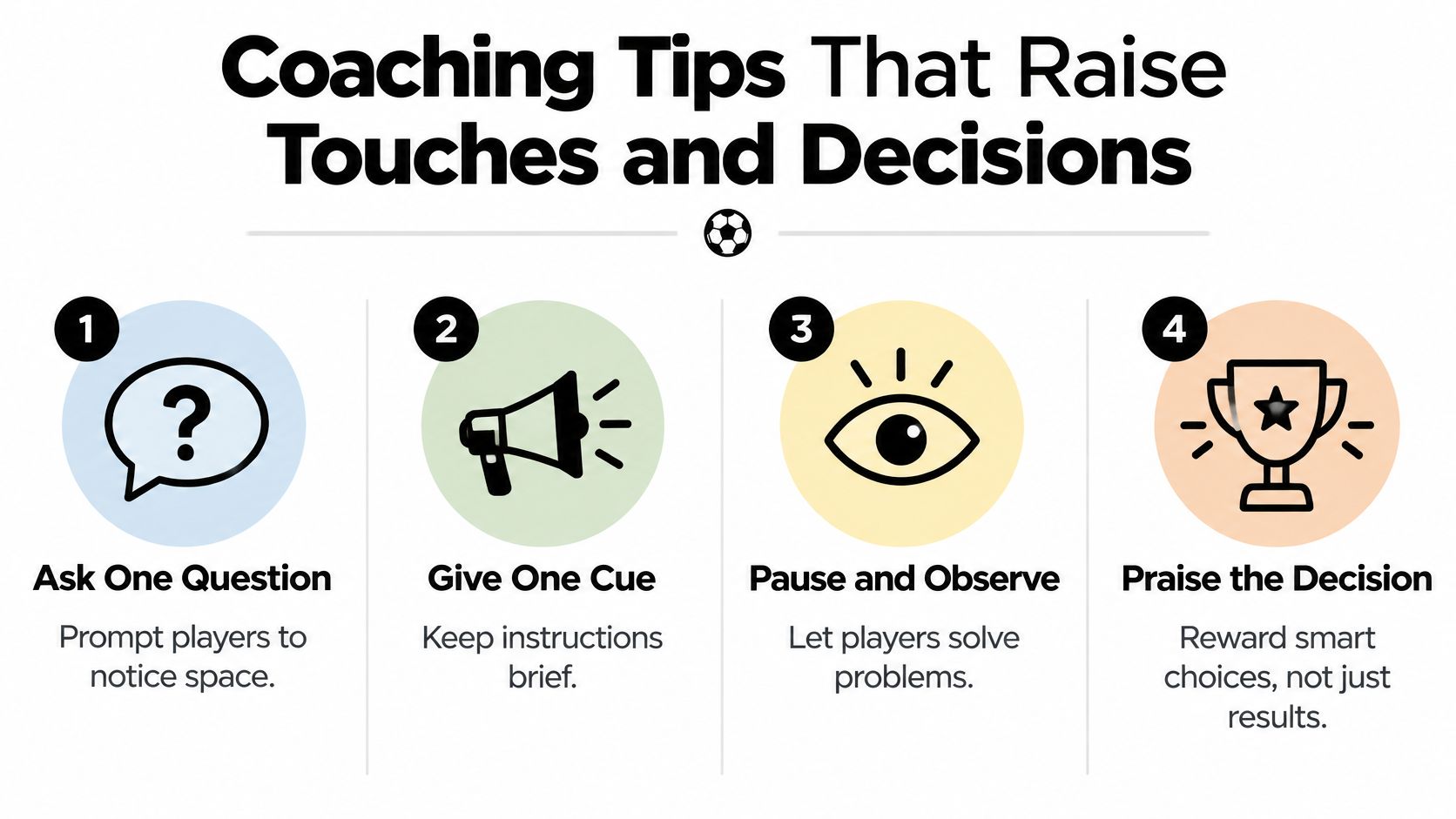
Make the intervention brief and usable
Freeze play only when there's a clear picture worth showing. Leave players where they are, point out the available space, and restart from that situation so they can attempt the choice immediately.
Avoid stopping for every imperfect touch. If a child notices the right option but miscontrols the ball, acknowledge the decision and give them another opportunity.
More talking usually means fewer touches. Stop when the explanation will help the next attempt, not simply because a mistake happened.
A creativity-first, Coerver-style emphasis on individual technique can fit inside this approach. A player might practice a change of direction, then use it in a game when a defender blocks the route ahead.
The move is a tool, not a performance requirement. If passing is the sensible option, don't insist on a dribble just because dribbling was the technical theme.
Adjust the game without taking it over
Rotate responsibilities. Let the quiet child start attacks and the confident scorer defend. Change opponents so players don't spend the entire session in the same comfortable or discouraging matchup.
Use a purposeful bonus. Reward a forward pass after a controlled reception, but remove the condition if players start forcing passes into closed space.
Observe selectively. Look for successful receptions, useful forward passes, or recoveries rather than trying to record every action.
Protect freedom. Leave room for children to surprise you with a solution that works, even if it isn't the one you expected.
Too many simultaneous conditions can make a game confusing. A passing rule that discourages every dribble or shot may undermine the broader learning you wanted.
The small-sided soccer games guide is a useful place to discuss game choices with a coach rather than collecting more drills.
For beginners, including girls new to organized soccer, start with belonging and achievable challenges. Notice who volunteers to receive, who tries after a mistake, and who needs a gentler introduction to pressure.
Don't mistake quietness for lack of interest. Give the player a manageable role and enough uninterrupted play to show you what they can do.
Spotting Progress Without Pushing Too Hard
A lively practice isn't proof of lasting improvement. Your child may face a favorable opponent, receive better passes, or arrive more rested than last time.
Look for patterns rather than treating a single session as a verdict. Observation should help the coach adjust teaching, not turn every game into an assessment.
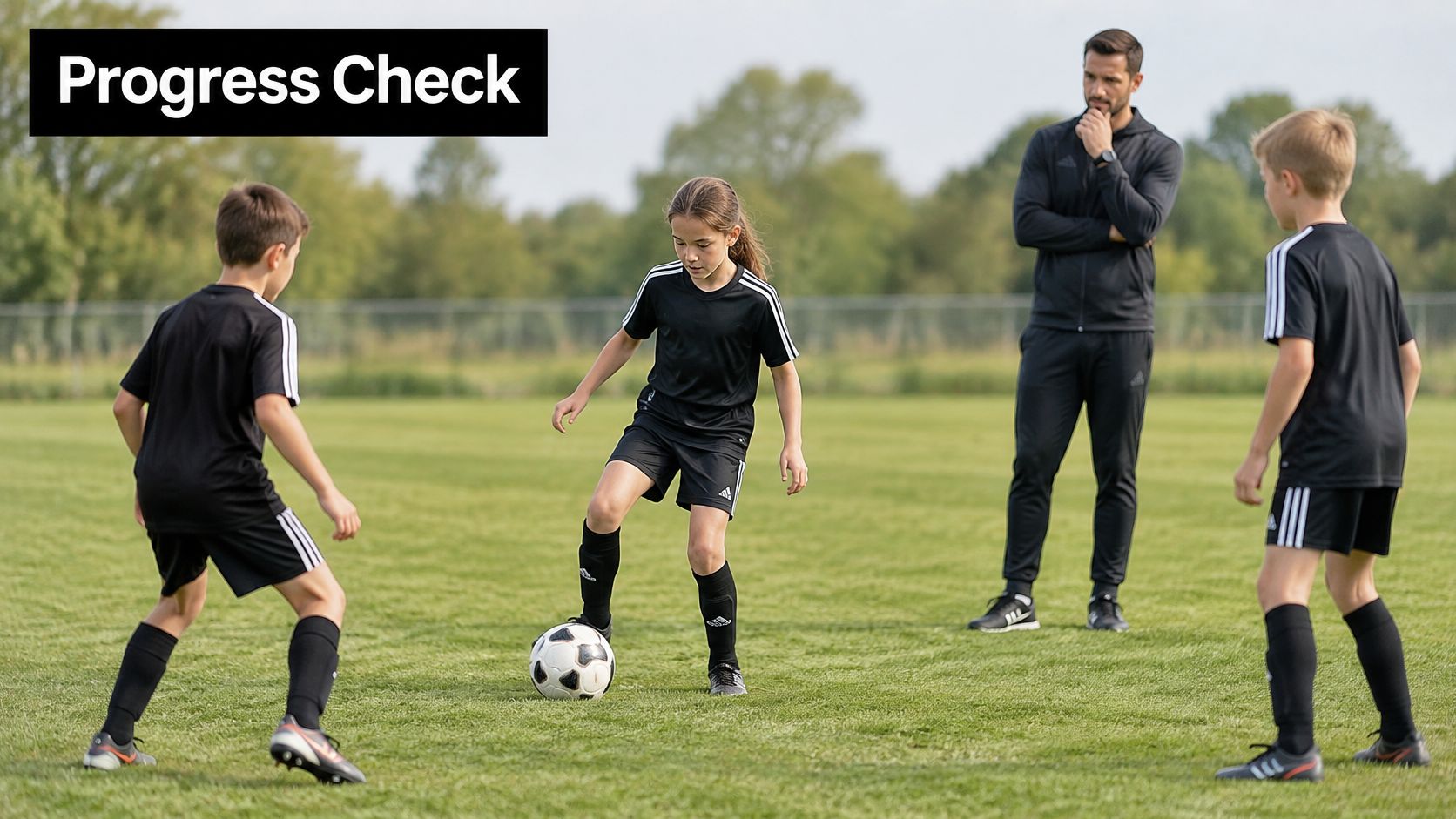
Compare like with like
In a study examining variability in youth small-sided games, actions in 3v3 and 6v6 varied between sessions, with coefficients of variation of 52.2% for received balls, 133.8% for conquered balls, 80.1% for lost balls, and 90.1% for both attacking balls and shots.
These figures describe variability in recorded actions. They aren't percentages of skill gained or lost.
For useful comparisons, keep the pitch, player numbers, game length, scoring conditions, and rest consistent. Record repeated comparable observations and describe both the usual performance and how widely it varies.
Use the same indicator you selected during coaching, rather than adding a new test whenever a child has a difficult day. Rotate matchups deliberately and note meaningful changes in the playing conditions.
For toddlers and beginners, adolescent technical-action counts aren't appropriate targets. Engagement, willingness to approach the ball, movement quality, and growing confidence are more useful early observations.
Count the whole week
Small groups don't automatically mean light workloads. A child who participates constantly may need more recovery than a parent expects from watching a short session.
A 2025 review of youth soccer injury risks identified peak height velocity, approximately 11.5 years for girls and 13.5 years for boys, as a higher-risk period for overuse injuries, found 35% higher injury risk when organized-sport time exceeded twice the time spent in free play, and reported injury reductions with plyometrics, trunk stabilization, and structured load monitoring in several prospective studies.
Those average growth-spurt ages aren't individual deadlines. Don't use them to diagnose maturity or decide that a child outside those ages has no risk.
Show the full calendar. Include school sports, league practices, private lessons, camps, and games when discussing additional training.
Adjust after heavy competition. Ask the coach to reduce repeated sprinting and hard kicking after a tournament instead of automatically completing the usual session.
Respond to symptoms. Persistent pain, limping, or altered movement calls for stopping and seeking appropriate medical guidance, not encouragement to push through.
Preserve unstructured time. Leave space for child-led play and days without another coached commitment.
Recovery check: A smaller group doesn't replace recovery, and an available class isn't necessarily a class your child needs.
There isn't a responsible universal answer to how many extra sessions fit. Make that decision with the coach using the child's current schedule, recovery, enthusiasm, and any relevant medical advice.
Taking the Next Step with Local Training
Before committing to a program, watch how your child responds to the people and the setting. A polished facility matters less than whether the coach can explain what your player needs and help them feel comfortable attempting it.
Bring your actual weekly calendar, not an idealized version without homework, travel, or tired evenings. Ask where targeted instruction would fill a gap and where it would merely duplicate something your child already receives.
Use the trial to answer practical questions
A free trial gives a beginner room to explore without making a long-term decision first. It also lets a player seeking technical work experience a group without assuming they need a travel-club schedule.
During that visit, keep your attention on these checks:
Participation. Does your child receive repeated opportunities to use the ball and make choices?
Purpose. Can the coach identify a clear skill target and explain why it suits your child?
Fit. Does the proposed commitment leave room for the rest of the child's week, including play and recovery?
The local soccer training center overview can help you prepare questions about program placement. Ask which indoor class suits your child's experience, whether a dedicated girls' group is appropriate, and how progression between programs works.
Make joining straightforward, not automatic
Online registration and real-time field status are conveniences, not reasons to enroll. Clear communication about attendance, scheduling, and what follows a trial should support your decision rather than pressure you into it.
For coaches or service providers reading alongside parents, AmaJova's resource on how to simplify fulfilment for service clients offers a related operational perspective. Families still need the essentials in plain language: what they're booking, what happens next, and whom to contact.
The longer-term aim is developing well-rounded, creative players who enjoy movement. Request the trial, watch your child, and choose deliberately rather than adding another unstructured assignment at home.
JC Sports Houston offers indoor, Coerver-based soccer training, including Just for Girls, alongside multi-sport classes, leagues, and school-break camps. Visit JC Sports Houston to request a free trial and see whether its small-sided coaching approach fits your child's skills, confidence, and weekly schedule.

Comments