

Sports of All Sorts for Houston Kids

You're standing by the door with a water bottle in one hand and a nervous three-year-old holding the other, wondering if you've signed up too early. Then a coach rolls out a soft ball, your child kicks it sideways, laughs, and runs after it. That small moment is where sports of all sorts starts to make sense.
A Morning at the Multi-Sport Class
The first ten minutes rarely look tidy. One toddler throws a ball with the wrong hand and grins anyway. Another child watches from beside a parent, then joins a cone game once the running starts.
Parents usually ask the same honest questions. Is my child too young? Will they just stand there? What happens if they don't like soccer, or baseball, or whichever activity comes first?
A good multi-sport class expects all of that. Coaches keep groups moving through short stations, so a child who isn't ready to kick can throw, balance, hop, or chase. No one activity has to carry the whole morning.
What that morning is quietly building
Under the giggling, four things are taking shape.
Motor skills: Running, stopping, jumping, and changing direction teach a child how their body moves in space.
Confidence: Small wins, like catching a bounced ball, give beginners a reason to try the next station.
Creativity: Open games invite children to solve simple problems, such as finding a new path around a cone.
Love of movement: When play feels social and varied, exercise doesn't feel like a chore.
The goal of a first class isn't a perfect technique. It's a child asking to come back next week.
That's the lens for everything that follows. You'll see how variety works by age, why small-sided games help older children think faster, and how to choose a program without locking your family into one sport before your child is ready.
What Multi-Sport Play Really Means
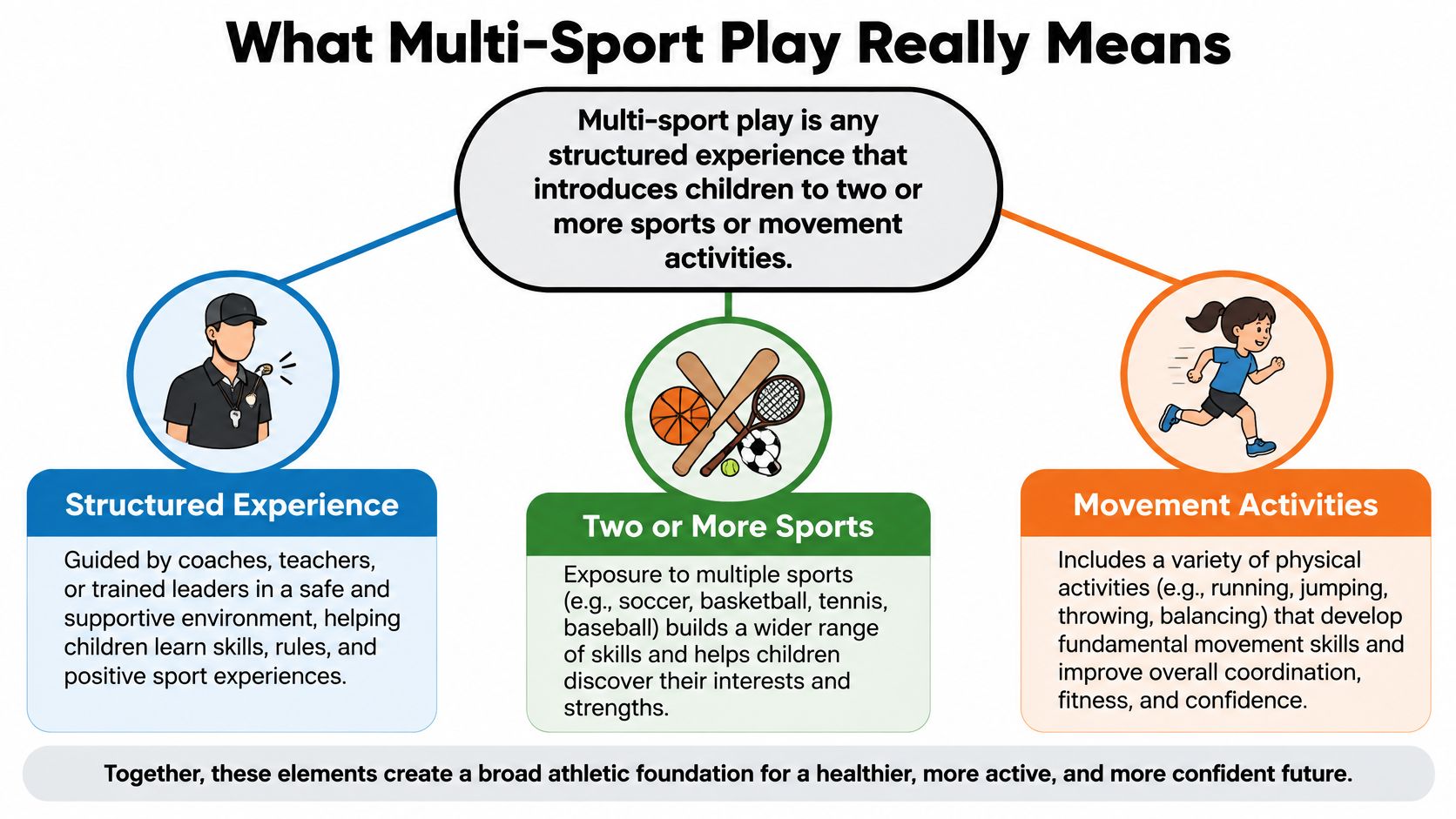
Multi-sport play is any structured experience that introduces children to two or more sports or movement activities within one program or season. It's different from free play at the park, because a coach plans the rotation. It's also different from early specialization, where a child commits to one sport year-round.
Think of it as a sampler plate instead of a single entrée. Your child tastes a little soccer, a little baseball, some basketball movement, and general athletic games. The point is exposure, not mastery in week one.
The building blocks you can actually see
Parents don't need coaching jargon. Watch for these movements instead.
Running and jumping: A child sprints to a base, hops over a low hurdle, then lands with both feet.
Throwing, kicking, and striking: One station uses hands, the next uses feet, and another adds a bat or similar tool.
Balance and rotation: Standing on one foot, turning to throw, or twisting to avoid a tag builds control.
Quick decisions: A coach calls a color, and children choose which cone to run to before a teammate gets there.
Each block supports a wider skill. Balance helps a future basketball player land safely. Throwing helps hand-eye coordination. Scanning a small field helps a soccer player spot open space.
Variety isn't random, and it isn't a scheduling accident. Coaches use sports of all sorts on purpose, because children develop coordination, confidence, and interest at different speeds. A broad menu gives every child more chances to find a movement that clicks.
Why Variety Matters for Growing Bodies and Brains
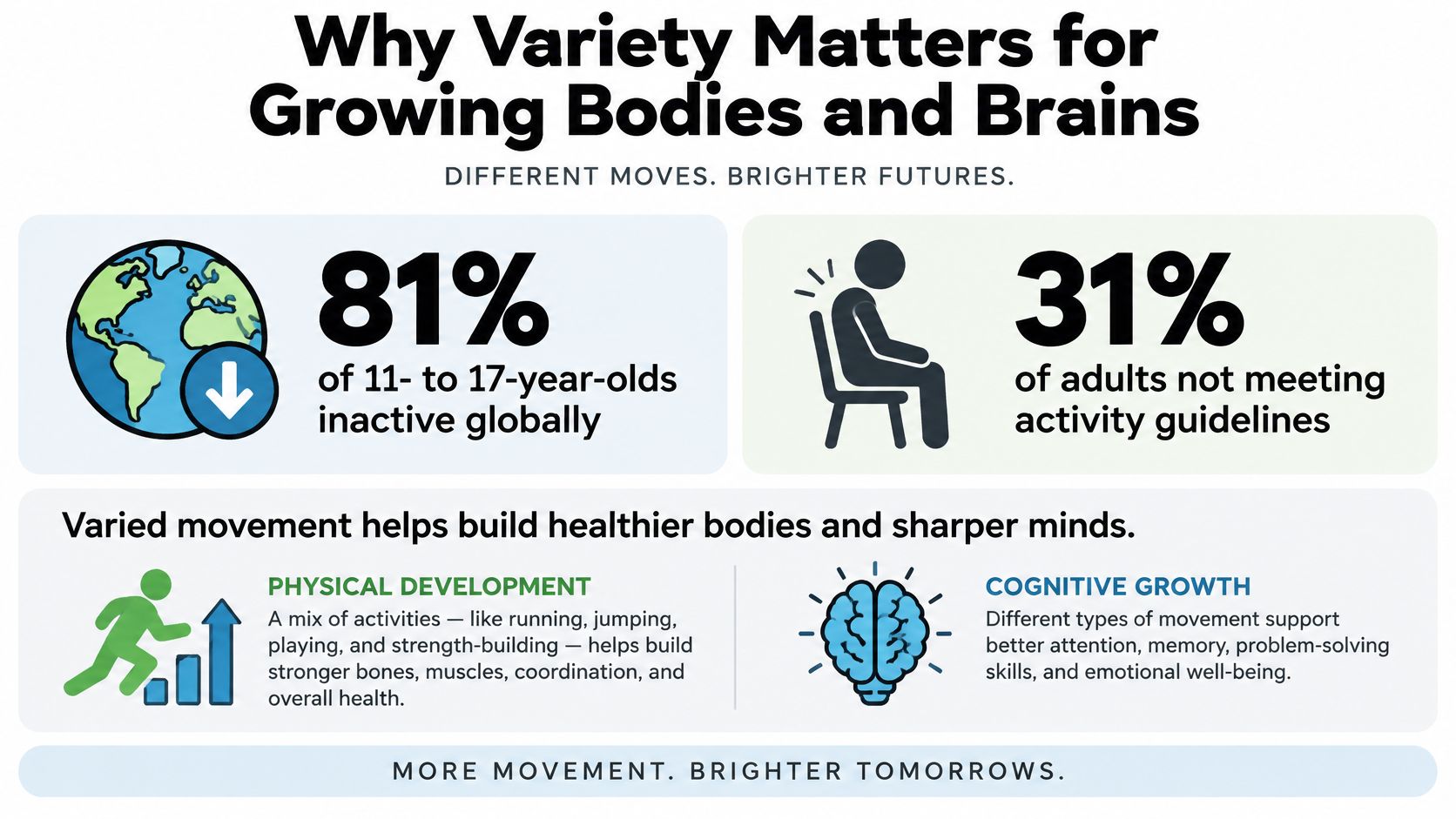
The World Health Organization reports that 31% of adults worldwide do not meet recommended physical-activity levels, and its detailed estimate places inactivity at 81% among 11- to 17-year-olds, as shown in the WHO physical activity fact sheet. Those numbers explain why childhood habits matter long before high school.
For children and adolescents, regular movement supports bone health, healthy muscle growth, motor development, and cognitive development. Varied play reaches those areas from several directions at once.
Three payoffs, not one
Motor growth comes from mixing loads and patterns. Kicking, throwing, and balancing don't stress the body in identical ways, and families exploring practical motor skill activities for young children can see how simple drills build step by step.
Cognitive growth shows up in attention and problem-solving. A child tracks a ball, remembers a rule, and decides where to move next.
Social growth is just as visible. Children take turns, share equipment, celebrate a teammate, and learn that a missed shot isn't a big deal.
Mindset shift: The question isn't which sport to pick first. It's how to keep a child moving joyfully for years.
Movement variety can also live outside field sports. Families comparing rhythm and coordination options sometimes browse studios and booking platforms for dance, which trains balance and timing in a different setting.
In Houston, long humid summers make consistency harder outdoors. Indoor options help families keep a routine when heat or storms cancel plans, so variety stays a habit rather than a fair-weather idea.
Comparing Class Formats by Age
Parents often treat class formats as rivals. They're better understood as a sequence. Toddlers need exploration, elementary-age children need lots of touches and decisions, and older children can layer in sport-specific detail once the basics feel natural.
Multi-Sport Class Formats Compared
Format | Typical Ages | Core Focus | Typical Session | Best For |
|---|---|---|---|---|
Toddler multi-sport | 2 to 5 | Balance, running, throwing, kicking | Short rotating stations with frequent breaks | First-time movers and shy beginners |
Small-sided play | 5 to 8 | Touches, scanning, teamwork, agility | 3v3 or 4v4 games with simple rules | Children ready for teammates and choices |
Skill-specific leagues | School-age | Technique, positions, game rules | Practice plus scheduled league play | Children showing clear interest in one sport |
A toddler circuit might move every few minutes. Children roll balls, run through tunnels, toss beanbags, and kick toward a big target. Attention spans are short, so coaches keep instructions to one cue at a time.
By ages 5 to 8, small-sided play fits better. Fewer players means more involvement, and children begin to understand space, passing, and defending without waiting in long lines.
Skill-specific leagues add structure later. A child learns positions, rules, and repeatable technique in soccer, baseball, or basketball. That step works best when they've already built general coordination and ask for more of that sport.
Practical rule: Match the format to what your child can enjoy today, not to the athlete you hope they'll become at fourteen.
If your child loves stations but dislikes scorekeeping, stay in multi-sport play a little longer. If they're asking for real games and teammates, a small-sided league may be the natural next step. Progress doesn't have to be rushed to be real.
How Small-Sided Games Build Speed and Creativity
A full-size game can leave a young player watching the ball from far away. Shrink the field and remove players, and everything speeds up. That's decision density, meaning more scans, touches, accelerations, and choices packed into each minute.
Here's a small-sided soccer moment in action.
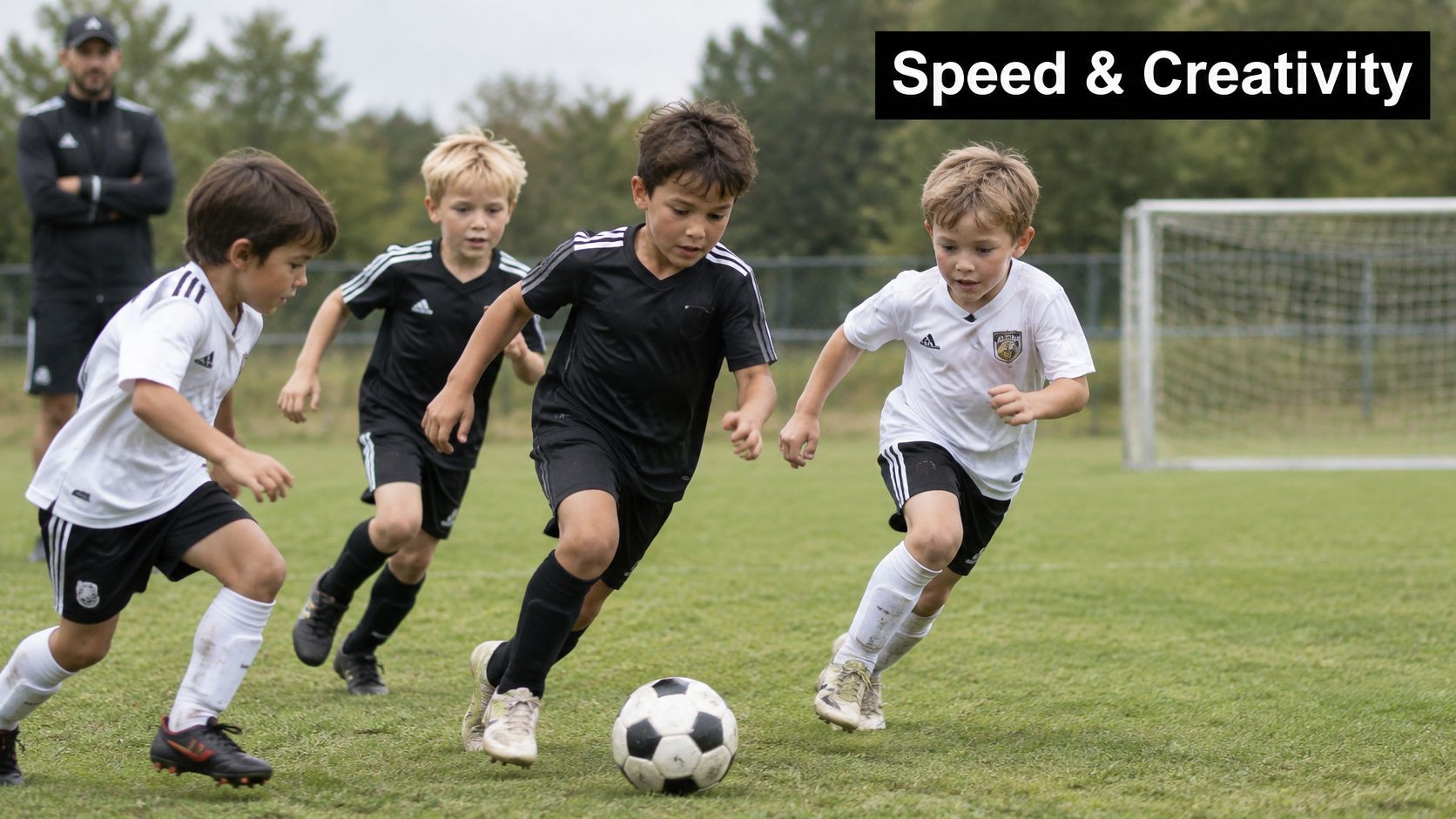
A 2025 randomized study of 26 highly trained youth soccer players found small-sided games produced significantly greater gains in 10 m and 30 m sprint performance and Illinois agility scores than a dribbling circuit, while also improving passing accuracy and interceptions more effectively, according to the 2025 randomized small-sided games study. Heart-rate and perceived-exertion responses didn't differ significantly, so the edge wasn't harder cardiovascular work.
A 3v3 example you can picture
Set two small goals: Players attack quickly instead of waiting for a long buildup.
Add a two-touch limit: Children must look up before the ball arrives.
Restart fast after turnovers: Losing possession becomes a cue to sprint and defend.
Coaches can widen the field for beginners or narrow it for experienced players. They can also swap two-touch play for free touches when children are still learning control, an approach that connects with ways to develop creative thinking through sport.
Watch how quickly players have to choose a pass, a dribble, or a run in the clip below.
That study involved highly trained adolescents, not preschool beginners. Coaches should scale field size, work intervals, and rules to age and ability. The principle travels well, but the intensity shouldn't be copied without adjustment.
The Case Against Early Specialization
More hours in one sport can look like the fastest path forward. Travel teams, club pipelines, and well-meaning sideline pressure can push families that way early. For growing children, that shortcut often creates problems it promises to solve.
Sports-medicine guidance generally discourages early single-sport specialization before puberty and supports multisport participation, linking diversification with broader motor-skill development and potentially lower exposure to repetitive overuse, psychological stress, and burnout, as summarized in the sports medicine review on early specialization.
Why rotation protects development
Different sports distribute mechanical loads differently. Throwing, kicking, jumping, striking, and balancing practice complementary muscles and movement patterns. Repeating one pattern all year stresses the same tissues while narrowing what a child learns to do.
Rest is part of the plan, not a gap in it. Commonly cited safeguards include at least one or two rest days each week and roughly three months away from organized training annually, divided into recovery periods. Families interested in load monitoring can also explore sports wearables injury avoidance insights for a broader view of fatigue and recovery.
Watch enjoyment: A child who dreads practice may need variety or rest, not more repetition.
Track total hours: Count school, club, and private sessions together, not separately.
Follow motivation: Add sport-specific training gradually when your child asks for it and recovers well.
More organized training is not necessarily faster development. A rested, curious child often learns more from two varied sessions than from five identical ones.
Children's coordination, strength, and tolerance for training change quickly. Coaches should judge those changes individually, not by adult performance standards. Sports of all sorts, paired with real downtime, gives families a safer way to build a resilient athlete.
Choosing the Right Program for Your Child
A polished website doesn't tell you how a coach handles a crying toddler. Use a checklist, visit if you can, and ask what a typical class looks like for your child's exact age.
National evidence indicates youth-sports costs rose 46% from 2019, a 2024 parent survey estimated average spending of $1,016, and organized participation among U.S. youth ages 6 to 17 reached 55.4% in 2023, according to congressional testimony on youth sports access and costs. Price matters, but total cost matters more.
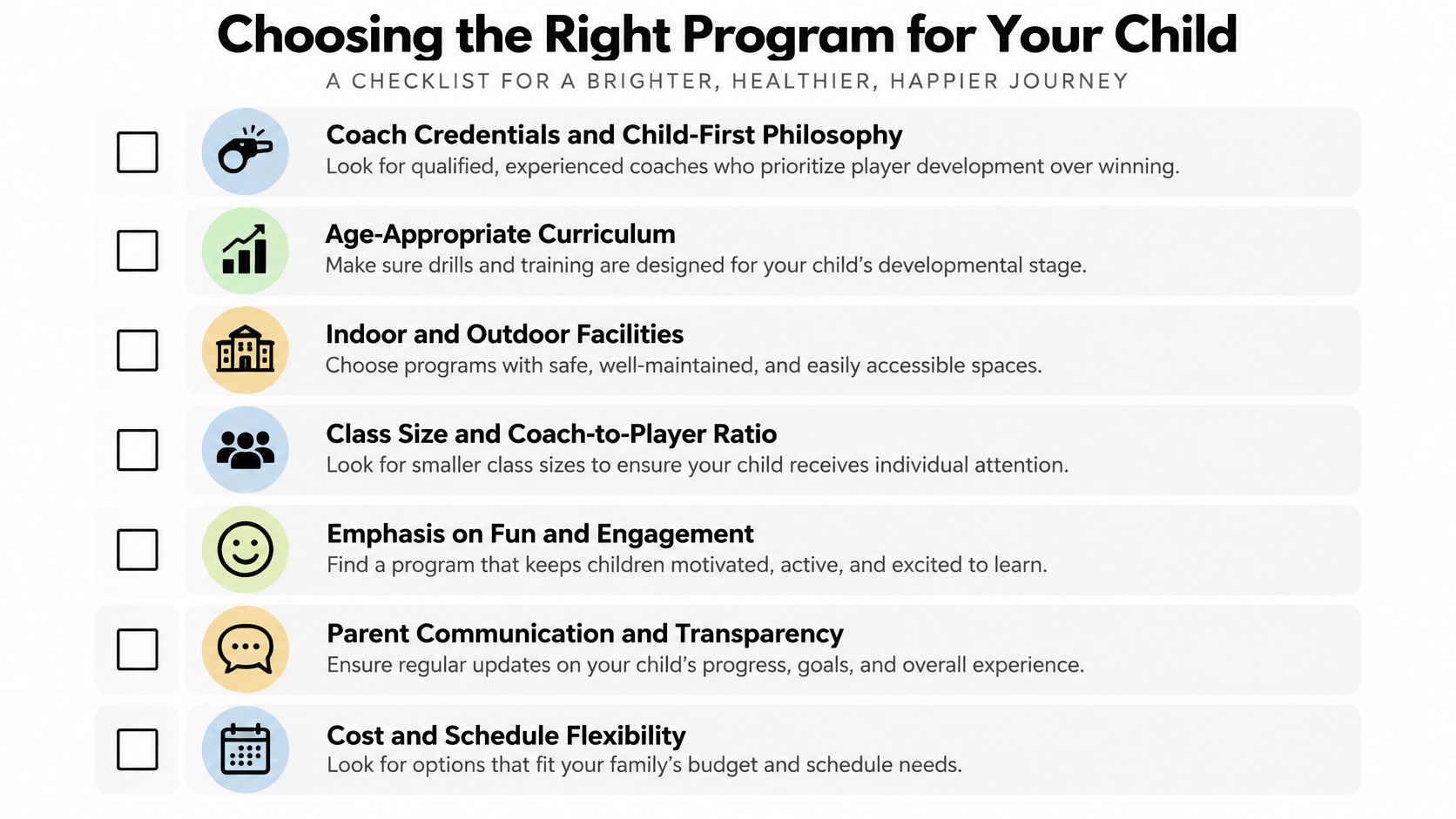
Your seven-point check
Coach philosophy: Do coaches learn names, encourage effort, and keep winning in perspective?
Age-appropriate curriculum: Are drills matched to attention span and physical development?
Safety and weather reliability: Is there an indoor option during Houston heat or storms?
Low-commitment trials: Can your child try a class before you buy gear?
Transparent total cost: Add registration, shoes, equipment, travel, and break camps together.
Sibling-friendly scheduling: Can brothers and sisters train on nearby days or times?
Clear pathways: Can a toddler progress toward leagues, as outlined in this guide to how youth sport organizations are structured?
Families who want non-field options too can compare BJJ and Karate options for kids alongside team sports.
Ask yourself one sorting question before registering. Does this program fit my child's interest and energy, or only my schedule? The honest answer usually points to the right choice.
A Simple First Step for Houston Families
A strong first experience has a recognizable feel. The space is tidy and safe, the coach greets children by name, and the warm-up starts with movement instead of a lecture. Groups stay small enough that no child disappears at the back.
From there, stations rotate. Children might kick at a target, throw to a partner, run a short agility path, then finish with a small game and a celebratory high-five line. Parents can see effort being praised more loudly than outcomes.
What to do this week
Pick one trial: Choose a single class that matches your child's age, not a full season.
Prepare: Bring water, comfortable shoes, and low expectations for perfect listening.
Watch for curiosity: Notice which station your child returns to, talks about, or imitates at home.
Decide after, not before: Let enjoyment and recovery guide the next enrollment.
One local option is JC Sports Houston, which offers multi-sport classes for toddlers alongside soccer, baseball, and basketball pathways for older children in Humble, Kingwood, and Atascocita. Whether you choose that center or another program, use the same checklist and start with a trial.
Families don't need to find the perfect sport on day one. They need a setting where a child can try, stumble, laugh, and try differently. That's the deeper value of sports of all sorts.
Start with variety, follow your child's curiosity, and protect rest along the way. The goal isn't a trophy this season. It's a child who still loves movement years from now.
If your child is ready to try soccer, baseball, basketball, and playful movement stations in one welcoming setting, JC Sports Houston offers age-appropriate multi-sport classes, leagues, camps, and a free trial for new families in the Humble, Kingwood, and Atascocita area. Visit JC Sports Houston to tour the facility, check schedules, and book a first class that lets your child explore sports of all sorts at their own pace.
Comments