

Youth Soccer Levels Explained for Houston Parents

You're comparing soccer programs after dinner, with a team invitation open on your phone and your child asking when they can play again. One program sounds impressive, another fits the school pickup routine, and neither makes it obvious what your child will do on the field. For Houston parents, choosing well starts with a different question: Which environment fits this player right now?
Why Two Youth Soccer Levels Can Feel Very Different
Consider a hypothetical pair of Houston families. A parent in Humble receives an invitation to a developmental academy, while a parent in Kingwood gets an offer for a competitive team. Both feel like exciting opportunities, but the names don't reveal whether the children will spend practice exploring with a ball or rehearsing team tactics under pressure.
The first child might still need encouragement to challenge for possession. The second might already seek out opponents and want help recognizing passing options. Giving both children the same session wouldn't necessarily serve either of them.
Read the Experience Behind the Label
A beginner's small-sided environment and an advanced full-sided team can both be excellent choices. Their value depends on what the coach asks players to do, how the children respond, and whether the demands match their readiness.
When you're looking for youth soccer levels explained, separate these questions:
Developmental purpose: Is the program introducing soccer, strengthening technique, or preparing a team for demanding competition?
Playing conditions: Will your child participate actively, or struggle to get involved?
Family commitment: Can you support the actual schedule, travel, and total expense?
Child motivation: Does your player want this experience, or mainly want the invitation?
Practical rule: Ask what your child will experience during an ordinary practice, not just what the team calls itself.
Change Programs for a Clear Reason
A move can make sense when a player needs a different challenge, more involvement, specialized instruction, or a workable schedule. It shouldn't require treating the previous program as a failure.
Before accepting an invitation, finish this sentence: “We're considering this change because our child needs…” If the answer is only a more impressive jersey or a stronger-sounding title, keep asking questions.
Understanding U-Levels and Developmental Readiness
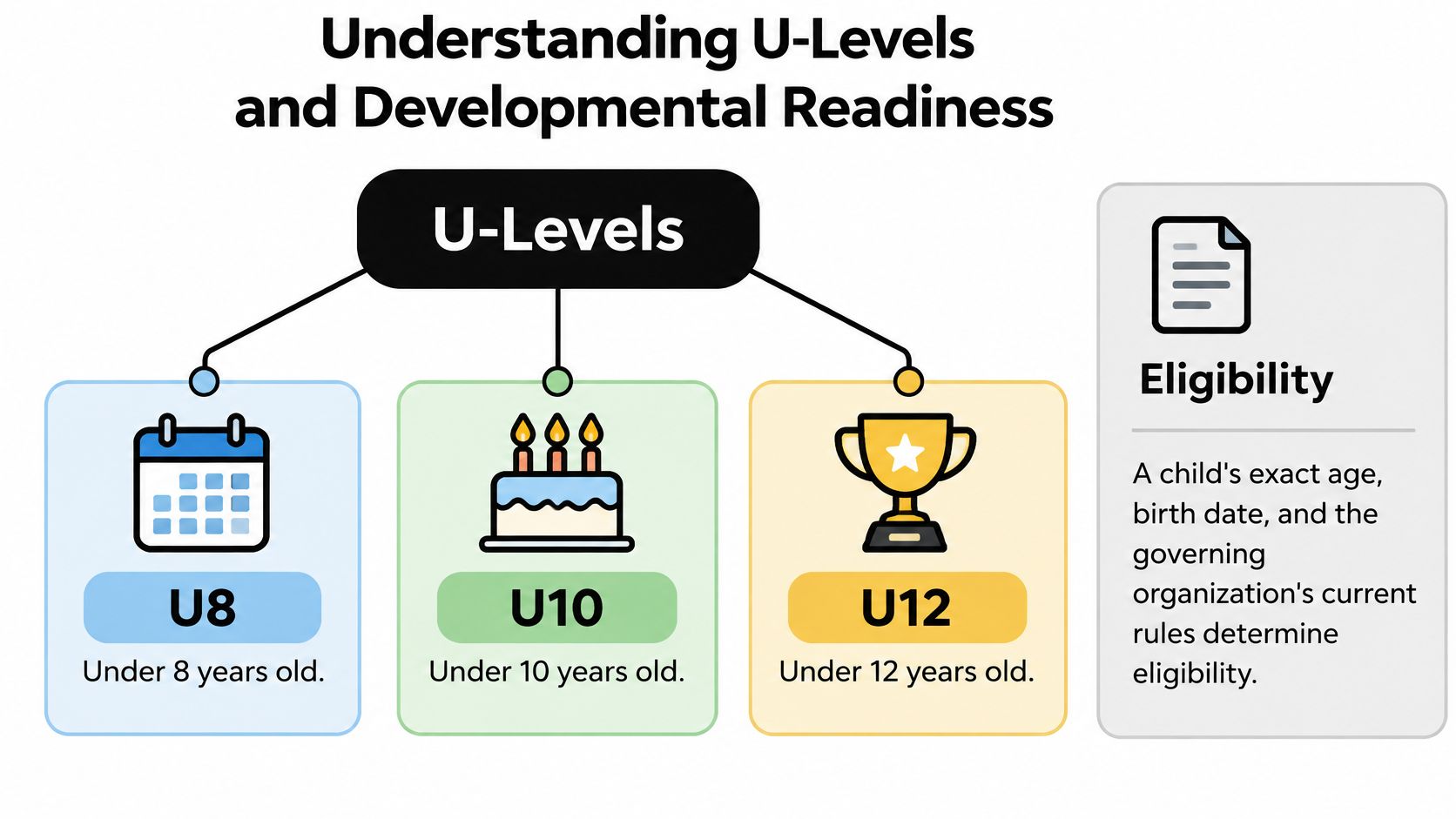
U-levels are age-group labels, not skill ratings. The shorthand “U” means “under,” but parents shouldn't interpret it as a universal birthday rule: the US Youth Soccer age matrix describes foundational groups such as U8 for children aged 8 and younger and U10 for children aged 10 and younger, subject to the applicable eligibility cycle.
That's why you shouldn't assume every child on a roster must be the same exact age. A child's birth date and the organization's season-specific rules determine placement.
Check Eligibility Before Comparing Teams
Treat the infographic as an introduction to the labels, not an eligibility calculator. For the 2026–27 season, US Youth Soccer, AYSO, and US Club Soccer announced a change to an August 1–July 31 formation cycle, so consult the birth-year and season matrix guidance and confirm your program's implementation.
Ask the registrar which matrix applies to the season you're entering. School grade alone isn't a reliable substitute, and a friend's placement doesn't establish your child's eligibility.
Keep these distinctions clear:
Age group: Identifies the eligibility category.
Program level: Describes the intended learning or competitive environment.
League name: Identifies the competition a particular team enters.
Look Beyond the Birthday
Once eligibility is settled, watch how your child handles soccer tasks. Can they stay engaged when another player approaches? Do they try again after losing possession? Are they beginning to notice teammates rather than following only the ball?
These are useful observation prompts, not entrance tests. A hesitant beginner may need reassurance, while a confident dribbler may need help sharing space and making choices.
Parents who want broader context around attention, movement, and emotional development can explore Guiding Growth's child development questions answered. Use that perspective to prepare a conversation with the coach, not to diagnose readiness from a checklist.
Eligibility tells you where a child may register. Observation helps you discuss how they should learn.
Comparing the Main Youth Soccer Levels
A useful comparison starts by separating format from environment. Small-sided soccer describes how players participate; recreational, travel, academy, and elite labels describe different program intentions. They aren't mutually exclusive categories.
Names also vary by organization. Treat the descriptions below as questions to investigate, not promises that every program using a label follows the same rules.
Youth Soccer Environments at a Glance
Environment | Typical developmental purpose | What parents should examine |
|---|---|---|
Small-sided | Create manageable soccer problems with fewer players | Whether the format suits the players and keeps them involved |
Recreational | Offer an accessible setting for learning and participation | Coaching support, placement approach, inclusion, and playing-time policy |
Travel or competitive | Combine player development with structured competition | Selection criteria, opponent demands, travel, and match opportunities |
Academy or club | Organize focused instruction or a broader team pathway | What “academy” means locally, who coaches, and how training connects to games |
Elite | Challenge players seeking a demanding performance environment | Individual role, feedback, selection expectations, and overall commitment |
These descriptions aren't a national ranking system. In particular, “academy” needs an explanation: ask whether it refers to a training class, a team program, or a competitive pathway.
Compare the Actual Role Offered
Suppose a hypothetical Atascocita family is choosing between a local beginner league and a selective competitive roster. Their child enjoys dribbling but becomes quiet when opponents close down space.
The competitive invitation may be flattering. Yet the useful questions are whether the coach can adapt tasks, whether the player will receive meaningful match opportunities, and whether the child wants the added demands.
The local league deserves equal scrutiny. A relaxed label doesn't guarantee thoughtful instruction, just as a selective label doesn't guarantee excessive pressure.
Ask both programs:
Who will coach? Meet the person responsible for ordinary sessions.
What will my child work on? Request an example of a practice activity.
What happens on match day? Clarify roster use and playing-time expectations.
How is progress discussed? Ask what feedback families can expect.
Choose Opportunity, Not Association
A child who wants focused instruction might combine local games with a separate training class. Another might prefer an integrated team environment. Neither arrangement should be dismissed because it doesn't resemble someone else's pathway.
A place on a roster is an invitation to an environment, not a prediction of a child's future.
Compare the actual coaching assignment, roster, schedule, field format, and playing model. The offer matters less than the role your child will have after accepting it.
How Age Groups Change the Match
Think of field space like classroom space. A larger room doesn't automatically create a better lesson; the teacher still has to arrange tasks children can understand and participate in.
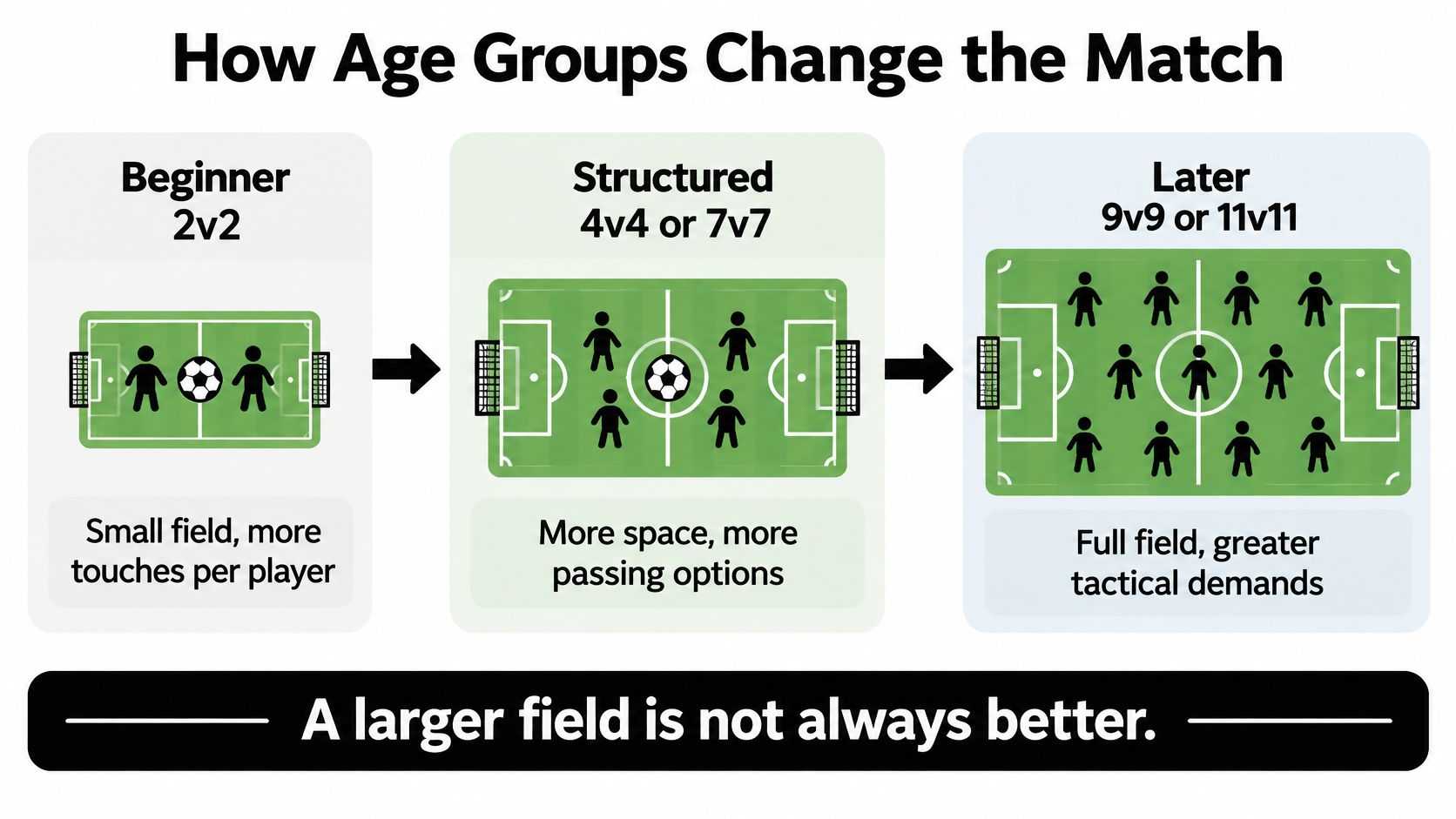
U.S. Soccer's player-development framework includes 1v1, 2v1, and 2v2 situations for introductory development and progressively more complex environments, including 4v4, 7v7, 9v9, and 11v11. Its small-sided standards address player numbers, field dimensions, ball size, game length, and special rules to support involvement and on-the-ball development.
The illustration shows the broad progression, rather than a universal assignment for every age group.
Follow the Player's Decisions
In a beginner activity, a child might face a clear choice: dribble past an opponent or pass to a nearby teammate. When possession changes, that same child immediately has a defensive problem to solve.
As the playing area and team structure expand, the questions become more layered. Where should a player stand before receiving? When should a teammate support behind the ball? Who protects space if someone presses?
The distinction isn't “easy soccer” versus “real soccer.” Coaches are changing the amount of information players must recognize and use.
Watch involvement: Does your child repeatedly take part in the action?
Watch understanding: Can they explain what they were trying to do?
Watch challenge: Are mistakes productive, or does the task leave them disconnected?
Observe More Than the Score
A beginner who rarely encounters the ball may finish a match without practicing the decisions they need. An experienced player may need a more demanding task than repeatedly succeeding without pressure.
For an additional viewing prompt, follow where players move before and after possession changes.
Ask a prospective coach why the chosen format suits the group. A useful answer should describe what the players are learning, not point to the size of the field.
What Changes in Coaching and Training Expectations
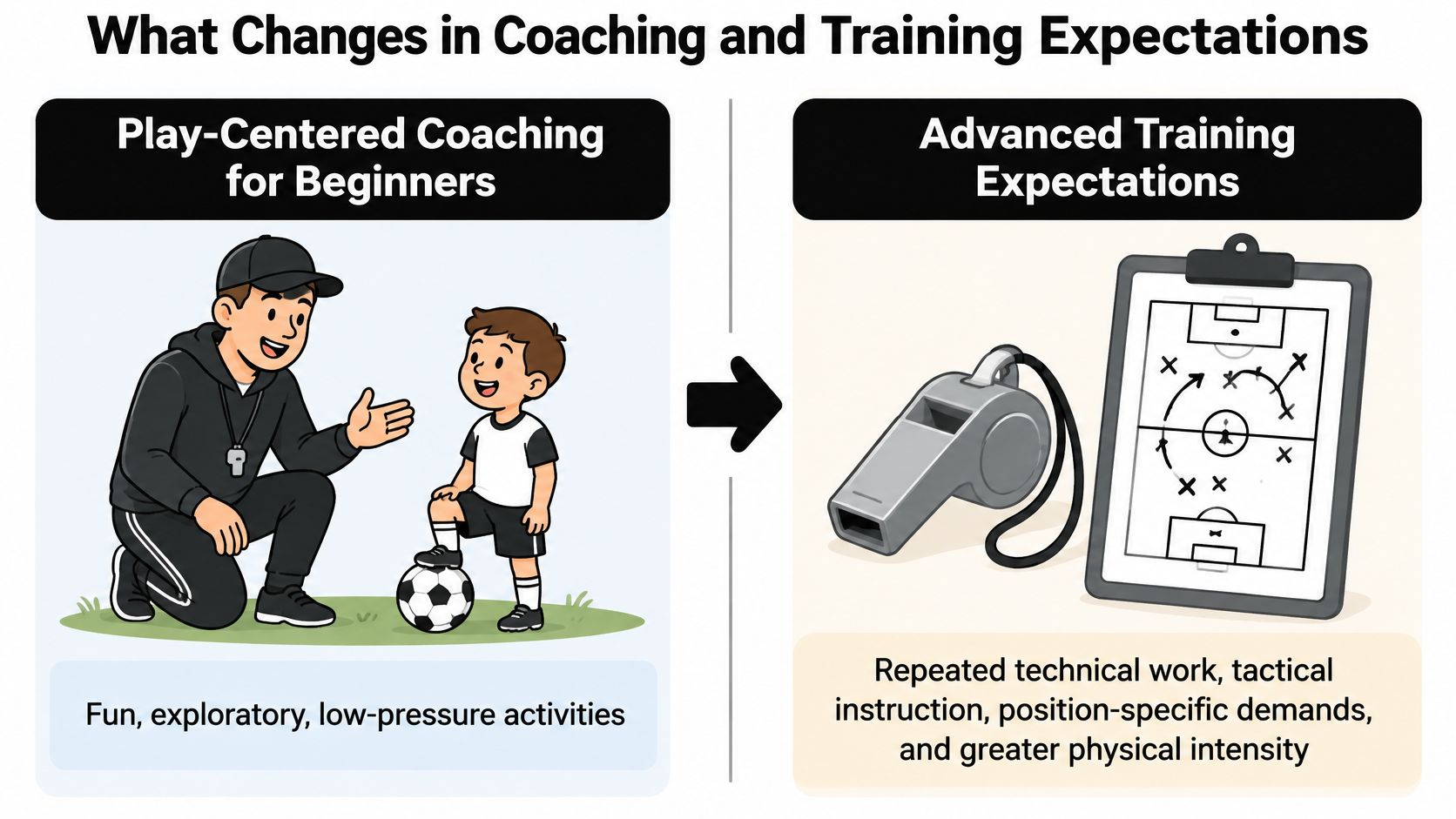
Beginner coaching should give children understandable tasks and permission to experiment. More advanced instruction can ask players to repeat techniques under pressure, recognize tactical cues, and understand responsibilities within a team. The important question is whether the coach connects those demands to the players in front of them.
Separate Physical Advantage From Learning
Chronological age doesn't explain every performance difference. A study of Brazilian youth players examining maturation and technical performance found associations involving biological maturation, body composition, experience, and technical results, reinforcing the need to look beyond current strength or speed.
Relative age adds another consideration. A meta-analysis of relative-age effects in soccer found that the effect was strongest during adolescence and became more common as performance level increased.
That doesn't mean an early-born player lacks skill or a later-born player should automatically change groups. It means selection deserves context, and an early rejection shouldn't become a permanent judgment about potential.
Ask for Evidence You Can Observe
Instead of asking whether your child is “advanced,” discuss specific actions:
First touch: Can they control the ball into useful space?
Awareness: Do they look before receiving?
Execution: Can they pass effectively when opponents apply pressure?
Recovery: What do they do after possession is lost?
Response to instruction: Can they apply feedback without becoming afraid to try?
Keep brief notes over time rather than grading every match. Ask the coach what would count as progress for this particular player.
A program's explanation of its approach can help you prepare questions. Use this soccer coaching philosophy as a conversation starter, then check whether the session reflects the stated principles.
Make Added Training Purposeful
More sessions create more opportunities to practice, but attendance alone doesn't tell you what a child has learned. Ask why additional training is recommended and how it fits around rest, school, and the player's enthusiasm.
Adults can organize their own exercise separately, perhaps with a resource such as GrabGains' mobile fitness plan for busy professionals. An adult workout plan isn't a template for a child's soccer workload.
Look for a coach who can explain both the challenge and the adjustment when a player needs something different.
Weighing Time Travel Cost and Family Fit
Put the proposed season on your real family calendar before paying. Include the trip from school, the return home, meals, homework, sibling activities, and the space your child needs to unwind. A schedule that looks manageable on a registration page can feel different on an ordinary school night.
Research connecting maturation with physical performance and selection, including this study of relative age and biological maturity in youth soccer, gives parents another reason not to treat selection as the only decision criterion. Your family still has to evaluate whether accepting the offer makes sense.
Build the Full Commitment Picture
Request the schedule and fee policies in writing. Then account for what registration doesn't make immediately obvious.
Time: Practices, games, tournaments, travel, and arrival expectations.
Spending: League fees, uniforms, equipment, camps, transport, and any additional instruction.
Participation: Roster size, substitutions, attendance requirements, and match selection.
Family work: Parent volunteer duties, transport arrangements, and communication responsibilities.
Flexibility: Missed-session rules, makeups, cancellations, and withdrawal policies.
The parent's guide to traveling soccer teams offers a starting point for preparing travel-related questions. Confirm the details directly with the team you're considering rather than assuming every travel program operates alike.
Ask the Awkward Questions Before Registering
“What happens if we miss a practice for a school event?” is a reasonable question. So are “Is additional training optional?” and “How do you decide substitutions when every rostered player attends?”
Ask how many players a coach supervises and what support is available during activities. If playing time matters to your decision, don't accept a vague answer about everyone having opportunities.
Family-fit test: Would you still choose this commitment during a tiring school week, not just after an exciting tryout?
Competitive soccer can suit a child who wants structured challenges and a family prepared to support them. A local or training-focused option may be more practical when transport, recovery, or competing responsibilities make the proposed season difficult. A sustainable choice is a legitimate development decision, not a lack of ambition.
Choosing a Program Through Local Next Steps
Use a trial as an observation visit, not an audition your child must pass. A free session, introductory class, camp, or short-term league can help you examine an environment before making a longer commitment, provided you confirm availability and participation policies first.
Before attending, write down what your child currently enjoys, what they find difficult, and what you want to learn. A useful concern is specific: “My child stops participating after losing the ball,” rather than “I don't know whether they're good enough.”
Watch the Coach's Responses
The revealing moment may come when an activity doesn't work. Does the coach simplify the task, demonstrate differently, or adjust the opposition? Or does the coach repeat the same instruction more loudly?
Bring a short observation list:
Explanations: Can the children understand what they're being asked to do?
Mistakes: Does the response help players try again?
Participation: Are children actively involved rather than waiting through long queues?
Adjustments: Can the coach challenge experienced players without abandoning beginners?
Communication: Can parents get a clear explanation of the program's purpose?
Afterward, ask your child what they tried, what felt difficult, and whether they'd like to return. “Was it fun?” is useful, but it doesn't tell you everything.
Explore Nearby Formats Before Choosing a Tier
For families in Humble, Kingwood, Atascocita, and nearby communities, the publisher's options include age-appropriate soccer and multi-sport classes, Coerver-based training, Just for Girls, private sessions, seasonal leagues, and school-break camps. Beginner-friendly BlastBall offers a different sport introduction for families exploring activities beyond soccer.
Choose which offering to investigate according to the question you're trying to answer. A soccer class can help you observe instruction; a league introduces a match setting; private training offers a setting to discuss a particular technical need. A camp may help a family explore participation during a school break without assuming a team placement.
Use the Houston soccer league information to begin that comparison. Check the official website for current schedules, pricing, policies, eligibility, and field status, and ask whether a free trial is available for the program you're considering.
A trial should leave you with clearer expectations. Before registering, be able to explain what your child will do, who will teach them, and what your family is agreeing to support.
Matching the Player With the Right Environment
The strongest decision is one you can explain without mentioning prestige. Your child needs an appropriate challenge, a coach who can teach it, and a family commitment you can sustain. The label should describe that choice, not make it for you.
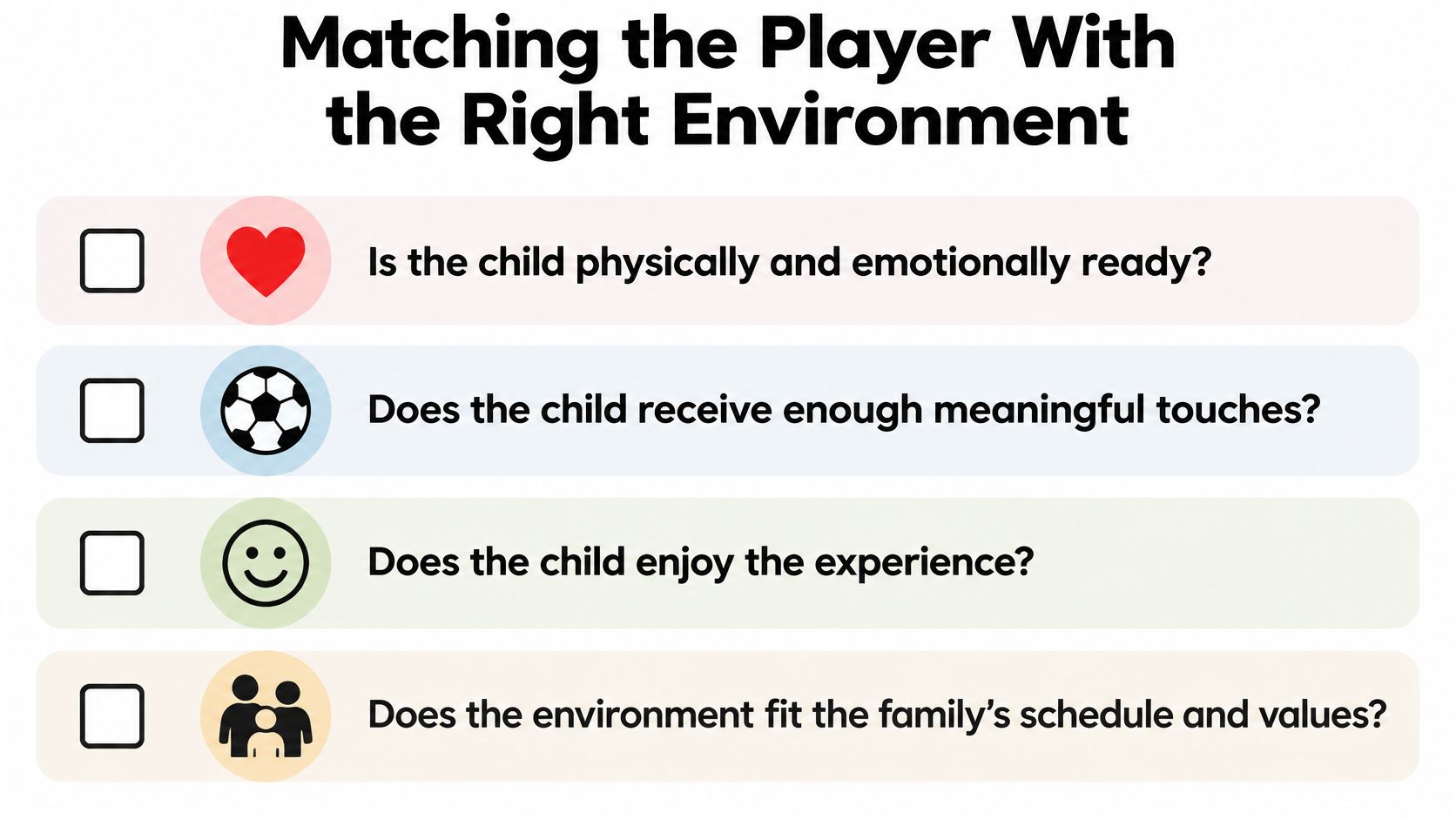
Use this checklist after visiting or speaking with a program.
Make the Decision From Your Notes
Review the experience with your child and any adult sharing the commitment. Distinguish what you observed from what you hope the program might eventually provide.
Readiness: Did your child understand enough to participate and feel comfortable asking for help?
Learning: Could the coach identify a useful next step?
Belonging: Did your child feel welcome among the other players?
Challenge: Was the experience demanding without leaving them persistently overwhelmed?
Practical fit: Can you support the calendar and expenses beyond an unusually easy week?
If an answer is unclear, ask another question before committing. You don't need to resolve uncertainty by choosing the most selective offer.
Leave Room to Reassess
A player can find worthwhile learning in different settings. Recreational play may provide room to build confidence, academy-style instruction may suit a focused learning goal, and an elite environment may fit a player who wants and can manage its demands.
Those possibilities aren't promises attached to labels. They're reasons to investigate what each program provides.
Choose a point to check in with your child and coach after participation begins. Ask whether the original reason for joining still holds and whether the agreed expectations match the experience. The right environment is one you can evaluate, not one you have to defend because its title sounds impressive.
JC Sports Houston offers age-appropriate soccer classes, Coerver-based training, leagues, and camps that families can compare according to their child's current needs. Visit JC Sports Houston to request a free trial, confirm current program details, and discuss a suitable starting point before making a tier decision.

Comments