

Youth Soccer Levels Explained for Houston Parents

Saturday registration is open, and you're comparing U6 and U8 links while your seven-year-old kicks a ball against the minivan tire. One form says recreational soccer. Another mentions academy training. A friend says your child should try out for travel, while your child just wants to know whether practice will include a game.
That confusion is normal. Youth soccer levels explained clearly means separating two different questions: How old is the player, and how competitive is the environment? Once those questions are separated, the right choice becomes less about labels and more about fit, enjoyment, skill stage, schedule, and readiness.
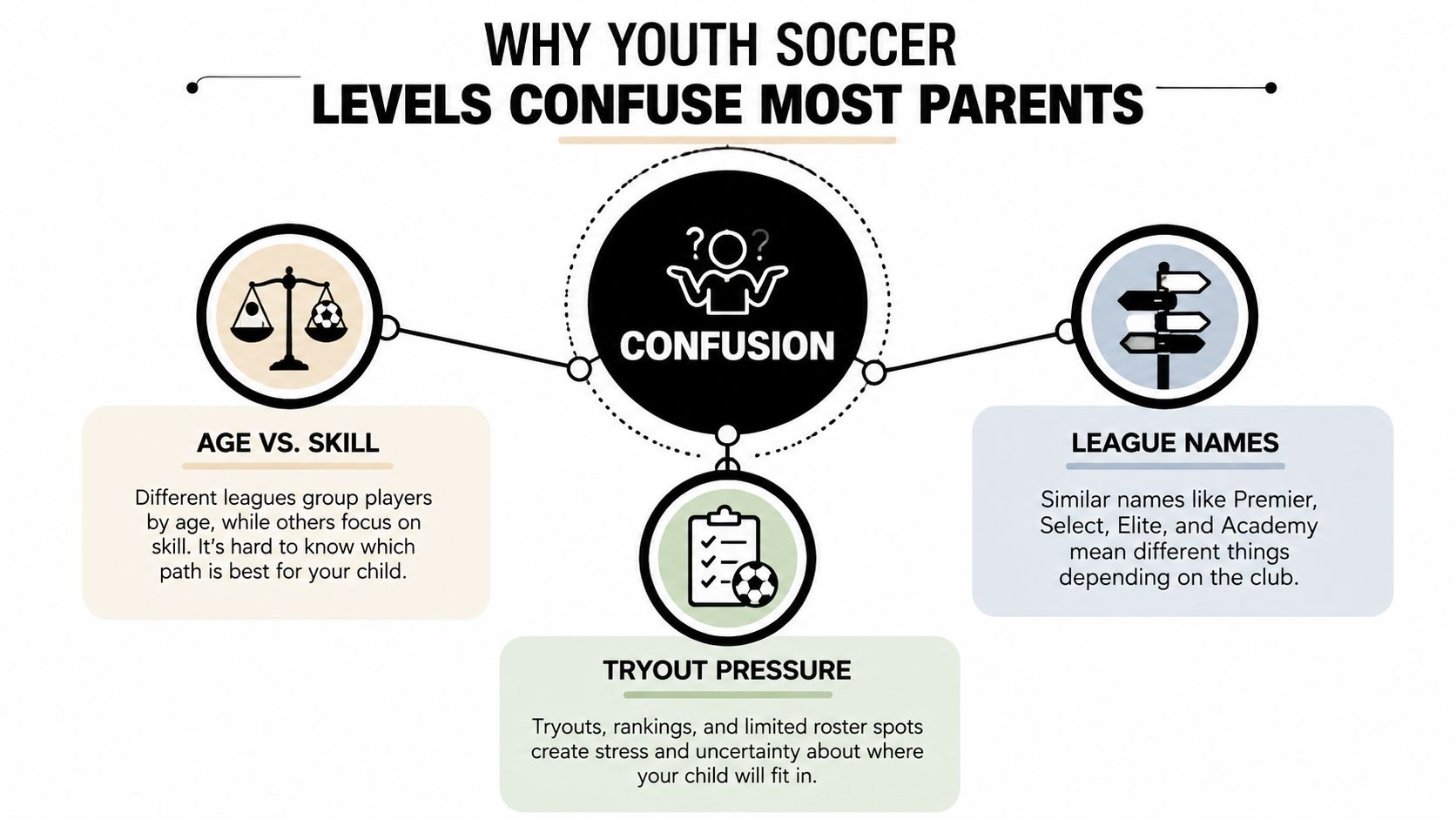
Why Youth Soccer Levels Confuse Most Parents
A label such as U8, U10, or U12 describes an age group, not a competition level. The “U” generally means “under,” but local registration rules can vary, so families should confirm the birth-year or age requirements with the organization running the program.
A competition tier describes the environment around that age group. Recreational soccer may welcome every player and emphasize equal involvement. Travel or select soccer usually introduces tryouts, more scheduled training, and games against teams from outside the immediate neighborhood. Academy or elite pathways add greater selectivity, stronger weekly demands, and more formal development structures.
That means two U10 teams can feel completely different. One might meet locally, use games to build confidence, and welcome a beginner. Another might select players through tryouts, train more often, and expect families to organize their calendar around soccer. The age group stays the same, but the pathway changes.
The three questions parents should ask
What is the age group? This tells you whether the activities and team format are designed for a preschooler, an elementary-age player, or an older athlete.
What is the pathway? Rec, travel, select, academy, and national platforms describe different levels of structure and competition.
What does my child need right now? A higher label isn't automatically better if the player gets fewer touches, feels anxious, or stops enjoying practice.
US Youth Soccer separates development into technical, tactical, physical, and mental domains. Its model places technical emphasis around ages 6 to 9, tactical development around 10 to 12, physical development around 13 to 15, and mental development around 15 to 18. That framework supports a staged view of development, not a single ladder that every child should climb at the same pace. US Youth Soccer's player development model gives parents useful language for discussing what training should emphasize.
For Houston families, the practical answer may be a toddler multi-sport class, an MLS GO entry program, Coerver-style technical work, a seasonal league, or a more competitive club environment. The correct next step depends on the child standing in front of you, not the most impressive program name on a registration page.
Toddlers and First Kicks Ages 3 to 6
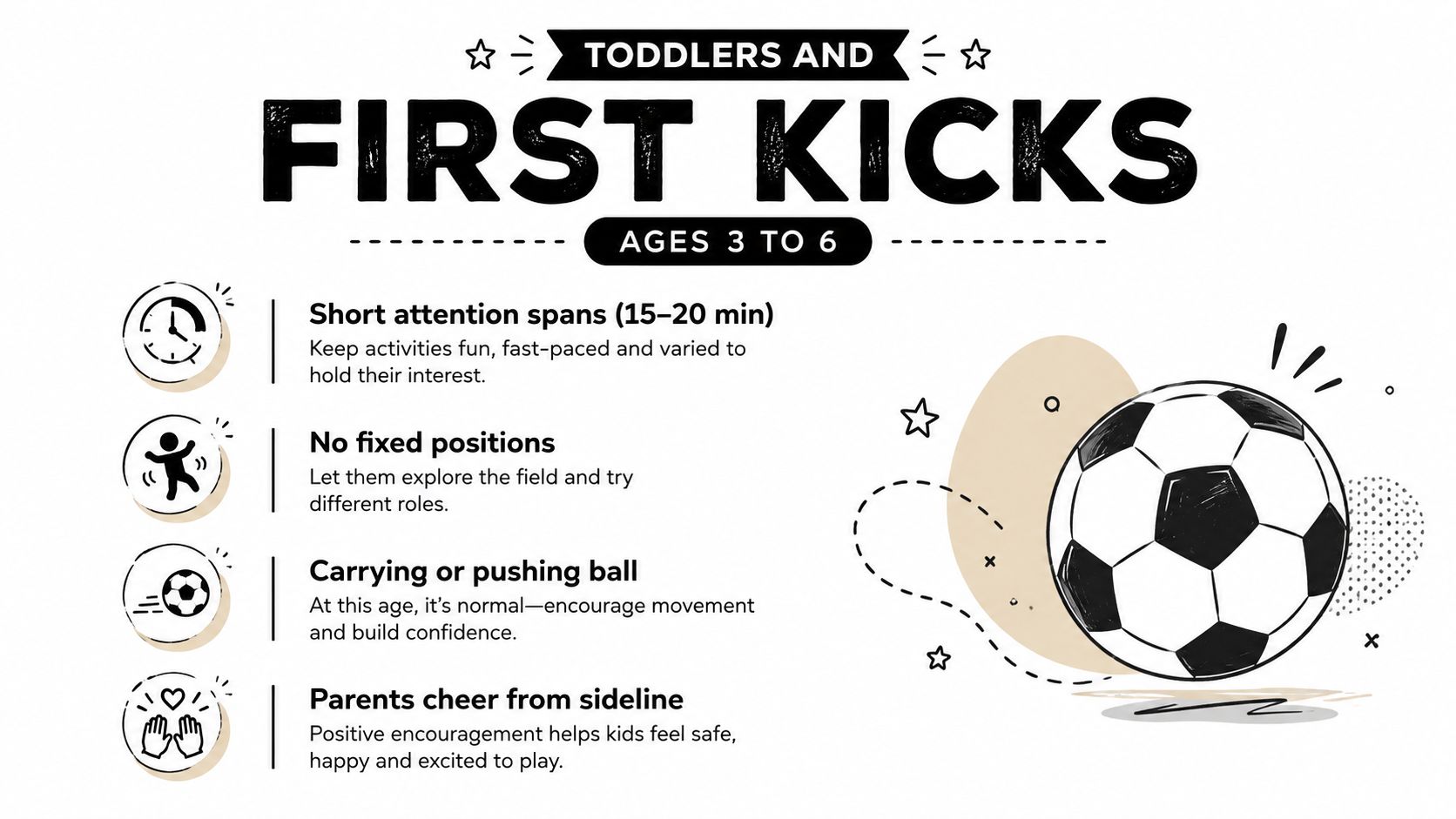
A four-year-old may carry the ball, nudge it with one foot, stop to inspect the grass, or sprint toward the wrong goal. In a Houston class, those moments are part of the lesson. Children ages 3 to 6 are discovering how their bodies, the ball, open space, and other players fit together. Early soccer should feel like movement discovery before it feels like organized tactics.
The useful markers at this age are coordination, balance, comfort with movement, and a positive relationship with the ball. Coaches can build those markers through short activities that invite children to run, stop, turn, kick, chase, and try again. Fixed positions, reliable passing patterns, and detailed explanations of team shape can wait.
A productive session keeps children active and gives them many small wins. The coach might change from a running game to rolling and stopping the ball, then add a simple challenge such as dribbling toward a colored cone. Frequent changes respect a preschooler's attention span without lowering the quality of instruction.
Each child also needs plenty of individual contact with the ball. Standing in a line for a single kick offers less learning than repeated chances to push, stop, roll, and dribble. Simple prompts work best: “Can you stop the ball with your foot?” gives a child something concrete to do.
Parents have a role, too. Cheer effort, help your child feel safe, and let the coach guide the activity rather than directing every kick from the sideline. A 45-minute class can provide plenty of learning when it includes movement and variety. Standings, results, and tactical positions belong in the background. A child who leaves smiling and asks to return has made meaningful progress.
JC Sports Houston's toddler multi-sport classes connect soccer with other movement experiences, allowing preschoolers to practice coordination without treating one sport like a test. Families comparing introductory choices can review this guide to soccer for four-year-olds before selecting a class. MLS GO entry programs start around age 4 and can gradually connect individual movement activities with simple team play. A child does not need passing skills before trying organized soccer.
This video shows another way to keep early instruction active, simple, and suited to young children.
Foundational Skill Years U8 and U10
U8 and U10 are often grouped together because children in these stages still benefit from small-sided soccer, but their technical expectations are beginning to grow. Teams use fewer players and less space than a full adult match, allowing children to see the ball more often and make decisions repeatedly.
A 2021 systematic review and meta-analysis found a significant beneficial effect of small-sided game training on technical execution in young and youth players. The review explains that coaches modify player numbers, pitch configuration, and rules to create age-appropriate learning environments. The Frontiers in Psychology review also describes common formats such as 3v3 and 4v4, with field dimensions adjusted to the format.
Why smaller games help
In a smaller game, a child can't hide from the action for long. Players receive more opportunities to control the ball, dribble past an opponent, choose a pass, or recover after losing possession. The game also gives coaches a better setting for teaching first touch, close control, striking technique, and basic scanning.
Research on small-sided games finds that scaled pitch areas can make training more representative of match play. It also connects this format with improvements in sprint performance, agility, technical development, and enjoyment compared with dribbling-circuit-style training. This research thesis on small-sided games supports a simple coaching principle: children learn technique more effectively when they use it in game-like situations.
Stage | Game Format | Roster Size | Session Length | Core Coaching Focus |
|---|---|---|---|---|
U8 | Small-sided games, often 3v3 or 4v4 | Small groups with frequent involvement | Age-appropriate, activity-rich sessions | Ball comfort, dribbling, stopping, turning, and basic striking |
U10 | Small-sided games, often progressing toward 7v7 | Larger than U8 while retaining regular touches | Structured technical and game activities | First touch, close control, passing choices, scanning, and finishing |
Parents can see this development in ordinary behaviors. A player may attempt more one-versus-one moves instead of immediately kicking the ball away. They may begin using a preferred foot, shielding the ball with their body, or looking up before receiving it. Those changes matter more than whether the child can recite a formation.
Coerver-style training pairs naturally with this stage because it isolates and repeats ball mastery skills, then helps players use those skills under pressure. JC Sports Houston offers technical development programming that families can explore through its technical development soccer resource. Seasonal MLS GO and recreational league play can then give children a place to use those skills with teammates and opponents.
Recreational Travel and Academy Pathways Compared
The three broad pathways differ most in commitment, selection, travel, and pressure. They aren't three grades of the same experience. Each one creates a different family routine and a different kind of challenge for the player.
Recreational soccer usually works well for beginners, children exploring several sports, and families that want a local activity with predictable demands. Travel soccer makes the schedule more serious and introduces tryouts. Academy or select environments can provide advanced coaching and identification opportunities, but they require the child and family to embrace a larger commitment.
The cost ranges in the table below come from the supplied Houston pathway brief. Actual fees vary by organization, age group, uniforms, tournaments, and travel arrangements.
Pathway | Seasonal Cost Range | Practices per Week | Travel | Primary Focus | Best Fit For |
|---|---|---|---|---|---|
Recreational | $100 to $250 per season | Once or twice | Home games within the local district or neighborhood area | Enjoyment, equal involvement, friendships, and basic skills | Beginners, multi-sport children, and families seeking a low-pressure schedule |
Travel or select | $800 to $2,000 per season, plus uniform and travel costs | Two to three | Houston metro tournaments and occasional out-of-state trips | More structured competition and regular development demands | Players asking for more challenge and families ready for tryouts |
Academy or select | $1,500 to $3,500 or more per season | Year-round commitment | Regional or broader travel depending on the program | Professional coaching, advanced training, and identification pathways | Highly motivated players whose schedules and support systems fit the demands |
What changes from one row to the next
Recreational soccer prioritizes access. Coaches can spend more time helping children feel comfortable, and equal playing opportunities keep the focus on participation rather than roster status.
Travel soccer adds selection and logistics. A child may need to attend tryouts, practice several times each week, and travel to play teams from other communities. The player should enjoy that added structure, not merely tolerate it because adults see the label as prestigious.
Academy and select programs may connect with pathways such as ECNL or MLS NEXT, but a pathway name doesn't tell you whether a specific roster is a good fit. Ask about the team's actual league, coaching approach, playing opportunities, travel calendar, and expectations for the age group. Families looking for a more structured local option can use this soccer academy guide as part of that conversation.
Practical rule: Choose the tier that gives your child meaningful challenge without turning every week into a family crisis.
A U10 player may be recreational, travel, or academy level. The age group answers “who is the player grouped with?” The pathway answers “what environment will the player enter?”
Preteen and Teen Stages U12 and Older
At U12 and beyond, a player may arrive at practice comfortable with the ball and still feel lost in a full-sided game. The field is larger, opponents close space faster, and every position carries clearer responsibilities. Players must scan before receiving, recognize pressure from behind, choose when to switch play, and use movement away from the ball to create passing lanes.
A simple example helps. A midfielder who takes an extra touch at U8 may now lose possession because a defender arrives immediately. The first touch, passing range, and decision speed all matter more as distances increase. The exact format varies by league and age group, but the mental workload rises.
What older players are learning
Tactics become easier to understand when families connect them to visible actions:
Tactical awareness: Players learn how teammates move together, how lines connect, and when to press or recover.
Physical preparation: Training develops movement quality, acceleration, repeated effort, and safe foundations for changing bodies.
Position-specific execution: Goalkeepers, center backs, midfielders, and forwards make different decisions throughout a match.
Mental preparation: Tryouts, mistakes, playing-time competition, and changing roles require resilience and communication.
Technical practice remains part of the job. Older players still need first-touch repetitions, dribbling under pressure, passing with both feet, and finishing from different angles. Winter futsal and seasonal leagues can keep those skills active during a school soccer offseason.
JC Sports Houston families also have options beyond one standard team format. For girls, a Just for Girls track offers same-gender coaching and competition. Some players find it easier to speak up, attempt new skills, and build confidence in that setting. It may suit one athlete better than another, so families should match the environment to the player.
Age group and competition tier answer different questions. U12 identifies the player's age grouping. A recreational, travel, academy, or club setting describes the demands around that player. A child can move from MLS GO into a competitive club, remain recreational, or choose a lower-pressure program during a busy school year. The right choice leaves room for changing interests, school responsibilities, and social needs.
The Case for Staying at the Right Level
Moving up can feel like the obvious definition of progress. A new badge, harder opponents, and a selective roster may look impressive from the sideline. Yet development depends on what the child does during training and games, not only on the title attached to the team.
Participation and retention deserve equal attention. A 2026 sport participation report estimates that 1.2 billion people globally play soccer regularly, citing FIFA 2022, while also reporting large regional differences in youth sports participation, including 68% in North America and 19% in Sub-Saharan Africa. The sport participation report illustrates why access and development pathways matter alongside elite selection.
The U.S. youth sports picture also points toward participation as a central concern. Project Play reported a 6% year-over-year increase in U.S. team-sport participation among children ages 6 to 17 in 2024, and broader organized-sport participation reached 55.4% of children, according to the supplied State of Play 2025 overview. These figures don't mean every child should pursue a higher soccer tier. They suggest that keeping children active and engaged matters at least as much as sorting them into prestigious pathways.
A stronger definition of progress
A player who leads a recreational team may build confidence, take responsibility, attempt creative skills, and receive constant repetitions. A player who joins a much stronger roster may face valuable challenges, but may also spend more time watching, hesitate to take risks, or feel that every mistake confirms they don't belong.
The right level is where your child is challenged, coached, involved, and still eager to return.
Look for the point between boredom and overwhelm. Consider moving up when your child consistently asks for more soccer, handles the current environment comfortably, practices willingly, and needs challenges the present program no longer provides. Don't move up because another parent chose a different label.
Parents can also protect interest outside the field by making room for varied activities and low-pressure hobbies. These practical hobby tips for parents can help families notice whether a child needs more variety, more autonomy, or less adult pressure before committing to a more demanding soccer pathway.
How to Pick the Best Level for Your Child
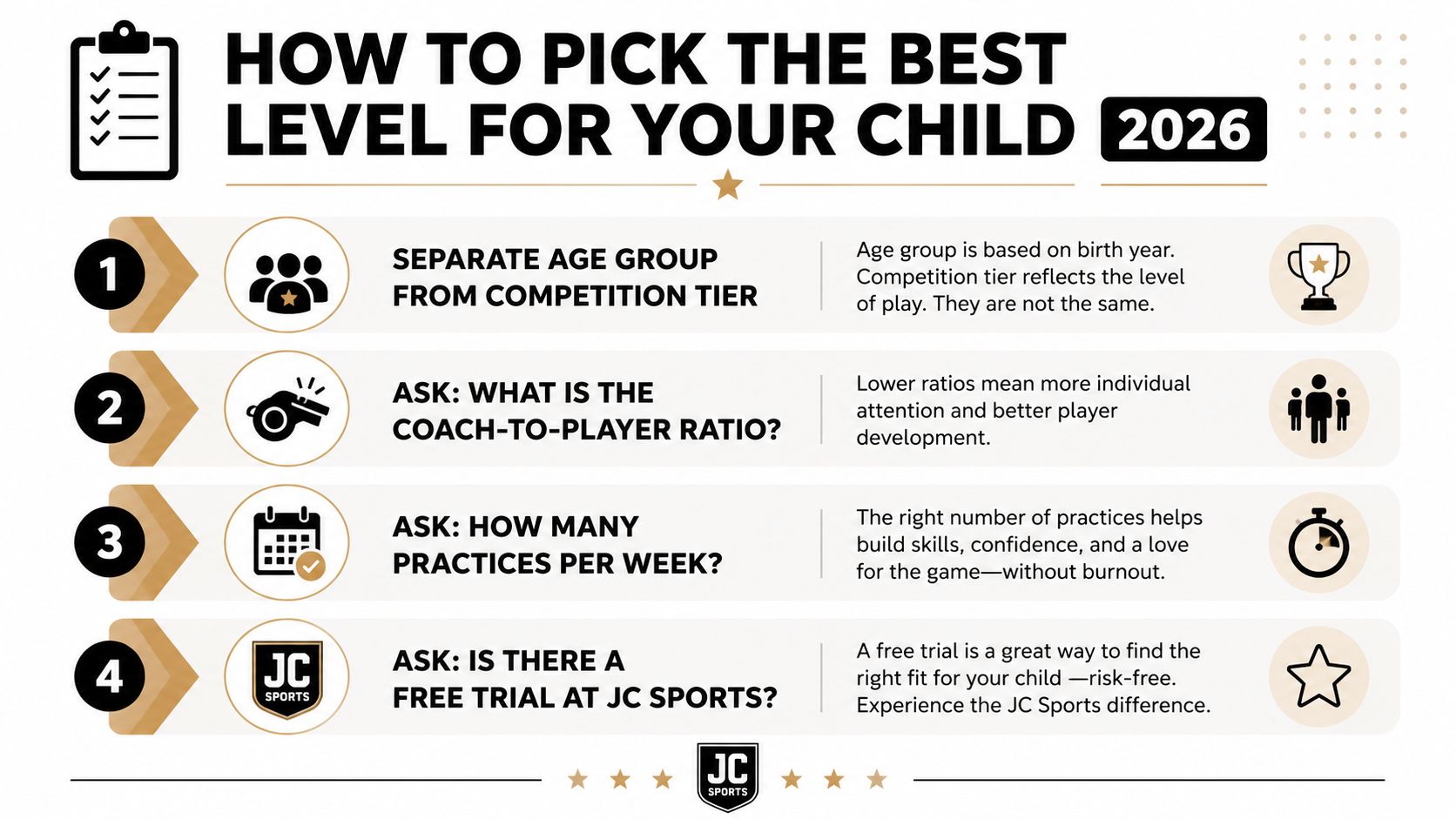
A six-year-old who loves chasing the ball may need a very different setting from a six-year-old ready for structured competition. Start by separating two labels: the child's age group and the program's competition tier. Age places a player with peers at a similar stage of development. The tier describes the pace, expectations, travel, and playing environment.
Use a trial to test the fit, not just the facility. Watch how the coach organizes the session and speaks with children. Notice whether players spend much of the time waiting, crowding around one ball, or making repeated decisions with their own feet. A useful session gives each child chances to control, dribble, pass, and finish.
Read the session like a coach
Listen for instructions children can understand. Watch whether small-sided games connect technique to real decisions. Check that the practice schedule fits your family before giving weight to labels such as recreational, travel, or academy.
Pay attention to mistakes. A coach should correct the action and give the player a way to try again. Public embarrassment, long lectures, and discussions about prestige are warning signs. So are pressure to specialize too early, promises of scholarships for very young children, or a program controlled by one personality.
Ask who leads each session, how teams are formed, how feedback is delivered, and what happens when a player needs a different pace. These answers reveal more than a program name.
Your child's response completes the evaluation. A shy beginner might settle into a toddler multi-sport class or introductory recreational program. A player who wants regular games may suit an MLS GO seasonal league, while a child asking for extra ball work may be ready for Coerver-style training. Girls seeking a confidence-first setting can explore Just for Girls.
For Houston families, review field locations, registration windows, sibling policies, and travel time. After the trial, ask what felt fun, difficult, confusing, or exciting. Combine that feedback with the coach's placement guidance, then choose the setting your child can attend consistently and enjoy.
Your Next Step With JC Sports Houston
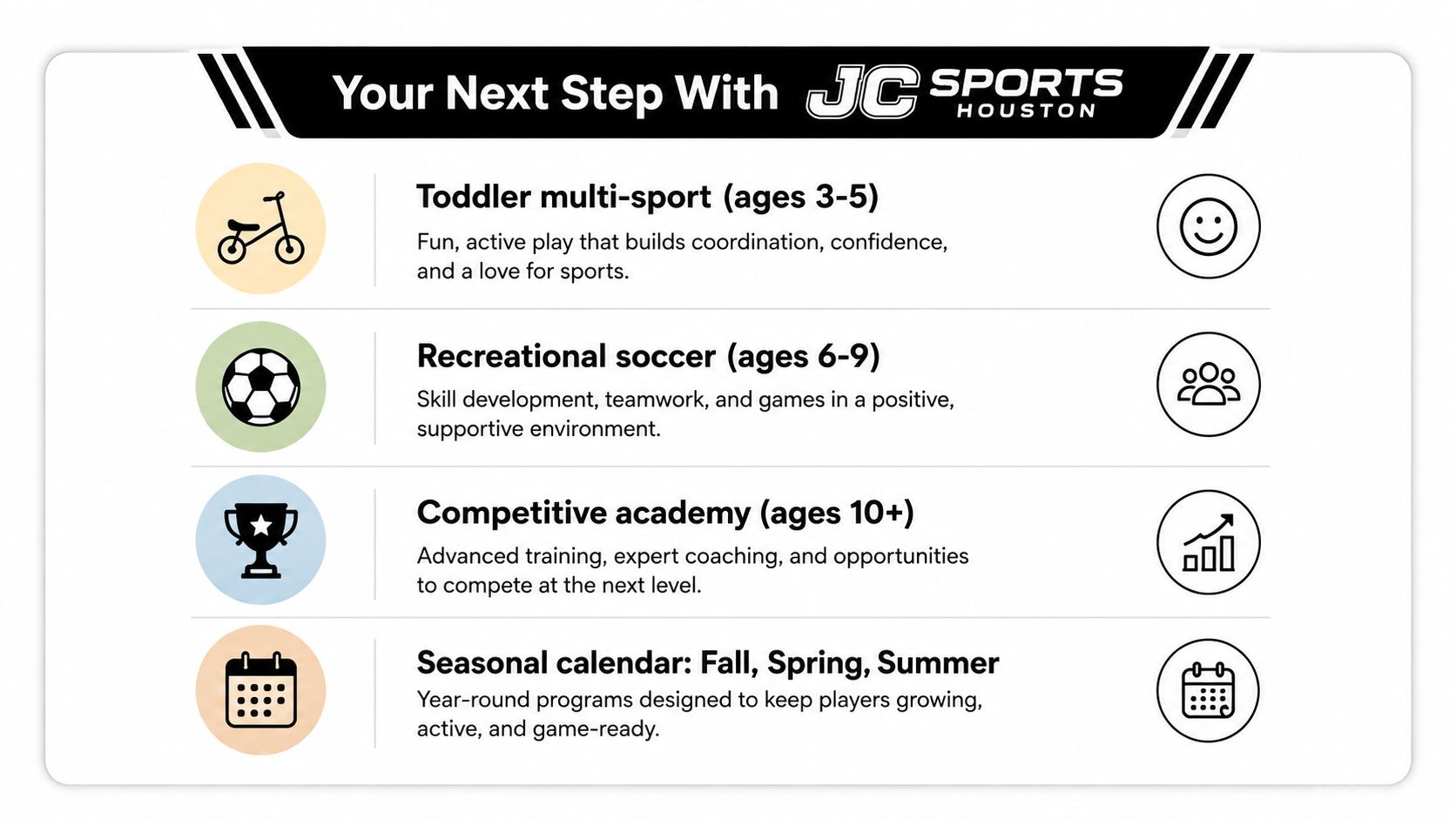
The simplest way to use this guide is to match the child's stage with the type of experience your family can support.
Ages 3 to 5: Start with toddler multi-sport activities that build movement confidence and ball comfort.
U8 to U12: Add Coerver-style technical training when your child wants more repetitions with dribbling, first touch, and ball mastery.
Girls seeking a dedicated setting: Consider Just for Girls for same-gender coaching and competition.
Families wanting a predictable game schedule: Explore seasonal leagues and MLS GO options.
The right level can change as the child grows. A beginner-friendly program today can prepare a player for a more competitive environment later, while a recreational league can remain the right choice for a child who values friends and flexible participation.
Book a free trial through the JC Sports Houston website, register for the upcoming MLS GO season, or visit a Coerver session and observe the fit. One session can give coaches useful information about your child's comfort, motivation, and current skill stage.
JC Sports Houston offers toddler multi-sport classes, seasonal soccer leagues, Coerver-style training, and Just for Girls programs for families in Humble, Kingwood, Atascocita, and nearby Houston communities. Visit JC Sports Houston to book a free trial or choose the next program where your child can learn, play, and keep coming back.
Comments