

Soccer League for 3 Year Olds: A Parent's 2026 Guide

Your three-year-old runs everywhere. They dribble a snack across the kitchen floor with their toes, chase anything round, and seem to have endless energy right up until bedtime. So you type soccer league for 3 year olds into Google, hoping to find something healthy, social, and manageable.
That instinct is a good one.
But the first helpful shift is this: for a child this young, you're usually not looking for a true league in the way older kids have teams, standings, and formal games. You're looking for a playful first sports experience that builds comfort, balance, listening, and confidence. If you start there, the whole search gets much clearer.
Your Energetic Toddler and the World of Soccer
A lot of parents arrive here with the same picture in mind. They imagine tiny jerseys, a little team photo, maybe a short game on Saturday morning. Then they wonder why every program description sounds more like story time with soccer balls than a real league.
That's because, at age three, play is the point.
A good program channels toddler energy without asking for skills they don't have yet. Your child may love to kick, but they're still learning how to stop their body, change direction, wait a turn, and listen to one short instruction at a time. That's normal. It's also why the best early soccer programs feel more like a sports playground than a miniature version of competitive youth soccer.
Parents often think they need to find the “right team.” At three, the bigger win is finding the right environment.
You might see classes where kids pretend to be animals while dribbling, run through cone “forests,” or freeze when the coach calls out a color. From the outside, it can look simple. From a developmental view, it's exactly right. Those games teach movement patterns, body control, and comfort being part of a group.
If your child is shy, clingy, or wildly excited, that doesn't mean they're not ready. It usually means they're three.
What parents are really searching for
Most families want a few practical things:
A safe place to move: somewhere your child can run, kick, and explore without constant correction.
An easy first group activity: not a high-pressure setting with scores and sideline stress.
A gentle routine: one that helps your child learn how classes work before school and bigger sports programs begin.
When you treat soccer as a developmental step instead of a performance test, it becomes much easier to choose well.
What Soccer for a 3-Year-Old Really Looks Like
You arrive a few minutes early. Your child clings to your leg, then spots a ball and takes off. Two minutes later, they want you again. That back-and-forth is a very normal start to soccer at three, and it helps explain why the word league can mislead parents.
For older kids, a league usually means teams, standings, and full games. For three-year-olds, a good program looks much more like a guided movement class with soccer themes. The Football Association even states in its youth football guidance that children under six should not play formal matches. That lines up with what experienced preschool coaches already know. At this age, the goal is participation, not competition.
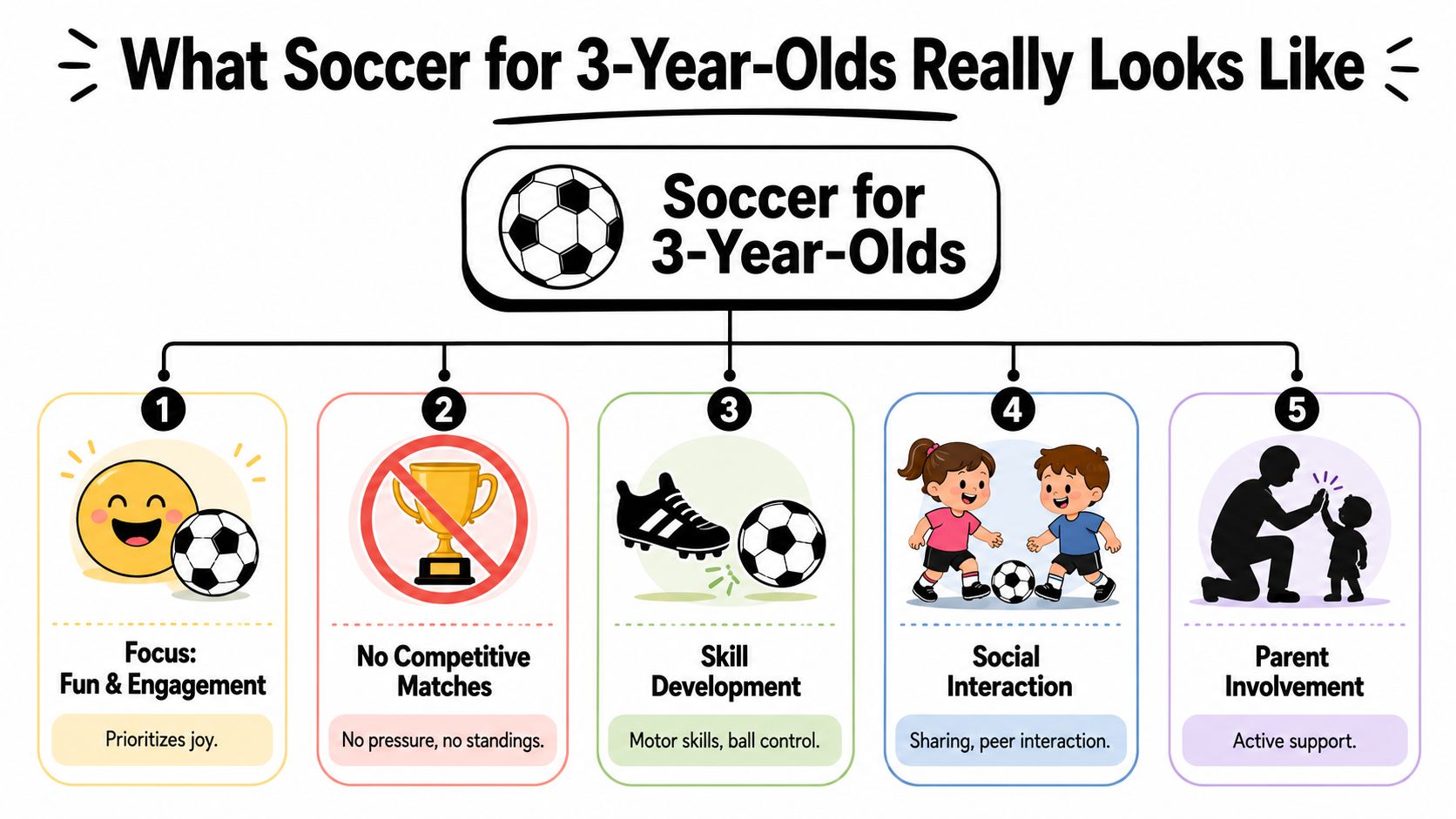
A three-year-old soccer class is really a lesson in being part of an activity away from your side, one small step at a time. Coaches are often teaching the child and the parent at once. The child is learning how to join, pause, try again, and recover from small frustrations. The parent is learning the field version of the handoff that also happens at preschool drop-off. Sometimes that means standing close for the first activity, then backing up as the coach builds trust. Sometimes it means your child spends half the class participating and half the class observing. That can still be a successful day.
What your child is actually learning
Under the surface, each activity usually works on several skills at once:
Body control: running, stopping, turning, balancing, and changing speed
Ball familiarity: tapping, trapping, nudging, and chasing a ball without getting overwhelmed by it
Listening habits: responding to one short instruction, then doing it
Group participation: waiting briefly, noticing other children, and rejoining after drifting away
That combination matters because three-year-olds do not separate “sports skills” from “life skills” yet. Kicking a ball and learning to follow a coach are happening in the same moment. If you want a broader parent-friendly look at what sports teach young children beyond the game itself, that bigger picture helps make sense of why these early classes look so simple.
The teaching style should look playful on purpose. A coach might ask children to dribble through a jungle of cones, stop their ball on a colored spot, or kick into a small goal after hopping like a frog. That is not fluff. It is instruction matched to how preschoolers learn. Their brains respond better to short images, repetition, and movement than to technical explanations about passing lanes or positioning.
Why the setting matters more than many parents expect
For this age, the facility can shape the whole experience.
A consistent indoor space usually gives three-year-olds a better shot at settling in. The same walls, the same boundaries, the same entry routine, and fewer weather disruptions make it easier for a child to predict what happens next. Predictability helps with the parent-coach handoff too. A toddler who knows where the cones go, where parents stand, and where class starts often separates more easily after a week or two.
An outdoor park league may cost less, but it often brings extra variables that are hard on this age group. Heat, wet grass, bugs, noise from nearby fields, and canceled sessions can turn a fragile new routine into a fresh adjustment every week. Older children can roll with that more easily. Many three-year-olds cannot yet.
What a strong class usually includes
You will usually see a session built in short blocks, with quick resets between them:
Arrival activity: an easy first task so children can join without pressure
Movement warm-up: marching, jumping, animal walks, or balance games
Simple ball work: lots of touches, short dribbles, gentle kicks
Story-based games: imagination used to keep attention and repeat a skill
Closing routine: a final cheer, sticker, stamp, or goodbye ritual that signals success
Clothing matters more than parents sometimes expect because toddlers squat, tumble, get warm, and pop back up constantly. If you are choosing first-day clothes, this guide to cotton athletic wear offers practical ideas on comfort and movement for active kids.
A real soccer league for 3 year olds looks like early childhood development with a ball at its center. If the class feels organized, cheerful, flexible, and patient with wobbly attention and wobbly emotions, you are probably in the right place.
The Developmental Wins Beyond Kicking a Ball
A three-year-old may spend the first few classes doing something that looks very small to an adult. They stop the ball with both hands instead of a foot. They watch another child before trying a turn. They glance back at you to make sure you are still there. Those moments are part of the foundational work.
At this age, soccer is less about learning the sport and more about building the child underneath the sport. The ball gives the class a job to do. The routine, the coach's voice, and the repeated movements help a young child practice skills that show up everywhere else, from preschool to the playground.
The body skills hiding inside simple games
A cone-dribbling game may look basic from the sideline, but a lot is happening at once. Your child is trying to stay upright, track the ball, avoid bumping into others, and adjust when the ball rolls away. That is a big assignment for a three-year-old brain and body.
These classes often strengthen:
Balance, while starting, stopping, and turning
Coordination, by matching eyes, feet, and body movement
Motor planning, by figuring out how to get around cones or into a goal
Body awareness, by noticing where their body is in space
That foundation matters more than many parents expect. A child who can control their body a little better often feels calmer and more willing to try again after a mistake.
If you want similar movement ideas for home, you can discover activities for babies and toddlers. The same large-muscle play supports early soccer success.
Why the parent-coach handoff matters
One part of toddler soccer gets overlooked in many articles. The handoff from parent to coach is its own developmental skill.
For some children, the hardest task is not kicking the ball. It is walking from your side to the coach's circle and joining the group without you. That small separation asks for trust, emotional regulation, and confidence in a new adult. A good program treats that moment gently. The coach may invite your child to hold a cone, stand nearby for the first activity, or join with you for a minute before trying independently.
This is one reason a consistent indoor facility can help so much at age three. The same entrance, the same field lines, the same coach location, and the same lower-distraction setting make the handoff easier to practice week after week. An unpredictable outdoor park can reset that progress. Noise, weather shifts, muddy grass, and activity from nearby fields can make a child feel like they are starting over, even if the soccer plan is good.
Listening, waiting, and trying again
Toddler soccer also gives children one of their first chances to follow another adult in a group. That is a big developmental step.
“Put your foot on the ball.”“Run back to the blue cone.”“Wait for your turn.”
These are short directions, but they ask for attention, impulse control, and patience. Three-year-olds rarely do all of that smoothly. They learn through repetition, warmth, and clear routines. In other words, they learn the same way they learn almost everything else.
For a broader explanation of how sports support habits off the field, this article on what sports teach children through movement and play gives a helpful overview.
Social growth that looks small, but is not
At three, many children still play alongside others more than directly with them. That is normal. Soccer can still be a good fit because social growth at this age often starts with very early group skills.
You may notice progress like this:
giving another child a little space
watching and copying the group
waiting a few seconds before taking a turn
accepting help from the coach
joining a team cheer, even if not loudly
Those wins are easy to miss if you are only looking for goals or “real games.” They are still meaningful. For many children, toddler soccer becomes a practice space for being part of a group, handling a brief separation from a parent, and feeling capable in a structured setting. That is a strong return from a class that, on the surface, looks like simple play with a ball.
A Look Inside a Typical Toddler Soccer Session
The best way to judge a program is to picture the flow. A strong toddler class doesn't feel random, even when it looks loose and playful. Good coaches move quickly, change activities often, and keep directions short.
Here's a sample format that reflects what many age-appropriate sessions aim for.
Sample 45-Minute Toddler Soccer Session Plan
Time Allotment | Activity | Developmental Goal |
|---|---|---|
5 minutes | Welcome circle and name game | Help children settle in, hear the coach's voice, and feel included |
8 minutes | Movement warm-up with animal walks, jumping, or marching | Wake up big muscle groups, build coordination, and release early energy |
8 minutes | Ball exploration with toe taps, gentle kicks, and stopping the ball | Build ball familiarity and basic foot-to-ball connection |
7 minutes | Imaginative dribbling game such as carrying an “egg” with the feet | Encourage control, balance, and focus through pretend play |
7 minutes | Turn-taking activity with cones or small goals | Practice waiting, short bursts of effort, and simple direction-following |
5 minutes | Group game like freeze, color call-out, or red light green light | Strengthen listening, stopping, and starting on cue |
5 minutes | Celebration, cool down, and goodbye routine | End with predictability, praise, and a positive memory |
Why short blocks matter
Toddlers rarely stay engaged in one task for long. That's why frequent transitions are helpful, not chaotic. A child who drifts away during one game may jump right back in for the next.
A coach might spend only a few minutes on dribbling, then switch to a color game, then return to kicking into goals. The child experiences variety, but the coach is repeating the same skills in different forms.
What “skill work” looks like at this age
Skill work for three-year-olds should be simple and concrete.
A dribbling activity might sound like this:
“Keep your ball close.”
“Tap it with little kicks.”
“Stop it when I say freeze.”
That's enough. Long explanations usually lose them.
A toddler class goes better when the coach teaches through movement first and words second.
Signs the session is age-appropriate
You're probably in the right place if you see:
lots of smiling and re-engagement after distraction
coaches modeling rather than over-talking
children allowed to warm up gradually
no pressure to perform in front of the group
praise for effort, not just execution
You may also notice that one child does every activity while another watches for several minutes before joining. That range is normal in toddler sports. The goal isn't uniform behavior. The goal is steady comfort and participation over time.
How to Choose the Right Program for Your Little Kicker
Your child is standing at the edge of the field with a ball tucked under one arm. They want to play, but they also want one hand on your leg. That moment tells you a lot about what kind of program will work for a three-year-old.
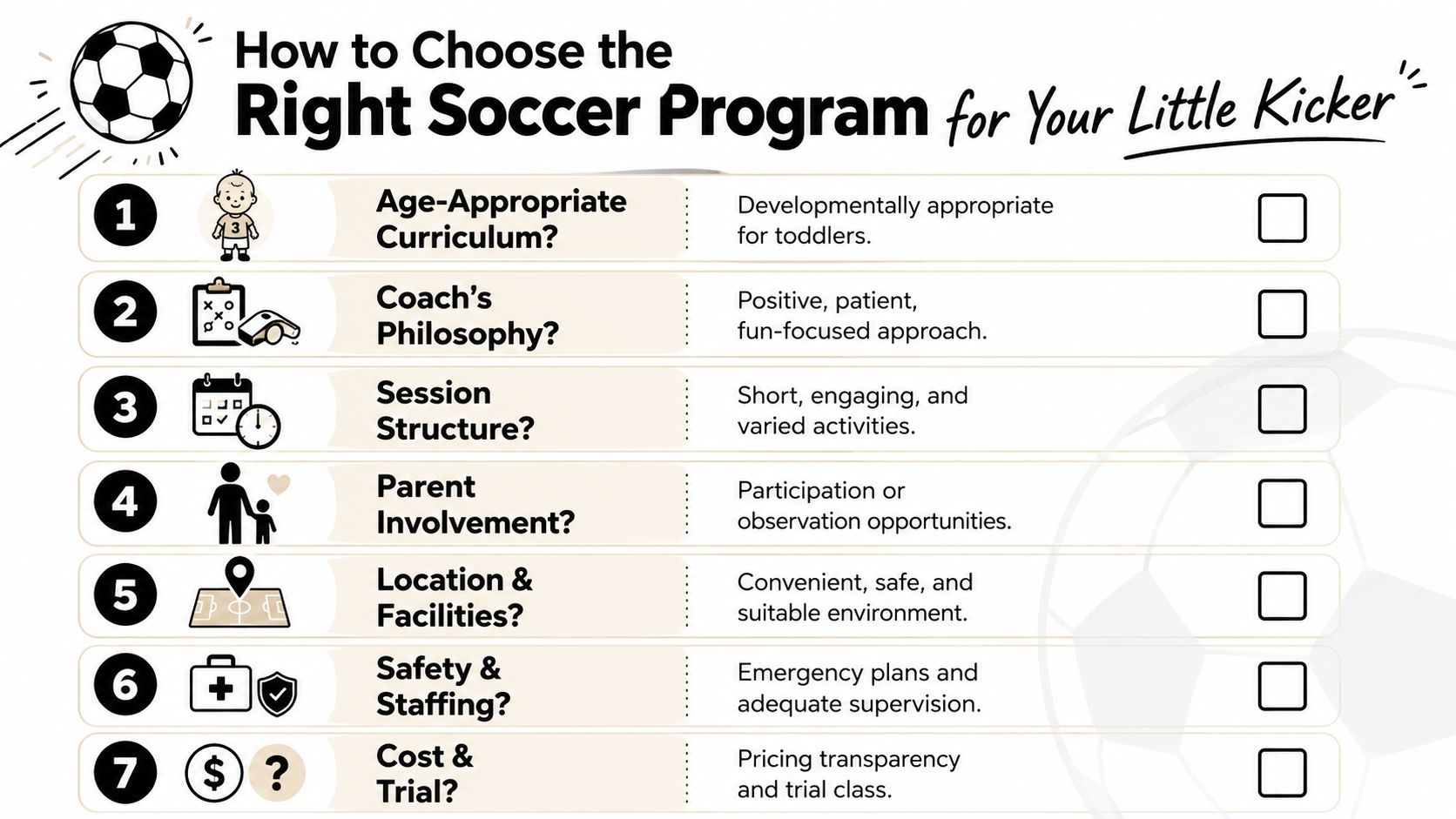
At this age, the right fit usually comes down to two things parents do not always hear enough about. First, how the coach handles the parent-child handoff. Second, whether the environment is predictable enough for a young child to settle in, repeat simple movements, and feel successful from week to week.
The indoor versus outdoor question
Parents often compare an outdoor park league with a pricier indoor class. For older kids, that choice can be more flexible. For many three-year-olds, consistency matters a great deal.
A predictable indoor space helps in very practical ways. The surface stays the same. The weather usually does not interrupt class. Noise and distractions are often easier to control. For a toddler who is still learning how to start, stop, turn, and track a moving ball, that regularity works like training wheels. It reduces extra variables so the child can focus on the skill in front of them.
As noted in the i9 Sports youth soccer FAQ, some locations offer indoor soccer, and for this age group a controlled environment supports repetition. Outdoor programs can still be a good choice, especially if they are well run and age-aware. But if your child is easily thrown off by heat, wet grass, long walks from the parking lot, or frequent schedule changes, indoor may save you a lot of frustration.
Questions worth asking before you enroll
A website will only tell you so much. The better clues usually come from a short conversation with staff or a trial class.
Ask questions like these:
What does the curriculum emphasize? Look for playful instruction and simple goals, not early competition.
How are classes organized? You want a program built around short activity changes and lots of chances to reset.
How do coaches respond when a child hangs back or says no? The answer should sound patient and specific.
What is the parent's role during the first few classes? Clear guidance here prevents confusion on day one.
How consistent is the facility and schedule? A regular space and routine often help toddlers settle faster.
If you want a useful frame for comparing options, this overview of a youth sport organization model can help you evaluate how coaching, structure, and facility choices shape the experience.
The parent-coach handoff matters
This is the part many parents worry about most, and for good reason.
A three-year-old may not separate from you the way an older child does. That is not misbehavior. It is development. New places, new adults, and a busy group setting can feel big to a small child. A good program expects that and has a plan.
Look for a coach who can explain the handoff in plain language. You should be able to ask, "Where do I stand at the beginning?" and get a calm, clear answer. In some classes, parents start on the field for the welcome activity, then drift to the sideline once the child is engaged. In others, a coach may invite the child into a game while you stay nearby as a secure base.
That process should feel gradual, not abrupt.
A strong program should be able to tell you:
whether parents begin on the field or off to the side
how coaches invite children without pulling, pressuring, or rushing
when parents are asked to step back
what happens if a child needs to return to a parent and try again
If a program cannot explain how it handles separation, observation, and gradual independence, it may not be designed with three-year-olds in mind.
Trust what you see. If coaches are warm, the routine is clear, and the setting helps your child feel steady, you are probably looking at a program that understands early childhood well.
Your Top Questions Answered for Houston Parents
Once parents narrow down options, the questions become very practical. That's good. Clear expectations make first-day nerves easier for both you and your child.
What if my child refuses to join at first
That's common.
AYSO describes its Playground model for ages 3 to 5 as a child development program in which coaches are sensitive to the parent bond, as explained in AYSO Playground guidance. That's the right mindset. A toddler may need to watch first, hold your hand for a few minutes, or participate only in parts of the class before becoming comfortable.
A good coach won't rush this. They'll usually invite, model, celebrate a tiny step, and let momentum build.
How should the handoff go on day one
A smooth handoff is gradual. You might begin standing near your child during the welcome activity, then step a little farther away once they're engaged. Some children separate quickly. Others need several classes.
Try this approach:
Arrive early: let your child look around before the group starts
Keep your language calm: “I'll be right here watching”
Avoid bargaining: too much negotiation can raise anxiety
Let the coach lead once your child connects: that gives the relationship room to form
Should I choose soccer only or a multi-sport class
It depends on your child.
If your child already loves kicking and chasing a ball, soccer can be a natural fit. If they're still exploring movement in a broader way, a multi-sport format can also work well because it exposes them to running, throwing, jumping, and balance in different forms. At this age, the quality of instruction matters more than sport specialization.
What should we bring to the first class
Keep it simple.
Comfortable clothes: easy to move in
Water bottle: toddlers get thirsty fast
Athletic shoes: suitable for the surface
A light snack for after class: not during, unless needed
A calm attitude: your child reads your energy
For families who want to compare local programs, searching nearby options like soccer leagues near me in Houston can help you see what formats are available in your area.
What should I expect from the first few weeks
Don't judge the experience only by whether your child “does everything” right away.
A successful start might mean your child:
walks onto the field willingly
kicks the ball a few times
listens for one instruction
smiles during one game
comes back next week more comfortable than before
That's real progress. Toddler sports are less about instant skill and more about building a positive relationship with movement, coaches, and group routines.
If you're in the Humble, Kingwood, or Atascocita area and want a simple next step, JC Sports Houston offers families a way to explore age-appropriate youth sports in a safe indoor environment. A trial class can help you see how your child responds before committing, and it gives you a chance to watch the coaching style, the pace of the session, and how the parent-child transition is handled in real time.
Comments