

8 Youth Soccer Drills U10 Coaches Can Use in 2026

It's Saturday morning, and twelve eight-year-olds are standing in a line waiting for a turn at a cone drill. Meanwhile, two teammates chase a loose ball into the corner, and someone asks when the game starts. You've barely begun, but you're already spending more time organizing children than coaching soccer.
The problem usually isn't effort. It's drill design. A single ball, a long queue, and instructions that take longer to explain than to perform will test any volunteer coach.
Good youth soccer drills for U10 players give children something useful to do right away. They need frequent touches, simple choices, and chances to try again after a mistake. You don't need complicated equipment or a library of professional training sessions.
Bring the essentials. Use balls, flat cones, contrasting bibs, water, and securely anchored goals.
Prepare small spaces. Build neighboring grids so you can split the group instead of building a longer line.
Choose one coaching point. Watch for a softer first touch, an earlier look up, or a better supporting angle.
Save extras such as custom baseball hats for teams for off-field organization. On the field, prioritize equipment that keeps children involved.
The activities below include suggested setup measurements, fixes for common problems, and progressions. Treat those measurements as starting prescriptions, not official field standards. Finish with the practice plans to organize an evening without trying to squeeze every drill into it.
1. Rondo Keep-Away (4v1 and 3v1)
The ball reaches a player, everyone stops moving, and the defender steals it. That's your cue to teach support before speed, not demand faster passing.
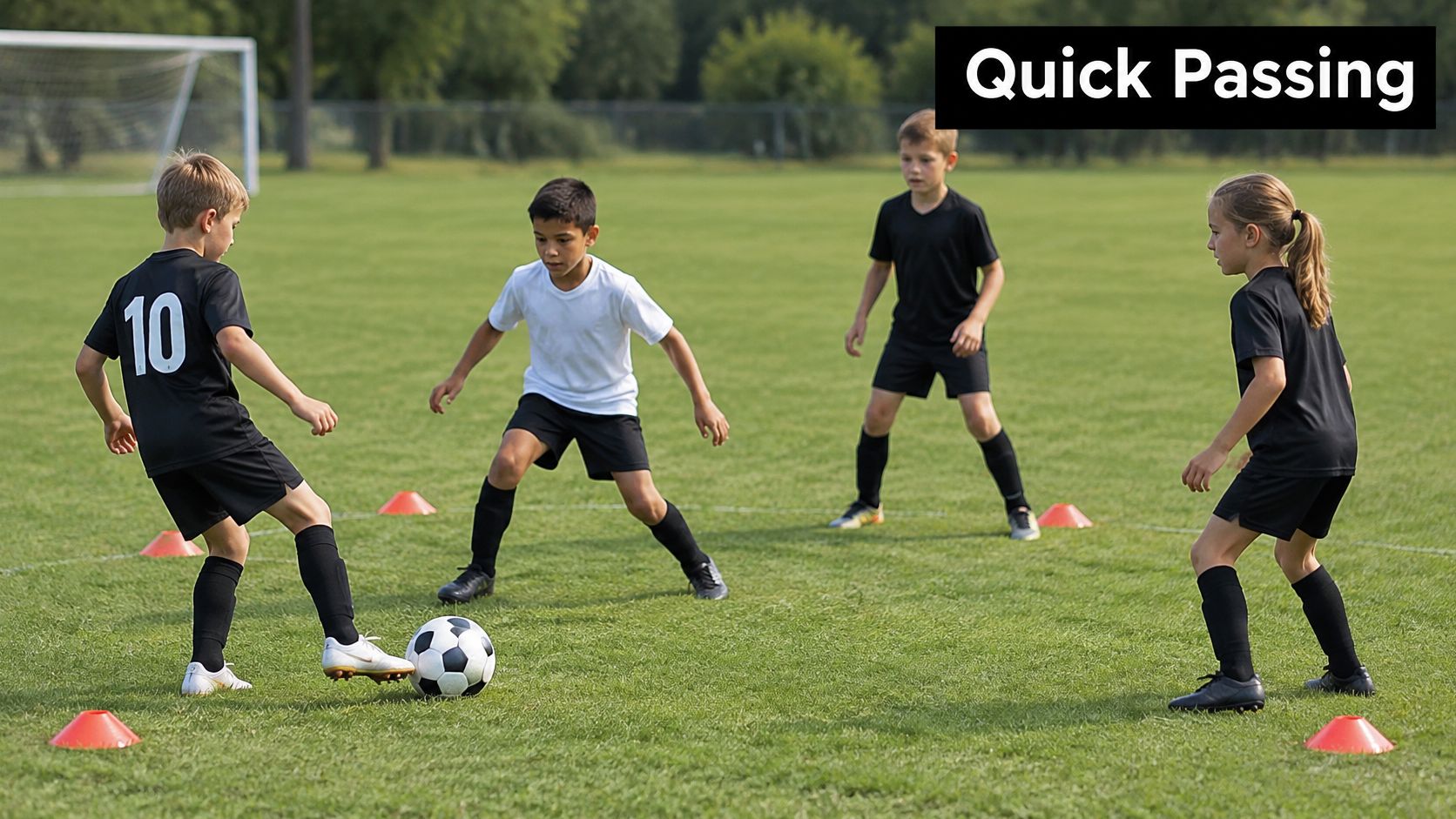
Suggested setup: Mark a square about 10 yards across. Put four attackers around the outside and a defender inside, with a spare ball beside you. Build another grid rather than having extra players watch.
Attackers pass across or around the square while the defender tries to intercept. Outside players can move along their edges to create passing lanes. When the ball goes out, restart quickly; rotate the defender regularly rather than leaving the least experienced child chasing.
Fix the passing lane first
Open the body. Ask receivers to stand sideways enough to see the ball and another teammate.
Move off the cone. Cones mark the space, not permanent parking spots.
Allow control. Beginners can take the touches they need before passing.
Reward support. Praise the child who moves into view, even when the pass goes elsewhere.
A touch limit can increase urgency, but imposing it too early turns the drill into rushed kicking. Start freely, then suggest a two-touch challenge when players can receive comfortably.
Say a confident passer keeps finding the same teammate. Pause briefly and ask the other attackers where they could move to become available. Don't solve every pass for them.
Progression: Reduce the space or try 3v1, which gives the receiver fewer options. For a game version, use small teams and award possession points before allowing an attack toward a goal.
Session role: Use this as the passing block after movement preparation. It teaches patience and support, but it shouldn't replace directional play.
2. Coerver-Style Ball Mastery Circuit
When children wait behind cones, give each child a ball. A ball-mastery circuit removes the queue and lets beginners practice without having a defender immediately take possession.
Suggested setup: Give each player a personal square about 3 yards across. Demonstrate sole rolls, inside-outside touches, and pull-backs, then let players work through the movements at their own pace.
Use this demonstration to help identify the movements before practice.
Start with the ball stationary. Ask players to roll it across their body, catch it with the opposite foot, and settle their balance before repeating. Then have them travel through open space using the same action.
Make the movement solve a problem
Ball mastery isn't a foot-speed contest. Watch whether the child can keep the ball reachable, switch feet, and look away briefly without losing control.
For beginners: Slow the action down and allow a reset between touches.
For confident players: Add a turn toward a colored cone you point to.
For game transfer: Introduce a shadow defender who follows without tackling.
For example, a player may perform a pull-back neatly while standing still but lose the ball when moving. Have that child dribble toward a cone, pull away before reaching it, and accelerate into clear space. That connects the movement to escaping pressure.
The Coerver soccer training guide provides additional context for this technical approach.
Practical rule: Finish an unopposed skill with a choice. A child needs to recognize when to use a move, not just remember its sequence.
Session role: Use a brief circuit before gates or a possession game. The trade-off is straightforward: individual practice offers repetition, but an opponent makes the technique meaningful.
3. 1v1 Dribbling Through Gates
A child who passes immediately whenever an opponent approaches may need permission to take a risk. Gate games make beating a defender a clear, achievable task.
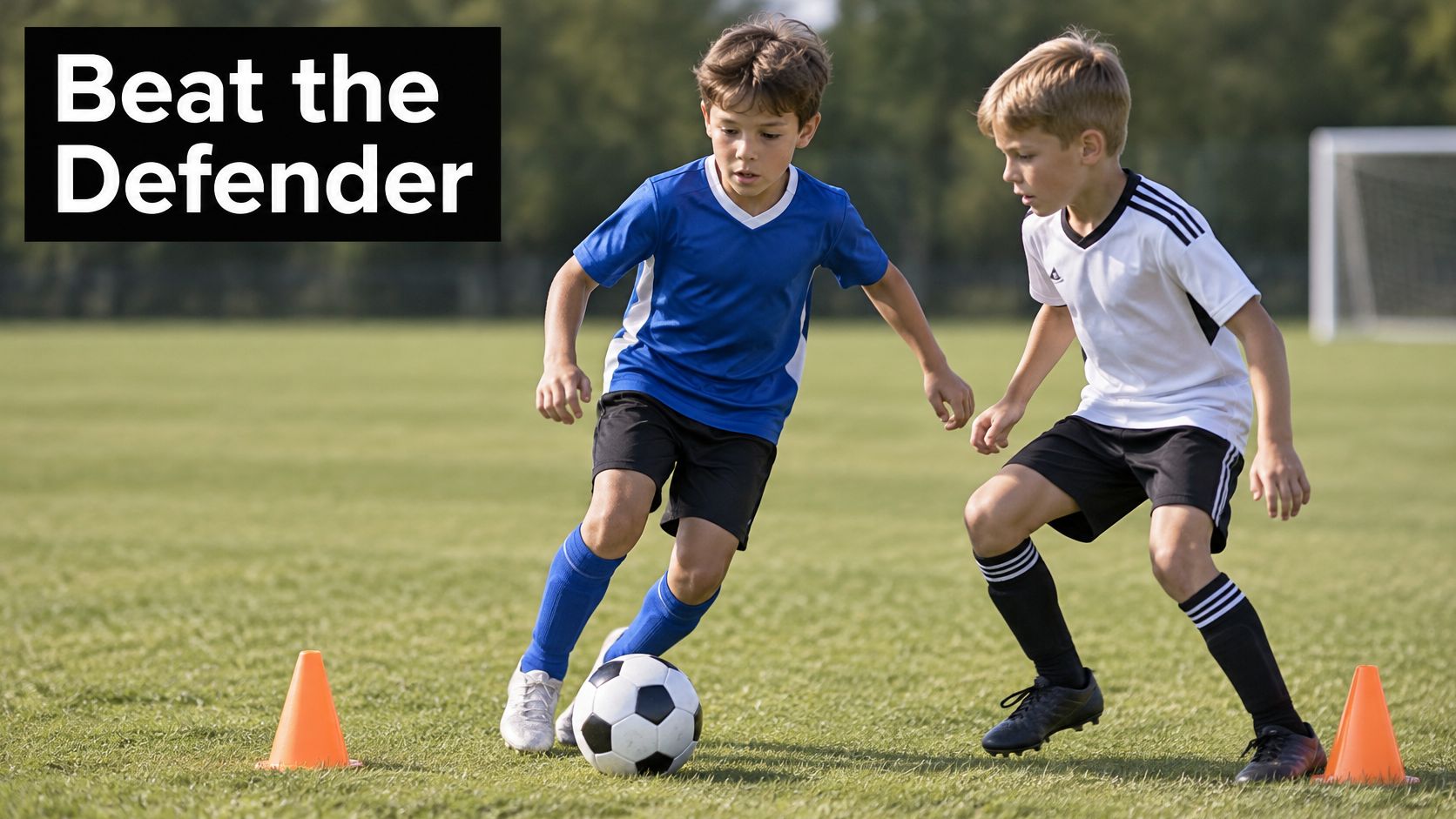
Suggested setup: Use a 12-by-12-yard grid with cone gates about 2 yards wide, spread around its edges. Give each pair its own area if space allows.
The attacker scores by dribbling through an available gate under control. The defender blocks routes and attempts a standing interception. Swap roles after an attempt, and prohibit pushing, sliding, and charging through the attacker.
Fix straight-line dribbling
If the attacker runs directly into the defender, widen the starting gap and offer gates in different directions. Cue approach, disguise, escape: approach under control, show one direction, then take the ball into another.
Make it easier: Ask the defender to shadow without tackling.
Make it harder: Let the defender counterattack through a gate after winning possession.
Keep it purposeful: Require the attacker to remain with the ball after crossing the gate.
A randomized study of players aged 9–12 used an 11-week intervention combining one-versus-one situations and small-sided games, with skill-course times improving by 7.9 seconds in the intervention group, according to the published youth-player study. That supports combining individual challenges with games, not promising improvement from gates alone.
For example, encourage a hesitant attacker to try a body feint even if the defender wins. Praise the attempted solution, then adjust the challenge.
The youth soccer dribbling drills guide offers related practice ideas.
Session role: Place gates after ball mastery, then finish with a small-sided game where dribbling remains an available choice.
4. Passing Triangles
Three children stand on cones and pass around the perimeter. The passes look tidy, but nobody learns to help a teammate after releasing the ball.
Change the movement, not just the passing direction. Use the triangle to teach receivers to adjust their position while the ball travels.
Suggested setup: Place cones in a triangle with sides about 7 yards long. Use three players and a ball, leaving room around every cone for movement.
Begin with passes around the triangle in either direction. After passing, the player moves away from the cone and resets into a useful receiving angle. Ask receivers to check their surroundings before the ball arrives.
Avoid the pass-and-follow traffic jam
With only three players, mechanically following every pass can crowd the receiver and leave another point empty. Keep the initial rotation simple, then add a spare player if you want a continuous pass-and-follow pattern.
Passing cue: Point the standing foot toward the target and strike through the middle of the ball.
Receiving cue: Take the first touch toward the next action, not underneath the body.
Communication cue: Call a teammate's name while the passing option is available, not after the ball has gone.
Say a receiver keeps stopping the ball dead and turning awkwardly. Ask them to begin side-on and receive across their body. Slow the pass if needed; don't mistake a hard delivery for a better challenge.
Progression: Introduce a passive defender in the middle. Let attackers move along the triangle's edges instead of requiring a fixed passing order.
A passing pattern teaches the movement. A defender reveals whether the player understands why it matters.
Session role: Use triangles before rondos in a passing-focused practice. Finish with a directional game so players must choose between supporting, passing, and carrying the ball.
5. Sharks and Minnows (Dribbling Tag)
The usual problem with Sharks and Minnows is elimination. The children who most need touches lose their balls first, then spend the activity chasing everyone else.
Keep players involved instead.
Suggested setup: Start with a 20-by-20-yard grid, a ball for each minnow, and designated sharks wearing bibs. Adjust the space if children repeatedly collide or can escape without changing direction.
Minnows dribble inside the boundary while sharks try to touch a ball with their foot. A caught minnow completes a controlled turn in a clear recovery area, then rejoins. Rotate shark roles on your signal instead of letting the whole group gradually become defenders.
Keep the game playful, not frantic
Use ball touches rather than body tags. Sharks shouldn't grab shirts, shove, or kick wildly through a player's legs.
When players bunch up: Pause and point out unused space, then restart from spread-out positions.
When stronger players dominate: Ask sharks to walk while beginners dribble normally.
When children stare down: Hold up a colored cone and ask them to name its color while moving.
The 2024 FIFA 11+ KIDS systematic review reported a 48% reduction in overall injuries and a 74% reduction in serious injuries among children playing soccer. Those findings concern a structured program, not this tag game or an improvised warm-up.
Prepare children with controlled jogging, balance holds, gentle landing practice, and gradual changes of direction before introducing full-speed pursuit. Don't turn the opening activity into an immediate sprint contest.
For example, if a child repeatedly boots the ball away when threatened, praise a successful turn instead of a narrow escape.
Progression: Let a minnow escape pressure through an outside gate and return elsewhere. For a team-game option, use small teams protecting possession against rotating defenders.
Session role: Choose this as a playful warm-up after gentle movement preparation.
6. 3v3 Small-Sided Games
A U10 match turns into a swarm fast: six players around the ball, nobody wide, and shouting "spread out" changes nothing. The fix is a field small enough that open space is obvious.
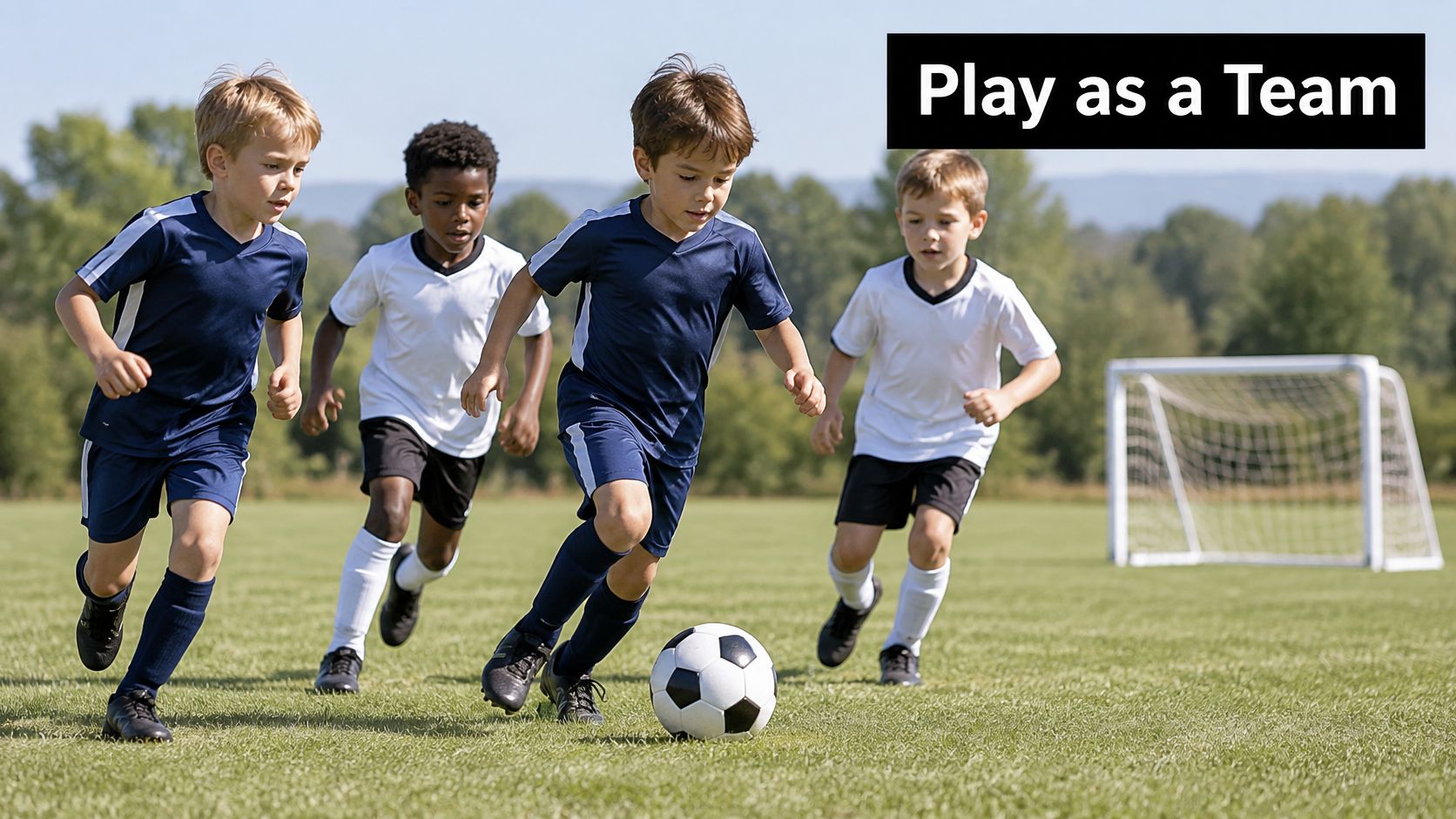
Suggested setup: Mark a 25-by-18-yard field with small, secured goals and no goalkeepers. For more than six players, build neighboring fields rather than parking substitutes in a queue.
Keep restarts simple and spare balls beside the field. Let players dribble or pass back into play, and let small mistakes go instead of whistling each one.
U.S. Soccer formally introduced its Player Development Initiatives on August 1, 2017, establishing age-appropriate small-sided standards, according to the Player Development Initiatives document. The takeaway for a Tuesday practice: build a child-sized learning environment, and skip the adult tactical shape.
Fix domination without banning dribbling
A strong player who carries the ball constantly tempts coaches into compulsory passing rules. Resist that. A forced pass count punishes useful initiative and produces passes to nowhere.
Create width: Offer wide scoring gates so teammates have a reason to pull away from pressure.
Balance teams: Adjust matchups when a child cannot touch the ball meaningfully.
Notice support: Praise an available teammate before the pass arrives, so off-ball movement gets credit.
Remove constraints: Return to normal scoring once players recognize the intended option.
A comparison of children transitioning from futsal found more frequent and successful technical actions in 7-a-side than 8-a-side play, with the authors favoring the smaller format for U8–U10 learning in the comparative small-sided study. It tested slightly bigger formats than 3v3, so treat it as a general pointer toward fewer players per side rather than a verdict on this drill.
When a team bunches, freeze play for a few seconds, point to where a supporting player could stand, and restart the same situation. The small-sided soccer games guide offers more variations.
Progression: Add a neutral player who always joins the attack, or award double goals for scores that arrive after a pass into a wide gate.
Session role: Run this as the main application game of a 45-to-60-minute session, and give it the biggest time block. The earlier drills transfer here.
7. Shooting Lanes with Rotating Goalkeepers
A long shooting queue creates impatient players and hurried shots. Splitting the queue helps only if you also prevent balls from crossing into another shooting area.
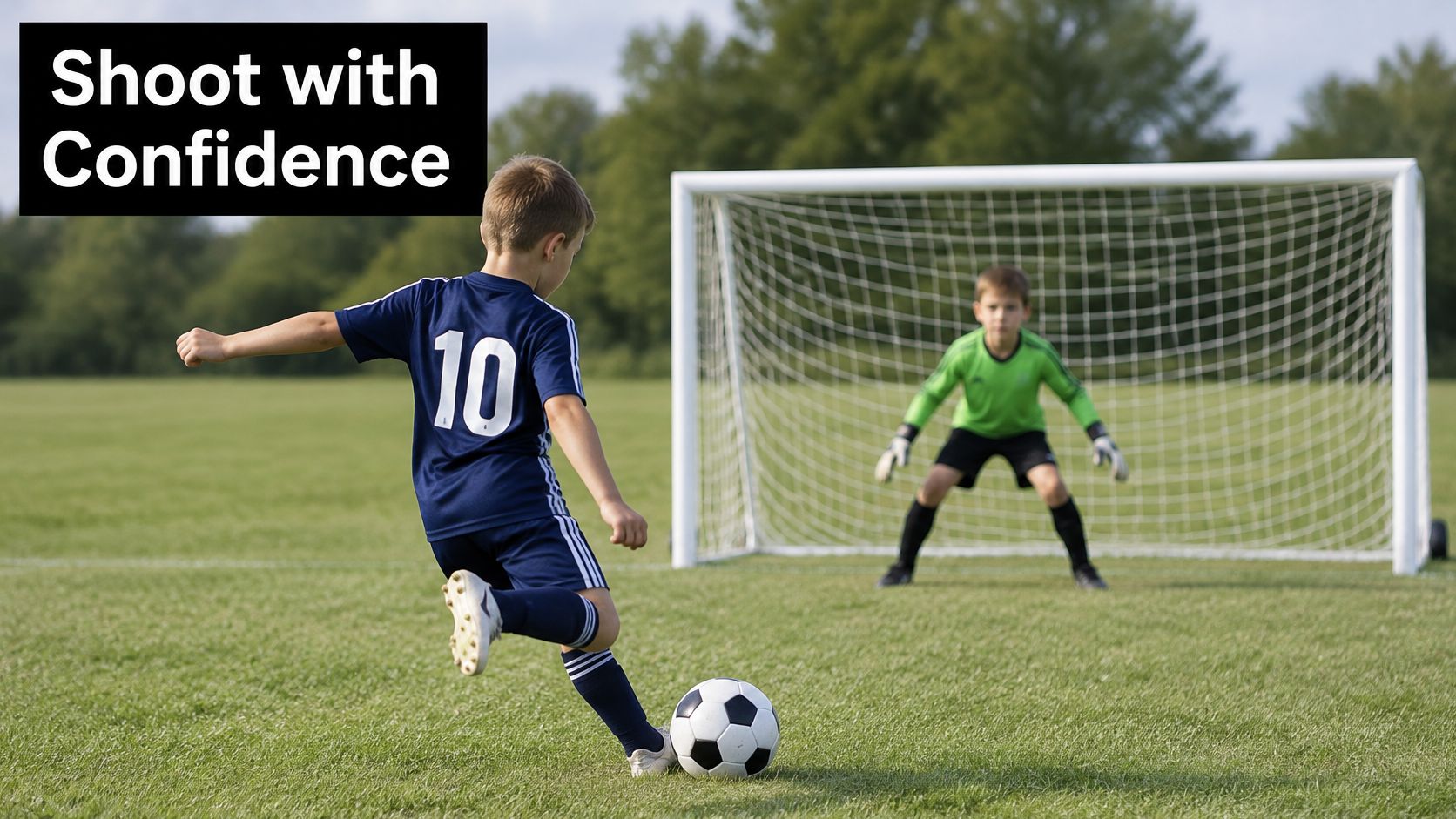
Suggested setup: Mark a starting cone about 10 yards from a secured goal and a shooting line closer in. Use separate goals for separate lanes, with generous buffer space between them.
If you only have a single goal, run a finishing station beside a ball-mastery station. Don't send simultaneous shots toward the same goalkeeper.
Organize the next ball before the shot
The shooter dribbles forward and finishes after you confirm that the goalkeeper is ready. Players retrieve balls only after your signal, outside the active shooting path.
Technique: Plant the non-kicking foot beside the ball and aim before adding power.
Rotation: Offer goalkeeper turns without forcing a reluctant child into goal.
Scoring: Reward accurate placement rather than the hardest strike.
Progression: Add a sideways pass to receive before shooting, then a recovering defender.
A child who repeatedly blasts over the goal may need a closer starting point and a smaller backswing. Ask for a controlled inside-foot finish into an open corner before returning to a driven shot.
Safety first: No shot starts while someone is retrieving a ball, adjusting the goal, or facing away inside the shooting area.
If you're also organizing uniforms, keep that task off the practice field; the Zero Sports custom design page is a separate planning resource.
Session role: Use finishing as a technical block, then play an attacker-versus-defender game toward goal. Unopposed shots help players adjust technique, but defenders teach them when a shooting opportunity is open.
8. Red Light, Green Light Dribbling
Some groups don't need more excitement at the start. They need a clear signal that everyone understands.
Red Light, Green Light gives you that signal while every child stays on the ball.
Suggested setup: Use a 20-by-15-yard grid with a ball per player. Explain that green means controlled dribbling, red means stopping the ball with the sole, and yellow means slowing down and finding space.
Demonstrate the stop before starting. Players should settle their balance over the supporting leg rather than stamp on the ball while sprinting.
Move from listening to looking
Begin with spoken commands, then introduce colored cones as visual signals. That asks children to glance up instead of listening while staring at their feet.
For beginners: Use a walking dribble and allow time to stop.
For confident players: Add a turn before changing direction.
For crowded groups: Split the grid and keep generous space between players.
For mistakes: Let children correct the action immediately instead of eliminating them.
Say several children keep running after red. Check whether they understand the movement and can hear you before treating it as poor attention.
The youth soccer sports-medicine editorial emphasizes diversified movement, structured rest, and attention to total training load. Keep this activity controlled when children arrive tired from school sports or another practice.
Progression: Replace a command with a problem. Point toward an occupied area and ask players to turn into clear space rather than obey a rehearsed direction.
For a small-sided version, release players into a normal game after a stop signal. Once play begins, let opponents and available space guide their decisions.
Session role: Use this to organize the opening minutes or reset a distracted group. Don't keep adding commands until remembering the rules becomes harder than playing soccer.
How the eight U10 drills compare at a glance
Drill | Main Skill Built | Typical Space | Equipment Needed | Best Used For |
|---|---|---|---|---|
Rondo Keep-Away (4v1 and 3v1) | Quick passing, first touch, and awareness | 10×10 to 15×15 yard grid | Ball and cones | Possession practice and warm-ups |
Coerver-Style Ball Mastery Circuit | Close control, coordination, and confidence | Small station or cone area | One ball per player and a few cones | Individual ball-skill repetition |
1v1 Dribbling Through Gates | Dribbling, direction changes, and 1v1 confidence | About 10×15 yards | Ball, cones, and marked gates | Practicing how to beat a defender |
Passing Triangles | Accurate passing, receiving on the move, and support angles | Triangle with 8- to 12-yard sides | Ball and cones | Passing technique and team movement |
Sharks and Minnows (Dribbling Tag) | Close control, spatial awareness, and direction changes | About 20×20 yards | One ball per player and cones | Fun, active dribbling practice |
3v3 Small-Sided Games | Game awareness, teamwork, and decision-making | About 25×35 yards | Ball, small goals, and field markers | Applying skills in game situations |
Shooting Lanes with Rotating Goalkeepers | Finishing technique, accuracy, and composure | Two or three lanes leading to a small goal | Balls, cones, and a small goal | Repeated shooting practice |
Red Light, Green Light Dribbling | Ball control, listening, and reaction time | About 20×20 yards | One ball per player; cones optional | Playful control and stopping practice |
Turn These Eight Drills Into Your Next U10 Practice
Start with one warm-up, one technical theme, and one small-sided game. You don't need every activity in the same practice. Repeating a useful challenge with a manageable progression usually beats explaining another unfamiliar drill.
The schedules below are suggested coaching prescriptions, not official duration standards. Include water and transitions inside the allocated blocks, and shorten an activity when children lose movement quality or concentration.
A suggested 45-minute dribbling practice
Opening movement and Red Light, Green Light, 8 minutes: Begin gently, then introduce controlled stops and turns.
Ball mastery, 7 minutes: Practice sole rolls and pull-backs, finishing with movement toward open space.
1v1 gates, 10 minutes: Start with shadow defending, then allow controlled challenges.
3v3 games, 15 minutes: Let players choose whether to pass or dribble.
Recovery and recap, 5 minutes: Walk, hydrate, and ask players when a turn helped them escape.
For a playful alternative, replace Red Light, Green Light with Sharks and Minnows. Keep the early pursuit controlled instead of turning the warm-up into an exhausting competition.
A suggested 60-minute passing and finishing practice
Movement preparation, 8 minutes: Include jogging, balance, gentle landings, and controlled direction changes.
Passing triangles, 10 minutes: Emphasize receiving position and a useful first touch.
Rondos, 10 minutes: Look for movement that gives the ball carrier an option.
Shooting lanes, 10 minutes: Prioritize readiness, accuracy, and safe retrieval.
Small-sided games, 17 minutes: Remove most restrictions and watch whether the earlier skills appear.
Recovery and recap, 5 minutes: Recognize a specific decision or improvement from each group.
Keep assessment simple. A study of highly trained U10 players used repeated 4v4 games to evaluate performance under game conditions, as described in the small-sided talent-identification study. For a volunteer coach, the useful principle is to watch skills during play, not only during demonstrations.
Look for earlier scanning, purposeful support, attempts with both feet, and recovery after mistakes. Don't judge progress only through goals or the fastest player's performance.
Check the surface, footwear, shin guards, and goal security before starting. Stop activity for pain, dizziness, or a suspected injury, and let children take water when needed. A tired child needs an adjustment, not punishment running.
Above all, praise the action you want repeated: a controlled turn, a teammate finding space, or a player trying again. Clear feedback gives children something practical to carry into the next game.
JC Sports Houston offers age-appropriate soccer training and free soccer trials for ages 4-6, 7-9, and 10-13, with interactive drills and small-sided play. Visit JC Sports Houston to request a trial using your child's name, age, and favorite sport, and explore a practice environment focused on confidence, technique, and creative decisions.
Comments