

8 Questions to Ask a Soccer Coach: A Parent's Checklist

The parking lot after the first session is where the decision gets made. Your child is still talking about the drill they scored in, and you're holding a flyer that used the words "development" and "fun" without defining either. The coach is twenty yards away stacking cones, and you have about five minutes to work out whether the hour you just watched matched the hour you paid for.
Most parents spend those minutes on logistics. Where to park, what to bring, whether the schedule shifts in June. Fair questions, and none of them tell you whether your child will be a better player in March or will have quit by then. The useful information comes from a short list of questions asked before you register, then checked during a trial session while the coach isn't selling anything.
The mistake I see most often isn't asking too few questions. It's asking broad ones. "How's the program?" gets a brochure. "How many minutes of a 45-minute session does my four-year-old spend waiting in line?" gets an answer you can verify by standing on the sideline for twenty minutes.
Ask these eight questions before you sign, and treat the trial as the audit.
1. What is your coaching philosophy, and how do you measure success and development?
A philosophy is easy to recite. The measurement half of this question is where coaches separate, because a coach who can't describe how progress gets tracked is describing intent rather than practice.
The scale behind that claim is worth knowing. The Aspen Institute's 2022 National Coach Survey drew 10,661 coaches across 38 sports, with soccer accounting for 24% of respondents, ahead of baseball at 15% and basketball at 12% (Aspen Institute National Coach Survey). A peer-reviewed study of 7,354 coaches in that survey found that prior training in sport skills, tactics, and positive youth development predicted a greater perceived impact on athletes' life-skill development. Read that outcome list carefully: self-efficacy, leadership, motivation, continued participation. Those are the things a strong philosophy answer should name.
Ask the coach to talk through one activity in next week's session plan.
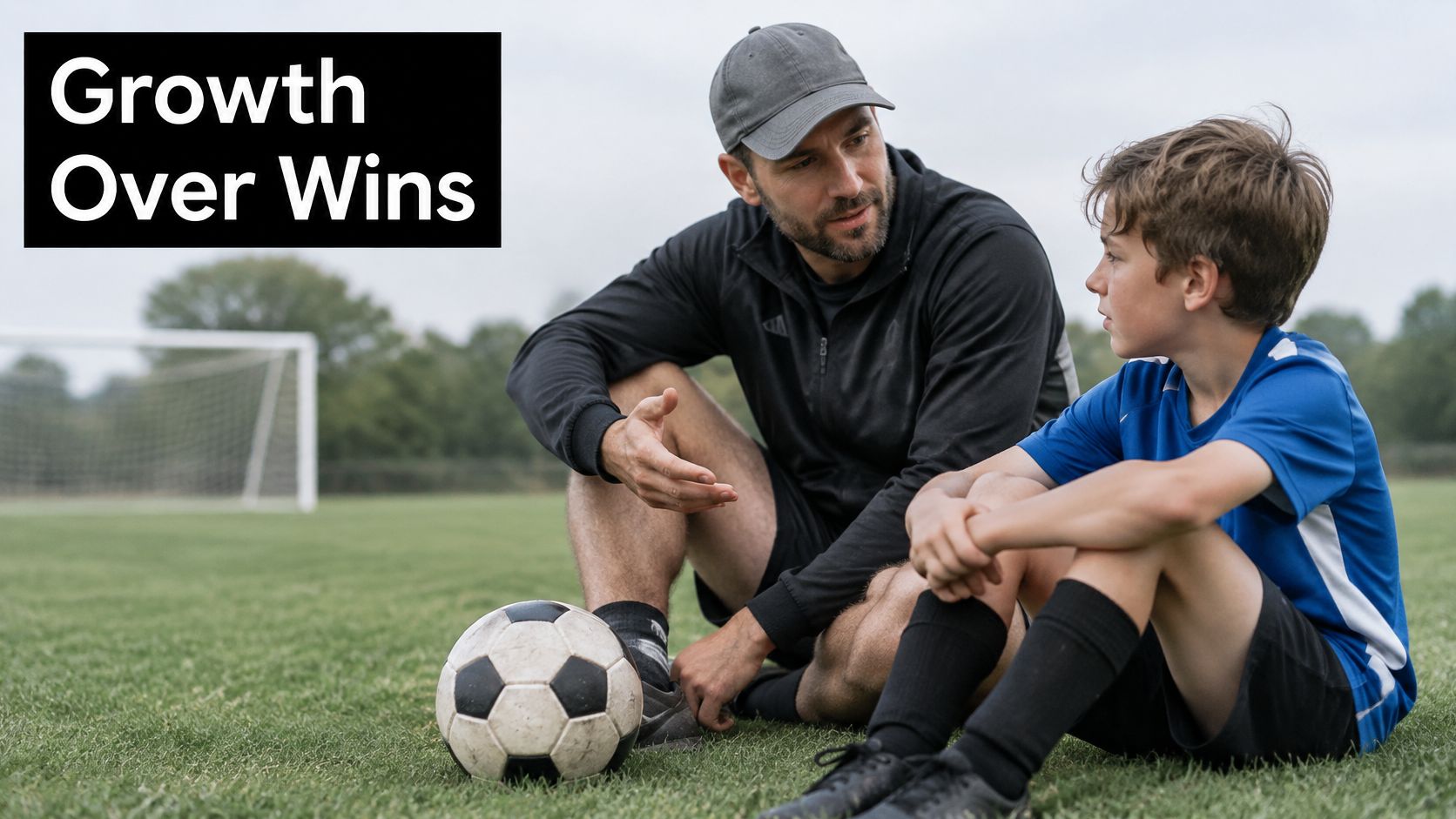
What a Strong Answer Sounds Like
Named milestones: "By midseason, a U8 player can receive across the body and choose between dribbling and passing."
A tracking artifact: a skills checklist, two or three targets per player, a scheduled review date.
A definition of success that includes retention and enjoyment, not just goals scored.
The weak version is "we develop the whole player" with nothing behind it, or "everyone plays" with no rotation policy.
Practical rule: If a coach can't name two observable behaviors your child should show by mid-October, they're running sessions, not developing players.
Watch the first fifteen minutes of a trial. If the warmup contains a decision, a pass or a turn under light pressure, the philosophy is doing work. If it's twelve kids in a line waiting their turn, the plan on paper and the plan on grass are different documents.
2. How much of each session is small-sided play compared with full-sided games?
This is the question with the clearest evidence behind it, and the one parents ask least.
FIFA-reported comparisons cited by US Youth Soccer found that goals occur roughly every 2 minutes in four-a-side games and every 4 minutes in seven-a-side, while the ball is out of play 8% of the time in four-a-side and 14% in seven-a-side, compared with 34% in 11-a-side (US Youth Soccer on small-sided games). Fewer players means more touches, more transitions, more passes, and more defensive decisions per minute.
The same guide sets out the recommended progression: U6 teams play 3v3 without goalkeepers, U8 plays 4v4, U10 plays 6v6, U12 plays 8v8, and 11v11 arrives at U14. A program running seven-year-olds through full-field scrimmages is making a choice you're allowed to question.
Format drives field size, rotation, and how many times a defender touches the ball, which is why our breakdown of small-sided soccer games starts with the format rather than the scoreline.
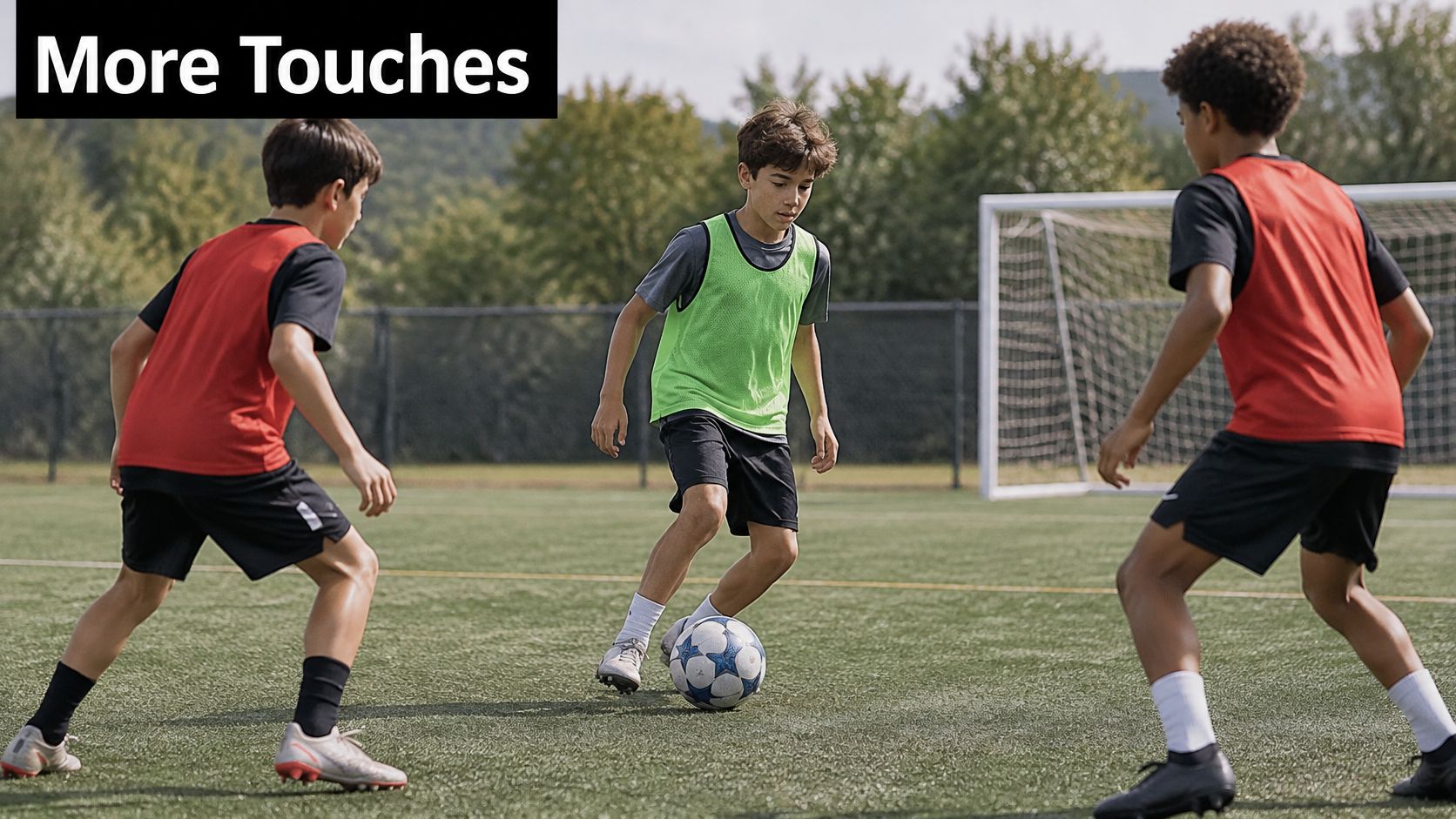
Count the Kids Standing Still
A strong answer gives minutes, not adjectives. "We play 4v4 in six-minute blocks with rotating teams, and every child touches the ball inside the first ninety seconds" tells you the session was designed around involvement.
Formats by age: the coach should name the format for your child's age group without checking a sheet.
Restart speed: quick restarts keep the ball moving and keep kids engaged between games.
Rotation: near-equal minutes within a single session, not just averaged across a season.
Weak answers include "we play small-sided sometimes" and anything that treats small-sided games as a drill rather than the main event of the hour.
Watch the last ten minutes, not the first. That's when tired kids stand in lines, and it's where a well-designed session shows its discipline.
3. How do you develop technical skills such as first touch, dribbling, and ball mastery?
Technical work is easy to promise and hard to deliver at scale, because it needs repetition and individual touches rather than group demonstrations. Ask the coach to walk through the sequence by age: what a four-year-old works on, what a nine-year-old works on, what a thirteen-year-old works on.
A strong answer sounds like a ladder. Close control and turns in isolation, the same move tested in a 1v1, then the move surviving a small-sided game with a defender pressing. Weak answers stay on the bottom rung, with dribbling taught in lines and never tested against an opponent.
Here's the sequence to look for, moving from individual touches into game decisions.
Where Technical Work Goes Wrong
The most common failure isn't a bad drill. It's a good drill with too many children per ball. Ask how many balls are in use during a technical block and what the player-to-ball ratio looks like when the group is at its largest.
Progression by age: turns and close control at 5, receiving across the body at 8, dominant and non-dominant foot work at 11.
Application: every technical block ends in a game where the skill has to survive contact.
Differentiation: a harder and an easier version of the same activity running side by side.
Say your nine-year-old has a decent first touch in drills but panics when pressed. A coach with a real progression will describe the bridge between those two states, usually a 1v1 or 2v1 constraint that forces the touch under pressure. A coach without one will tell you it comes with time.
If you want to see how technical work is sequenced across age groups, our guide to soccer technical training walks through the progression.
4. What are your expectations for attendance, effort, and behavior from players?
A parent asks this question after practice starts, when the car line is moving and the child is still in cleats. That timing matters. Expectations are where a program's honesty shows, especially when the answer includes a limit on how much soccer a child should play in a week.
The load question gets skipped in most attendance conversations. A 2024 peer-reviewed study of Japanese male youth soccer players found that multisport participation combined with high training volume in fifth and sixth grade was associated with previous serious overuse injuries, and the authors recommended age-appropriate volume planning (study of youth soccer training volume). A strong answer gives a weekly range, names when rest is expected, and explains how the coach handles school teams, camps, and private lessons. A weak answer says only that more soccer is always better.
The Commitment Question Behind the Commitment
Ask what the coach expects in writing: arrival time, water, missed sessions, makeup policy, and behavior standards for players and parents. At JC Sports Houston, participants should check in with their coach each week and use the restroom before class. If a parent or caregiver has a concern, the right route is the coach or the director.
Written policies: attendance, cancellations, refunds, and weather rules before you pay, not after.
Volume limits: total weekly hours once school teams, camps, and private lessons are added together.
Pain protocol: who gets told, and what changes when a child reports pain or fatigue.
Watch the first trial for the trade-off between discipline and flexibility. A clear coach notices a tired child early, adjusts the session, and keeps the group moving. A vague coach either plays everyone through fatigue or removes children without explaining why.
Red flag: "We train through it" tells you more about a program than any mission statement on the website.
Ask how the program gathers feedback on its own rules. The 2024 Annual Soccer Parent Survey collected 1,255 responses from parents across 46 U.S. states (2024 Annual Soccer Parent Survey), which suggests families answer when someone asks them. A useful answer names who reads that feedback, who acts on it, and what parents should observe at the next session.
5. How do you communicate with parents and provide feedback on my child's progress?
Parents don't only want a knowledgeable coach. They want one who tells them what's happening.
A 2024 study of parents' perceptions of youth soccer coaches ranked coach expertise highly, but it also identified sharing performance information with parents, friendly communication, and motivational leadership as important attributes (study of parents' perceptions of youth soccer coaches). Expertise alone doesn't read as good coaching from the sideline.
Most lists of questions to ask a soccer coach stop at "how will you contact me." Push one step further and ask what the contact will contain. A 2025 peer-reviewed study of youth soccer communication included 1,024 parents and 340 coaches (youth soccer communication study), which makes parent messaging a design decision rather than an afterthought.
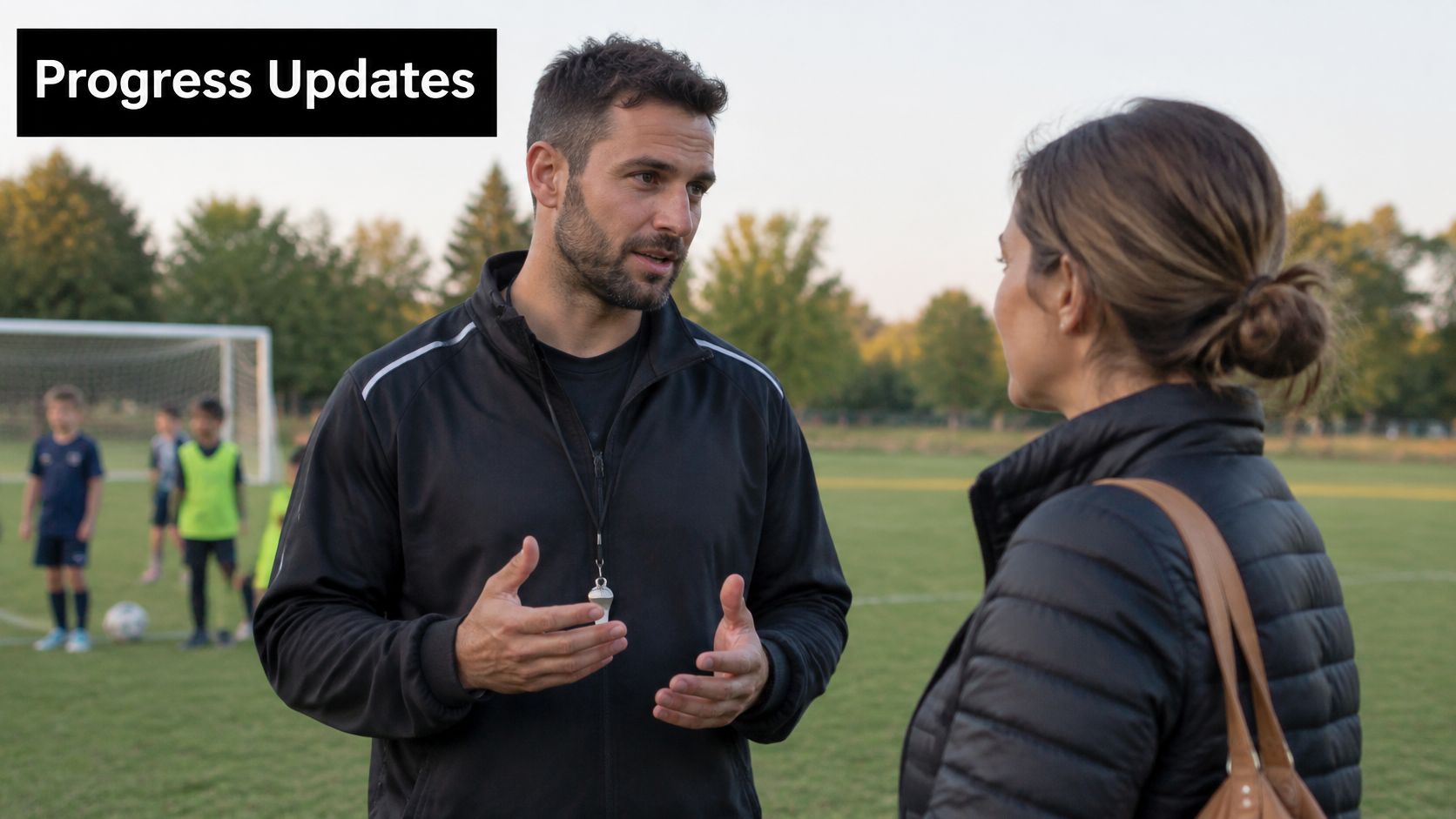
What a Weak Answer Hides
"My door is always open" isn't a communication system. It puts the burden on you to guess when to approach a coach who is packing equipment with three other parents waiting.
A strong answer has three parts:
Frequency: monthly updates, a midseason review, and an end-of-season summary.
Format: a short written note naming one skill that improved and one target for the next block.
Escalation: who to contact about safety, playing time, or placement when the coach isn't the right person.
Ask for one thing your child can practice at home this week. A coach who answers in ten seconds with a concrete cue, "wall passes with the inside of both feet, fifty each," has a working picture of your kid.
6. How do you decide playing time, team roles, and roster placement?
The 2025 National Youth Sports Parent Survey found that parents ranked keeping athletes healthy and fit and distributing playing time fairly among their most important coaching philosophies, and they named communication and trauma-informed education as desirable areas of coach training (2025 National Youth Sports Parent Survey). Fair minutes aren't a soft preference parents tolerate. They're a core expectation.
So ask for the rule rather than the reassurance. "Everyone plays" is a slogan until you hear the mechanism: how minutes get allocated in a developmental league, how roles rotate, and what happens when a child is clearly behind the group.
How to Read a Rotation Policy
Developmental leagues: a set minimum number of minutes per player per game, tracked by the coach rather than estimated afterward.
Competitive teams: performance-based selection stated plainly, with a described pathway for the players on the bench.
Placement reviews: a scheduled midseason check, not a midseason surprise.
Say your ten-year-old is the smallest on the roster and gets the final five minutes of most games. Ask what has to change for that to become fifteen, and who decides. A coach with a plan names the specific gap, usually holding the ball under pressure or defensive positioning, and the drill that addresses it. A coach without one will tell you to be patient.
That's what a weak answer hides here. Not malice, just the absence of a method.
7. How do you adapt training for different ages, skill levels, and interests, including girls' programs?
Ask the coach how the same ball-control activity would change for a beginner and an experienced player. A strong answer names the adjustment and explains why it helps. “We work with every ability” leaves the method unclear.
Research identifies four technically important feedback dimensions: content, delivery, growth orientation, and stereotyping (study of coaching feedback). Ask how cues such as scanning before receiving, supporting the ball carrier, or using the non-dominant foot get simplified for a six-year-old.
Why Feedback Style Matters More Than You Think
Listen for praise that names an action and explains why it worked. “You looked before receiving” gives a child something to repeat. General encouragement can help, but it does not explain the skill.
Use these questions to test how specific the coach can be:
Age band specifics: How do activities and instructions differ between a toddler class and a U12 session? Watch whether the language fits the children.
Skill variation: What different constraints would a beginner and an experienced player use in the same activity? Watch whether both can participate meaningfully.
Placement: How is a new player assessed before joining a group? Ask what the coach looks for beyond age.
For families comparing girls-only sessions with mixed groups, ask what changes in group size, instructional pace, and support for newcomers. A session label alone tells you little about those choices.
During a trial, watch a child who struggles. Does the coach simplify the instruction, adjust the activity, and give the child another attempt? Also ask how activities accommodate different interests. A useful answer connects the adjustment to keeping that child involved while practicing the skill.
8. What qualifications, safety standards, and environment do you provide for players?
Credentials and safety procedures are dull until they aren't, and then they outrank everything else on this list.
Ask directly. Are staff background checked? Who holds current first aid and CPR certification? What's the concussion protocol, and who makes the return-to-play decision? What's the adult-to-child ratio in a session, and who is watching the door during drop-off and pickup?
At JC Sports Houston, programs aren't drop-off classes, so parents and caregivers stay in the building during classes. That single policy answers a good part of the supervision question before you ask it.
The Safety Questions Nobody Enjoys Asking
Certifications: first aid and CPR, current, with more than one staff member holding them.
Injury reporting: a named person, a written note to parents, and a clear return-to-play step.
Facility: indoor space, weather policy, equipment condition, and a visible check-in process.
Visit before you register, or use the trial as an inspection. Watch how the coach handles a collision, how quickly a crying child gets attention, and whether equipment is checked between groups.
If you're weighing private sessions against club training, our guide to choosing a youth soccer coach covers the questions specific to one-on-one work, including fees, missed-session rules, and how progress gets reviewed.
How the 8 questions compare for parents evaluating a coach
Question | Main Focus | Strong Answer Includes | Best Time to Ask |
|---|---|---|---|
What is your coaching philosophy, and how do you measure success and development? | Coaching values and how player progress is assessed | Age-appropriate instruction; growth in skills, effort, confidence, teamwork, and enjoyment, not just results | Before choosing a program or during a trial session |
How much of each session is small-sided play compared with full-sided games? | Game format and player involvement | Frequent small-sided games, active rotations, and age-appropriate progression to larger formats | Before enrolling, especially for younger players |
How do you develop technical skills such as first touch, dribbling, and ball mastery? | Technical skill instruction and progression | Repetition, progressive drills, both-foot practice, and chances to apply skills in games | Before enrollment or when comparing training programs |
What are your expectations for attendance, effort, and behavior from players? | Participation, conduct, and family responsibilities | Clear attendance and communication policies, effort standards, sportsmanship, and arrival expectations | Before registration or the start of a season |
How do you communicate with parents and provide feedback on my child's progress? | Parent communication and progress updates | Regular, specific feedback; clear contact channels; practical guidance; and expectations for parent conduct | Before enrollment and at the start of the season |
How do you decide playing time, team roles, and roster placement? | Fairness, selection criteria, and opportunities to advance | Clear placement and playing-time criteria, meaningful opportunities, and ways to progress | Before joining a team or when roles and placement are being decided |
How do you adapt training for different ages, skill levels, and interests, including girls' programs? | Age- and player-specific instruction | Suitable content for each age and level, thoughtful placement, and supportive options such as girls' programs | When choosing a program or discussing group placement |
What qualifications, safety standards, and environment do you provide for players? | Coach credentials, child safety, and facility conditions | Relevant certifications, background checks, first aid and CPR, emergency procedures, and safe supervision | Before registration or visiting the facility |
Turn These Questions Into a Confident Choice
Bring your three most important questions to a trial session, and grade the answers twice: once on what the coach says and once on what happens after the whistle. The second grade is the one that counts, because a coach can talk about development for an hour and still run a line drill for forty minutes.
Start with the question that matters most to your family. If your child is four, that's small-sided play and feedback. If your child is eleven and asking about a competitive league, it's placement, minutes, and the pathway upward. The rest of the list can wait for a second conversation.
Write the answers down the same day. Two programs blur together by the following week, and a vague memory of "they seemed good with the kids" won't help you compare. Ask the same eight questions of every coach so you're comparing like with like rather than a great answer at one club against a rushed answer at another.
Take your child's reaction seriously as well. A program that makes a cautious five-year-old want to come back is doing something right, even if the drills look messy from the sideline. Enjoyment and retention are development outcomes, not distractions from them.
There's a real trade-off to hold in mind. Development-first programs tolerate messy games and mixed ability, and they can look less polished in a tournament. Results-first programs produce sharper short-term play and higher dropout among the kids who need the most patience. Neither is automatically wrong, but you should know which one you're buying before the season starts.
If you want to see the approach firsthand, JC Sports Houston lists free trials for MultiSport and for soccer at ages 4-6, 7-9, and 10-13. Families can request one by filling out a form with the child's name, age, and favorite sport. Bring the question list, watch the warmup, and judge for yourself.
JC Sports Houston runs age-appropriate soccer programs for children 24 months and up, from toddler classes and Coerver-based training to seasonal leagues, with small-sided play and progressive instruction built into the curriculum. If these questions sharpened what you're looking for, bring them to a session and see how the answers hold up on the field. Visit JC Sports Houston to browse programs, check schedules, and request a free trial for your child.
Comments