

7 Beginning Basketball Plays for Young Players

You've drawn up a beautiful play on the whiteboard, and thirty seconds into practice, half your players are standing still, two are cutting into each other, and someone's asking which basket you're shooting on. That's not a motivation problem. It's a progression problem, and it's completely fixable.
The best beginning basketball plays aren't the most complicated ones. They're the actions children can repeat, recognize, and enjoy, even when a defender does something unexpected. That's how we build this list for JC Sports Houston classes and camps, where players first learn passing, cutting, spacing, communication, and decision-making before you add screens, transition speed, or defensive reactions.
Use each play below three ways. Start it as a two-player drill, turn it into a small-sided game, then use it as a building block inside a larger team action. When a child freezes, you don't need a new play. You reduce the space, remove a defender, or simplify the rule until the next decision becomes obvious again.
1. Give-and-Go
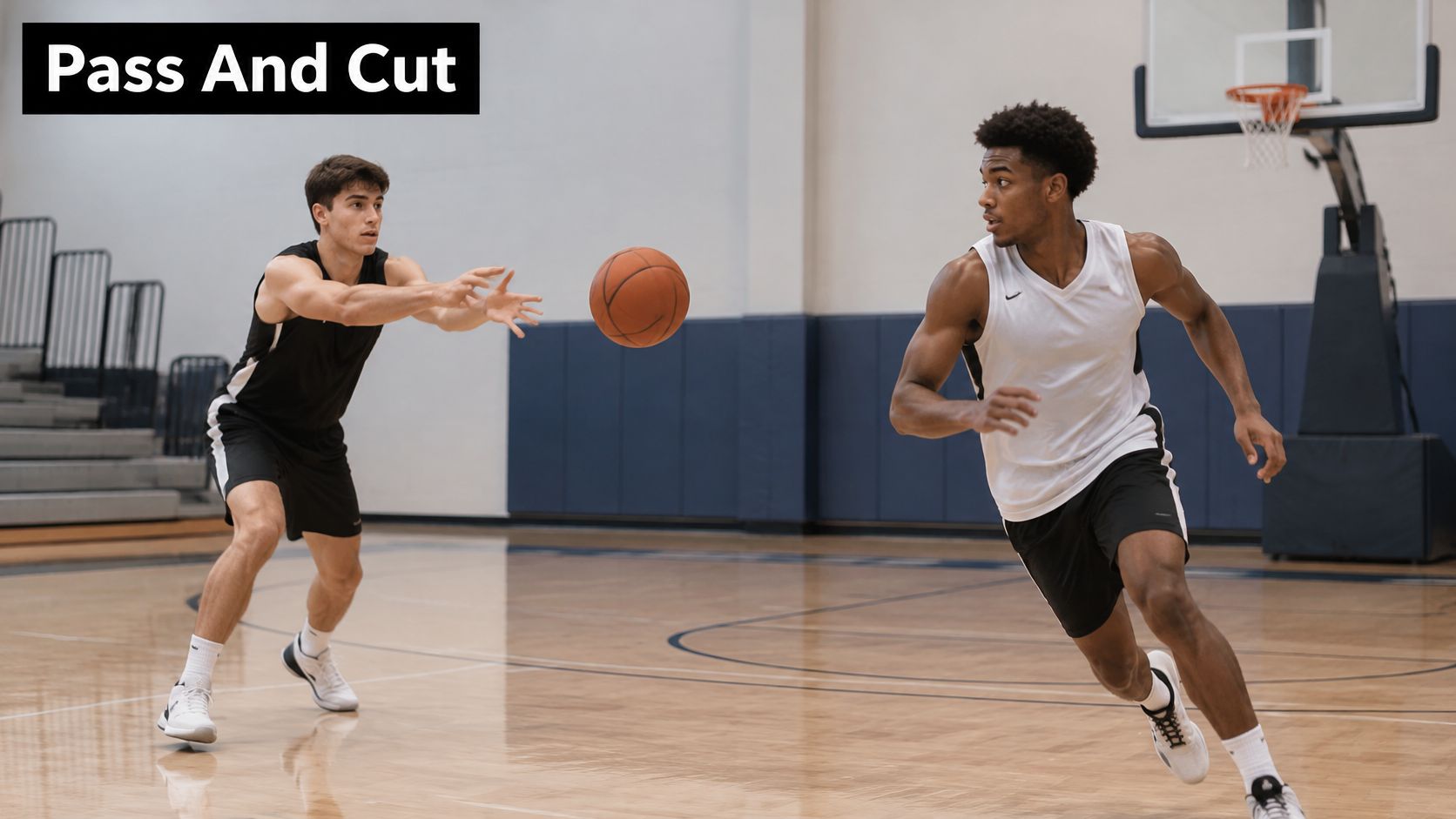
Start here because the give-and-go teaches four skills in one short action. The passer throws to a teammate, then immediately cuts toward the basket for a return pass. The defender has to choose between guarding the cutter and staying with the ball, and that choice creates the opening.
That simple idea fits basketball's roots. Under James Naismith's original 13 rules written in December 1891, players couldn't run while holding the ball, so early offense relied on passing, positioning, and cutting. You're teaching the same foundation today, just with a cleaner finish.
Coach It With Short Cues
Step in first: Have the passer step toward the defender before passing, which draws the defender close.
Pass and go: The passer cuts through the lane right after the pass and doesn't stand and watch.
Eyes up: Both players keep their eyes up so they see when the defender turns or leaves space open.
Youth and high school teams across the United States use this as a foundational drill, and NBA teams still create layups with give-and-go actions from perimeter passers. For beginners, practice it with pass and follow the pass in small-sided games, which fits JC Sports Houston's small-sided philosophy. If your cutter gets lost, pair the work with defense youth basketball drills that teach players to track cutters so both sides learn the read at the same time.
2. Pick-and-Roll
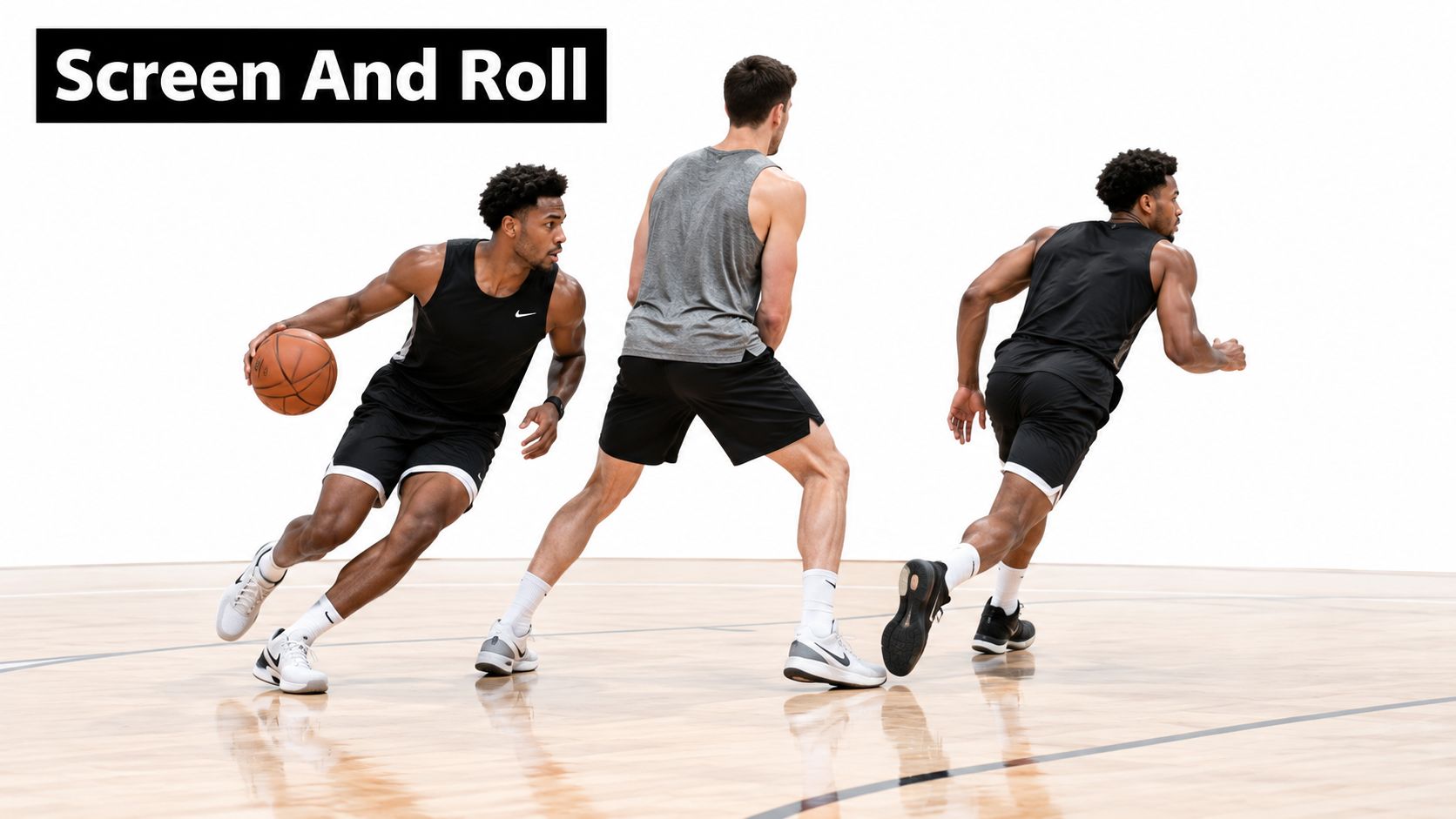
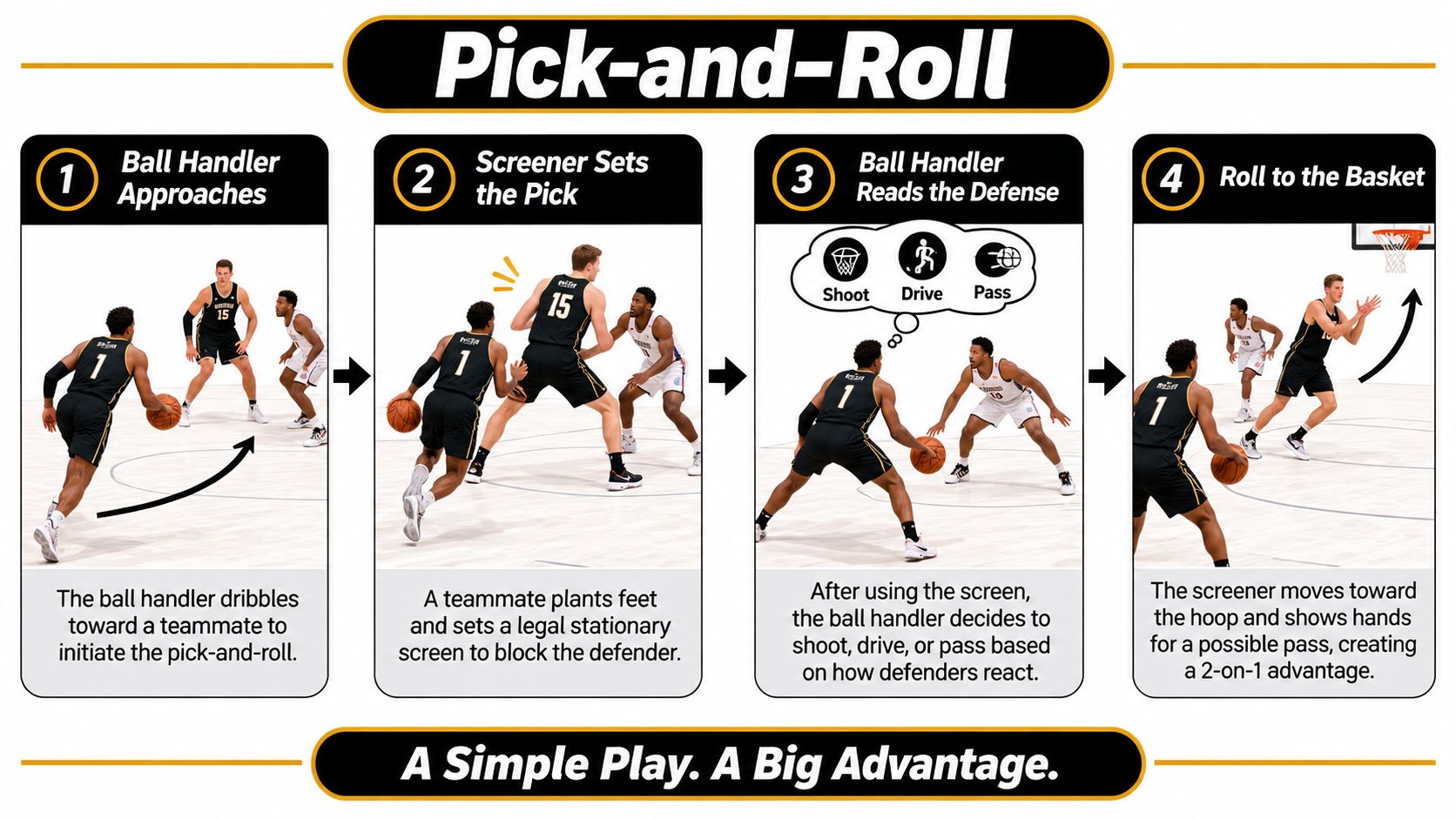
John Stockton and Karl Malone made the pick-and-roll famous with the Utah Jazz in the 1990s, but your beginners don't need that level of timing. They need one clear idea. A teammate sets a screen, the ball handler uses it, and the screener rolls toward the basket with hands ready.
Teach the legal screen before you teach the read. The screener stays stationary with feet set and arms in front of the body. The ball handler then attacks close to the screener's shoulder, almost brushing past, so the defender can't slip through easily.
Make the First Read Simple
Ask the ball handler to make only one decision at first. If the defender follows you around the screen, pass to the roller. If the defender drops toward the roller, keep the ball and drive or shoot. That's enough for beginners.
Start in 3-on-3 or 4-on-4 so players get repeated reps without five defenders crowding every lane. Encourage players to call out screen or ball on every rep, because communication prevents collisions and helps shy players claim their role. Modern NBA teams run pick-and-roll actions constantly, but for young players the value is simpler. It teaches teamwork, timing, and patience, and it connects naturally to broader basketball skills development for young players such as stopping, pivoting, and passing out of pressure.
Coaching cue: Screen, show your hands, roll to the rim. If the screener can't say it while moving, slow the drill down.
3. Backdoor Cut
A backdoor cut punishes a defender who's trying too hard to steal the pass. When that defender leans toward the ball and denies the passing lane, the offensive player plants a foot, changes direction sharply, and cuts behind the defender toward the basket for a layup.
This is a reading play, not a memorizing play. Teach players to look for a defender who's face guarding or cheating toward the ball with their back partly turned to the basket. That's the signal. One hard step toward the ball sells the fake, then the cutter goes the other way.
The visual below breaks the pick-and-roll into four steps, and it's a useful comparison because both actions ask beginners to read one defender and react.
Set Up the Rep So It Actually Happens
Run a 3-on-3 scrimmage where you coach one defender to overplay on purpose. Now the backdoor cut appears naturally instead of by accident. Tell the cutter to plant the foot nearest the baseline to change direction quickly, and tell the passer to see the cut early, make eye contact, and pass before the cutter reaches the rim.
College programs use backdoor cuts inside motion offenses to counter aggressive defense, and NBA offenses use them when ball-side pressure gets too tight. For beginners, celebrate the correct read even if the layup misses. You're building court awareness, and the finish will catch up.
4. Dribble Hand-Off (DHO)
Think of the dribble hand-off as a moving give-and-go. The ball handler dribbles toward a teammate and hands the ball off while both players are moving. The receiver takes it at speed and can drive, shoot, or pass before the defense resets.
The Golden State Warriors and other NBA teams use hand-offs to free shooters and open driving lanes. College programs use them to create motion against slower defenders. Your beginners get a simpler benefit. Nobody has to stand still and wait, so energy stays high and touches are shared.
Build It in Two Stages
Stationary first: Practice a clean handoff at walking speed, with the ball handed forward, not tossed backward.
Angle the approach: The receiver runs in at an angle, not straight at the ball handler, which avoids collisions.
Mark the zones: Use cones to show where handoffs happen so spacing stays consistent.
If the exchange gets fumbled, the problem is usually dribbling control, not effort. Slow down and rebuild the handle with practical ways to improve basketball dribbling before you add a defender. Once the handoff is clean, add one passive defender who only shadows the receiver. That single change forces players to protect the ball and choose a direction, without turning the drill into chaos.
A good hand-off looks boring at first. Clean, close, and on balance beats fast and fumbled every time.
5. 3-on-2 Fast Break
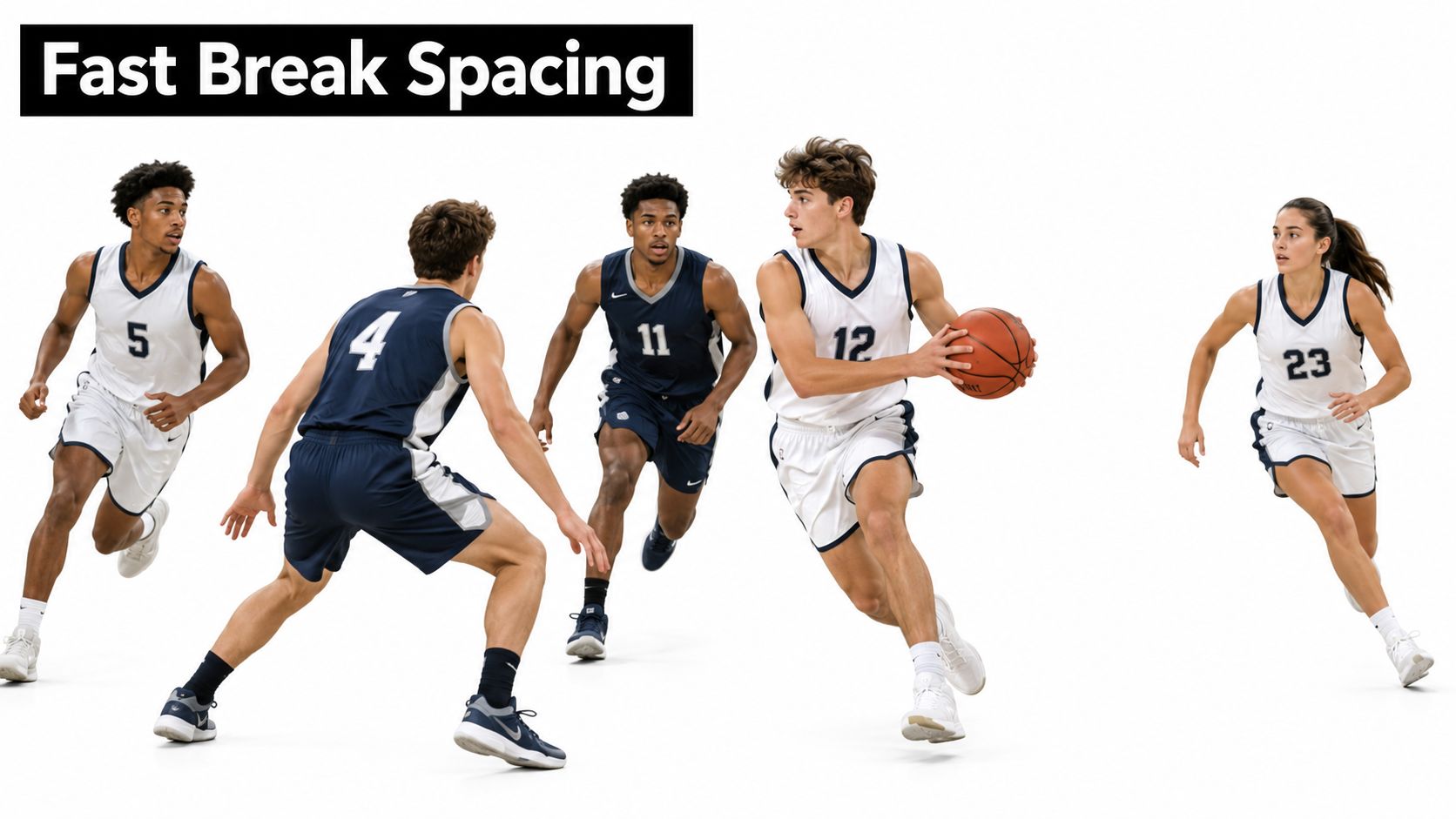
Fast breaks feel chaotic to beginners because everything happens at once. The 3-on-2 fast break slows that chaos into a teachable shape. Three attackers run against two defenders after a rebound, turnover, or made basket, and the extra player means someone should end up open if the ball moves early.
Evidence backs starting even smaller. In a study of 16 novice male players aged 11 to 15, the 2-versus-1 half-court format produced significantly better dribbling, reception, and rebounding efficacy and the small-sided format comparison in novice players also found 4-versus-3 and 5-versus-4 full-court games improved pass efficacy. So build from 2-on-1, then graduate to 3-on-2 when catches are secure.
Three Rules That Keep It Organized
Teach players to stay wide so two defenders can't guard three people in a narrow lane. Keep the trailer behind the ball for a kick-out pass if the drive gets stopped. Coach the ball handler to attack the middle defender and pass early the moment that defender commits.
The Seven Seconds or Less Phoenix Suns built their offense around quick transition attacks, but your goal isn't speed for its own sake. It's speed with spacing. If players rush into turnovers, walk the break at half speed for two reps, then speed it up again.
6. Motion Offense (Princeton-Style Basic Motion)
Some children memorize a play perfectly in practice and panic the first time a defender stands somewhere unexpected. Motion offense solves that by replacing fixed routes with shared rules. Players keep moving, passing, and cutting, and they read the defense together instead of waiting for their named turn.
Princeton University under Pete Carril used this style to upset stronger NCAA opponents, and Bob Knight's Indiana teams ran motion principles for decades. Beginners get a stripped-down version with only three or four rules they can repeat back to you.
Watch how continuous passing and cutting keeps every player involved, even without the ball.
Give Beginners Rules, Not Routes
Pass and cut: After every pass, move toward the basket or to open space.
Screen away: Set a screen for a teammate away from the ball, then relocate.
Stay spaced: If two teammates are close enough to high-five, one of them moves.
This approach protects decision-making instead of reducing kids to memorized patterns. In a modified-games program for 10-year-old children, average performance rose from 3.77 to 6.77 successful shots, a 79.6% improvement, on the AAHPERD Basketball Shooting Test results in the modified-games program after coaches adjusted constraints such as distance, ball size, and opposition level. Rotate players through all positions in 4-on-4 or 5-on-5 scrimmages scored for good passes and cuts, not just baskets.
7. Spread Five-Out Motion
Five-out motion places all five players around the perimeter and leaves the middle open. That empty space is the whole point. When a player drives, there's room to reach the rim, and when defenders help, a teammate on the outside is open for the pass.
The Phoenix Suns under Mike D'Antoni and Steve Nash used spread spacing to create efficient scoring chances, and NBA teams still use five-out sets to open driving and shooting lanes. For beginners, the setup is friendly because nobody has to learn a post position or a complicated route. Everyone starts in a visible spot and everyone touches the ball.
One Decision Rule for Young Players
Teach drive, kick, and shoot as a single chain. Drive if your defender is slow to close out, kick the ball out if a second defender helps, and shoot if you're open and balanced. Practice closeouts and passing angles in small-sided games so the rule becomes a habit, and encourage players to pass quickly when defenders rotate instead of holding the ball and hoping.
Don't rush children into this shape before they're ready. Guidance on readiness suggests beginners should first learn triple-threat position, stopping and pivoting, cutting, and spacing, and youth basketball coaching guidance on concepts before fixed patterns supports teaching those transferable ideas before memorized plays. Adapt for mixed groups too. Research on small-sided formats identified 2-on-2 as suitable for beginners, and the youth small-sided games comparison identifying 2-on-2 for beginners found 2-on-2 produced significant gains in passing accuracy, defensive rebounds, and reduced turnovers. Scale the court to your group, whether you're in a Houston gym or checking where to play pickleball at Bagacay for court ideas abroad.
Comparison of 7 Basic Basketball Plays
Basketball Action | 🔄 Implementation Complexity | Resource Requirements | 📊 Expected Outcomes | Ideal Use Cases | ⭐ Key Advantages |
|---|---|---|---|---|---|
Give-and-Go | Low; requires a pass, immediate cut, and return pass | 2 players to learn; court and ball | Layup or close-range shot; develops timing and off-ball movement | Beginner practices and simple half-court actions; ages 6+ | ⚡ Quick to teach; builds passing, cutting, and court awareness |
Pick-and-Roll | Moderate; players must time the screen and read defenders | 2 players to learn; court and ball | Creates a shot, drive, or roll pass by forcing a defensive choice | Two-player actions and small-sided games; ages 9+ | 💡 Offers the ball handler multiple options; widely adaptable |
Backdoor Cut | Low to moderate; depends on recognizing overplay and timing the pass | 2 players to learn; court and ball | Open pass and high-percentage shot near the basket | Against defenders denying the passing lane; ages 10+ | Punishes overplaying and encourages active movement |
Dribble Hand-Off (DHO) | Moderate; handoff timing and approach angles require practice | 2 players to learn; court and ball; cones optional | Creates a driving lane, shot, or passing opportunity | Motion offenses and actions to free a shooter; ages 10+ | ⚡ Creates movement with minimal setup and adapts to defensive reactions |
3-on-2 Fast Break | Low to moderate; requires spacing and quick decisions | 5 players; full or half court and ball | Generates a quick shot from a numerical advantage | Transition drills and teaching fast-break decisions; ages 8+ | 📊 Builds transition habits, court awareness, and fitness |
Motion Offense (Princeton-Style Basic Motion) | Moderate; players must follow spacing rules and read the defense | 5 players for full practice; court and ball | Creates shared scoring opportunities and develops team play | Team practices focused on passing, cutting, and basketball IQ; ages 10+ | 💡 Adaptable principles teach players to move and make decisions without the ball |
Spread Five-Out Motion | Low to moderate; simple structure, but depends on spacing and quick decisions | 5 players; court and ball; perimeter shooting skills helpful | Opens driving lanes and creates cutting and shooting chances | Teams developing perimeter skills and drive-and-kick play; ages 11+ | ⭐ Creates space and encourages all players to handle, pass, and shoot |
Turn One Play Into a Complete Practice
Pick one play per week and run it through the same four steps every time. Children learn faster when the structure of practice stays familiar and only the challenge changes. You'll also spot problems earlier, because you can tell exactly which step broke down.
A Simple Weekly Progression
Learn it without defense: Walk through the action slowly so players understand where to pass, cut, and stop on balance.
Add a passer and cutter: Repeat the two-player version until the timing looks smooth and both children can explain their job.
Add one defender: Start with a passive defender who shadows, then let that defender play live when the read is reliable.
Play it in a small-sided game: Finish in 2-on-2, 3-on-3, or a numbers-up game where the action has to appear on its own.
Change one constraint at a time when progress stalls. Shorten the shooting distance or use a smaller, lighter ball if control is the limiting factor. Limit dribbles or time if players aren't scanning the court. Shrink the space or reduce defensive pressure if a child freezes, and widen it again when confidence returns.
Track more than made baskets. Count correct passes, good cuts, turnovers, and appropriate shot choices, because a play that produces a lucky basket without teaching spacing won't transfer to a live game. Praise the player who sets a solid screen, calls for the ball clearly, or makes the extra pass, even when someone else scores.
That progression is how JC Sports Houston builds its beginner-friendly programs, with small-sided play and progressive instruction that develop confidence, creativity, communication, and court awareness. Start with the give-and-go on Monday, protect the child's enjoyment, and let each new play grow out of one they already understand. The diagram matters far less than the decisions your players learn to make inside it.
JC Sports Houston offers coach-led, beginner-friendly basketball classes, camps, and small-sided leagues in Humble, Kingwood, and Atascocita where young players learn these passing, cutting, and spacing actions step by step. If your child is ready to turn simple plays into real game confidence, visit JC Sports Houston to explore programs and request a free trial.
Comments