

Best sports for 3 year olds: Fun, Safe Activities for Young Learners

At three years old, your child's world is exploding with new abilities—running, jumping, throwing, and boundless curiosity. This is the perfect age to introduce them to the joy of sports, not for competition, but for development, confidence, and fun. Choosing the right activity can feel overwhelming, but it's about finding an environment that nurtures their budding skills and fosters a lifelong love of movement.
This guide explores the best sports for 3 year olds, breaking down the unique developmental benefits of each, what to look for in a program, and how to know if your child is ready. We'll provide actionable tips and real-world examples to help you make an informed choice that sets your little one up for a happy, active future. While structured sports are fantastic, remember that balanced development also includes unstructured play. For a broader perspective on engaging young children, consider these fun and age-appropriate activities for preschoolers that complement organized classes.
From the foundational skills taught in multi-sport classes to the specific joys of soccer or BlastBall, we'll connect you with options that align with your child's natural energy and developmental stage. This list is designed to give you clarity and confidence in selecting an activity. You will learn not just what sports are suitable, but why they are beneficial and how to find a quality program. We will highlight how specialized classes, like those at JC Sports Houston, create the perfect, age-appropriate introduction to physical literacy and teamwork. Let's dive into the options that will have your toddler cheering.
1. Soccer
Soccer is a fantastic entry point into the world of sports for 3-year-olds. Its simplicity is its greatest strength: the core actions of running and kicking are natural movements for energetic toddlers. This makes it one of the best sports for 3 year olds, as it builds fundamental motor skills in an intuitive, play-based setting. The sport inherently encourages constant movement, which is perfect for developing cardiovascular health and burning off that boundless toddler energy.
At this age, the focus is entirely on fun and basic skill acquisition, not complex rules or competition. Early soccer experiences are about building a positive relationship with physical activity and the ball itself.
What Soccer for a 3-Year-Old Looks Like
Forget 11-on-11 matches. For a 3-year-old, a "soccer class" looks more like a structured playdate. Coaches use imaginative games to teach core concepts. Instead of drills, children might play "Red Light, Green Light" to practice stopping the ball or "Dragon's Treasure" where they protect their soccer ball (the treasure) from a "dragon" (the coach).
These activities build key developmental skills:
Gross Motor Skills: Running, kicking, jumping, and changing direction.
Coordination: Connecting the movement of their feet with their eyes to track and kick a ball.
Social Skills: Learning to share space, take turns, and listen to a coach.
Balance: Maintaining stability while standing on one leg to kick the ball.
Tips for a Positive Start in Soccer
To ensure your child's first soccer experience is a success, keep the environment positive and age-appropriate.
Choose the Right Program: Look for classes that emphasize fun over winning. For example, the multi-sport toddler programs at JC Sports Houston introduce soccer basics through engaging, non-competitive games designed specifically for this age group.
Use Proper Equipment: A lightweight, size 3 soccer ball is perfect for small feet. Avoid heavy, adult-sized balls that can be intimidating and difficult to control.
Keep It Short and Sweet: A 3-year-old's attention span is short. Sessions should be limited to 30-45 minutes to maintain engagement and prevent burnout.
Focus on Fun, Not Form: The goal is for your child to enjoy touching and kicking the ball. Don't worry about perfect technique. Encourage them to use both feet and celebrate their effort, not the outcome.
By introducing soccer through playful activities, you help your child build a foundation of physical literacy and a lifelong love for the game. For more detailed insights on a child's soccer journey, you can explore more about the best age to start soccer for kids.
2. Multi-Sport Classes
For parents unsure which sport will capture their child's interest, multi-sport classes are an ideal solution. These programs introduce toddlers to a variety of sports like soccer, baseball, and basketball in a single, rotating curriculum. This approach is one of the best for 3-year-olds because it prevents boredom and allows them to explore different movements, equipment, and rules in a low-pressure environment. It builds a broad athletic foundation rather than early specialization.
This variety helps children develop a wide range of motor skills and discover their natural preferences through hands-on experience, perfectly aligning with the goal of developing well-rounded, confident young athletes.
What Multi-Sport Classes for a 3-Year-Old Look Like
A multi-sport class is like an athletic sampler platter for toddlers. Instead of focusing on one sport for the entire session, the coach will guide the children through activities from two or three different sports. For example, the first 15 minutes might involve kicking soccer balls, the next 15 minutes could be spent learning to hold a bat and hit a soft T-ball, and the final 15 minutes might involve trying to bounce and throw a small basketball.
These diverse activities build key developmental skills:
Gross Motor Skills: A wider range of skills are practiced, including kicking, throwing, catching, and striking.
Adaptability: Children learn to switch between different tasks and rules, boosting cognitive flexibility.
Coordination: Hand-eye and foot-eye coordination are developed through various sport-specific actions.
Motor Planning: Learning the sequence of movements for different activities (e.g., how to swing a bat versus how to kick a ball).
Tips for a Positive Start in Multi-Sport Classes
To make the most of a multi-sport experience, choose a program designed specifically for a toddler's developmental stage.
Choose the Right Program: Look for programs with experienced coaches who understand early childhood development and can manage smooth transitions between activities. At JC Sports Houston, our coaches are trained to keep young children engaged as they switch from one sport to another.
Prioritize Small Class Sizes: A smaller group (ideally 8-12 children) ensures each child gets adequate attention and doesn't feel overwhelmed by the variety of activities.
Observe a Class: Before enrolling, ask to watch a session. This helps you see if the instruction is age-appropriate, positive, and keeps the children engaged.
Focus on Exploration, Not Mastery: The goal is exposure and fun. Celebrate your child's willingness to try something new, whether it's throwing a ball or holding a bat, rather than their ability to perform the skill perfectly.
By introducing multiple sports in a fun, rotational format, you give your child the freedom to discover what they enjoy. You can see how this works by checking out our Toddler Multi-Sport Program.
3. Baseball/Tee Ball
Tee Ball serves as an excellent introduction to the world of baseball, modified specifically for young children. By using a stationary tee instead of a pitched ball, it removes the pressure of timing and allows 3-year-olds to focus on the fundamental skill of hitting. This makes it one of the best sports for 3 year olds, as it guarantees a higher rate of success, building confidence and fostering a love for the game from the very first swing. The sport teaches patience, focus, and celebrates individual achievement within a team context.
At this age, the emphasis is on the joy of making contact with the ball and running the bases. Early Tee Ball programs prioritize basic motor skill development and understanding simple game concepts in a fun, non-competitive atmosphere.
What Baseball/Tee Ball for a 3-Year-Old Looks Like
A Tee Ball session for a 3-year-old is far from a traditional baseball game. It is a highly active and engaging experience built around imaginative play. Coaches use fun, simple drills to teach the core actions of hitting, throwing, and running, often disguised as games. For example, children might pretend they are superheroes hitting a meteor (the ball) or race around the bases like their favorite fast animal.
These activities help develop crucial skills:
Gross Motor Skills: Swinging a bat, throwing a ball, and running between bases.
Hand-Eye Coordination: Focusing on a stationary ball and coordinating a swing to make contact.
Social Skills: Learning to wait for their turn at bat, cheering for teammates, and listening to coaches.
Focus and Patience: Developing the ability to concentrate on hitting the ball and waiting for instructions.
Tips for a Positive Start in Baseball/Tee Ball
To set your child up for a fun and successful Tee Ball experience, focus on creating a supportive and safe environment.
Choose the Right Program: Look for leagues or classes that prioritize fun and skill-building over scores. Programs like JC Sports Houston’s BlastBall are perfect for this age group, using soft equipment and a simplified structure to introduce baseball concepts in an exciting, age-appropriate way.
Use Proper Equipment: A lightweight plastic or foam bat (16-20 ounces) and soft, safety-approved baseballs are essential. A properly fitting helmet is a must for safety, even during practice.
Keep It Short and Sweet: Sessions for 3-year-olds should be around 30-45 minutes to hold their attention and keep the energy high from start to finish.
Focus on Fun, Not Form: Celebrate every swing, whether it connects or not. The goal is to encourage effort and participation. Let them enjoy the feeling of running the bases and being part of a team.
4. Basketball
Basketball introduces 3-year-olds to the exciting concepts of bouncing, aiming, and shooting, making it a fantastic sport for developing hand-eye coordination. The actions of dribbling and passing are less intuitive than kicking, presenting a fun challenge that builds fine and gross motor skills simultaneously. This makes it one of the best sports for 3 year olds, as it refines coordination in a dynamic and engaging way. The sport encourages controlled movements, focus, and the joy of seeing a ball go through a hoop.
At this early stage, the emphasis is purely on playful interaction with the ball and the basket. The goal is to build confidence and a positive association with physical activity, not to create the next basketball star.
What Basketball for a 3-Year-Old Looks Like
A basketball session for a 3-year-old is far from a 5-on-5 game. It’s a creative and energetic play environment where coaches use games to teach foundational skills. Instead of complex plays, children might engage in activities like "Popcorn," where they all dribble at once, or "Sleeping Giants," where they must dribble quietly around obstacles.
These activities cultivate crucial developmental skills:
Hand-Eye Coordination: Tracking the ball while bouncing it (dribbling) and aiming for a large, low target (the hoop).
Gross Motor Skills: Running, jumping, stopping, and changing direction on a court.
Fine Motor Skills: Developing the finger and hand strength needed to control a ball.
Listening and Following Directions: Responding to a coach’s instructions in a fun, game-based setting.
Tips for a Positive Start in Basketball
To make your child's first experience with basketball enjoyable and constructive, prioritize a supportive and age-appropriate setup.
Choose the Right Program: Find classes that are designed for toddlers and focus on fun and participation. Programs at JC Sports Houston introduce basketball basics through imaginative play that captures a young child’s attention.
Use Proper Equipment: A lightweight, size 3 (or mini) basketball is essential for small hands to manage. Hoops should be lowered significantly, often to just a few feet off the ground, to make shooting achievable and rewarding.
Keep It Short and Sweet: Toddler attention spans are limited. A 30-45 minute session is the ideal length to keep them engaged without causing frustration or fatigue.
Focus on Fun, Not Form: The objective is for your child to enjoy bouncing and throwing the ball. Celebrate their attempts to dribble or shoot, regardless of the outcome. Perfect technique is not the goal at this age.
By introducing basketball in a playful and encouraging manner, you can help your child develop new skills and build physical confidence. For parents considering the next steps, you can discover more about finding quality basketball programs for 4-year-olds in your area.
5. Gymnastics/Movement Classes
Gymnastics and movement-based classes are an exceptional choice for 3-year-olds, providing a comprehensive foundation for all future athletic pursuits. These programs are less about formal gymnastics routines and more about exploring movement in a safe, structured, and playful environment. They are one of the best sports for 3 year olds because they directly target the development of body awareness, balance, and coordination, which are critical building blocks for physical literacy.
At this age, the emphasis is on developing fundamental movement patterns through joyful expression. Your child will learn how their body moves through space, building confidence and a positive relationship with physical challenges.
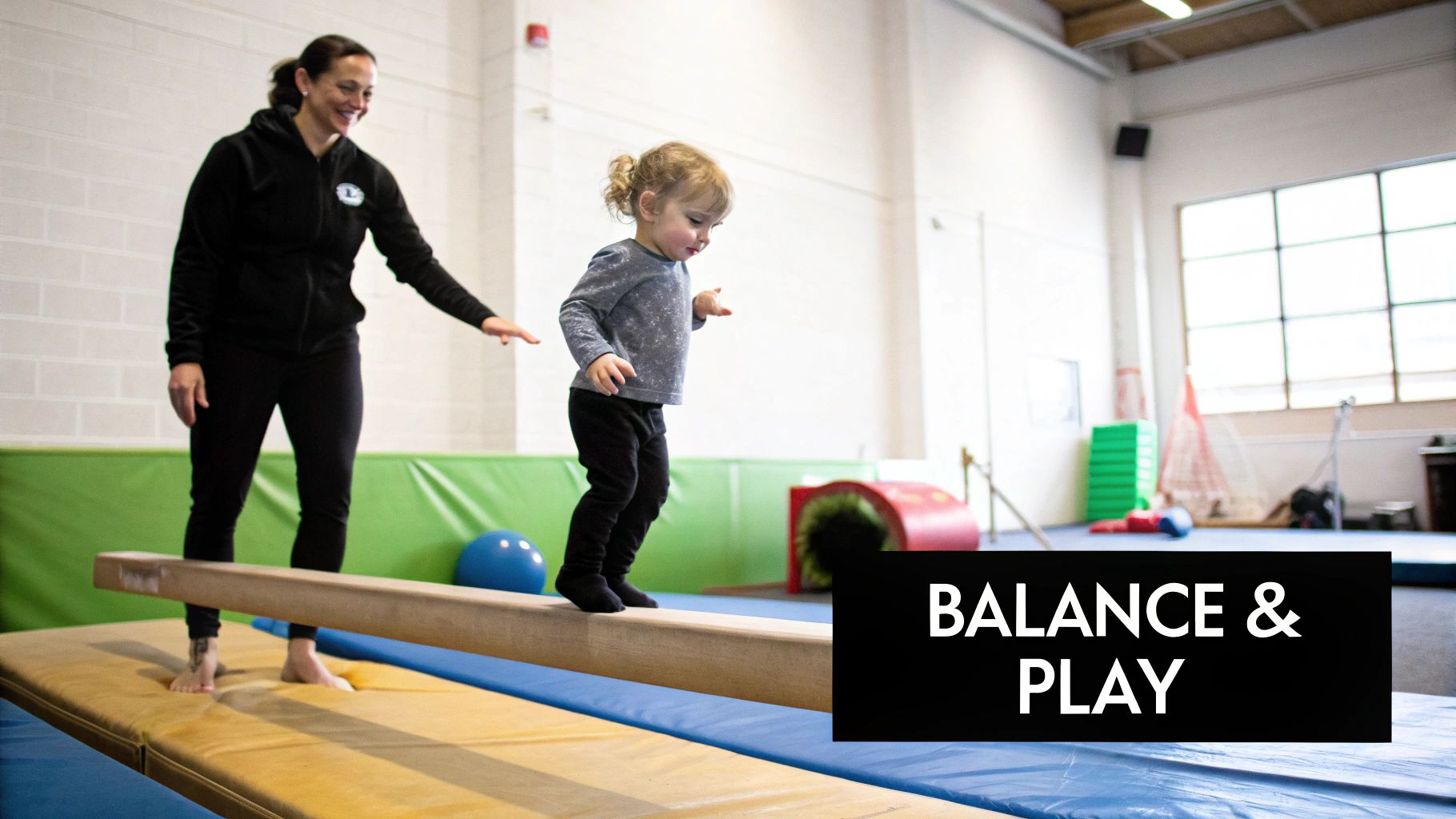
What Gymnastics for a 3-Year-Old Looks Like
A class for a 3-year-old is a world of colorful mats, low beams, and soft shapes designed for exploration. Forget the Olympics; think "active playground." Coaches guide children through imaginative circuits and games where they might pretend to be animals to learn different crawling motions or cross a "river" on a low balance beam.
These activities cultivate crucial developmental skills:
Gross Motor Skills: Tumbling, jumping, climbing, and balancing.
Body Awareness (Proprioception): Understanding where their body is in space, which is key for coordinated movement.
Strength & Flexibility: Building core, arm, and leg strength through activities like hanging on bars and performing simple stretches.
Social Skills: Following directions from a coach, waiting for their turn on equipment, and interacting with peers.
Tips for a Positive Start in Gymnastics
To ensure a safe and encouraging introduction to gymnastics, focus on the program's philosophy and environment.
Choose a Play-Based Program: Look for classes specifically labeled "toddler," "preschool," or "parent-and-me." The curriculum should be centered on exploration and fun, not competition.
Verify Safety and Credentials: Ensure the facility is clean, equipment is well-maintained, and coaches have experience with this specific age group. Certifications from organizations like USA Gymnastics are a plus.
Observe a Class First: Before enrolling, ask to watch a session to see how coaches interact with the children and if the atmosphere is positive and supportive.
Focus on Fun, Not Perfection: The goal is for your child to enjoy moving their body in new ways. Celebrate their willingness to try a forward roll or walk on the beam, regardless of how "perfect" it looks.
6. Swimming/Water Safety Classes
Swimming is more than just a sport; it is a critical life skill. For 3-year-olds, water safety classes provide a gentle and positive introduction to the aquatic environment, building comfort and confidence. This makes it one of the best sports for 3 year olds, as it combines physical development with essential safety knowledge in a play-based, supportive setting. The focus is not on perfect strokes but on becoming familiar with water, learning to float, and understanding how to be safe.
At this age, early exposure helps prevent fear of water from developing and builds a strong foundation for future swimming proficiency. These classes are designed to be fun, using songs, games, and toys to teach fundamental concepts like breath control and buoyancy.
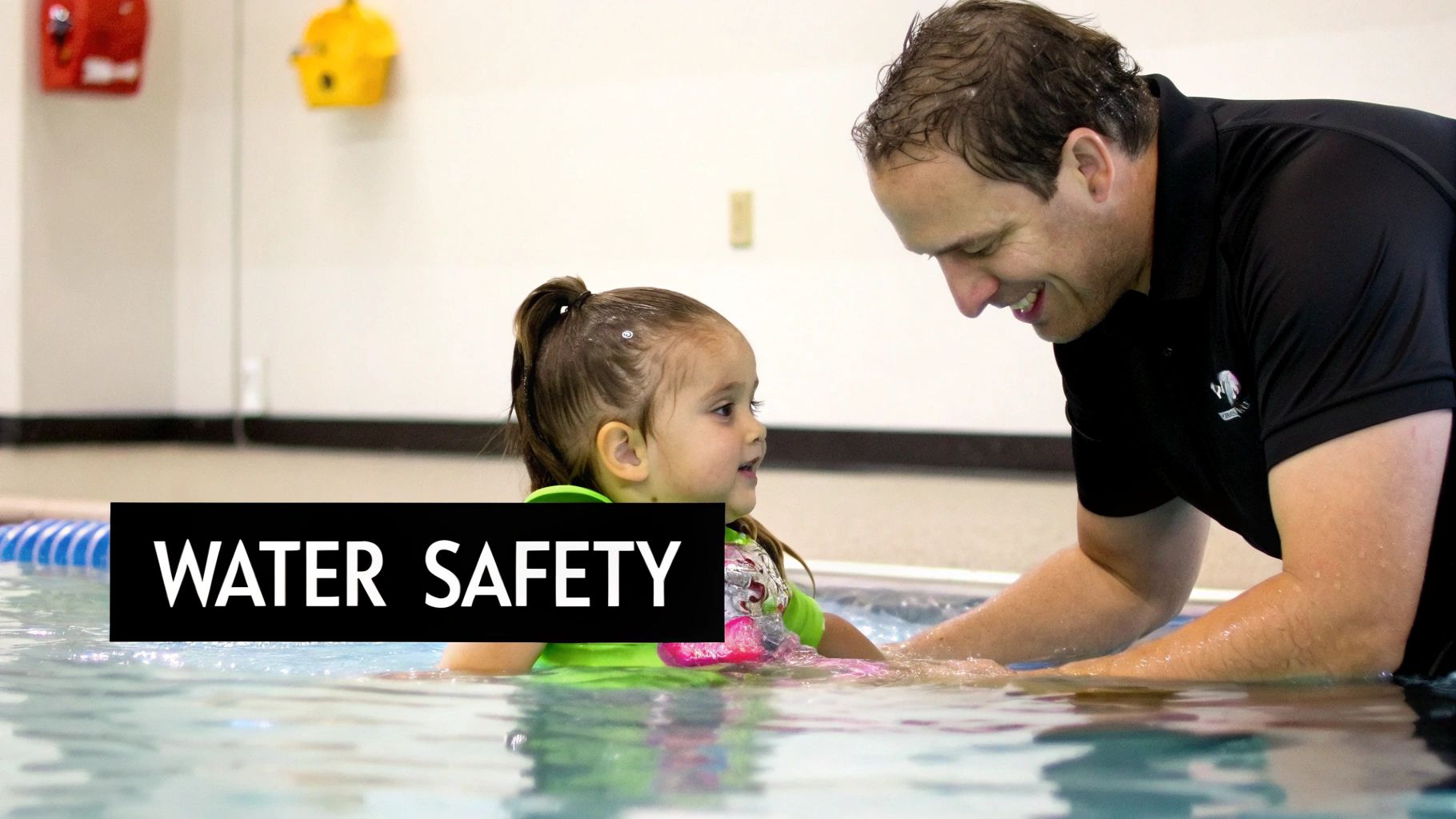
What Swimming for a 3-Year-Old Looks Like
A swim class for a toddler is a guided water play session, often with a parent or caregiver in the pool. The instructor leads activities that make learning feel like a game. For example, children might blow bubbles to practice breath control, sing "Ring Around the Rosie" before splashing in, or use kickboards as "motorboats" to practice kicking.
These activities build key developmental skills:
Gross Motor Skills: Kicking, paddling, and using arms and legs for propulsion.
Coordination: Synchronizing arm and leg movements in the water.
Sensory Processing: Acclimating to the unique sensations of being in the water.
Life-Saving Skills: Learning to float on their back and safely enter and exit the pool.
Tips for a Positive Start in Swimming
To create a safe and encouraging first swim experience, focus on the environment and the instructor’s approach. For parents considering formal instruction, it's helpful to understand the guidelines on when babies can start swimming lessons to make an informed decision.
Choose Certified Instructors: Look for programs where instructors hold certifications in water safety and have experience with early childhood development.
Ensure Small Class Sizes: A low student-to-instructor ratio (4-6 children per instructor) ensures each child gets personalized attention and supervision.
Check Water Temperature: The pool should be warm, ideally between 85-90 degrees Fahrenheit, to keep young children comfortable and prevent them from getting cold.
Be Patient and Positive: Some children have water anxiety. Choose a program that uses gentle, play-based methods and never forces a child to do something they are scared of.
7. Dance/Movement Classes
Dance and creative movement classes are a joyful and expressive way to introduce 3-year-olds to physical activity. Instead of focusing on a specific sport, these classes use music and imaginative play to develop core physical and cognitive skills. This makes dance one of the best sports for 3 year olds, as it nurtures body awareness, rhythm, and self-expression in a non-competitive, creative environment. The focus is on exploration and fun, laying a foundation for athletic coordination and a positive relationship with their bodies.
At this age, the goal is not technical perfection but to build confidence and coordination through music-based activities. It's about feeling the rhythm, moving freely, and learning how their bodies can tell a story.
What Dance for a 3-Year-Old Looks Like
A dance or movement class for a 3-year-old is far from a formal ballet lesson. It’s a dynamic, playful session where instructors use creative prompts and music to guide movement. Children might be asked to hop like frogs, float like feathers, or stomp like giants to different musical tempos. The structure is built around storytelling and imagination to teach foundational concepts.
These activities cultivate crucial developmental skills:
Gross Motor Skills: Hopping, skipping, leaping, and balancing.
Coordination: Syncing body movements with musical rhythms and cues.
Body Awareness: Understanding how different parts of their body move and occupy space.
Social and Emotional Skills: Expressing emotions through movement, following directions, and cooperating with peers.
Cognitive Skills: Memorizing simple movement sequences and patterns.
Tips for a Positive Start in Dance
To ensure your child’s first dance experience is joyful and enriching, prioritize a supportive and age-appropriate atmosphere.
Choose the Right Program: Look for classes described as "creative movement" or "pre-ballet" that emphasize play over performance. Avoid studios that have a heavy focus on recitals or competitions for this age group.
Embrace Creativity, Not Perfection: The instructor should encourage free expression and celebrate individual interpretations of movement. The focus should be on the process, not a perfect final product.
Keep It Short and Engaging: A 3-year-old’s attention span is limited. Classes should last no more than 30-45 minutes to keep them engaged and wanting to come back.
Focus on Fun: The primary objective is for your child to enjoy moving to music. Encourage their silly dances at home and celebrate their effort and willingness to try new things.
By introducing dance through imaginative play, you help your child develop physical literacy, emotional intelligence, and a lifelong appreciation for movement and music.
8. BlastBall
BlastBall is a brilliant introduction to baseball concepts, specifically engineered for the youngest players. It acts as a precursor to Tee-Ball, stripping away complexities to focus on the pure joy of hitting a ball and running. This makes it one of the best sports for 3 year olds, as it uses oversized, soft equipment and simplified rules to build confidence and fundamental skills in a non-intimidating, high-energy environment. The game is designed for constant action and immediate success.
At this age, the goal is to create a positive first impression of bat-and-ball sports. BlastBall ensures every child gets to hit, run, and score, associating the game with fun and achievement from their very first swing.
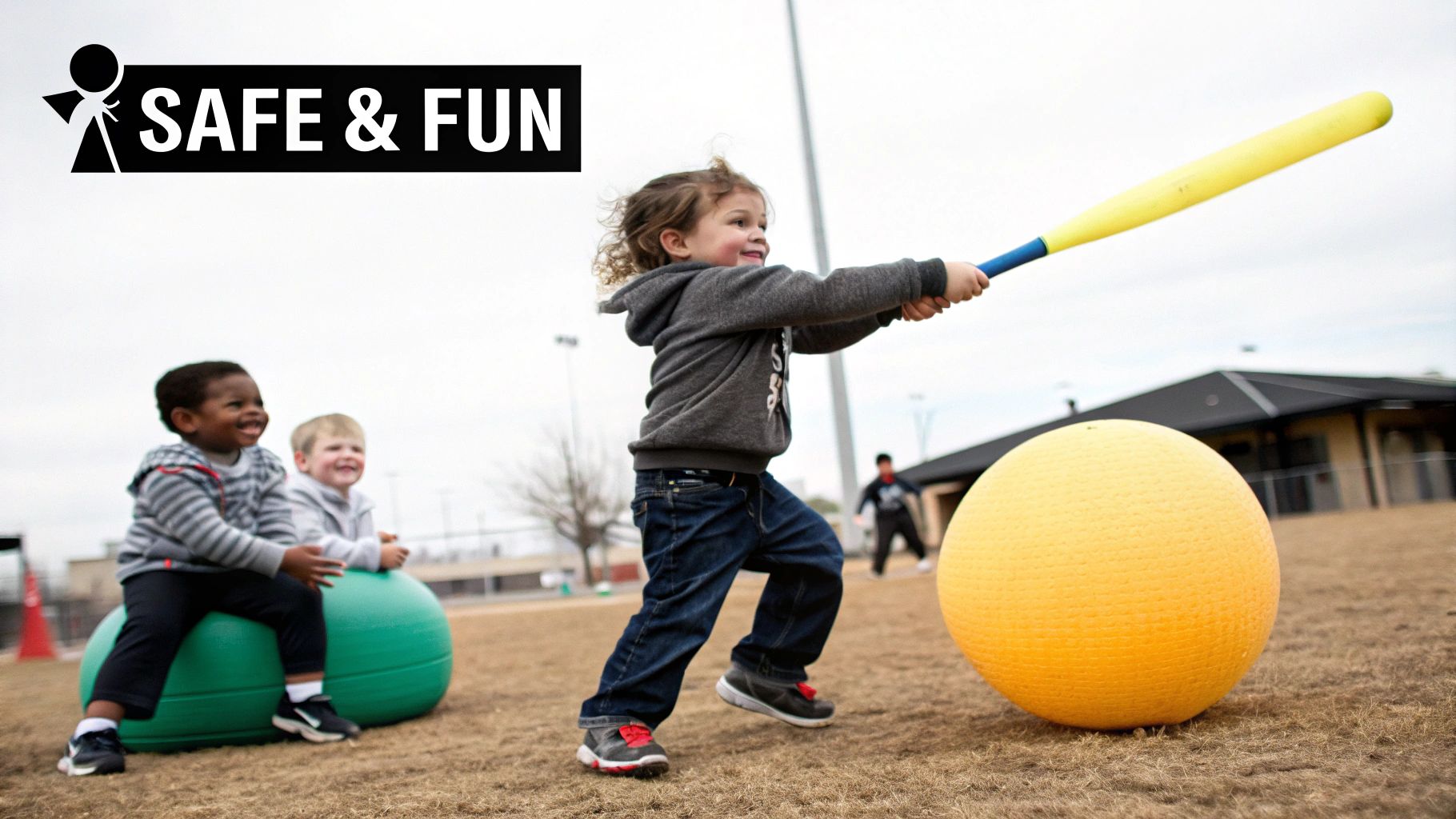
What BlastBall for a 3-Year-Old Looks Like
A BlastBall game is fast-paced, simple, and packed with excitement. Instead of a traditional baseball diamond, there's just one base that honks when a player steps on it. The game flow is simple: a player hits an oversized, soft ball off a tee, then runs to the honking base while the "fielders" try to grab the ball. There are no outs or complex rules, ensuring every turn is a success.
These activities are designed to develop key abilities:
Gross Motor Skills: Running to the base, swinging the bat, and picking up the ball.
Coordination: Developing hand-eye coordination to connect the bat with the stationary ball.
Listening Skills: Following simple, one-step instructions like "hit the ball" and "run to the base."
Social Skills: Learning to take turns batting and cheering for teammates.
Tips for a Positive Start in BlastBall
To ensure your child’s first experience with a bat and ball is a home run, focus on the unique, fun-first nature of BlastBall.
Choose the Right Program: Look for programs specifically designed for this age group that prioritize participation. For example, the JC Sports Houston BlastBall program uses a curriculum focused on engagement and skill-building through fun, ensuring toddlers learn the basics in a supportive setting.
Use Official Equipment: The game is designed around its unique equipment: a soft, foam bat, an oversized ball, and a honking base. This gear is key to making the sport safe and enjoyable for toddlers.
Keep It Short and Active: Sessions should last around 30-45 minutes to match a 3-year-old’s energy and focus levels. The best programs minimize waiting and maximize movement.
Celebrate Every Action: The sound of the honking base is its own reward. Cheer for every swing, every run, and every fielding attempt. The goal is to build confidence and a love for the game, not to achieve technical perfection.
Best Sports for 3-Year-Olds: 8-Way Comparison
Activity | Implementation 🔄 (complexity) | Resources ⚡ (equipment & facility) | Expected outcomes 📊 (developmental impact) | Ideal use cases 💡 (who/when) | Key advantages ⭐ (quality/effectiveness) |
|---|---|---|---|---|---|
Soccer | 🔄 Low — simple drills, small-sided play | ⚡ Low — ball, cones, outdoor/indoor space | 📊 Gross motor skills, coordination, cardio, teamwork | 💡 Group intro for 3–4 y/o; year-round play | ⭐⭐⭐⭐ — Accessible, builds confidence and spatial awareness |
Multi-Sport Classes | 🔄 Medium — rotating activities, varied coaching skills | ⚡ Moderate — multiple sport items, flexible spaces | 📊 Broad motor skill development, movement literacy | 💡 Exploratory toddlers; prevents early specialization | ⭐⭐⭐⭐ — Versatile sampling; keeps short attention spans engaged |
Baseball / Tee Ball | 🔄 Medium — station setup, adult support required | ⚡ Moderate — tee, bats, gloves, open field | 📊 Hand-eye coordination, batting mechanics, running | 💡 Structured seasonal leagues; kids ready for batting | ⭐⭐⭐ — Frequent success builds confidence; introduces game concepts |
Basketball | 🔄 Medium — skill progression (dribbling/shooting) | ⚡ Low–Moderate — lowered hoop, small balls, indoor court | 📊 Hand-eye coordination, agility, teamwork, cardio | 💡 Indoor programs; short focused sessions for skill work | ⭐⭐⭐⭐ — Great for agility and hand skills; indoor option |
Gymnastics / Movement | 🔄 High — specialized coaching and progression | ⚡ High — padded apparatus, dedicated facility | 📊 Core strength, balance, body awareness, flexibility | 💡 Children needing body-control foundations; year-round class | ⭐⭐⭐⭐ — Strong foundational motor skills; safe movement education |
Swimming / Water Safety | 🔄 High — certified instructors, strict safety protocols | ⚡ High — warm pool, lifeguards, aquatic equipment | 📊 Water comfort, breath control, survival skills, full-body fitness | 💡 Essential for all children; parent-child classes for acclimation | ⭐⭐⭐⭐⭐ — Potentially life‑saving; low‑impact full‑body development |
Dance / Movement | 🔄 Low — music-based, play-focused instruction | ⚡ Low — music, open space, minimal props | 📊 Rhythm, coordination, creative expression, confidence | 💡 Shy or expressive children; short creative sessions | ⭐⭐⭐ — Encourages expression; low injury risk, builds stage comfort |
BlastBall | 🔄 Low — very simple rules, fast-paced gameplay | ⚡ Moderate — oversized foam ball, plastic bats, small field | 📊 Intro to baseball concepts, motor skills, rapid confidence gains | 💡 First baseball experience for 3 y/o; transition to Tee Ball | ⭐⭐⭐⭐ — Zero intimidation; guaranteed success and high engagement |
Taking the Next Step: Finding the Perfect Program for Your Family
Choosing the right introduction to sports for your three-year-old is a significant and exciting decision. It's a journey that extends far beyond learning to kick a ball or swing a bat. As we've explored, the best sports for 3 year olds are those that build a foundation of fun, ignite a passion for movement, and gently introduce the building blocks of physical literacy. From the coordinated chaos of beginner soccer to the structured exploration of gymnastics and the pure, simple joy of BlastBall, each activity offers a unique pathway to growth.
The key takeaway is that at this tender age, the process is infinitely more important than the performance. Your child’s first sports experience should be filled with laughter, encouragement, and the freedom to try without fear of failure. It's about developing motor skills, learning to listen to a coach, and experiencing the simple happiness of being part of a team.
Your Action Plan for Finding the Perfect Fit
As you move forward, the most crucial tool you have is observation. Pay close attention to what naturally captures your child's interest. Do they love to run endlessly in the backyard? A multi-sport or soccer class might be a perfect match. Are they constantly climbing and tumbling on the furniture? A gymnastics or movement class could be the ideal outlet.
To ensure you make a confident choice, here is a simple checklist to guide your next steps:
Review the Readiness Signs: Think back to the signs of physical, social, and emotional readiness we discussed. Does your child demonstrate a basic ability to follow simple instructions? Can they handle being in a group setting for a short period?
Talk to Your Child: Use simple, exciting language. Ask, "Would you like to try a class where we get to run and kick a special ball with other friends?" Their reaction can be very telling.
Research Local Programs: Look for facilities that specialize in early childhood development. Read reviews, examine their philosophy, and don't hesitate to ask questions about coach-to-child ratios and curriculum.
Schedule a Trial Class: There is no substitute for a firsthand experience. A trial class allows you and your child to feel the environment, meet the coaches, and see if the program's energy aligns with your family’s expectations.
The Lasting Impact of a Positive Start
Remember, this first step into organized activity sets the stage for your child's future relationship with sports and physical fitness. A positive, supportive, and fun-filled introduction can foster a lifelong love of being active. It teaches resilience when they stumble, teamwork when they share a ball, and confidence when they master a new skill, no matter how small.
The goal isn't to find the sport your child will play forever. The goal is to provide them with a joyful and empowering experience that builds a strong body and an even stronger character. By prioritizing fun, safety, and developmentally appropriate instruction, you are giving your child an incredible gift that will benefit them for years to come. This is more than just a class; it’s an investment in their health, happiness, and holistic development.
Ready to give your little one the perfect introduction to sports in a fun, safe, and encouraging environment? At JC Sports Houston, we specialize in programs designed specifically for toddlers, including multi-sport classes, beginner soccer, and our exciting BlastBall league, all held in our comfortable indoor facility. Visit JC Sports Houston to learn more and schedule a free trial class today
Comments