

Youth Basketball Age Groups Explained for Parents

Youth basketball divisions run as single-year groups from 6U through 13U, set by the player's maximum age during a playing year from September 1 to August 31, then switch to grade-based classification from ninth grade.
That answers the paperwork. It doesn't tell you whether the game size and your child's body belong in that group too.
Parents often stop at the birth year. A late-summer birthday or a growth spurt can put a child in the right division and the wrong session. Youth basketball age groups fit better when the official band, the practice format, and the child's physical maturity are one decision.
Two classmates can both read as "10" at school and still fall on opposite sides of the cutoff. One may also grow several inches while the other doesn't. The form looks the same. The session shouldn't.
Walk the checks in order: playing-year age, what that band should teach, which game size matches, how to read growth, and how to judge a program before you pay.
Basketball Age Divisions at a Glance
The NBA and USA Basketball Youth Basketball Player Segmentation Model assigns players to single-year age groups beginning at age 6 through age 13, then shifts to grade affiliation after a player enters ninth grade. Eligibility follows a playing year from September 1 through August 31. The division is the player's maximum age in that window, not the age on the first practice.
In the model's 2021–22 framework, a player who stayed 12 or younger on August 31, 2022, qualified for 12U. A child who turns 13 on September 1 can still be 12U for that year. A child who turns 13 on August 30 cannot. That is why a late-summer birthday can separate classmates who share a classroom.
The same model names three wider developmental bands: 8-and-under, ages 9–11, and ages 12–14. A seven-year-old beginner, a 10-year-old learning team ideas, and a 13-year-old moving toward formal competition should not get the same court size, rules, workload, or coaching load. Local leagues may rename groups. The bands still give families a shared map for what the stage is supposed to feel like.
How to read each row
Division | Eligibility rule | Developmental band |
|---|---|---|
6U | Maximum age 6 during the playing year | 8 and under |
7U | Maximum age 7 during the playing year | 8 and under |
8U | Maximum age 8 during the playing year | 8 and under |
9U | Maximum age 9 during the playing year | Ages 9 to 11 |
10U | Maximum age 10 during the playing year | Ages 9 to 11 |
11U | Maximum age 11 during the playing year | Ages 9 to 11 |
12U | Maximum age 12 during the playing year | Ages 12 to 14 |
13U | Maximum age 13 during the playing year | Ages 12 to 14 |
Grade 9 and up | Grade affiliation replaces age | High school competition |
Say your child turns 11 on August 20. On August 31 of that playing year the maximum age is 11, so the row is 11U, inside ages 9 to 11. A sibling who turns 11 on September 10 is still 10 on August 31 and stays 10U.
Three steps before you trust a flyer
Mark August 31. Write the age your child reaches on that date for the season you are joining.
Match the row. Maximum age 8 is 8U. Maximum age 13 is 13U. Ninth grade and above follows grade, not a "U" label.
Confirm the league name. Ask which cutoff they use. Community programs can change labels even when the idea of the band stays the same.
Practical rule: The division is a safety and teaching tool, not a status label. If the posted name doesn't match the August 31 age, ask which court, ball, and rules that group actually uses.
What Each Age Band Should Teach
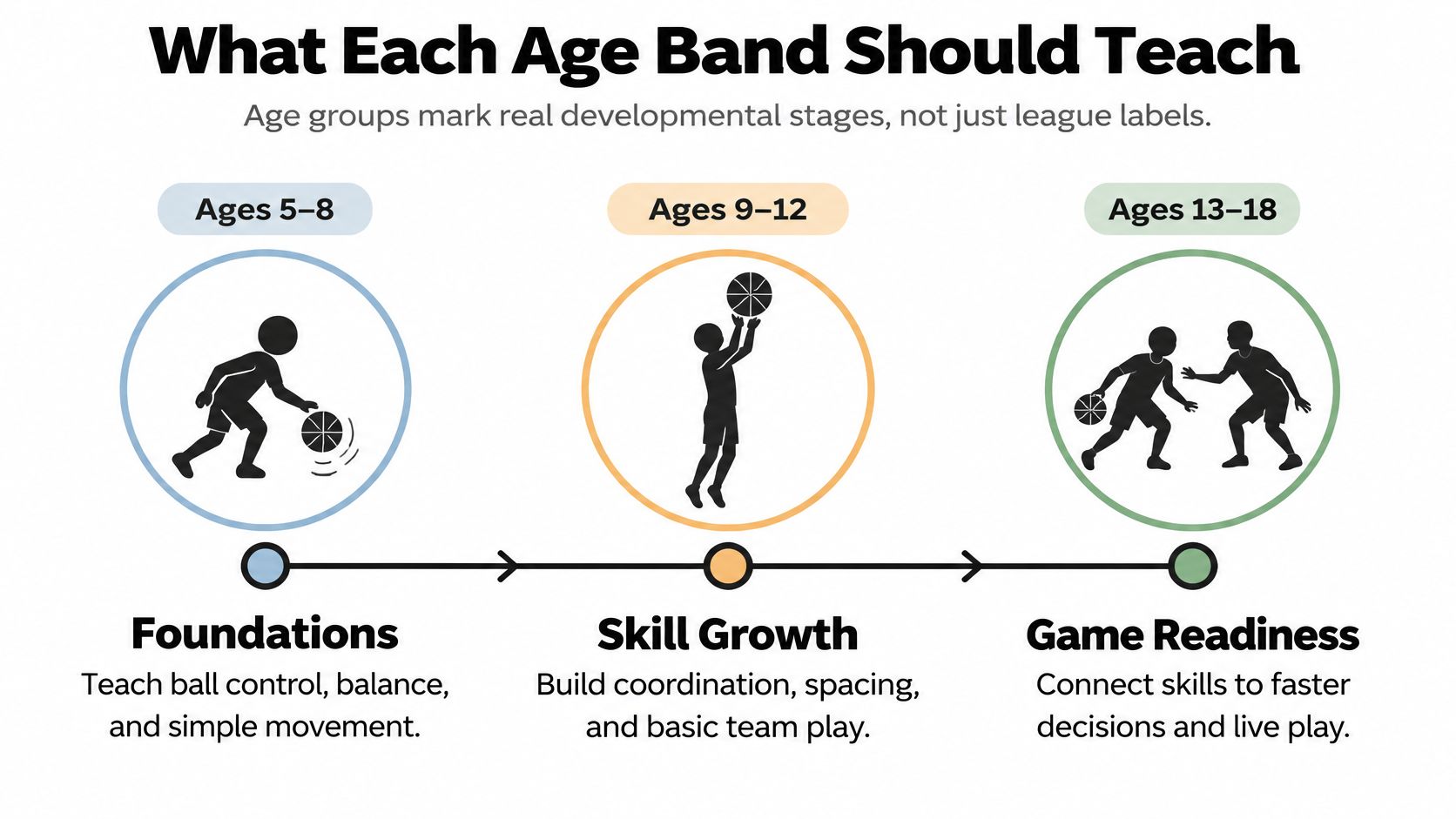
An age band describes a stage of learning. What a child can already do inside that band matters more than the label printed on the schedule. A three-year mixed-longitudinal study tracked 97 young male basketball players twice a year across overlapping cohorts aged 11, 12, 13, 14, and 15, splitting them at the start into under-12 and under-14 groups and following whether technical-skill patterns stayed stable or shifted, as described in research on youth basketball skill development. Pathway work in that same body of research calls U12 a "play and learn" phase, U14 a move toward "learning and training," and U16 a shift into structured training and competition.
What changes from band to band
Ages 6 to 8 are for movement, ball familiarity, and wanting to come back. Dribbling with the eyes up for a few steps, stopping without falling, and smiling at a made layup matter more than a set play. A coach who runs set plays with this group is teaching the wrong subject.
Ages 9 to 11 add ball control, simple choices, and noticing a teammate. A good session has the child catch, decide, and pass before a coach shouts the answer. If the ball is still bouncing off a foot at every drill, the group is moving faster than the skill.
Ages 12 to 14 bring spacing, passing while someone is close, a few basic tactics, and light conditioning. The game speeds up. Teaching should still name one idea at a time, such as "find the open lane," rather than installing a full offense.
Ninth grade and up is where position roles and competitive team patterns belong. Players who skipped the earlier stages often look busy and still can't make a simple read. Bodies arrive at this band at very different times, so two players in the same grade may need different amounts of contact and conditioning.
Reading groups work the same way. Two children in the same grade can need different books, and a good teacher adjusts the book rather than the grade. Basketball splits children along similar lines: the division, the practice format, and the child's physical maturity are one decision. A league that sets all three from a birth year alone is guessing at two of them.
That progression is easy to over-apply. Most of the published research on youth basketball follows older teenagers, so the under-10, under-12, and under-14 age groups are studied far less. Advice written for a 16-year-old is a weak guide for an elementary beginner. Smaller numbers of players and shorter courts are the usual tools for matching the game to the child, and they matter more than which drill looks impressive on video. A practical map of those stages sits in this guide to youth basketball skill development.
What to watch across a season
Visible skill: Can the child do something in March that failed in October, such as a controlled stop or a pass to a moving teammate?
Confidence: Does the child still ask for the ball after a mistake?
Wanting to play: A child who dreads the car ride is telling you the stage is off, even if the team wins.
If older players freeze under pressure, skill drills alone may not be the fix. Katy Teen & Family Counseling on EMDR describes how performance blocks can sit in the nervous system, which is worth knowing once competition gets loud.
Keep the scoreboard as a side note. Skill, confidence, and the wish to return are the season's real measures.
Practice and Game Formats for Each Age Band
Game size teaches more than most parents expect. Fewer players mean more catches, more choices, and less standing in a corner while five teammates sort out a play.
Age band | Game format | Practice focus | Rule and equipment note |
|---|---|---|---|
6U to 8U | 2-versus-2 half court | Ball familiarity, movement, enjoyment | Modified rules; confirm hoop height and ball size with the league |
9U to 11U | 2-versus-2 moving to 3-versus-3 half court | Ball control, passing, spacing | Half court; confirm hoop height and ball size with the league |
12U to 14U | 3-versus-3 moving to 5-versus-5 | Team concepts, decisions, conditioning | Full court where the league allows |
Grade 9 and up | 5-versus-5 full court | Position play, competitive systems | Standard competition rules |
An eight-week study of 12- to 15-year-old players found that both 2-versus-2 and 3-versus-3 improved performance, but not in the same way. 2-versus-2 brought stronger gains in passing accuracy, defensive rebounding, and turnover reduction. 3-versus-3 brought greater gains in passing volume, shooting, scoring, and team attacking variation. A wider review in that small-sided game research found small-sided training can improve aerobic performance and change-of-direction ability about as well as other methods, while also building technical and tactical learning.
When to move the format up
Stay with 2-versus-2 while the goal is ball control, passing, defensive spots, and lots of touches. Move toward 3-versus-3 when players show better spacing, scanning, passing under pressure, and decisions made with a teammate. Jumping a 7-year-old group into full-court five-on-five because it "looks like real basketball" usually means long lines and one child dribbling.
Hoop height, ball size, and court length are league choices, not a single national number you can assume. Ask before the first week. If the program can't name the ball and the hoop for that band, the format plan is probably loose too.
Shooting can stay playful inside these small games. Short, high-repetition ideas like the ones in these fun basketball shooting games fit a 2-versus-2 or 3-versus-3 session without turning practice into a shooting line.
A useful test: count how many times your child touches the ball in ten minutes. If the answer is "twice, then they waited," the format is too big for the band.
Why Birth Year Is Not the Whole Story
Two children with the same August 31 age can be far apart in limb length, strength, and coordination. Growth-related changes can temporarily alter limb length, coordination, strength, movement mechanics, and injury exposure, and athletes in rapid growth face a higher risk of growth-related and overuse injuries, according to research on youth basketball growth and maturation.
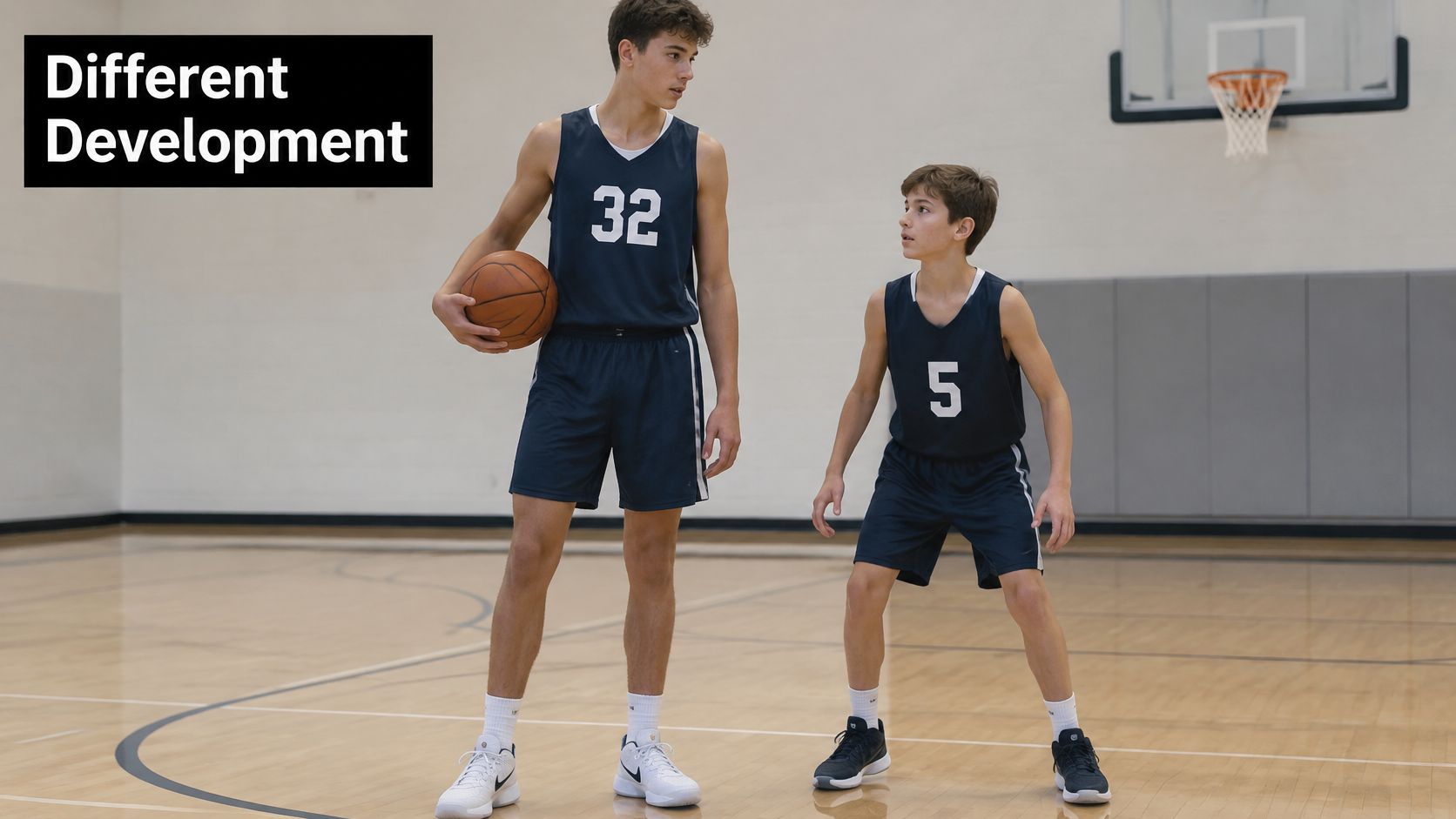
A workable system still uses standard bands such as U10, U12, U14, U16, and U18. Inside the band, coaches change workload, court space, contact, and skill demands. Birth year sets the room. Maturity sets the dose.
Two 10-year-olds, one division
Picture two players who both qualify for the same 10U group. One is a head taller and already controls every rebound. The other is smaller, later to mature, and rarely gets the ball in a crowd.
Both belong in that division. The taller child may need less repetitive jumping while the growing body catches up. The smaller child needs more chances to handle the ball, make a decision, and lead a small group. Moving the tall child up only because of size often trades a rebound advantage for a year of being the youngest body in a faster, rougher game. Early size is not proof of greater long-term potential.
Warning signs and the next step
Rapid height change: Clothes and shoes stop fitting inside one season.
Recurring pain: The same knee, heel, or back complaint shows up after practices.
Changed running: The stride looks stiff, heavy, or newly awkward.
Slipping coordination: Skills that were clean last month fall apart.
When those signs show up, cut repeated jumping and high-intensity volume. Ask the coach for a reassessment each season rather than a permanent move-up based on height.
Some programs also ask about bio-banding, which groups athletes partly by biological maturation. Work on maturation-based grouping suggests it can make learning fairer, while evidence on injury reduction and long-term outcomes is still limited. Contact often rises at the same time puberty widens size gaps, so the question is fair to raise. Treat bio-banding as something to ask about, not a promise that injuries will fall.
How to Choose the Right Youth Basketball Program
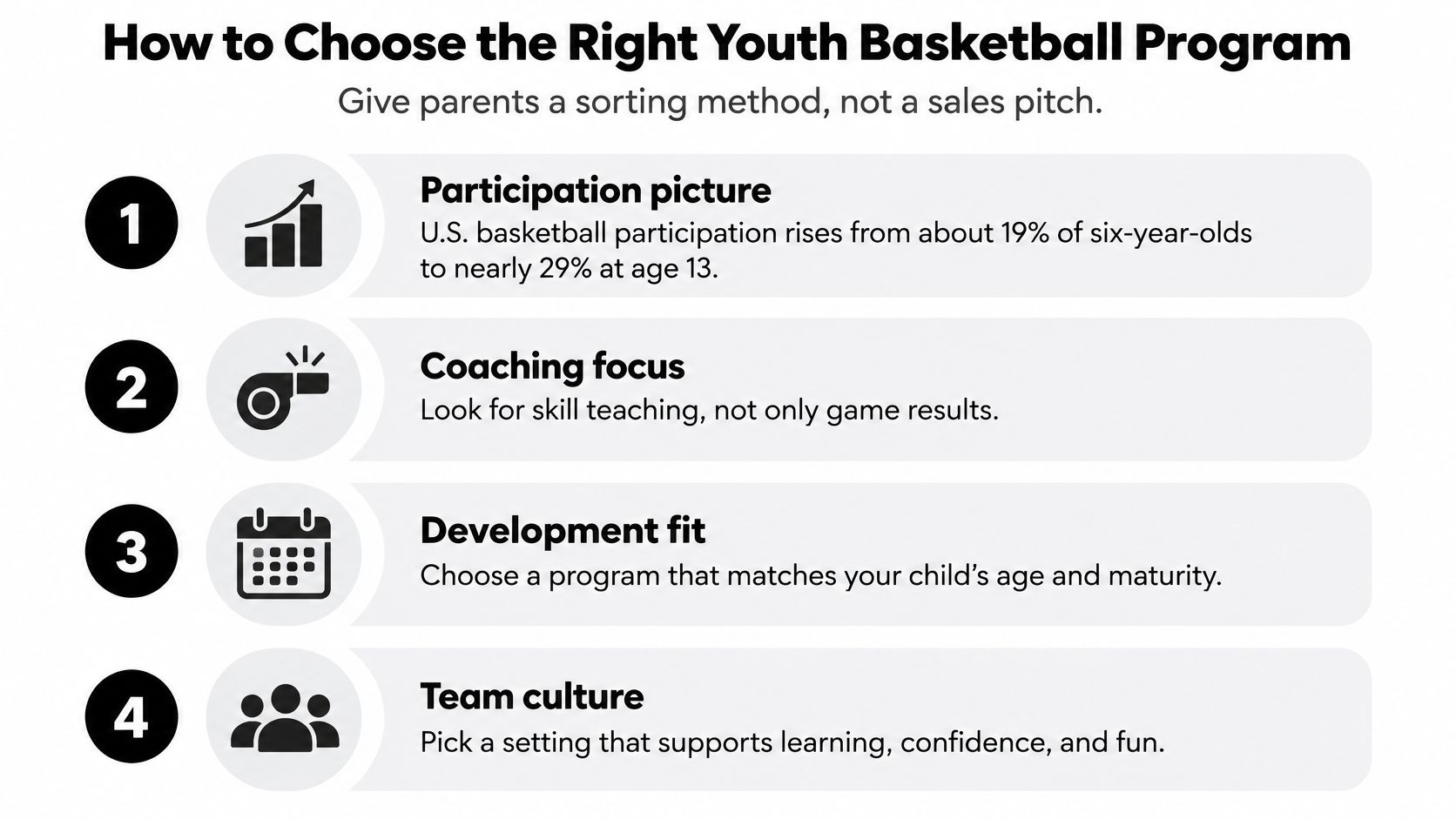
Basketball participation in the United States rises from about 19% among six-year-olds to nearly 29% at age 13 and stays about 24% through age 17, so older children are not just aging out of the sport, as noted in research on age-group teaching and specialization pressure. The harder question is what should change in the session as play gets more competitive, and how to keep pressure from pushing a child into one sport all year.
A national parent survey in that research found 48% of parents feel at least some pressure to specialize, while 21% said their child plays a primary sport nine to 12 months a year. A good program can name the stage without demanding a 12-month contract to "keep up."
Five checks to take on a visit
Criterion | Good sign | Warning sign |
|---|---|---|
Coaching | Trained coaches who explain each drill | Coaches who prioritize winning over development |
Session design | Small-sided games and frequent touches on the ball | Long lines and waiting time |
Pressure | Clear goals, with optional extra training | Pressure to commit to year-round play |
Age placement | Regular reassessment and flexible movement | Moving children up by size alone |
Parent role | Clear rules and a named person for concerns | Unclear rules on who to ask |
Ask three plain questions. How do you decide a child is ready for this group, and how often do you look again? What happens in the session when a child struggles? Who do I talk to if something feels off?
At JC Sports Houston, all teachers are experienced and trained in the JC Sports curriculum. Sports programs are not drop-off classes, so a parent or caregiver stays in the building. If you have a concern, consult the coach or the director. A program that can answer those points without a sales script is easier to trust. You can compare that clarity with how basketball classes for kids are usually described before you visit.
A short fit test
If most rows land on the good-sign side and your child still wants to come back, the program likely matches the stage. One weak row is a conversation. Several weak rows, especially size-based promotions plus year-round pressure, are a reason to keep looking.
As contact and speed pick up, teeth take hits that a recreational mouthguard from a bin may not cover well. How custom mouthguards protect teeth is a useful read before a league that allows more physical play.
Matching a Local Program and Enrolling
JC Sports Houston is a toddler and youth indoor sports center serving Humble, Kingwood, and Atascocita. Use it as one worked example of the same method you would use anywhere else. Our curriculums put the child at the center of the game, and children build motor skills, self-confidence, and sports technique through interactive games and drills. We provide the training equipment and curriculum materials, so you are not guessing which ball belongs in the gym bag.
Before you register anywhere, confirm five things in the current season. Brackets, times, and policies change.
Division match. Which age bracket or grade does this class use, and does it line up with your child's maximum age on August 31?
Format match. Is the group in small-sided play, or has it moved toward fuller team play as children near high school?
Readiness. Who assesses placement, how often is a child looked at again, and what happens if the group is too fast or too slow?
A look before you pay. Is there a trial, observation, or introductory session? Families can request a free trial with the child's name, age, and favorite sport so you can see the pace yourself.
Money rules in writing. There are no refunds or credits on camps, clinics, and leagues, so check dates and times before you enroll. Get any other provider's cancellation terms on paper too.
If those answers fit your child's age, skills, and week, register. If the bracket is off, ask about the next group or another provider. The choice stays with your family.
A new season is also a sensible time for a checkup that looks at sport demands, not only a school form. Families near that part of Florida can look at sports physicals in Deerfield Beach as one example of a visit built around school and sport clearance.
JC Sports Houston offers age-appropriate basketball and multi-sport sessions for children from toddler age up, with coach-led games that build skill and confidence instead of rushing kids into full-court systems. If you are sorting youth basketball age groups for a child in Humble, Kingwood, or Atascocita, come see how a session runs. Visit JC Sports Houston to check current classes and request a time on the court.
Comments