

Private Soccer Coach Houston: A Parent Guide

The most common advice for finding a private soccer coach in Houston is to train more and move up faster. That can be the wrong goal, especially for a young player who's still deciding whether soccer is their sport. A better question is: What's the lowest-pressure plan that helps my child improve one skill without crowding out rest, friends, or other sports?
A few focused sessions may help a child get more comfortable receiving a pass or using their weaker foot. But a weekly lesson isn't automatically better than a small group, a recreational league, or just playing for fun. Choose the format that fits your child's interest and your family's schedule, then check whether the skill is improving.
What Each Houston Soccer Format Really Costs
Start with the format, not an assumed lesson price. A Houston news report cites national estimates of about $1,500–$6,000 a year for competitive travel soccer, with some elite pathways reaching $8,000–$15,000 a year (Click2Houston's 2026 report). Those figures concern competitive travel pathways, not private lessons or every Houston club, but they show why it's useful to compare the whole commitment rather than focus on one session.
Format | Best fit | Cost picture | Typical load |
|---|---|---|---|
Weekly private lessons | One stuck skill or a short confidence block | Ask for the session rate; don't assume a year-round commitment | 30–60 minutes, often as a 4–6 week block |
Small-group technical training | Beginners and players who learn better with peers | Usually less per child than a private hour; confirm group size | One weekly session in season |
Seasonal rec or indoor league | Team play, friends, and a simple game day | Registration and basic gear; generally a lighter commitment than travel | One practice and one game window |
Holiday or break camp | A short reset during school breaks | A fee for a few days, not a yearly plan | Several sessions in one week, then stop |
Competitive travel club | Older players who want the roster and weekend competition | About $1,500–$6,000 a year; some elite paths reach $8,000–$15,000 | Multiple practices, games, and tournaments |
Weekly private lessons make the most sense when your child can name a specific challenge: perhaps they avoid the ball on their weaker foot or rush their first touch. Try a short block focused on that skill, then review whether the child feels more confident before booking another block. Ask for both the single-session price and the block price. If a coach hasn't quoted a fee, treat it as unknown, not as an assumed local rate.
Small-group training gives a beginner instruction and peers in the same session. Ask how many players share the coach's attention, and whether the exercises include turns to practice the skill rather than long waits in line. A recreational or indoor league offers something different: teammates, routine, and a game environment. It may be a better starting point than private coaching for a child who mainly wants to play with friends.
Camps fit into a school break, but a burst of sessions isn't a continuing development plan. Travel soccer carries a larger commitment, and the listed team fee may not capture the whole family cost. Check registration, footwear for the playing surface, fuel for trips across Houston, tournament weekends, and what happens if your child misses a session. For siblings or players who enjoy company, a small group may also make more sense than paying for a second private hour.
If your child is new to soccer, isn't asking for extra training, or already has another sport, begin with a group or league. Families still deciding how much structure their player wants can use this guide to youth soccer levels to think through the options before calling coaches.
How Often Private Lessons Should Happen
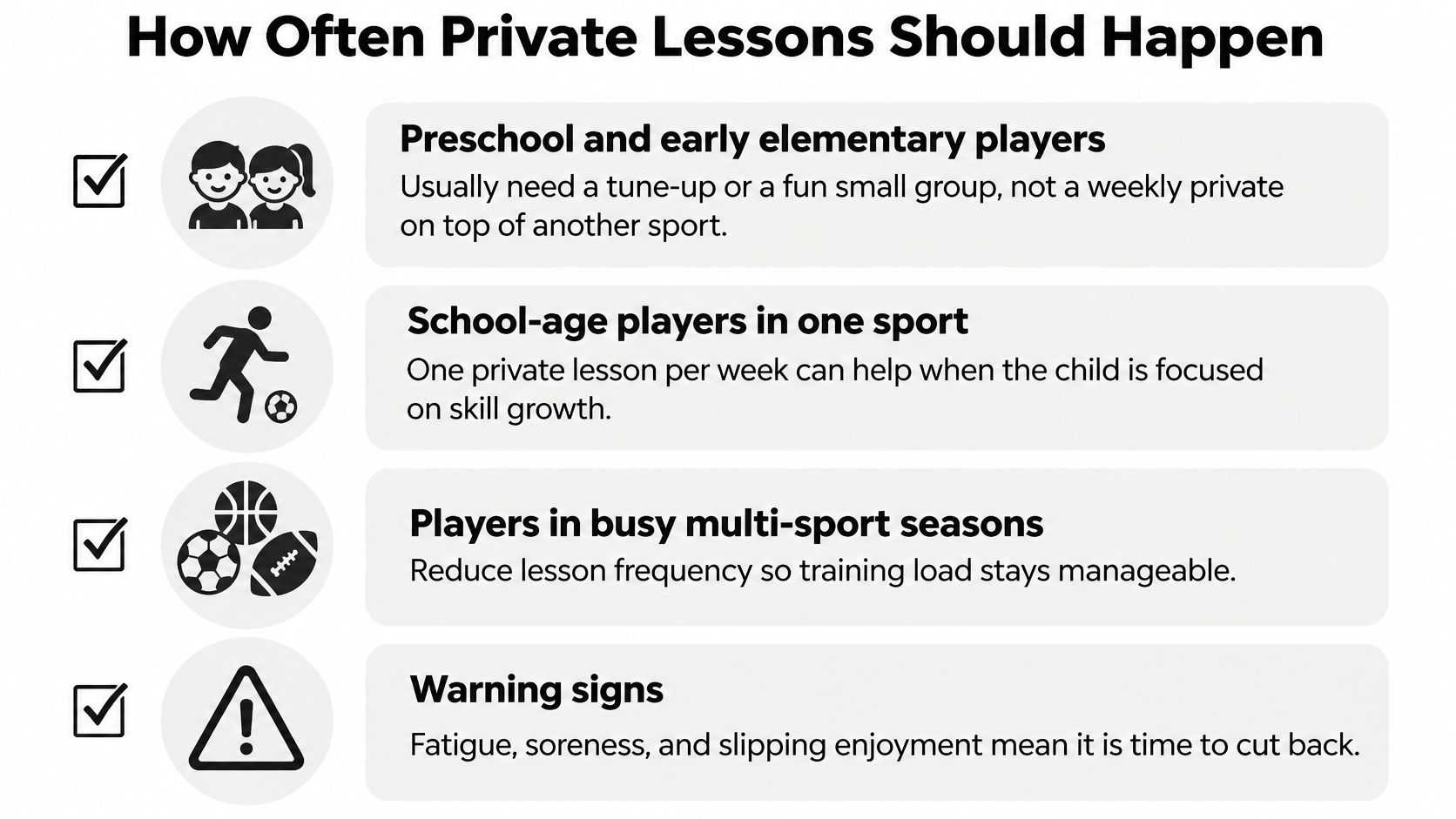
A child's age and weekly schedule matter more than a blanket rule that every player needs weekly lessons. Use this table as a starting point, then adjust for your child's interest, energy, and existing activities.
Age | Private frequency | Keep in the week | Skip or stop when |
|---|---|---|---|
Preschool to about 6 | Occasional trial or short fun block, not a standing weekly hour | Free play and other movement | The child is afraid, in pain, or attending only to please an adult |
About 7 to 12 | A skill block of several weeks, or a session every other week | Rec or club, plus another sport or free play | Soreness changes running, or soccer crowds out school and friends |
Teen club player | Periodic technical tune-ups, not soccer as the only activity all year | Rest days and total training kept under about 20 hours | Fatigue, poor sleep, pain, or slipping grades and mood |
The frequency suggestions are a practical guide, not a medical prescription. For teenagers, add up private lessons along with team practices and other training. A 2025 review notes that intensive training, particularly more than 20 hours weekly, can coincide with higher burnout and poorer sleep and academic outcomes (the review indexed by PubMed). That's a reason to look at the whole schedule, not a target to train up to.
A developmental coach will ask what the child enjoys, what they already do each week, and what they want help with. A coach selling the fastest roster jump may instead treat rest as lost ground or suggest dropping every other activity. Those are different approaches, and only one leaves room for a child to grow at their own pace.
Notice the child's response
Cancel or cut back when a child reports pain, dreads the drive, or is so tired that homework and ordinary routines suffer. Soreness that changes how they run is a reason to stop and reassess, not to ask them to push through a technical session. If discomfort persists, speak with an appropriate healthcare professional.
Warning signs of pressure aren't limited to the training field. Watch for a coach who compares your child with teammates every session, dismisses enjoyment as weakness, or says improvement requires quitting other activities. A better measure of progress for a young player is whether they're becoming more willing to try, more coordinated, and more confident with the ball.
Keep home practice short and child-led. A few passes against a wall can be enough when the child wants to do them; home drills shouldn't become another compulsory session. Families planning the week can use this soccer training schedule guide to make space for lessons, team commitments, rest, and play.
How to Find and Book a Coach
Treat the first lesson as a trial of fit, not a promise of a competitive future. These steps help you check whether a coach can work on your child's goal, communicate clearly, and make the session practical for your family.
Write one goal your child would recognize. “I want to feel comfortable striking with both feet” is clearer than “I want to get better.” If the child can understand and care about the goal, it's easier to judge whether the lesson helps.
Limit the shortlist to relevant coaches and a realistic drive. Choose someone who already teaches your child's age and experience level. Include the after-school trip from Humble, Kingwood, Atascocita, or your neighborhood; a plan that's too hard to reach is difficult to sustain.
Ask where training happens and what the backup plan is. Confirm whether the ball work is outdoors or indoors, and what happens when heat, rain, or lightning disrupts an outdoor session. A workable weather plan can make scheduling less stressful.
Clarify who's present and how parents can observe. Ask the maximum group size, who supervises the session, and whether you can watch. You should be able to understand the setup before your child participates.
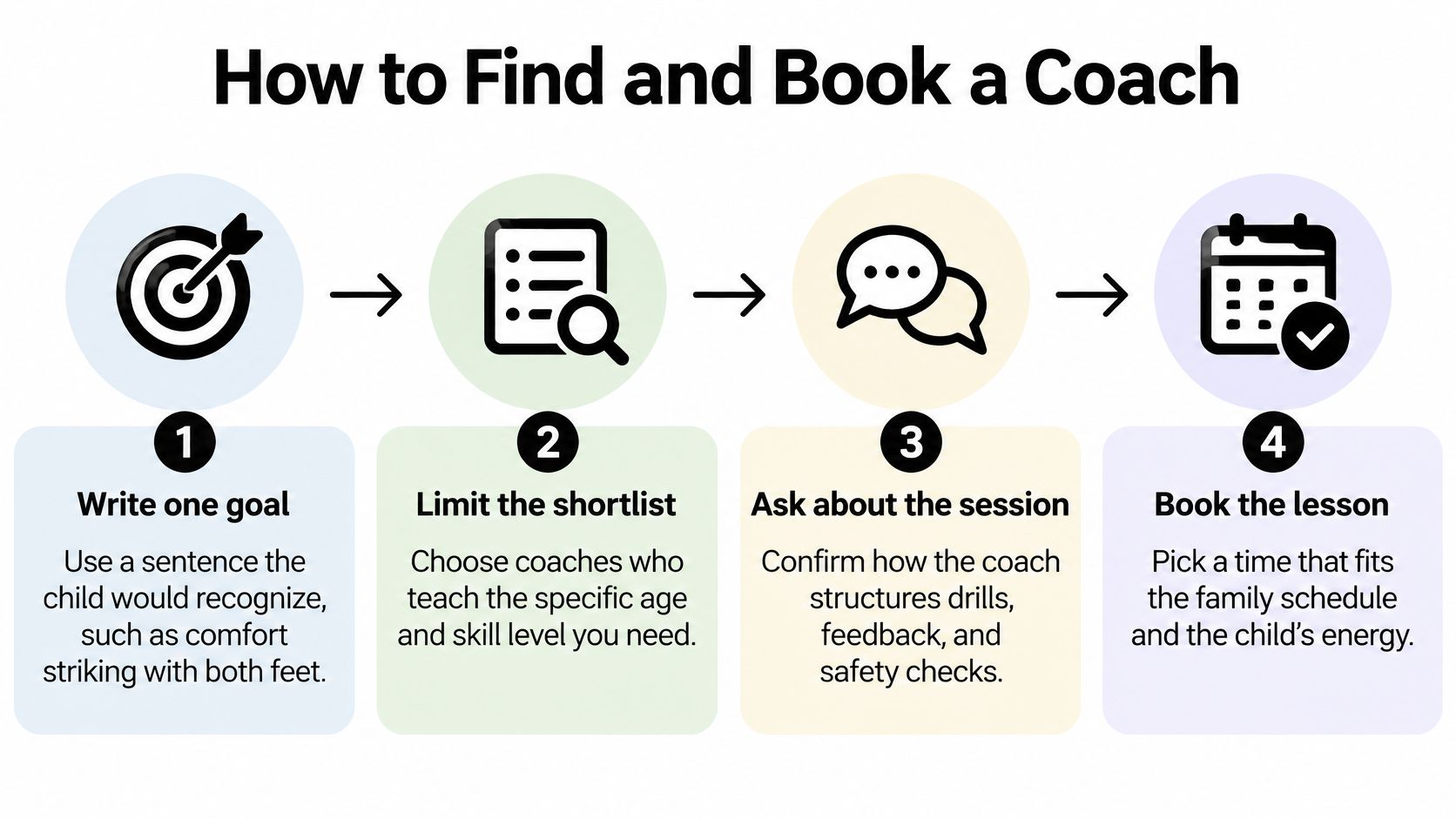
Check youth-specific preparation. Ask about coaching experience with children of the same age, a current coaching license or course certificate, CPR and first-aid certification, and a background check on file. If the program requires SafeSport training, ask whether the coach has completed it. Two parent references from families with children around your child's age can help you understand the teaching style.
Book one trial and share relevant context. Tell the coach the specific goal, your child's other weekly sports, and any prior injury. A former player's résumé can be valuable, but playing experience alone doesn't show how they explain a skill to a young beginner.
Watch the teaching, not just the drill list. Notice whether your child gets meaningful turns with the ball, tries both feet when that suits the goal, and has chances to look up and make decisions. Long lines, lectures, and repetition without feedback make it hard to tell what your child is learning.
Confirm the practical details before booking again. Ask for the fee, the missed-session rules, who can pick up your child, and when you'll review progress. A check-in after a few weeks gives both parent and coach a chance to decide whether the original goal needs more work or a different approach.
Walk away if a coach won't state a price or pressures a preschooler toward year-round, exclusive soccer on the first call. A useful first session should leave you knowing what the coach worked on, what your child can practice if they want to, and what would make another block worthwhile.
Session Structure and Injury Checks
A useful session isn't just a set of cone drills. Look for a progression that helps your child prepare, rehearse one skill, use it under pressure, and then try it in a game-like setting.
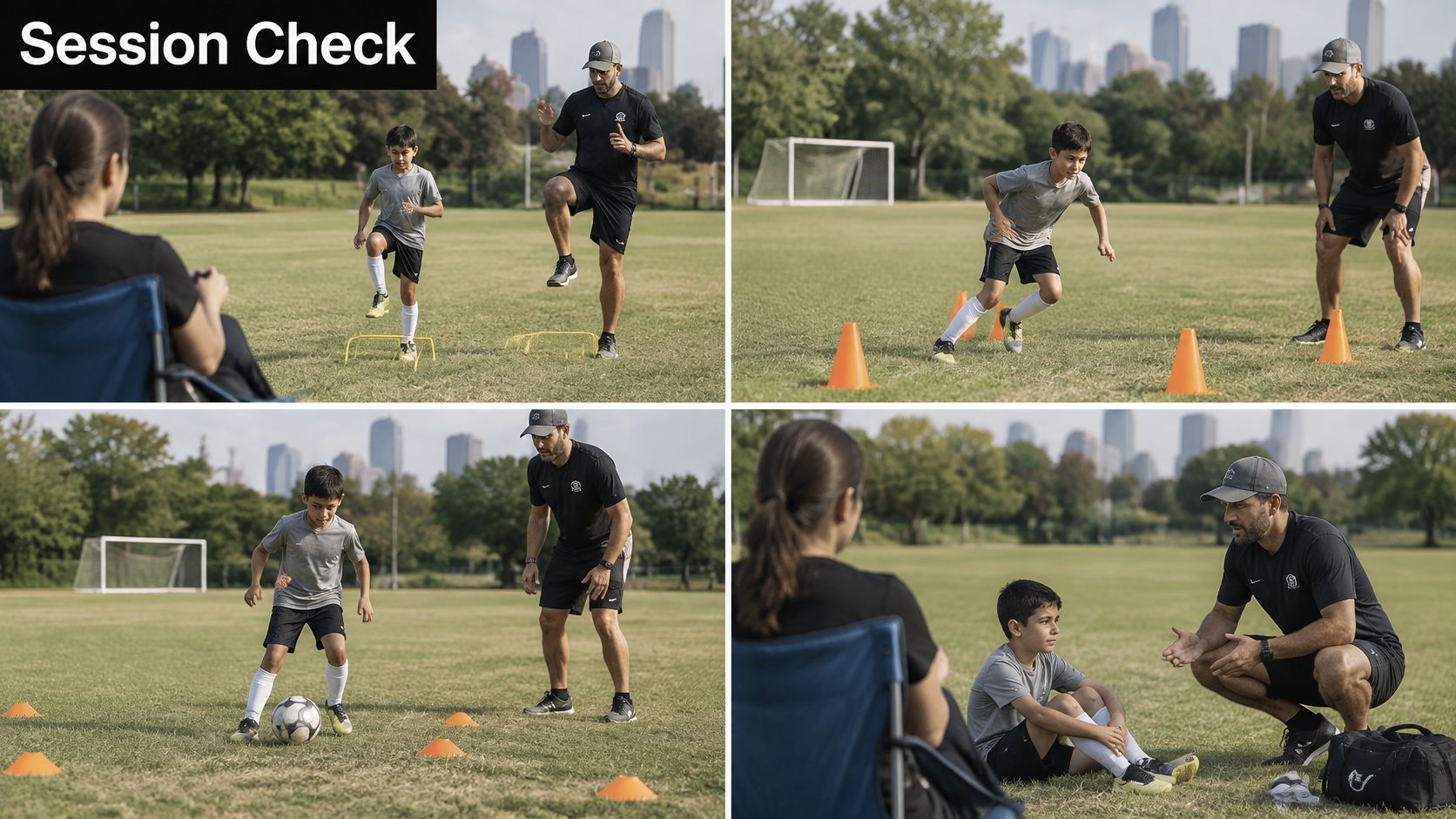
Four beats to look for
First, prepare the body for movement. The warm-up can include dynamic mobility, balance, short accelerations, and controlled decelerations. Long static stretching alone doesn't prepare a player for the changes of direction and quick decisions that follow.
Next, rehearse one skill without much pressure. A coach might work on a first touch, a passing angle, or dribbling with both feet. The point is to let the child understand the movement before making the task more demanding.
Then add a decision. The coach can introduce an opponent, a time limit, a directional target, or a transition rule. These constraints encourage the player to scan, choose an action, and adjust instead of repeating a motion without reading what's around them.
Finish with a small-sided game. In a six-week randomized study of highly trained youth players, small-sided games produced greater gains than dribbling-circuit training in 10 m and 30 m sprinting, Illinois agility, passing accuracy, and interceptions (the study in Scientific Reports). The finding applies to the study's participants and conditions, not as a guarantee for every young player. It does support asking whether the lesson gives a child a chance to use a skill in a realistic game context.
A coach should be able to explain what they're observing. For example, if first touch is the focus, do they track whether the child controls the ball and finds a next action under pressure? Cone work can be useful for learning movement, but without an opponent or decision it doesn't tell you whether the child can scan, time, or choose well in a game.
Progress check: Ask the coach to count successful actions, such as accurate passes or retained possessions, in the same 10-minute game block and repeat the check every 4–6 weeks.
Consistency makes that comparison useful. If the coach changes the drill and scoring measure every session, you won't know whether the child improved or the test changed. For injury-aware programming and parent questions about physical safety, use this guide to sports injury prevention.
Warm up, observe, and adjust
Injury prevention is also about how a coach handles workload. A neuromuscular warm-up can combine dynamic movement, balance, jumping and landing mechanics, agility, and eccentric-strength elements before high-speed work. A youth-soccer trial used a structured program two to three times weekly for about 20 weeks, recording 2.08 injuries per 1,000 player-hours compared with 3.35 in the control group. Its adjusted injury-incidence ratios were 0.62 for all injuries and 0.57 for acute-onset injuries, equivalent to approximate reductions of 38% and 43% in that study (the youth-soccer injury-prevention trial).
A separate analysis found that players completing three neuromuscular sessions weekly had 81% lower odds of injury than those completing one session weekly, according to the same injury-prevention source. These are group findings, not a promise that a particular child won't be injured. Age, workload, playing level, and how consistently a warm-up is performed all matter.
Notice whether the coach asks about previous injuries, session exposure, fatigue, and how the child lands or changes direction. If a child limps, reports joint pain, or starts cutting and landing differently because of fatigue, the coach should stop or reduce the session rather than push for more repetitions. Static stretching alone, sudden increases in sprint volume, and claims that a program makes a player injury-proof are reasons to ask more questions.
For home practice, keep the task modest: the child can try ten passes with their weaker foot against a wall if they're interested. A coach can also help you compare soccer shoe inserts as one part of thinking through footwear comfort, but inserts don't replace suitable shoes, sound coaching, or attention to pain.
Here's a short visual example of how a skills session can progress from technique into play:
Book a Developmental Trial in Northeast Houston
A developmental trial can be a sensible next step for a beginner, a girl looking for a supportive ball environment, or a player who wants to work on one specific skill. It lets a family see how coaching feels before committing to a longer plan. The trial should help answer two questions: does the child enjoy the session, and can the coach explain what they'd work on next?
JC Sports Houston is an indoor youth sports center serving Humble, Kingwood, and Atascocita. Its address is 18610 Page Forest Drive, Humble, TX 77346. When you call, explain your child's goal in plain language, such as building confidence with the first touch or striking with both feet. Mention other sports in the weekly schedule and any previous injury so the coach can take that context into account.
A useful trial should give a child plenty of chances to handle the ball and finish with a small game. Ask how the coach will decide whether another block would help, and what you should look for at home or in team play. The aim isn't to sign up for more training automatically. It's to find out whether this coaching style fits the child and leaves enough room for rest, school, and other interests.
After the session, ask your child how it felt without steering them toward the answer you want. If they had plenty of touches, left willing to return, and still have room in the week for recovery, continuing may make sense. If something feels off later, raise the concern with the coach or director before adding sessions.
Free soccer trials are listed for ages 4–6, 7–9, and 10–13. Call JC Sports Houston at 281-624-6867 to discuss which age group and training option fits your child.
JC Sports Houston offers youth soccer training, private sessions, and age-group free soccer trials for families in Humble, Kingwood, and Atascocita. If your child has one skill to work on and you want to try coaching before making a longer commitment, visit JC Sports Houston to take the next step.
Comments