

Private Soccer Skills Training: What Kids Need to Know

Across 205 member associations, FIFA's global review found that talented players can go undiscovered because development systems lack adequate planning, educational quality, infrastructure, and resources, according to its technical development report. For a parent, the useful lesson isn't that every child needs elite training. It's that playing on a team and getting the individual instruction a child needs aren't always the same thing.
Private soccer skills training can fill that gap. The right program gives your child time to practice a specific skill, receive a clear correction, and try again. Judge it by what your child gets to do with the ball, not by how many lessons you're encouraged to buy.
What Private Soccer Skills Training Covers and Who It Suits
Private soccer skills training means a coach works with an individual player or a small group on ball control, first touch, dribbling, passing, receiving, and finishing. Instead of organizing an entire team, the coach can concentrate on the player's technique.
Training formats compared
Format | Coach-to-player ratio | Individual ball touches | Best use |
|---|---|---|---|
Private one-to-one | A dedicated coach for the player | Very high opportunity | Targeted technical correction |
Small group | A coach shared by a few players | High opportunity | Skills practice with peer competition |
Team practice | Coaching attention shared across the roster | Lower per child when players queue or share a ball | Tactics and team organization |
League match | Coach guides the full team on the field | Limited by involvement in play | Applying skills under real pressure |
These are practical comparisons, not guaranteed touch counts. A thoughtfully designed team practice can keep children active, while a poorly organized private lesson can waste time.
Outdoor soccer attracted nearly 14.1 million Americans aged six and older in 2023, but 62% participated casually, between one and 25 times annually, according to SFIA-derived figures reported by For Soccer. That national picture helps explain why some children need more structured opportunities to practice than their current schedule provides.
Find the actual gap
A beginner might need help stopping the ball without it rolling away. An established player might consistently avoid the weaker foot. Another child might understand the coach's instructions but spend much of practice waiting for a turn.
Those are different needs, and they shouldn't produce identical lesson plans.
Parent self-check: Can your child name something they want to do better, and does their current soccer environment give them repeated chances to practice it?
If the answer is yes to the first question and no to the second, individualized instruction is worth considering. If your child mainly wants more time playing with friends, an enjoyable developmental group may be the better starting point.
Session Length and Focus by Age Group
Age group | Session length approach | Main focus | Coaching style |
|---|---|---|---|
4-6 | Short, play-led sessions that finish before attention fades | Ball comfort, balance, and coordination | Short games and generous praise |
7-9 | Longer engagement through changing activities | Both-foot touches, dribbling, and basic passing | Small games with clear rules |
10-12 | Sustained technical work broken up by live challenges | First touch, individual attacking moves, and weak-foot work | Pressure drills with progressive constraints |
13 and older | Longer focused blocks when workload and attention allow | Decision-making, speed of execution, and position work | Game-realistic scenarios and direct feedback |
These are developmental starting points, not fixed duration prescriptions. Confirm the session format before enrolling, and consider your child's experience and enthusiasm alongside their age.
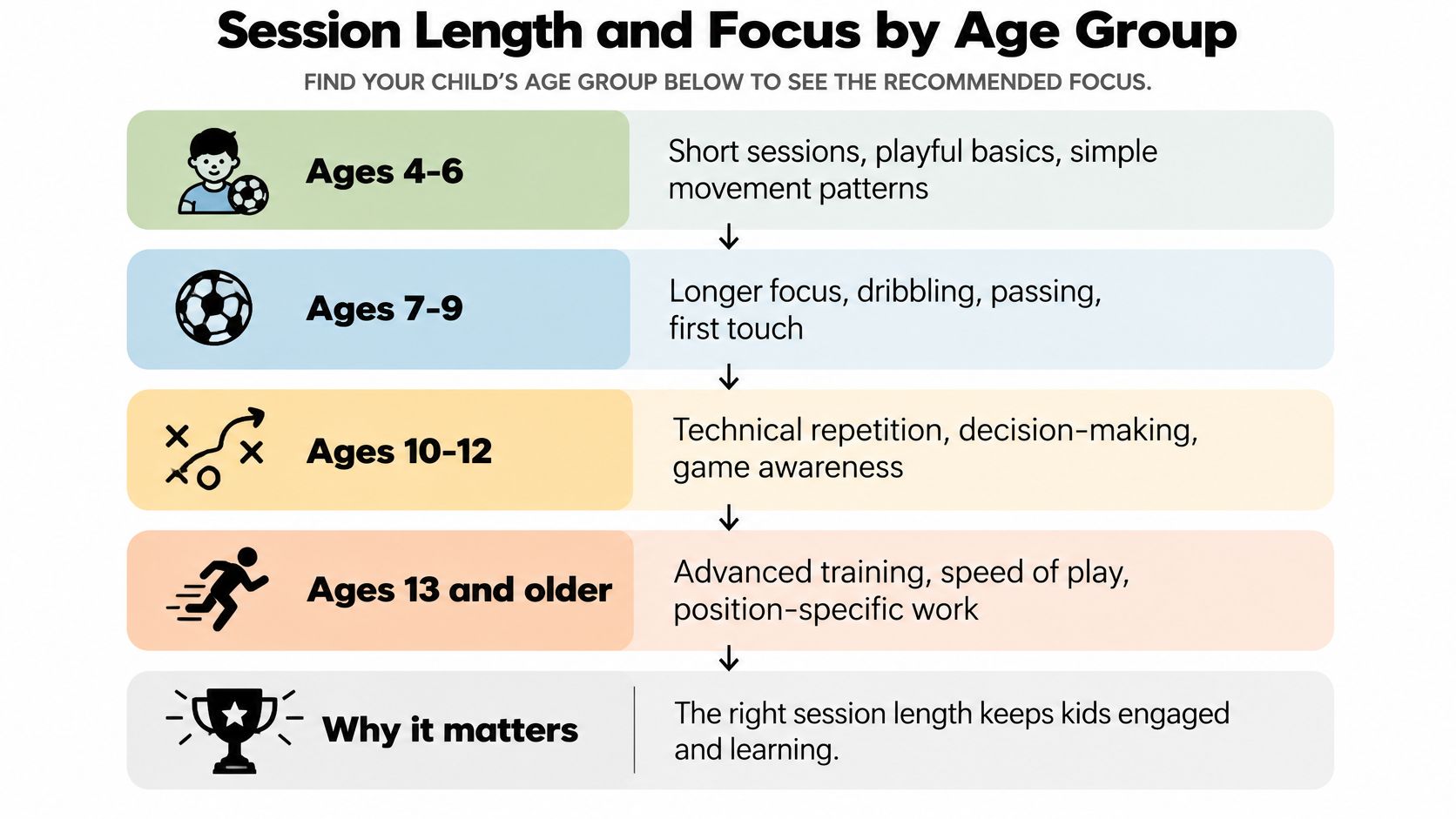
Young children need movement, simple instructions, and frequent opportunities to succeed. Older players can usually spend longer examining details, but a birthday alone doesn't establish readiness for demanding technical instruction.
What a well-built session contains
A useful session flows through different kinds of activity rather than repeating an isolated drill throughout:
Ball-mastery warm-up. The player moves with the ball, changes direction, and becomes comfortable using different surfaces of the foot.
A focused technical task. The coach teaches a specific action, such as receiving across the body, and offers a brief correction.
An opponent. A defender creates a reason to protect the ball, change direction, or pass.
Application through play. A small-sided game gives the skill a purpose. In a strictly individual lesson, the coach can provide opposition, but genuine teammate interactions require other players.
A short reflection. The child describes what felt easier and what still needs practice.
In a randomized study of 90 players aged 9-12, participants receiving 11 additional 75-minute sessions combining ball mastery, individual duels, and small-sided games improved their skill-course time by 7.9 seconds, compared with 3.9 seconds in the control group, according to the published youth soccer intervention.
That study supports combining technical work with application. It doesn't establish the ideal private-lesson duration for every child or promise the same improvement.
Watch the child rather than the clock alone. A productive session includes purposeful ball contact, decisions, and manageable challenges, not long queues or extended explanations.
Skills and Confidence Kids Gain From One-to-One Coaching
A child passes the ball, misses the target, and immediately tries again. Without feedback, they may repeat the same mistake. With a coach watching closely, the next attempt can have a clear purpose: place the supporting foot beside the ball and direct it toward the target.
That's the main technical advantage of individual instruction. The coach can connect a correction to the exact action the child just performed.
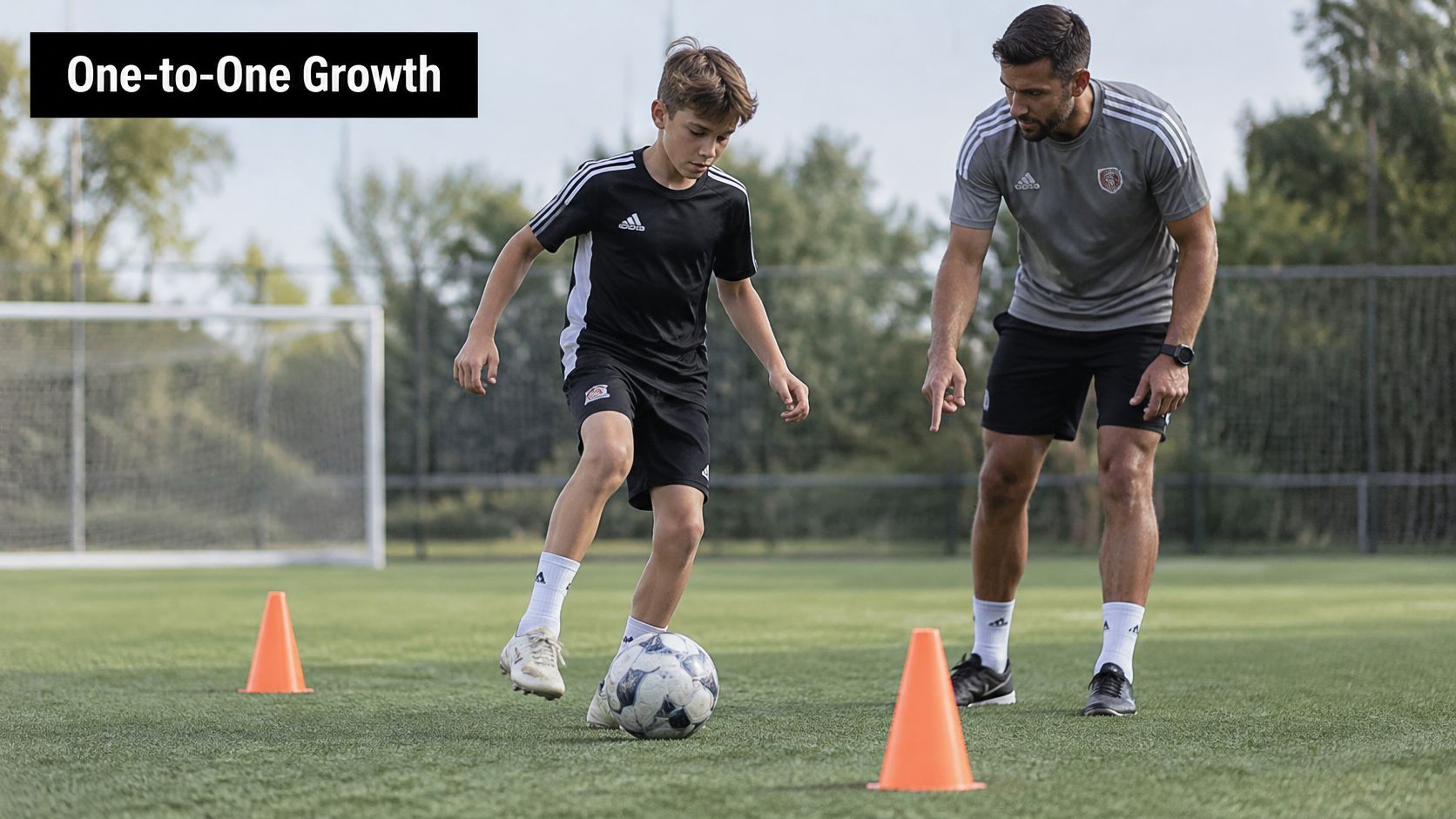
Technique becomes understandable
Consider receiving on the back foot, meaning the foot farther from the arriving ball. The coach can show the player how to open their body, receive across it, and prepare to move forward.
Instead of hearing a broad instruction such as control it better, the child gets something they can change. The coach should then reduce reminders so the player learns to act independently.
Confidence comes from manageable success
A quieter player may hesitate because they expect to lose possession. Begin with a pass they can control, then introduce a gentle challenge when they're ready.
The aim isn't to remove mistakes. It's to make mistakes safe enough that the child keeps trying. Praise should identify a useful action, such as looking up before receiving, rather than treating every attempt as perfect.
Focus makes progress easier to recognize
When the lesson has a defined objective, parents and players can tell what they're working toward. A child who previously chased every first touch may begin keeping the ball within playing distance.
Private coaching still has limits. It can't replace teammates, match experience, or the unpredictable choices opponents create.
Over the following weeks, look for:
Cleaner control: The ball stays close enough for the next action.
Greater willingness: Your child asks for possession or attempts an unfamiliar move.
Ownership: They can explain what they're practicing and why.
These are signs to discuss with the coach, not a deadline every child must meet.
How Coaches Build From Clean Touch to Game Speed
A player can look comfortable passing to a stationary coach and struggle when an opponent approaches. That doesn't necessarily mean the technique has disappeared. The player now has to notice pressure, choose an option, and execute the pass together.
A sensible progression keeps the movement objective consistent while changing the challenge around it.
Passing progression from stable to game speed
Stage | Example task | Constraint added |
|---|---|---|
Stable pattern | Unopposed right-foot passes at a fixed distance | Fixed target with no defender |
Added variety | Introduce alternating feet, moving targets, and changing angles separately | Change the required foot or target position |
Added pressure | Pass while a defender closes a passing lane | A defender can remove an option |
Game speed | Receive, scan, and pass before the opportunity closes | A time constraint, followed later by a scoring rule |
The table shows a progression, not a requirement to add every challenge at once. When the target begins moving, keep the pass distance comfortable. When a defender enters, allow enough space for the player to recognize what's happening.
Change something for a reason
Blocked practice means repeating a predictable task. It can help a player understand a movement, but clean execution during that drill isn't the same as durable learning.
A systematic review of practice variability in soccer cautions that variation doesn't automatically improve learning; coaches need to match changes to the player's age, ability, and objective. Randomly making a drill harder isn't a development plan.
Our explanation of technical development gives parents additional context for discussing these training goals. For practical ways to connect technique with opponents and teammates, TFA Tactics Board's guide to using small-sided games in training is a useful resource.
A difficult drill is worthwhile only when the child understands the problem and has a realistic chance to solve it.
To check learning, repeat the assessment after a rest period, then try a related task in a new context. For passing, that could mean receiving before the pass or executing after a directional run.
Ask whether the player can still find the target without continuous prompting. That tells you more than a polished performance immediately after repeated coaching cues.
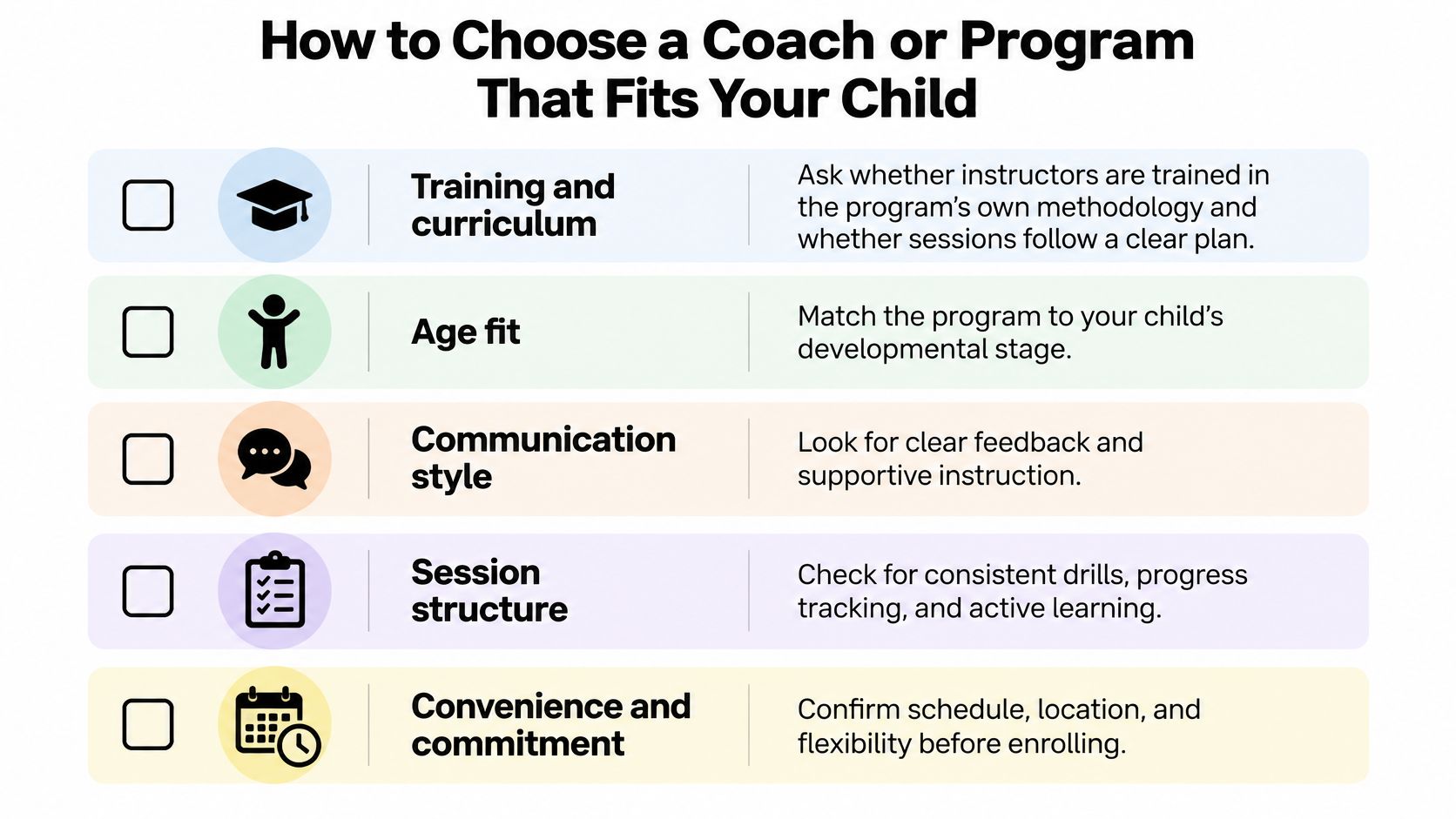
How to Choose a Coach or Program That Fits Your Child
Choose a coach who can explain what your child needs, how they'll teach it, and what progress would look like. A playing résumé or an impressive drill video doesn't answer those questions.
Use these criteria to compare providers on the same terms:
Training and curriculum: Ask how instructors learn the teaching method and whether they follow a clear progression. Our teachers are experienced and trained in the JC Sports curriculum, which places the child at the center of the game.
Actual group size: Establish who will share the coaching time and whether activities keep everyone involved. A small group loses its advantage if children still spend most of the lesson waiting.
Method and learning environment: A named technical method should translate into understandable instruction. Also consider whether your child feels more comfortable learning individually, with peers, or in a dedicated girls' setting.
Developmental fit: Ask how the coach changes the task for a beginner, a hesitant child, or a player who finds it easy. Repeating identical instructions louder isn't adaptation.
A useful trial: Watch whether the coach notices errors, provides a manageable correction, and gives the child another attempt.
Compare communication, not just credentials
During a trial, listen to how the coach responds when the player struggles. Helpful feedback identifies an action: turn your supporting foot toward the target. Unhelpful feedback merely announces the outcome: that was wrong.
Our guide to choosing a youth soccer coach can help you frame that conversation. Bring the same questions to each provider so you're comparing teaching quality rather than presentation.
Red flags include guaranteed rapid results, evasive answers about progression, and lessons dominated by lectures. Be cautious, too, when a coach explains every difficulty as a lack of effort.
A good fit doesn't mean the child finds everything easy. It means they understand the challenge, feel respected, and want to participate. Before committing, also confirm the location, schedule, and attendance expectations so practical difficulties don't undermine an otherwise suitable choice.
How Often to Train and What Private Lessons Cost
Start with the smallest useful commitment, not the fullest available schedule. A child learning a new receiving technique may need an occasional coached check-in and simple practice between visits. A player with a persistent technical problem may benefit from a more concentrated block, provided it fits comfortably around team commitments and rest.
There isn't a universal lesson frequency that every child needs. Set a review point before enrolling so continued payment depends on a useful purpose.
Match the schedule to the problem
Situation | Sensible starting approach | Reason to reassess |
|---|---|---|
A skill needs maintenance | Spaced coaching with independent practice | The player can self-correct |
A specific error keeps recurring | A focused block with a defined objective | The action becomes reliable |
The child already has a demanding schedule | Reduce or postpone extra instruction | Energy and enthusiasm recover |
Budget limits individual lessons | Consider shared coaching or a home practice plan | The child needs more specific feedback |
Use a soccer training schedule to consider the whole week, including matches, school demands, travel, and unstructured play. Don't treat empty calendar space as a requirement to add training.
Calculate the full cost
Families spent an average of $910 on youth soccer in 2024, up from $537 in 2019, according to KJZZ's reporting on youth soccer costs. Those are overall participation costs, not private-lesson rates.
Get a current written quote rather than assuming a national average tells you what a local lesson should cost. Include equipment purchases, transportation, missed work, and sibling care in your comparison.
Cost per hour of active ball time = total block cost ÷ hours of actual ball involvement.
Treat that calculation as a planning estimate, not a stopwatch contest. Receiving, scanning, and choosing a pass can be valuable even when the player isn't continuously touching the ball.
Budget rule: Pay for a defined learning purpose, and leave room to stop when that purpose has been met.
Ask about trial eligibility, shared sessions, package terms, payment plans, and sliding-scale options without assuming they're available. Compare a short block with other commitments over an equivalent period, not against an entire season's headline fee.
Preparing for the First Session and Tracking Progress
Preparation should make the first visit feel manageable, not like an examination. Tell the coach what your child enjoys, what they find difficult, and whether they're nervous about individual attention.
Before leaving home
Check footwear: Bring suitable soccer footwear and confirm what works on the training surface.
Pack water: Have a clearly identifiable bottle your child can reach during breaks.
Explain the visit: Tell your child they'll try activities and meet the coach, not pass a selection test.
Allow time to settle: Use the restroom and check in before joining the activity.
We provide training equipment and curriculum materials. Participants should check in with their coach each week and use the restroom before class.
Our sports programs aren't drop-off classes. Parents or caregivers must remain in the building during classes, so plan work and sibling arrangements accordingly.
Keep a balanced progress record
Use a simple notebook rather than turning every attempt into a score. Record these different kinds of evidence:
Measure | What to record |
|---|---|
Technical control | Successful first touches across a consistent set of attempts |
Enjoyment | Your child's own description of how the session felt |
Application | Whether the skill appears during small-sided play |
A study covering 33,156 player-session observations across 11 European academies suggests mixed training designs may support more balanced technical development, as described in the academy training study. That supports looking beyond an isolated drill result, without assuming academy findings predict your child's outcome.
Review patterns across weeks. Use a delayed check and a changed playing situation to examine transfer, while keeping the conversation supportive.
If control improves but enthusiasm falls, speak with the coach. If your child enjoys training but the target skill remains unchanged, ask whether the task or feedback needs adjusting.
Book a Free Trial Before Your First Session
Test the fit before making a longer commitment. A trial lets you observe the instruction and gives your child a voice in the decision.
Our listed free trials cover MultiSport and soccer for ages 4-6, 7-9, and 10-13. Don't assume that a trial listing includes private instruction or every older age group; confirm the current eligibility before booking.
Identify your child's developmental stage. Use the age guidance as a starting point, then explain their playing experience and comfort level.
Confirm the suitable trial. Check which current offer matches your child and whether the location works for your family. We serve Humble, Kingwood, and Atascocita.
Attend and observe. Notice whether the coach gives understandable corrections and whether your child has meaningful opportunities to practice.
Use the selection checklist. Consider curriculum, group size, teaching method, developmental fit, and the quality of feedback.
Choose without pressure. Continue if the match is useful, or wait if your child needs a different environment.
Afterward, ask your child what they learned and whether they'd like to return. Their answer matters alongside your observations of the coach.
Families can request a free trial using a form with the child's name, age, and favorite sport. The useful decision isn't whether to buy the largest package. It's whether the teaching gives your child purposeful ball time, understandable progression, and enjoyment.
JC Sports Houston offers age-appropriate soccer programs and private sessions that can help address individual technical needs alongside team play. Visit JC Sports Houston this week to request an eligible free trial and confirm which training option fits your child.

Comments