

Youth Soccer Coach Guide: Roles, Styles and Red Flags

You're standing beside the field, watching a coach demonstrate a sharp turn while your child waits behind a line of cones. The coach clearly knows soccer. What's harder to judge is whether your child will get enough help, feel comfortable making mistakes, and be looked after when something goes wrong.
Choosing a youth soccer coach means evaluating more than footwork or a playing résumé. Watch how the coach organizes practice, responds to children, and answers ordinary parent questions. Technical instruction matters, but safety and communication deserve their own checks.
What a Youth Soccer Coach Does Every Session
A useful practice starts before the children arrive. The coach sets cones, checks the playing surface and goals, reviews relevant health information and emergency contacts, and prepares an activity children can enter without standing around.
Once players arrive, the coach checks how they're feeling, leads an age-matched warm-up, and introduces a technical focus through manageable activities. A receiving session might move from controlling a rolling ball to finding space away from a defender. Before dismissal, each child should hear something specific about their effort or progress.
This work often falls to community members rather than full-time professionals. US Youth Soccer's coaching manual describes more than 300,000 dedicated coaches, most serving as volunteers, within a broader network of more than 600,000 volunteers and administrators. Volunteer status isn't a warning sign. Preparation, support, and follow-through are what parents need to assess.
The duties behind the drills
Core duties of a youth soccer coach
Duty | What good looks like | Red flag |
|---|---|---|
Session planning | Age-matched activities with clear reasons for each drill | Same adult-style drills for every age |
Safety and supervision | Hazards checked before play, water breaks, a known first aid plan | Coach leaves the field during play or ignores heat |
Parent communication | Regular updates on progress and any injury or absence | Parents learn of problems only from their child |
Individual feedback | Specific praise and a manageable corrective cue for each child | Feedback only for the strongest players |
Inclusion | Activities designed to distribute ball touches and leadership opportunities fairly | Playing time decided by size or confidence alone |
Age matching changes the job considerably. A preschooler may need a demonstration, help restarting, and permission to explore. An older school-age player can work through tactical questions and explain why a particular decision succeeded.
Administrative organization matters too. For families comparing how programs handle scheduling and communication, Vanta Sports' Youth Sports Management is a relevant resource to explore. Software, however, can't establish whether a coach teaches patiently or supervises attentively.
Observe the full routine, not just the most impressive drill. Across your initial visits, look for every duty in the table, and ask the coach to explain anything you can't see.
Coaching Philosophies Side by Side, Coerver Included
A coaching philosophy is the lens a coach uses to decide what practice is for. Is the priority better individual technique, understanding teammates, solving problems independently, or preparing to win the next match?
Most coaches blend methods. The useful question isn't whether they follow a recognizable label, but whether they can explain why a particular activity suits the children in front of them. A session full of impressive demonstrations can still leave beginners confused.
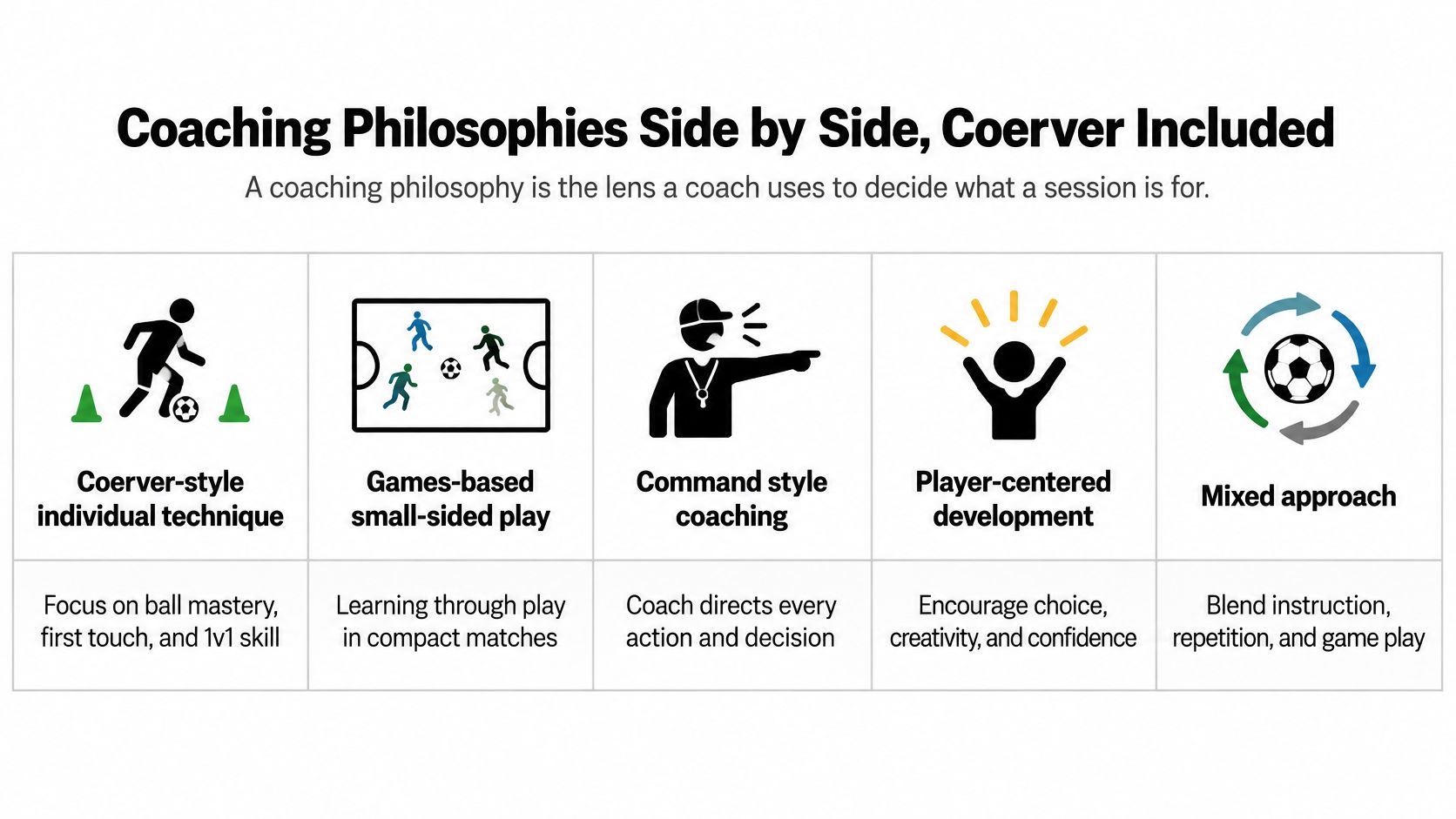
Youth soccer coaching philosophies compared
Philosophy | Core focus | Best fit | Trade-off |
|---|---|---|---|
Coerver-style technical training | Repetitive, progressive ball mastery and first touch | Children ready for focused technical work | Less time for tactics and team structure if used alone |
Games-based small-sided play | Frequent touches and decisions in compact games | Beginners and developing school-age players, with simpler versions for preschoolers | Needs thoughtful grouping and clear boundaries |
Tactical positional training | Team shape, roles, and patterns of play | Players ready to connect individual skills with team decisions | Can overload children whose basic skills aren't secure |
Win-first competition | Results, selection, and match preparation | Competitive players comfortable with the ball and the selection expectations | Can restrict experimentation and opportunities for others |
Development-first mixed model | Technique, creativity, movement, and enjoyment | Children needing a balanced learning environment | Requires careful planning rather than an assortment of unrelated drills |
Repetition needs a destination
Coerver-style training uses progressive ball-mastery activities to develop close control, first touch, and confidence manipulating the ball. Small-group instruction gives a coach room to demonstrate a movement and correct how a child performs it.
The limitation appears when children rehearse moves without learning when to use them. A useful progression takes a turn or feint into an activity with an opponent, then into a game. Clean cone work and effective match decisions aren't the same achievement.
Games-based teaching addresses that decision-making component. A study comparing small-sided soccer formats found more frequent attacking actions, including shots, goals, and balls entering the penalty area, in smaller formats when comparing 5v5, 7v7, and 9v9 among U9 and U14 players.
Parents can use a simple observation exercise: watch whether each child receives the ball, attempts a solution, and gets another opportunity. If a confident player dominates, the coach can change teams, adjust space, or simplify the task rather than repeatedly calling for everyone to pass.
A drill teaches a movement. A well-designed game asks the child to choose it.
Our guide to soccer coaching philosophy offers another way to consider those choices. Which approach matches your child's readiness, goals, and temperament, rather than sounding most advanced?
Qualifications That Matter and Those That Don't
A coach's résumé can show relevant preparation, but it cannot show how they'll teach your child or manage a group. Assess safety preparation, coaching education, and method-specific training separately. Each answers a different question.
What each credential type proves
Credential type | Examples | What it proves | What it does not prove |
|---|---|---|---|
Safety credentials | First aid, CPR, abuse-prevention course, background check | Relevant training or screening has been completed, subject to its currency and scope | Age-appropriate teaching skill or a guarantee of safe conduct |
Coaching education | National or regional licence, US Soccer grassroots courses | Formal preparation in the coaching methods covered by the course | Current emergency readiness unless separately maintained |
Technique certification | Coerver coaching course | Training in a particular ball-mastery methodology | Broader competence in safeguarding, communication, or other methods |
Playing career | Former club or college player | Experience playing at the stated level | How to teach young children or supervise them safely |
Check the scope, not just the badge
Ask what safety preparation was completed, when, and how the organization checks that it remains current. A background check is screening. CPR training addresses emergency response. Neither explains how a coach will handle a frustrated beginner or communicate with a parent.
For coaching education, ask for a specific example of how the coach applies it. A useful answer might describe shortening an explanation, improving transitions between activities, or adapting a task for children who are still learning to receive a moving ball. That connects training to the session your child will experience.
A former player may spot a passing option quickly yet struggle to explain it in child-friendly steps. Playing ability and teaching ability are separate skills.
Staffing determines what preparation can deliver
Youth sports participation has grown while the supply of volunteer coaches has struggled to keep pace. Ask how many children will be in your child's group, whether another adult assists, and what happens if that person is absent.
Even a well-prepared coach can have trouble noticing hesitation, giving individual feedback, and supervising transitions when responsible for too many children. A clear staffing plan matters alongside relevant qualifications.
A coach's credentials are most useful when you can connect them to the work: what the coach has learned, how that preparation applies to the group, and who helps supervise.
Safety Standards to Verify Before You Enroll
Parents shouldn't have to infer safety readiness from a coach's confidence. Project Play's coaching trends report states that 26% of youth coaches received general safety or injury-prevention training in 2024, while 88% of youth-sports parents say coaches should pass criminal background checks.
That gap is a reason to verify procedures, not assume every coach is unprepared. Ask to see the program's arrangements and listen for clear responsibilities.
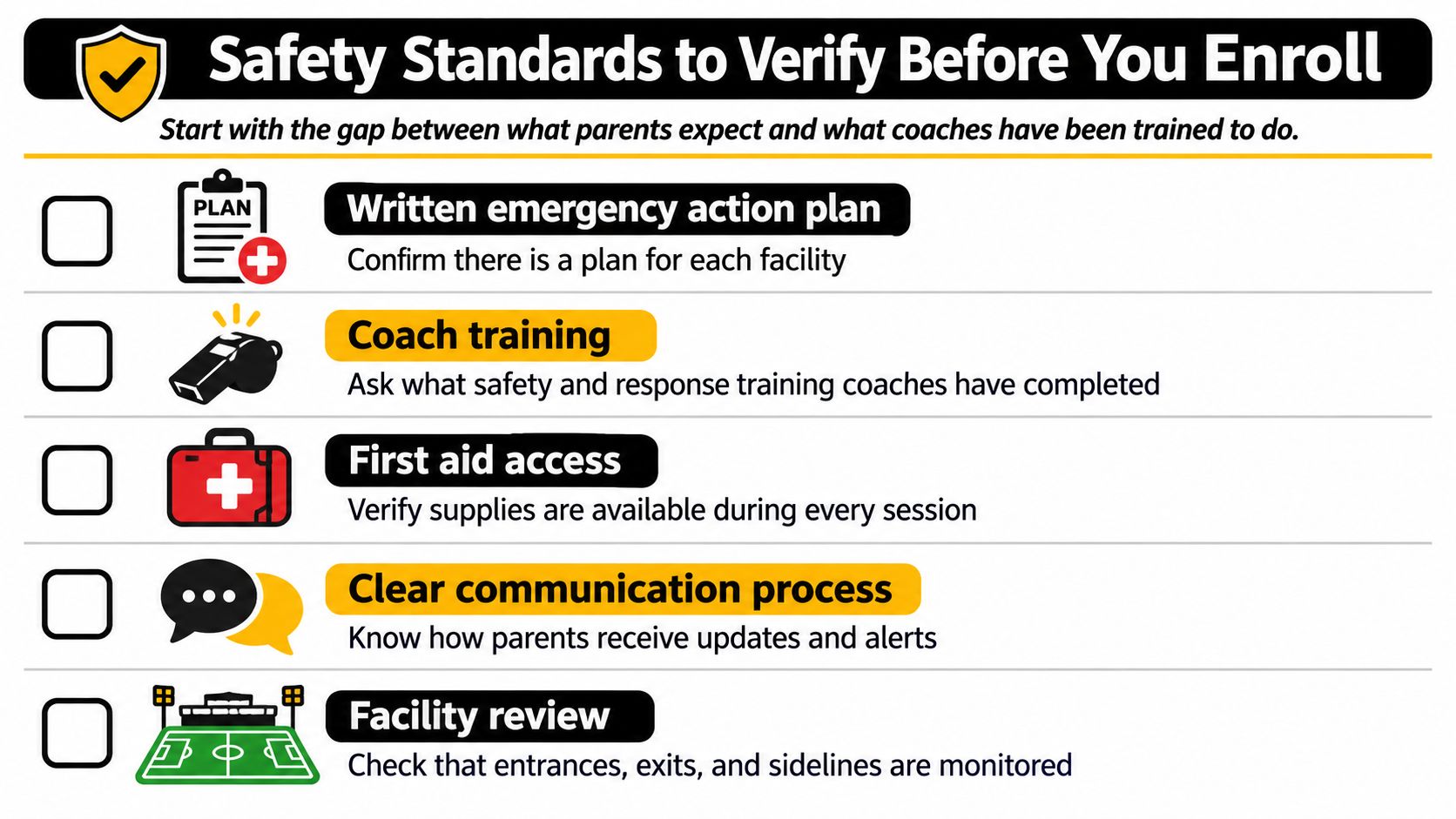
Verify the response before it's needed
Written emergency action plan. Confirm the plan covers the actual facility, including its address, emergency access, who calls for help, and who supervises the remaining children.
Current emergency preparation. Ask about first aid and CPR training, where supplies are kept, and whether an AED is accessible. Someone should know its location and the facility's response procedure.
Concussion procedure. Look for immediate removal when concussion is suspected, no same-day return, and medical clearance under the applicable return-to-play process. A coach shouldn't diagnose or clear a child independently.
Heat management. Outdoor sessions need accessible water, shade, breaks, and adjustments to workload or cancellation when conditions warrant. Being indoors doesn't remove the need for hydration or attention to a child's condition.
Developmentally appropriate preparation. The warm-up should gradually introduce movements used in the session, not begin with exhausting sprints or punishment exercises.
Safeguarding and supervision. Confirm background screening is recorded and ask how the program handles child collection, bathroom transitions, adult conduct, and concerns raised by families.
Pain isn't a character test
When a child reports pain, the activity stops for that child. The coach should check what happened, notify the parent, and follow the written response plan, seeking qualified medical assessment when appropriate.
A parent conversation isn't medical clearance. Neither is a child saying they want to keep playing.
Non-negotiable: A coach must not pressure a child to hide symptoms or earn approval by playing through pain.
Our sports injury prevention guide can help parents prepare additional questions about training and recovery. Keep those questions separate from discussions about selection or competitive commitment.
Request the emergency plan in writing. Then ask the coach to describe what happens after a suspected concussion, including who contacts the family and who authorizes return. The answer should describe a process, not depend on how important the match is.
Communication and Belonging Signs to Watch
Say your daughter loves kicking a ball at home but becomes quiet after joining a team. Nobody seems to pass to her, and you haven't received an update explaining how she's settling in. Her technique may not be the immediate problem. Her place in the group needs attention.
In the 2025 Soccer Parenting survey of 965 soccer parents, 67% prioritized a coach's interpersonal skills. Parents are right to look beyond whether a coach can demonstrate a skill.
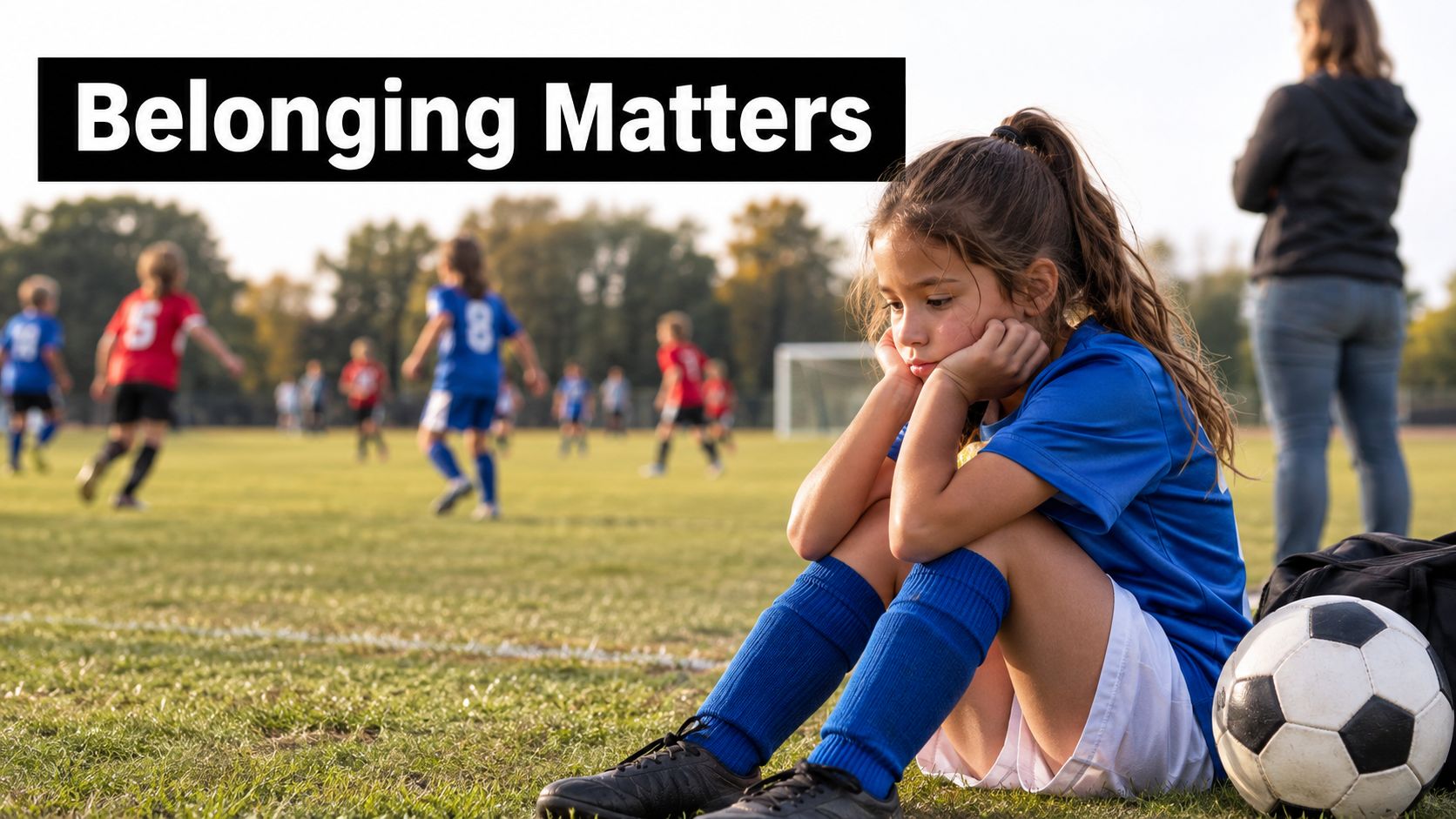
Watch who gets noticed
Healthy inclusion is observable. A hesitant child receives invitations to participate, not just instructions to be louder. After a mistake, the coach offers a usable cue and another opportunity rather than turning the error into a public lesson about attitude.
Feedback should describe behavior: turning away from pressure, looking before receiving, or trying again after losing possession. Calling the fastest child naturally talented gives everyone else little guidance and can confuse physical maturity with learning.
A shy beginner may need a supportive partner before joining a competitive activity. Multilingual families may need a demonstration or a clear written explanation. Girls should receive meaningful technical feedback and leadership opportunities, not merely reassurance that they're welcome.
Make updates useful
A brief parent update can follow this pattern:
Learning focus. Identify the skill or decision children practiced.
Progress example. Describe something the child attempted or improved.
Next step. Explain what the coach will help them work on next.
Contact route. State how parents can raise a private concern.
Email or a managed app can keep important messages accessible. An unmoderated group chat can bury a useful update beneath unrelated conversation, so ask which channel carries official information.
For a child returning after a poor experience, the coach should learn what made participation difficult without demanding a public explanation. A low-pressure introduction and an achievable task are better starting points than promises to toughen the child up.
At JC Sports Houston, parents or caregivers with a concern should speak with the coach or director. After observing a session anywhere, test the environment with a concrete question: Can you name something specific the coach praised in your child?
Parent Interview Questions and Strong Answers
A short call or a conversation after practice can reveal how a coach thinks. Take notes and compare programs using the same questions, rather than relying on whichever conversation feels friendliest.
Ask for examples of what the coach does. You're not testing whether they can recite coaching terminology. You're checking whether their answers identify actions, responsible people, and boundaries.
Parent interview questions for a youth soccer coach
Question | Strong answer | Red flag |
|---|---|---|
What do you do when a child says something hurts? | Stops participation, contacts the parent, and follows a written response plan | Tells the child to push through |
What emergency training have you completed recently? | Names courses and completion or renewal dates, such as first aid and CPR | Relies on training from years ago without checking currency |
How do you update parents on progress? | Offers regular summaries with specific examples and a private contact route | Only contacts parents when there's a problem |
How do you keep every child active in practice? | Describes small groups, available equipment, and rotating roles | Accepts long lines as unavoidable |
How do you adapt drills for a shy or beginner child? | Gives an example involving simpler tasks, supportive pairing, and achievable goals | Uses identical demands for everyone |
How do you help a child who had a bad experience before? | Listens, agrees on individual goals, and introduces participation patiently | Dismisses the experience or blames the child |
How many children will be in my child's group? | Gives the planned number, identifies assistants, and explains absence cover | Cannot describe staffing or group limits |
Follow general answers with a scenario
If the coach says activities are individualized, ask what changes when a beginner repeatedly loses control of the ball. A useful response might involve allowing more space, slowing the service, or removing defensive pressure temporarily.
If the answer is that everyone gets encouragement, keep asking. Encouragement helps, but it doesn't explain how the task becomes learnable.
Listen for a named activity, a clear policy, or an identifiable person responsible for the next step.
Don't confuse honesty with weakness. A coach who says they'll confirm a renewal date with the director may be more reliable than someone who casually claims every qualification is current. What matters is whether they follow up with a verifiable answer.
Decide what you can accept
Some differences are preferences. Your child may enjoy a quieter teaching style or want more competitive play. Other concerns, including dismissing pain or avoiding safeguarding questions, aren't matters of personality.
I would keep looking when vague answers persist across several topics. A coach who welcomes reasonable scrutiny gives you a better basis for trust, but the practice you observe should still match what was promised.
Book a Free Trial and Compare Programs
A trial is most useful when you arrive with something to evaluate. Choose a few priorities for your child, such as joining activities comfortably, understanding instructions, or receiving more purposeful technical feedback. Then watch how the coach responds when the activity becomes difficult.
At JC Sports Houston, we serve Humble, Kingwood, and Atascocita from an indoor facility, with age-appropriate sports programs for children 24 months and up. Our curriculum places the child at the center of the game, using interactive games and drills to build motor skills, self-confidence, and sports technique.
Observe how the teaching fits your child
All our teachers are experienced and trained in the JC Sports curriculum. We provide training equipment and curriculum materials, and our Coerver-based soccer training gives children seeking technical development an option for focused ball work.
Those facts give you a starting point, not a reason to skip observation. Watch whether your child understands the demonstration, gets help after an unsuccessful attempt, and has room to try again. Enjoyment matters, but so does whether the challenge is appropriate.
Our sports programs aren't drop-off classes. Parents or caregivers must remain in the building during class, so plan to stay rather than scheduling another errand.
Make the comparison practical
Use the same interview questions. Compare concrete answers rather than marketing language or the appearance of the facility.
Watch a complete session. Arrivals, transitions, water breaks, and dismissal reveal organization that a highlight clip won't show.
Ask your child about the experience. Find out what they tried, what felt difficult, and whether they'd like another opportunity.
Resolve concerns before enrolling. At our center, speak with the coach or director rather than leaving an unanswered question to become frustration.
A successful trial doesn't require your child to perform well immediately. It should help you understand whether the teaching approach makes participation manageable and worthwhile. A cautious child who starts joining in may give you more useful information than a confident child who scores repeatedly.
Before requesting a visit, review our explanation of whether free trials are really free. Families can request a free trial through our website form by submitting the child's name, age, and favorite sport.
JC Sports Houston offers child-centered sports instruction and soccer training for families looking for purposeful, age-appropriate coaching. Visit JC Sports Houston to request a free trial, then bring your questions and watch how the coach helps your child learn, participate, and feel part of the group.
Comments