

Youth Basketball Skill Development by Age

More basketball isn't automatically better basketball. Year-round teams, private lessons, and extra practice can help some children, but they aren't the default route to stronger skills. A better starting point is a manageable weekly routine that fits a child's age, current coordination, interest, and opportunity to play.
For youth basketball skill development, the useful question isn't “How much can we add?” It's “What can this child practise well, enjoy, and repeat?” Start with the plan below, then adjust the drills and game size as the child's skills become more reliable.
A Weekly Plan by Age and Skill
Start this week with a simple schedule, not a travel-team calendar. The sessions below are practical starting points. Keep them playful for younger children, and let current coordination and enjoyment guide the pace.
Age band | Sessions per week | Skill focus | Game size |
|---|---|---|---|
5–6 | 1–2 sessions of 30–40 minutes | Both-hand dribble, chest pass, layup steps | Tag or 1v1 to a cone |
7–8 | 2 sessions of about 45 minutes | Weak-hand dribble, close form shot, bounce pass | 2v2 |
9–10 | 2–3 sessions of 50–60 minutes | Change of direction, pass on the move, closeouts | Mostly 2v2 |
11–12 | 3 sessions of 60–75 minutes | Help-side ideas, ball security, shooting off a cut | 2v2 moving into 3v3 |
13–15 | About 3 basketball sessions of 70–90 minutes, plus 1 other movement day | One skill block, then spacing and decisions | 2v2 then 3v3, not constant 5v5 |
Choose the row that fits the player
A birthday doesn't tell you everything about a child's basketball readiness. A child who's new to dribbling may benefit from the 7–8-year-old focus even if they're older, while a younger player with steady control may be ready for a slightly harder challenge. Keep the movement simple enough that the child can pay attention to the ball, teammates, and space.
For ages five and six, practise in short bursts. Let a player dribble while walking, pass to a partner, then try the steps of a layup without worrying about making a basket. A cone can stand in for a defender or finish line. For seven- and eight-year-olds, add a weak-hand challenge and a close-range shot, then use 2v2 so each player gets chances to handle the ball and make a choice.
Older beginners can also start with the younger row's skills. Change one thing at a time, such as adding a defender after a child can pass to a moving teammate. For ideas suited to the youngest players, see basketball practice for five-year-olds.
Keep a little room for play
For teenagers, make space in the week for recovery as well as basketball. A day of another movement activity can give a young athlete a different physical challenge, and a rest day leaves room to recover. Early specialization hasn't been shown to speed basketball-specific fitness gains compared with specializing during or after puberty, according to a study of youth basketball players.
Keep one block of the week as free play, without stopping every possession to correct a mistake. That gives players a chance to try moves, solve small problems, and enjoy the game on their own terms. If the child is tired, frustrated, or losing interest, shorten the session before adding more days.
How to Build One Practice Session
A practice works better when it has one clear target. Choose weak-hand dribbling, passing under pressure, shooting after movement, or defensive footwork. Tell the child what the target is, then build from simple repetitions to a small game that uses the same skill.
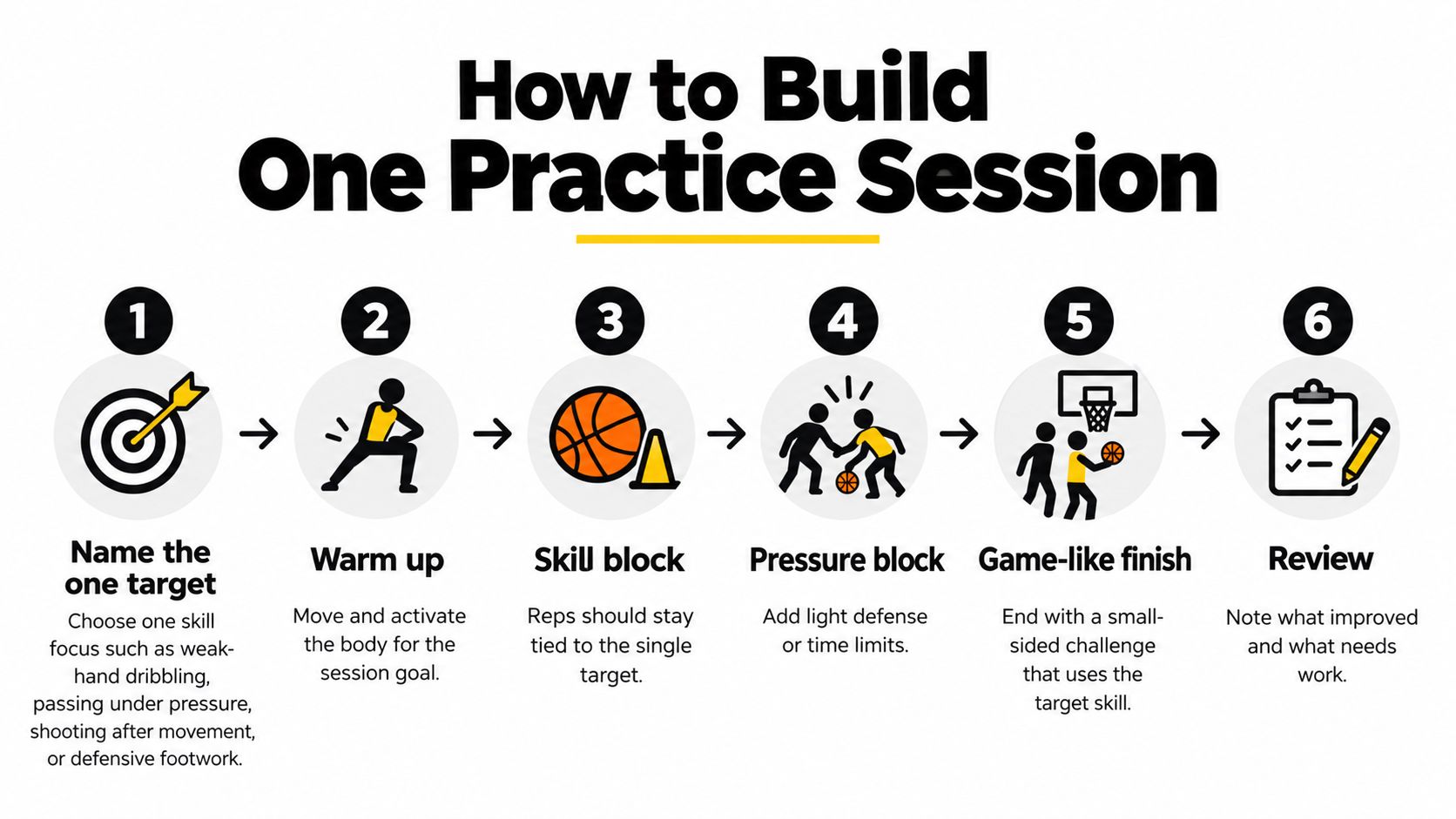
Use this six-stage session
Name the one outcome. Say, “Today we're working on passing to a teammate who's moving.” A clear purpose helps you choose drills that fit. The common slip is trying to train too many skills in one practice.
Warm up for 5–8 minutes. Put a ball in each player's hands if possible. Use easy dribbling, walking, turning, and an athletic stance to get moving without spending the opening on long laps. Don't make the warm-up so complicated that it becomes the main lesson.
Practise the technique for 8–10 minutes. Begin without a defender and give one short cue, such as “eyes up” or “step to the target.” Simple repetitions let a player focus on how the movement feels. Avoid adding a stream of instructions after every attempt.
Add constrained opposition for 10–12 minutes. For passing, a defender might start one step away; for a closeout, the defender might approach from a set starting spot. The constraint creates pressure without making the task too difficult. If the defender is too strong or close, the player may never get a useful repetition.
Finish with a representative game for 12–15 minutes. Use a small-sided game that requires the same skill. If the target is passing under pressure, score a point for a successful pass to a moving teammate. The game should make the skill matter, not turn into an unrelated contest.
Review with one memorable cue. Ask what felt easier and choose one reminder for next time, such as “show your hands” or “stay balanced.” Keep the review short. Don't turn a good finish into a long correction session.
Check both the skill and its transfer
Keep the session age-appropriate. For a younger child, shorten the technique and game stages to fit a 30–40-minute practice, but keep a game-like finish. The point is to leave time for play, not to remove the part where the player uses the skill in context.
A study of 42 under-14 players compared two additional weekly sessions across small-sided games, technical skill training, plyometrics, and control conditions over an eight-week period. Its findings underline that different training methods can affect different outcomes, so a lively game shouldn't be assumed to improve every quality; the study report on training methods and performance recommends checking both the practiced skill and a measure of how it transfers to play.
Use the same simple skill check before and after a training block, then add one game measure. For example, test passing accuracy with a moving partner and count successful passes under pressure in a short game. A favorable result in one test isn't proof that every part of a player's game has improved.
Progress from 2v2 into 3v3
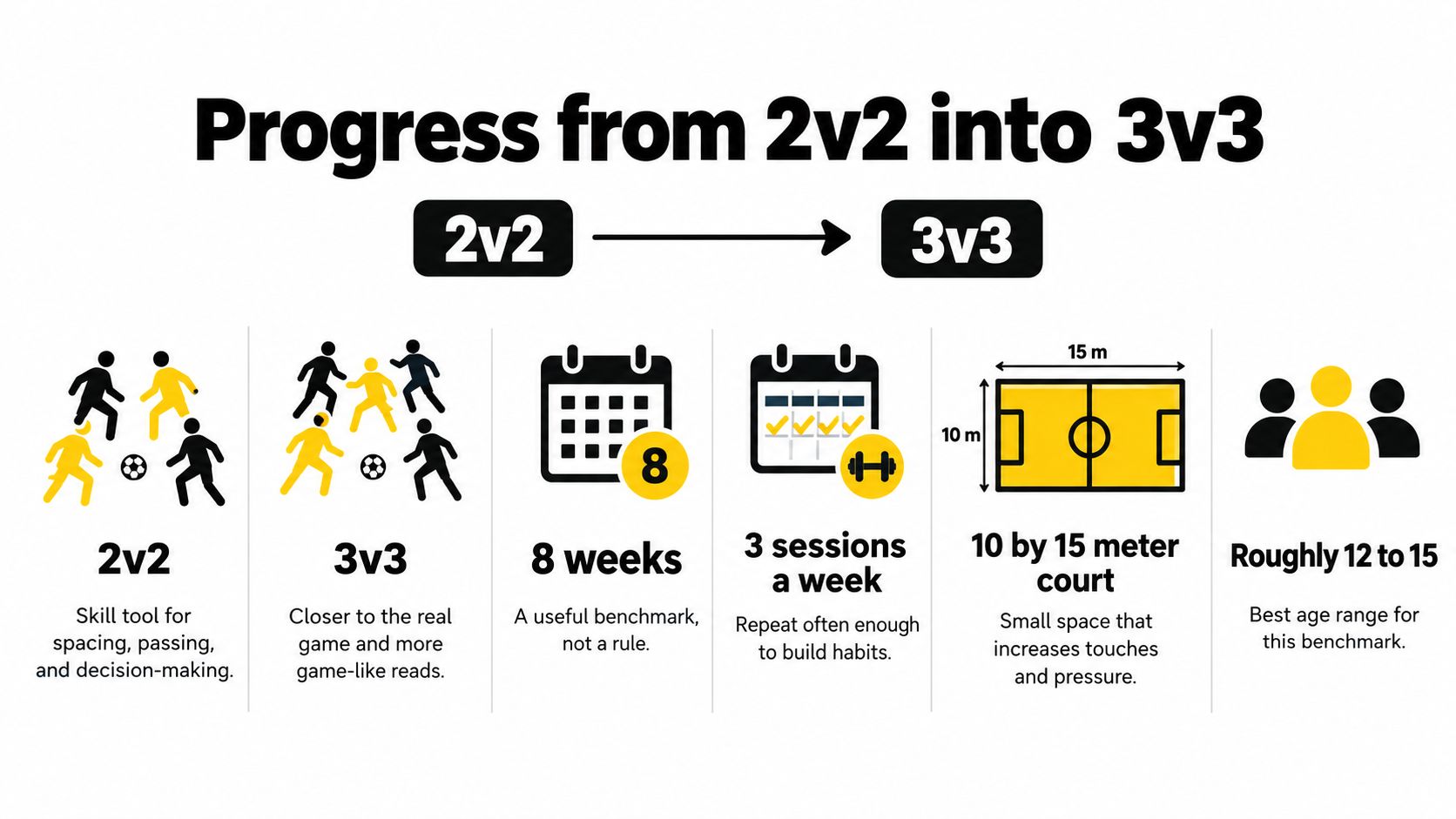
Two players per side give each child more chances to handle the ball, defend, rebound, and make decisions. Add a third player to each side when those basics hold up. The extra player creates more choices about spacing, help defense, and cutting, like adding another moving piece to a puzzle.
In an eight-week intervention, players roughly 12 to 15 years old played three sessions a week on standardized 10 by 15 meter courts. The small-sided-games study reported these changes in 2v2: total passes rose from 10.45 to 12.50, accurate passes from 8.40 to 10.50, defensive rebounds from 1.65 to 2.95, and turnovers fell from 2.55 to 1.85. In 3v3, the study reported broader gains in passing, shots, and points.
Measure | 2v2 start | 2v2 after 8 weeks | 3v3 pattern |
|---|---|---|---|
Total passes | 10.45 | 12.50 | Larger gain than 2v2 |
Accurate passes | 8.40 | 10.50 | Larger gain than 2v2 |
Assists | 1.95 | 3.05 | 2v2 increased; 3v3 gains were broader |
Defensive rebounds | 1.65 | 2.95 | 2v2 increased; 3v3 gains were broader |
Turnovers | 2.55 | 1.85 | 2v2 decreased; broader 3v3 gains were reported for team play |
The study involved 40 male athletes. Treat its figures as a benchmark for that group, not a target for every child, especially a younger beginner.
Look for habits before adding players
Keep younger or novice players in 2v2 if they still struggle to control the ball, find a teammate, or stay with a defender. Adding players too soon can mean fewer touches and make it harder to see whether a challenge comes from technique, decision-making, or confusion about movement.
Try a driveway game with two cones as a basket. Play 2v2, first to five, and watch whether players keep control and find a clear pass. Add a third player to each side once they handle the ball with fewer careless turnovers and use the extra space constructively.
A short game can show how players apply team ideas. For examples, see beginning basketball plays.
Check Skills Before You Add Load
Retest skills every four to eight weeks before increasing practice demands. A made shot or a win can feel encouraging, but neither tells you whether a player's movement, control, or decisions are becoming more consistent. Look for observable cues, then progress the challenge only when the player can repeat them.
Skill | What good looks like | Move up when |
|---|---|---|
Dribbling | Changes hands at a jog with eyes up | The player takes several steps without looking at the ball |
Shooting | Quiet guide hand and repeated follow-through | Form holds from close range before stepping back |
Passing | Chest or bounce pass to a moving target | The pass arrives on time more often than it's late |
Footwork | Low slide and a controlled closeout | The closeout stops near the ball instead of flying by |
Decisions | Ball stays secure in 2v2 | Turnovers in a five-minute block drop across two checks |
Use the cue as the promotion rule
Watch the player try the skill three times under the same conditions. If two of the three attempts miss the cue, keep the current challenge for another block rather than adding speed, distance, or a more difficult defender. This isn't a permanent limit; it gives the player more chances to build a repeatable movement before the next layer arrives.
For a dribble check, ask whether the player can switch hands while jogging without staring at the ball. For shooting, stay close enough to the basket that the child can repeat a balanced form and finish with the same follow-through. To check passing, have a teammate walk or cut into space so the pass must arrive at the right moment.
Read a temporary dip calmly
During a growth spurt, a child's coordination, strength, and shooting mechanics may wobble while their body proportions change. A short-lived dip doesn't mean the child needs extra repetitions or should be removed from play. Keep the task comfortable and give the player time to adjust.
Track three different signs rather than relying on one result: a technical cue, a simple physical sign such as a short sprint or jump that stays pain-free, and a game sign such as turnovers during a short block. A parent can film a minute from the side and watch it later instead of calling out every missed shot from the sideline. The useful question is whether the child is finding a more repeatable movement, not whether every attempt goes in.
Balance Basketball with Cost and Rest
Year-round basketball and private lessons aren't automatic proof of better development. A study of youth basketball players found no meaningful physical-fitness advantage for athletes who specialized before puberty compared with those who specialized during or after puberty, and early specialization didn't produce faster basketball-specific fitness gains across a season, according to the study of specialization and youth basketball development.
Treat access as part of the plan
The cost of playing can shape which opportunities a child gets. The Aspen Institute's Project Play report reports that, in 2023, youth from households earning $25,000 or less participated in sports at about half the rate of youth from households earning more than $100,000. It also reports that average family spending on a child's primary sport rose 46% over five years, while basketball spending rose 105%.
Those figures describe unequal access, not a family's commitment to a child. A child doesn't need a private lesson, travel schedule, or a closet full of equipment to practise useful skills. A ball, a wall or driveway, a playground, and a willing partner can create a meaningful session.
Try a short home week
Set aside 15 minutes for a focused home session:
First five minutes: Practise weak-hand dribbling while standing, then walking.
Next five minutes: Take close-range form shots, or make controlled passes against a wall where it's safe.
Final five minutes: Play a made-up 1v1 challenge or aim for a target, such as passing through a gap between two objects.
A family can share a ball, use a school or community court when available, and choose free play over a costly activity when transport is the obstacle. Rest matters too. Keep other sports, active play, and quiet days in the mix so basketball doesn't crowd out recovery or a child's interest.
For families weighing different activities, playing multiple sports can be part of a balanced approach rather than a distraction from progress. Measure improvement by safer ball control, a more reliable pass, or fewer rushed decisions, not by what a family spends.
A short video can help parents see how rest and training fit into a child's week.
Pick the Next Court for Your Child
Choose the next step that fits what your child wants from basketball right now. If they're still learning to enjoy the ball, keep the home practice short and add one playful game this week. If they're asking for teammates and a coach, look for a small, age-banded session where beginners get time with the ball and can learn without pressure to specialize.
At a first visit, watch how the coach organizes the game. Do players get repeated touches? Does the coach adjust the space or rules when a task is too difficult? Are beginners given time to try again? Those observations tell you more about the fit than comparing your child with the most experienced player on the court.
After the week, use a skill-check cue to choose what comes next. If the player's passing to a moving teammate is becoming more reliable, repeat that kind of practice before making it harder. If it isn't, reduce the space or the number of players rather than adding more sessions.
JC Sports Houston is a toddler and youth indoor sports center serving Humble, Kingwood, and Atascocita, with basketball, soccer, baseball, private sessions, and seasonal leagues. Free trials are listed for MultiSport and for soccer for ages 4–6, 7–9, and 10–13. Parents or caregivers stay in the building during classes, so you can watch how the session suits your child.
Make one choice for this week: keep the home practice and playful game, or visit a local session to see how your child responds to a coach and teammates. Either way, judge the next step by your child's interest and the skill cues you can observe, not by how much training you can fit into the calendar.
JC Sports Houston offers youth basketball alongside soccer, baseball, private sessions, and seasonal leagues, with programs serving Humble, Kingwood, and Atascocita. If your child would benefit from a coached, age-appropriate place to practise skills and play with others, visit JC Sports Houston to explore the available programs.
Comments